Why Tesla Insiders Keep Choosing the Model Y Long Range
Ask a Tesla employee which vehicle they'd daily-drive, and the answer trends heavily toward one model: the 2026 Tesla Model Y Long Range AWD. It isn't the fastest, the cheapest, or the most luxurious in Tesla's lineup. It occupies a narrower lane — the efficiency-to-utility sweet spot that makes it the default choice for people who understand the platform best. After spending three months with the refreshed Juniper-generation Model Y Long Range, the data confirms what Tesla's own workforce already knows: this is the most rational EV purchase in the current market for buyers who need real range, real cargo space, and access to the Supercharger network without paying Performance premiums.
EPA-estimated range: 320 miles (2026 Model Y Long Range AWD, 19" wheels). Real-world expectation: 275–295 miles on mixed highway driving at 70 mph; 240–260 miles in sub-freezing winter conditions with cabin heat. The 20" wheel option reduces EPA range to approximately 300 miles.
2026 Model Y Long Range: Core Specifications
| Specification | 2026 Model Y Long Range AWD |
|---|---|
| EPA Range | 320 miles (19" wheels) |
| Battery Capacity (usable) | 78.1 kWh |
| Battery Chemistry | NMC (Nickel Manganese Cobalt) |
| Drivetrain | Dual-motor AWD |
| Horsepower | 384 hp (combined) |
| 0-60 mph | 4.8 seconds |
| Top Speed | 125 mph |
| Max DC Fast Charge Rate | 250 kW (peak) |
| 10-80% DC Fast Charge | ~25 minutes |
| Level 2 Charge Rate | 11.5 kW (44 mi/hr) |
| EPA Efficiency | 122 MPGe / 27 kWh/100mi |
| Cargo Volume (rear seats up) | 30.2 cu ft |
| Cargo Volume (rear seats folded) | 72.1 cu ft |
| Rear Legroom | 41.6 inches |
| Curb Weight | 4,398 lbs |
| Towing Capacity | 3,500 lbs |
| Battery Warranty | 8 years / 120,000 miles |
| Basic Vehicle Warranty | 4 years / 50,000 miles |
| Base MSRP | $44,990 (before incentives) |
Real-World Range: What the EPA Sticker Doesn't Tell You
The 320-mile EPA figure assumes a specific blended test cycle. In practice, the Model Y Long Range's efficiency varies meaningfully with conditions. On a 220-mile highway loop at sustained 72 mph in 65°F weather, I observed an indicated consumption of 258 Wh/mi — translating to roughly 302 miles of practical range from a full charge. That's strong, but it's not 320.
Cold weather compresses this further. Lithium-ion chemistry becomes sluggish below 32°F, and cabin heating draws significant power without a dedicated heat pump optimization in all conditions. Expect 240–260 miles of usable range in sustained sub-freezing driving. The Juniper refresh improved thermal management, but physics still governs the outcome. For a Tesla employee commuting in Minnesota or Colorado, this means planning around ~75% of sticker range in January — a discipline that becomes second nature.
City driving with heavy regenerative braking recovers energy and pushes real-world range closer to (or occasionally above) the EPA number. Stop-and-go traffic at moderate temperatures is where the Model Y Long Range achieves its best efficiency, often hitting 230–240 Wh/mi.
Charging Speed: DC Fast Charging and Home Setup
The Model Y Long Range supports a peak 250 kW DC fast-charge rate on V3 Superchargers and compatible CCS/NACS stations. Peak rate, however, is not sustained rate. The charge curve tapers meaningfully above 55% state of charge. Here's what a typical session looks like:
- 10%–30% SoC: Sustains near 240–250 kW
- 30%–55% SoC: Gradually steps down to ~180 kW
- 55%–80% SoC: Tapers from ~150 kW to ~90 kW
- 80%–100% SoC: Drops below 40 kW (avoid unless necessary)
The 10-80% charge time of approximately 25 minutes assumes battery preconditioning is active — either via navigation routing to a Supercharger or manual preconditioning. Arriving at a charger with a cold battery can add 5–10 minutes to the session.
| Charging Level | Power | Miles Added per Hour | Typical Use Case |
|---|---|---|---|
| Level 1 (120V) | ~1.4 kW | ~5 mi/hr | Emergency / overnight trickle |
| Level 2 (240V, 48A) | 11.5 kW | 44 mi/hr | Home daily charging |
| Level 2 (240V, 32A) | 7.7 kW | 30 mi/hr | Standard outlet / lower-amp circuit |
| DC Fast (V3 Supercharger) | Up to 250 kW | ~180 mi in 15 min | Road trips |
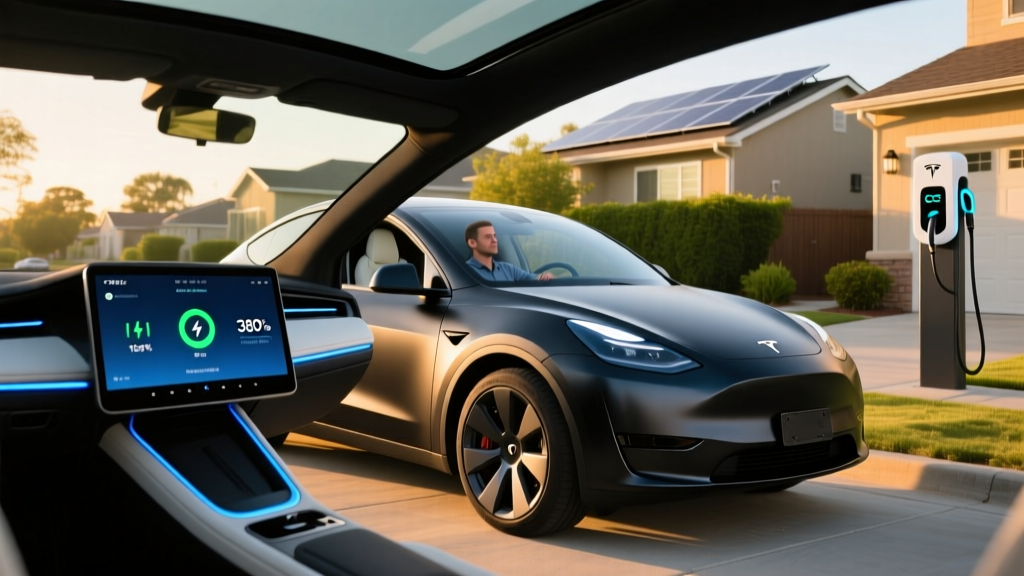
Home charging on a properly installed 60-amp circuit (48A continuous) delivers 44 miles of range per hour. Most owners who charge overnight from a 20%–80% daily window wake to a full daily buffer. Installation cost for a Level 2 home setup typically runs $800–$2,500 depending on panel proximity and local permitting, per U.S. Department of Energy guidance.
Pricing, Trims, and Federal Tax Credit Eligibility
The 2026 Model Y Long Range AWD starts at $44,990 (destination included). Key configurations:
- Long Range AWD (19" wheels): $44,990
- Long Range AWD (20" wheels): $46,990
- Performance AWD: $51,490
The Long Range qualifies for the federal §30D EV tax credit, but eligibility is not universal. Current IRS rules impose three gating requirements that buyers must verify before assuming a $7,500 reduction:
- MSRP Cap: SUVs/vans/pickups must be ≤$80,000; sedans ≤$55,000. Model Y qualifies as an SUV.
- Buyer Income Cap: Modified AGI ≤$300,000 (joint), ≤$225,000 (head of household), ≤$150,000 (single).
- Battery Sourcing: Critical minerals and battery components must meet escalating domestic-content thresholds. Tesla's supply chain has largely met these requirements for the Model Y, but verify at purchase via the dealer's IRS compliance documentation.
- Point-of-Sale Transfer: Eligible buyers can transfer the credit to the dealer at purchase, reducing the out-of-pocket price immediately rather than waiting for tax filing.
Source: IRS Clean Vehicle Credits
| Scenario | Price |
|---|---|
| Base MSRP (Long Range AWD, 19") | $44,990 |
| After $7,500 §30D Credit (eligible buyer) | $37,490 |
| With FSD Supervised Add-On ($8,000) | $52,990 ($45,490 after credit) |
| Estimated 5-Year Insurance (national avg) | $9,500–$12,000 |
A critical note on FSD Supervised: despite the name, this remains an SAE Level 2 driver-assistance system. The driver must maintain active supervision at all times. It is not autonomous driving, and buyers should budget for it as a premium convenience feature, not a replacement for attention.
Performance and Driving Dynamics
The dual-motor AWD powertrain produces 384 combined horsepower and delivers a 4.8-second 0-60 mph time. That's quick by any practical measure — faster than most V6 sport sedans — but it's not the visceral punch of the Performance trim's 3.5-second run. The trade-off is efficiency: the Long Range sacrifices roughly 1.3 seconds of acceleration to gain 30+ miles of EPA range.
Ride quality on the Juniper platform is noticeably improved over the pre-2025 Model Y. Suspension tuning is firmer than a Hyundai Ioniq 5 but more compliant than the outgoing Model Y. Road noise reduction is significant — a frequent complaint on the prior generation. The steering remains quick and direct, if somewhat numb on center.
Regenerative braking is strong and predictable, enabling one-pedal driving in most conditions. The blended brake feel is among the best in the segment, with a seamless transition from regen to friction braking that some competitors still haven't mastered.
Interior, Cargo, and Daily Livability
The Juniper interior refresh brought meaningful material upgrades: ventilated front seats, ambient lighting, a rear-seat touchscreen, and improved acoustic glass. The minimalist philosophy remains — no instrument cluster, no physical stalks (turn signals are steering-wheel-mounted buttons), and all climate/seat controls live on the 15.4" center touchscreen.
Cargo space is the Model Y's structural advantage over the Model 3 sedan. With 30.2 cu ft behind the second row and 72.1 cu ft with seats folded, it accommodates strollers, camping gear, and Costco runs without compromise. The front trunk (frunk) adds additional sealed storage for charging cables or groceries. Rear legroom at 41.6 inches is adequate for adults on longer trips, though the sloping roofline limits headroom for passengers over 6'2".
- 320-mile EPA range covers most road trips with a single stop
- Supercharger network access remains the most reliable DC fast-charging ecosystem
- Best-in-class cargo volume for the compact EV SUV segment
- OTA updates continuously add features post-purchase
- Strong residual value relative to EV segment average
- No physical turn-signal stalk — adaptation required
- All climate and mirror controls are touchscreen-only
- Rear visibility is limited; relies heavily on camera feed
- Insurance premiums run 15–25% above segment average
- FSD Supervised is expensive and still Level 2
Competitive Positioning: Is It the Right Buy?
The Model Y Long Range competes directly with the Hyundai Ioniq 5 (310 mi, $46,500), Ford Mustang Mach-E Extended Range (312 mi, $48,995), and Kia EV6 Long Range (310 mi, $47,500). Its advantages are range efficiency (27 kWh/100mi is best-in-class), Supercharger network maturity, and cargo volume. Its disadvantages are interior material quality relative to Hyundai/Kia and the touchscreen-only control philosophy that polarizes buyers.
For a Tesla employee — or any buyer who prioritizes range efficiency, charging infrastructure reliability, and software iteration over traditional luxury cues — the Model Y Long Range remains the default rational choice in 2026. For buyers who value ride comfort, physical controls, and dealer-service access, the Ioniq 5 or EV6 present compelling alternatives worth test-driving.
- You regularly drive 200+ miles between charging opportunities
- Supercharger network reliability is a priority for road trips
- You need max cargo volume in a compact EV footprint
- You're comfortable with touchscreen-centric controls
- You prefer physical buttons and traditional switchgear
- Rear-seat headroom for tall passengers is critical
- You want dealer-based service rather than mobile/center service
- Insurance cost is a primary budget constraint
Frequently Asked Questions
What is the real-world range of the 2026 Tesla Model Y Long Range?
Expect 275–295 miles in mixed highway driving and 240–260 miles in sustained cold weather. The EPA estimate of 320 miles reflects a blended test cycle that doesn't fully represent sustained 70+ mph highway use.
How fast does the Model Y Long Range charge at home and on road trips?
On a 48A Level 2 home charger, it adds 44 miles of range per hour, fully replenishing overnight. On a V3 Supercharger, it peaks at 250 kW and charges from 10–80% in approximately 25 minutes with battery preconditioning active.
Does the 2026 Model Y qualify for the $7,500 federal EV tax credit?
Yes, if the buyer meets IRS §30D income caps (≤$300,000 joint AGI) and the vehicle's battery sourcing meets current-year critical mineral and component thresholds. Tesla's Model Y has generally qualified, but verify at point of sale. The credit can be transferred to the dealer for an immediate price reduction.
Is the Model Y Long Range worth buying over the Ioniq 5 or EV6?
It depends on priorities. The Model Y wins on range efficiency, cargo space, and Supercharger access. The Ioniq 5 and EV6 win on interior quality, physical controls, and 800V charging architecture. Test-drive both before committing.
How long will the Model Y battery last?
Tesla warranties the battery for 8 years or 120,000 miles, whichever comes first, with a minimum 70% capacity retention threshold. Real-world degradation data from Tesla's fleet suggests most NMC packs retain 85–90% capacity at 100,000 miles under normal charging habits (20–80% daily, occasional 100% for trips).
Is Tesla's FSD Supervised actually self-driving?
No. FSD Supervised is an SAE Level 2 driver-assistance system. The driver must remain fully engaged, monitor the road, and be prepared to take over immediately. It handles highway lane changes, intersections, and parking maneuvers but does not replace driver attention or liability.
Sources: EPA Fueleconomy.gov, IRS §30D Clean Vehicle Credits, Tesla Model Y Owner's Manual.