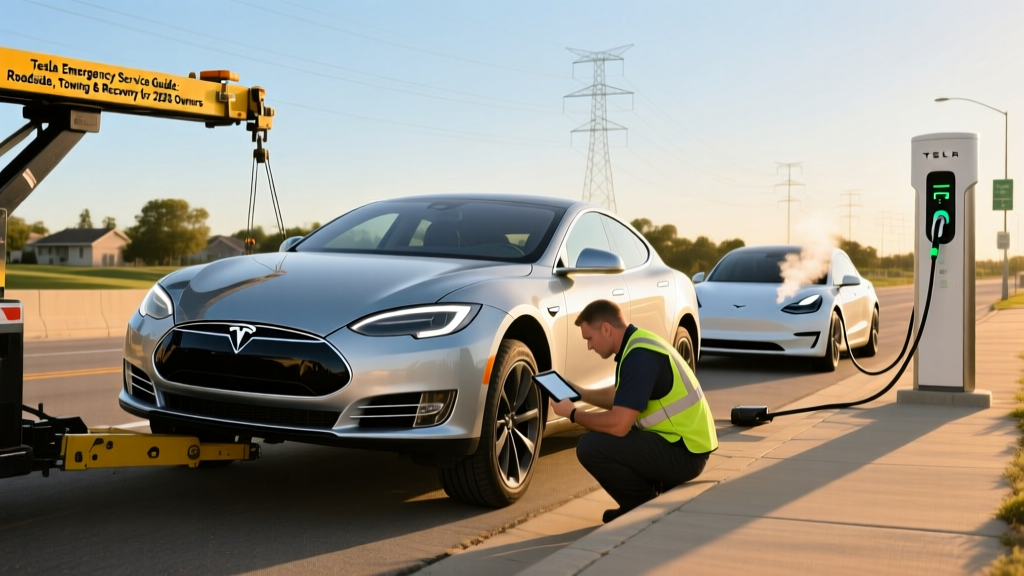
If you own a Tesla—or are about to buy one—understanding Tesla emergency service is as critical as knowing your EPA range. Unlike legacy automakers that outsource roadside help through AAA or dealer networks, Tesla runs its own integrated emergency ecosystem: in-app roadside assistance, mobile service rangers, flatbed towing to Service Centers, and over-the-air diagnostics that can sometimes fix issues before you even call. But the system has real limitations, especially for owners in rural areas or those driving outside warranty coverage.
This guide dissects exactly what Tesla's emergency service covers in 2026, how fast help arrives, what it costs out-of-warranty, and how it compares to third-party alternatives like AAA. We'll also review the current Model Y—the highest-volume Tesla—as a reference platform, since emergency protocols are identical across the S/3/X/Y/Cybertruck lineup.
What Tesla Emergency Service Actually Covers
Tesla's roadside assistance program is bundled with the vehicle's New Vehicle Limited Warranty (4 years / 50,000 miles) and the Battery and Drive Unit Limited Warranty (8 years, mileage varies by model). During the warranty period, Tesla covers:
- Flatbed towing to the nearest Tesla Service Center or Supercharger (up to 500 miles under the New Vehicle Warranty for warrantable breakdowns)
- Flat tire service — Tesla does not carry spare tires on any model; roadside will tow or, in some metro areas, lend a loaner wheel to get you to a service center
- Battery-related lockout or failure — including 12V auxiliary battery issues that prevent the vehicle from powering on
- Key fob / phone-key lockout assistance
- Extrication if the vehicle is stuck in snow, mud, or off-road (within reason)
Critically, Tesla does not provide traditional jump-starts. There is no internal combustion engine to jump. If the high-voltage traction battery is depleted, the solution is a tow to a charger—not a boost from jumper cables. The 12V lithium-ion auxiliary battery (used in all current Teslas) can fail, but Tesla's roadside team addresses this through mobile service or towing, not a conventional jump.
How to Request Tesla Roadside Assistance
The fastest path to help is through the Tesla mobile app. Here's the workflow:
- Open the Tesla app → tap Service
- Select Roadside Assistance
- Choose your issue category (flat tire, won't start/charge, lockout, accident, other)
- The app auto-detects your vehicle's GPS location and current state of charge (SoC)
- A dispatcher confirms ETA — typically 30–90 minutes in metro areas, longer in rural zones
Alternatively, you can call Tesla's 24/7 roadside hotline (available on Tesla's support site). For emergencies involving personal safety—accidents, medical situations—always call 911 first, then Tesla roadside after.
Because Tesla vehicles are always connected, the dispatcher often has remote diagnostic data before you even describe the problem. In some cases, Tesla engineers can push an over-the-air (OTA) software fix remotely, resolving issues like a stuck charge port or a sensor fault without dispatching a truck at all.
Tesla Mobile Service vs. Service Center Towing
Not every emergency requires a flatbed. Tesla's Mobile Service fleet—technicians in equipped vans—can handle many repairs at your location:
| Service Type | Handled By | Typical Response | Cost (In-Warranty) |
|---|---|---|---|
| Flat tire (loaner wheel) | Roadside / Mobile Service | 1–3 hours | Covered* |
| 12V battery failure | Mobile Service | Same day / next day | Covered (8-yr warranty) |
| Depleted HV battery (0% SoC) | Roadside → Flatbed tow | 1–4 hours | Out-of-pocket if out of warranty |
| Software fault / sensor error | OTA fix or Mobile Service | Minutes to same day | Covered |
| Collision damage | Roadside → Flatbed to Body Shop | 1–4 hours | Insurance-dependent |
| Charge port / connector stuck | OTA diagnostic or Mobile Service | Minutes to same day | Covered |
*Tire damage from road hazards is generally not covered under warranty; the loaner wheel program lets you drive to a tire shop.
Tesla Emergency Service for the Model Y: Platform Reference
Since emergency service protocols are identical across the fleet, we'll use the 2026 Tesla Model Y Long Range AWD—Tesla's best-selling vehicle—as the reference platform. Understanding the car's specs helps you plan for worst-case scenarios like range depletion or charging deserts.
| Specification | 2026 Model Y Long Range AWD |
|---|---|
| EPA Estimated Range | 320 miles |
| Battery Capacity | ~75 kWh usable, NMC chemistry |
| Max DC Fast Charge | 250 kW peak (V3 Supercharger) |
| 10–80% DC Fast Charge | ~27 minutes |
| Level 2 Home Charge Rate | 11.5 kW (~44 mi/hr) |
| 0–60 mph | 4.8 seconds |
| Horsepower | 384 hp (dual-motor AWD) |
| Efficiency | 122 MPGe combined / 28 kWh/100 mi |
| Cargo Volume | 72.1 cu ft (rear seats folded) |
| Rear Legroom | 41.6 inches |
| Battery Warranty | 8 years / 120,000 miles (min 70% retention) |
| New Vehicle Warranty | 4 years / 50,000 miles |
| Base MSRP | $44,990 |
What Happens If You Run Out of Charge?
Running the traction battery to 0% is the most common non-accident reason Tesla owners call roadside assistance. Here's exactly what happens:
- The car warns you progressively — at 10%, 5%, and 1% SoC, the touchscreen displays increasingly urgent warnings. At ~0%, the vehicle reduces power to preserve the ability to pull over safely.
- The vehicle enters a "towing mode" — accessible via the touchscreen (Controls → Service → Towing) to release the parking brake and allow the car to be winched onto a flatbed.
- Tesla dispatches a flatbed — not a wheel-lift tow truck. All Teslas require flatbed towing or dollies under all four wheels to prevent drivetrain damage from the permanent-magnet motors.
- You're towed to the nearest Supercharger or Service Center — typically within 10–50 miles depending on location.
Cost: If your New Vehicle Limited Warranty (4 yr / 50,000 mi) is active and the depletion was not due to ignoring vehicle warnings, Tesla may cover the tow. However, repeated depletion tows or out-of-warranty tows are billed to the owner—typically $200–$600+ depending on distance and region. This is where a third-party plan like AAA Plus/Premier (which covers up to 200 miles of towing) can save significant money.
Tesla Emergency Service vs. AAA and Third-Party Alternatives
| Feature | Tesla Roadside (In-Warranty) | AAA Plus | AAA Premier |
|---|---|---|---|
| Flatbed Towing | Yes, to SC or Service Ctr | Up to 100 miles | Up to 200 miles |
| Flat Tire Service | Loaner wheel (metro) or tow | Inflate or tow | Inflate or tow |
| Lockout Assistance | Yes | Yes | Yes |
| Remote Diagnostics | Yes (OTA capable) | No | No |
| EV-Specific Training | Yes | Varies by region | Varies by region |
| Annual Cost | Included with warranty | ~$100/yr | ~$130/yr |
| After Warranty Expires | Paid per incident | Covered (membership) | Covered (membership) |
Our recommendation: Carry AAA Premier (or equivalent) as a supplement, especially after your 4-year New Vehicle Warranty expires. Tesla's roadside is excellent during warranty, but AAA provides a safety net for tire damage, extrication, and long-distance towing that Tesla charges for post-warranty. Many EV owners carry both.
Tesla Warranty and Emergency Coverage Breakdown
Understanding which warranty covers which emergency scenario prevents costly surprises. Per Tesla's official warranty documentation:
- New Vehicle Limited Warranty: 4 years / 50,000 miles — covers bumper-to-bumper defects, including roadside assistance for warrantable failures
- Battery and Drive Unit Warranty (Model Y LR/Performance): 8 years / 120,000 miles — covers battery degradation below 70% capacity and drive unit failure
- Battery and Drive Unit Warranty (Model Y RWD with LFP): 8 years / 100,000 miles — same 70% retention threshold
- Supplemental Restraint System: 5 years / 60,000 miles
After the New Vehicle Limited Warranty expires, you can purchase a Tesla Extended Service Agreement (ESA) if your vehicle is still within the original warranty period. ESA pricing varies by model and mileage but typically ranges from $3,000–$5,000 for an additional 2–4 years of coverage, including continued roadside assistance.
Pricing, Tax Credits, and the Cost Equation
If you're evaluating a Tesla purchase and factoring in emergency service peace of mind, here's the current pricing landscape for the 2026 Model Y:
| Trim | MSRP | Est. Federal Credit (§30D) | Effective Price |
|---|---|---|---|
| Model Y Long Range AWD | $44,990 | Up to $7,500* | ~$37,490 |
| Model Y Performance | $48,990 | Up to $7,500* | ~$41,490 |
*Federal §30D tax credit eligibility depends on multiple factors per current IRS rules: buyer income caps ($150K single / $300K joint AGI), vehicle MSRP cap ($55,000 for SUVs), and battery critical-mineral and component sourcing requirements. The credit can now be transferred to the dealer at point of sale as an instant discount. Eligibility changes as sourcing rules tighten—always verify with a tax professional before purchase.
Pros and Cons of Tesla's Emergency Service System
Pros
- Integrated app-based dispatch with GPS and remote diagnostics
- OTA fixes can resolve some issues without a physical visit
- Flatbed towing standard (safe for EV drivetrains)
- Mobile Service handles many repairs at your home/office
- Free during 4-year/50,000-mile New Vehicle Warranty
- 24/7 availability nationwide
Cons
- No spare tire on any model — flat means tow or loaner wheel
- Rural response times can exceed 2–4 hours
- Out-of-warranty towing is expensive ($200–$600+)
- Cannot jump-start a depleted HV battery — only tow
- Service Center capacity bottlenecks in some regions
- No traditional roadside "quick fix" for a dead battery
Who Benefits Most from Tesla's Emergency Ecosystem?
Tesla's emergency service works best for metro-area owners within 30 miles of a Service Center or Supercharger, where response times are fast and mobile service vans are plentiful. It's less ideal for:
- Rural drivers who regularly travel 100+ miles from the nearest Tesla Service Center
- High-mileage road-trippers who may face out-of-warranty towing costs after 50,000 miles
- Fleet/commercial owners who need guaranteed uptime and may benefit from commercial roadside contracts
For these use cases, pairing Tesla's built-in roadside with a AAA Premier membership or a dedicated EV roadside plan provides the best coverage overlap.
Frequently Asked Questions
Can Tesla roadside assistance tow me to a non-Tesla charger?
Yes, but Tesla's default protocol is to tow to the nearest Supercharger or Service Center. If you request a specific destination (e.g., a home charger or a third-party DC fast charger), the dispatcher may accommodate if it's within the covered tow distance. Beyond warranty-covered distances, you'll pay per mile.
What if my Tesla is in an accident?
Call 911 first for any personal safety emergency. After that, use the Tesla app to request roadside assistance. Tesla will dispatch a flatbed to tow the vehicle to an approved Tesla Body Shop. The vehicle's automatic collision notification may also alert Tesla if airbags deploy.
Does Tesla provide a loaner vehicle during emergency repairs?
Tesla does not guarantee loaner vehicles. Availability depends on the Service Center's inventory and the repair's expected duration. For warranty-covered repairs taking multiple days, some Service Centers offer loaners, but this is not contractually guaranteed. Tesla's Extended Service Agreement may improve loaner priority.
How do I put my Tesla in towing mode?
Go to Controls → Service → Towing on the touchscreen. This releases the electronic parking brake and puts the vehicle in a neutral-like state so it can be winched onto a flatbed. If the touchscreen is unresponsive, consult the owner's manual for the manual parking-brake release procedure specific to your model.
Is Tesla's emergency service available internationally?
Tesla's roadside assistance is available in all markets where Tesla sells vehicles, but coverage terms, tow distances, and response times vary by country. In Europe and Australia, Tesla partners with local roadside providers. Check Tesla's regional support pages for specifics.
Does the Tesla Model Y qualify for the federal EV tax credit?
The 2026 Model Y qualifies for up to $7,500 under IRS §30D, subject to buyer income limits ($150K single / $300K joint), the $55,000 SUV MSRP cap, and battery sourcing requirements. The credit can be applied as a point-of-sale discount. Always verify current eligibility at fueleconomy.gov and with a tax professional, as sourcing rules evolve annually.