The Reality of Tesla Electric Wheelchair Accessibility in 2026
When shoppers search for a "Tesla electric wheelchair" solution, they're usually looking for one of two things: a Tesla vehicle that can accommodate a wheelchair user as a passenger or driver, or an electric wheelchair made by Tesla. Let's clear up the second point immediately — Tesla does not manufacture electric wheelchairs or mobility scooters. The company's focus remains squarely on electric vehicles, energy storage, and robotics (Optimus). However, Tesla's EV lineup — particularly the Model Y and Model X — has become an increasingly popular platform for wheelchair-accessible vehicle (WAV) conversions by certified third-party mobility upfitters.
This guide breaks down what wheelchair users and caregivers need to know about converting or purchasing a Tesla as a wheelchair-accessible vehicle in 2026, including real-world range expectations, charging logistics for mobility users, pricing, tax credits, and the practical trade-offs versus traditional WAV platforms like the Chrysler Pacifica or Honda Odyssey.
Which Tesla Models Work for Wheelchair Access?
Not every Tesla is a viable candidate for wheelchair accessibility. The critical factors are door opening dimensions, interior floor height, cargo volume, and structural feasibility for ramp or lift installation. Here's how the current lineup stacks up:
| Factor | Model Y (2026) | Model X (2026) | Model 3 | Cybertruck |
|---|---|---|---|---|
| Body Style | Compact SUV / Crossover | Midsize SUV | Sedan | Pickup Truck |
| Cargo Volume (rear seats folded) | 72.1 cu ft | 88.1 cu ft | 23.0 cu ft (trunk + frunk) | Bed: ~74.0 cu ft |
| Rear Door Opening Height | ~48 inches | ~52 inches (falcon-wing) | ~42 inches | N/A (truck bed) |
| WAV Conversion Feasibility | High (side-entry ramp) | Moderate-High (unique doors) | Very Low | Low |
| Ground Clearance | 6.6 inches | 7.0 inches (adjustable) | 5.5 inches | ~16 inches |
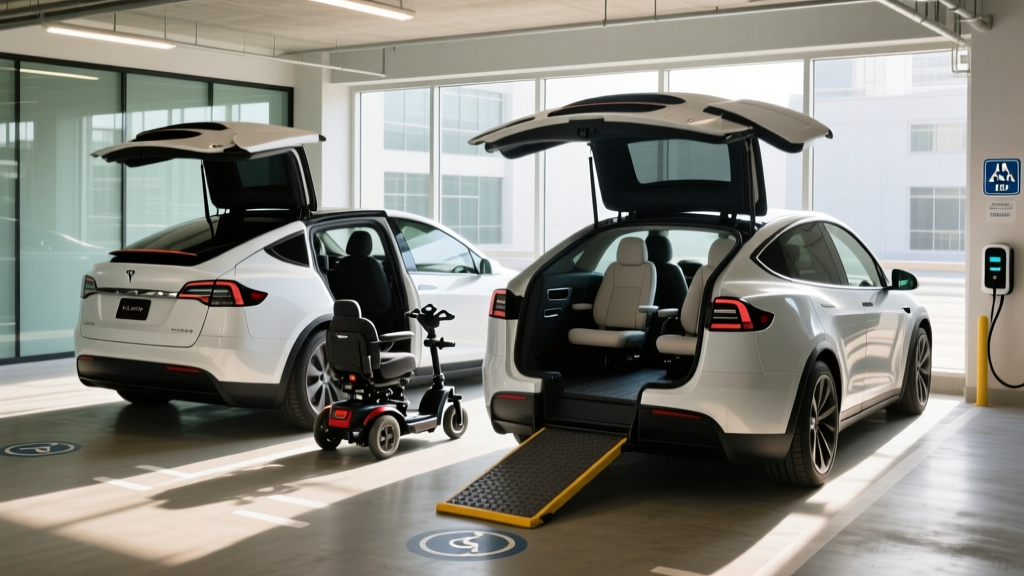
The Model Y has emerged as the preferred Tesla platform for wheelchair conversions in 2026. Its crossover ride height, wide rear door openings, and flat floor (thanks to the skateboard battery architecture) make side-entry ramp installations achievable. Several NMEDA-accredited (National Mobility Equipment Dealers Association) upfitters now offer Model Y conversion packages.
The Model X presents unique challenges and advantages. Its falcon-wing rear doors offer dramatic vertical opening clearance, but the complex hinge mechanism and aluminum structure make structural modifications for ramp integration more expensive and limited to specialized shops. The Model X's air suspension can lower the vehicle for easier ramp entry — a significant accessibility benefit.
Tesla Model Y WAV Conversion: Specs That Matter
For buyers seriously considering a Tesla Model Y as a wheelchair-accessible platform, here are the core vehicle specifications you'll be working with post-conversion:
| Specification | Model Y Long Range AWD (2026) | Model Y Performance (2026) |
|---|---|---|
| EPA Estimated Range | 320 miles | 293 miles |
| Battery Capacity (usable) | ~75 kWh (NMC) | ~75 kWh (NMC) |
| Battery Chemistry | NMC (Nickel Manganese Cobalt) | NMC |
| Drivetrain | Dual-Motor AWD | Dual-Motor AWD |
| Horsepower | 384 hp | 510 hp |
| 0-60 mph | 4.8 seconds | 3.5 seconds |
| Max DC Fast Charge Rate | 250 kW (Supercharger V3/V4) | 250 kW |
| 10-80% DC Fast Charge Time | ~27 minutes | ~27 minutes |
| Level 2 Home Charging (48A) | 11.5 kW (~44 mi/hr) | 11.5 kW (~44 mi/hr) |
| Efficiency | 122 MPGe / 27 kWh/100mi | 111 MPGe / 30 kWh/100mi |
| Battery/Drive Unit Warranty | 8 years / 120,000 miles | 8 years / 120,000 miles |
| Base MSRP | $46,630 | $51,490 |
Real-World Range Expectations for WAV Conversions
The EPA estimates 320 miles for the Model Y Long Range AWD. However, wheelchair-accessible conversions typically add 200-400 pounds of equipment (ramp, tie-down systems, reinforced flooring). Expect real-world range to reflect this added weight:
- City/suburban driving (moderate climate): ~280-300 miles
- Highway driving (70+ mph): ~240-265 miles
- Cold weather (below 32°F): ~200-240 miles (NMC batteries lose 15-30% range in freezing temps without preconditioning)
- Combined real-world estimate with WAV equipment: ~260-285 miles in normal conditions
The added weight of conversion equipment will reduce efficiency by roughly 5-8%. Always factor in range buffer for medical appointments and unplanned detours.
Charging Logistics for Wheelchair Users
Charging accessibility is one of the most overlooked factors in EV adoption for wheelchair users. Not all public charging stations are ADA-compliant, and handling heavy charging cables from a seated position presents real challenges. Here's what to plan for:
Home Charging: The Priority
For wheelchair users, Level 2 home charging isn't just convenient — it's essential. A Tesla Wall Connector installed in an accessible garage or carport eliminates the need to maneuver around public charging infrastructure. Key considerations:
- Tesla Wall Connector (48A): Adds ~44 miles of range per hour; a full overnight charge is standard
- Installation cost: $800-$2,500 depending on electrical panel capacity and conduit run (240V/60A circuit required)
- Cable management: Tesla's 24-foot cable can be routed overhead or along walls to avoid ground-level obstacles
- Panel upgrade: Older homes may need a 200A service upgrade ($1,500-$3,500) before installing a Level 2 charger
Public Charging Accessibility
Tesla Superchargers are expanding ADA-accessible stalls with wider pull-through spaces and lowered screen heights, but coverage remains inconsistent. As of early 2026, Tesla has committed to upgrading a percentage of Supercharger stations to meet accessibility standards, partly driven by their opening of the network to non-Tesla EVs under the NEVI (National Electric Vehicle Infrastructure) program. Before relying on a specific Supercharger, check PlugShare or Tesla's in-app station details for accessibility notes.
| Charging Level | Power (kW) | Miles Added Per Hour | Accessibility Notes |
|---|---|---|---|
| Level 1 (120V outlet) | ~1.4 kW | ~4-5 mi/hr | Standard outlet; very slow but universally accessible |
| Level 2 (240V home) | 11.5 kW (48A) | ~44 mi/hr | Best option for WAV users; install in accessible location |
| DC Fast (Supercharger V3/V4) | Up to 250 kW | ~1,000+ mi/hr (peak) | Cable weight and stall width vary; check ADA compliance |
Pricing, Conversion Costs, and Tax Credits
Budgeting for a Tesla wheelchair-accessible vehicle requires stacking the base vehicle cost, the conversion expense, and available incentives. Here's the financial picture for 2026:
| Cost Component | Estimated Range |
|---|---|
| Model Y Long Range AWD (base MSRP) | $46,630 |
| WAV Conversion (side-entry ramp, tie-downs, floor mods) | $15,000 - $28,000 |
| Home Level 2 Charger + Installation | $1,200 - $3,500 |
| Total Before Incentives | $62,830 - $78,130 |
| Federal EV Tax Credit (§30D) | Up to $7,500 (see eligibility below) |
| State Mobility/WAV Rebates (varies by state) | $0 - $5,000 |
| Estimated Total After Incentives | $55,330 - $73,130 |
Federal EV Tax Credit Eligibility (§30D) — 2026 Rules
The Tesla Model Y Long Range AWD may qualify for the full $7,500 federal tax credit under IRS §30D rules, but eligibility depends on several factors that change periodically:
- MSRP cap: SUVs must be under $80,000 MSRP — the Model Y qualifies
- Buyer income cap: Modified AGI must not exceed $150,000 (single), $225,000 (head of household), or $300,000 (joint)
- Battery sourcing: Critical minerals and battery components must meet escalating domestic-content thresholds — verify current-year compliance on fueleconomy.gov
- Point-of-sale transfer: As of 2024+, buyers can transfer the credit to the dealer for an immediate price reduction at purchase
Important: The WAV conversion cost is NOT included in the vehicle MSRP for tax credit purposes. The credit applies to the base vehicle. Consult a tax professional to confirm eligibility for your specific situation. Additionally, some states offer separate mobility equipment tax deductions or grants — check with your state's department of revenue.
Tech, Safety, and Driver-Assistance Features
Tesla's technology suite offers unique benefits — and some frustrations — for wheelchair users and caregivers:
Beneficial Features
- Tesla App remote controls: Pre-condition cabin temperature, open/close doors, and summon the vehicle in tight parking spaces — all from a smartphone. This is invaluable for wheelchair users who need the vehicle positioned precisely for ramp deployment.
- Smart Air Suspension (Model X): Lowers the vehicle for easier entry. Model Y does not offer air suspension as of 2026.
- Over-the-air updates: Continuous feature improvements without dealership visits — a significant benefit for users with limited mobility.
- Sentry Mode and cameras: Eight surround cameras provide full vehicle visibility, helpful when maneuvering in tight accessible parking spaces.
Limitations and Drawbacks
- Touchscreen-only controls: Nearly all vehicle functions (climate, mirrors, glovebox) are controlled via the 15.4-inch center touchscreen. For users with limited upper-body mobility, physical button alternatives are absent. Voice commands partially mitigate this.
- Autopilot / FSD (Supervised): Tesla's driver-assistance suite is SAE Level 2 — it is NOT self-driving. The driver must remain fully engaged, hands on the wheel (or steering input detected), and eyes on the road at all times. Wheelchair users who drive from their chair using hand controls should understand that Autopilot's steering-input detection may not function correctly with aftermarket hand-control systems.
- Aftermarket hand control compatibility: Mechanical hand controls (for accelerator and braking) can be installed in the Model Y by mobility specialists, but integration with Tesla's regenerative braking and drive-by-wire systems requires careful calibration by experienced installers.
ADAS Clarification
Tesla Autopilot and Full Self-Driving (Supervised) are SAE Level 2 driver-assistance systems. They provide steering, acceleration, and braking assistance but require continuous driver supervision. They do not make the vehicle autonomous. The driver is legally and operationally responsible at all times.
Tesla vs. Traditional Wheelchair-Accessible Vehicles
How does a Tesla Model Y WAV conversion compare to the established wheelchair-accessible vehicle market? The incumbents are minivan-based platforms like the Chrysler Pacifica (BraunAbility or VMI conversions) and the Honda Odyssey.
| Factor | Tesla Model Y WAV | Chrysler Pacifica Hybrid WAV | Honda Odyssey WAV (Gas) |
|---|---|---|---|
| Powertrain | Full EV (BEV) | Plug-in Hybrid (PHEV) | Gasoline V6 |
| Electric-Only Range | ~260-285 mi (real-world) | ~32 mi (EPA) | N/A |
| Total Range | ~260-285 mi | ~460 mi (gas + electric) | ~450 mi |
| Fuel/Energy Cost Per Mile | ~$0.04-$0.06 (home charging) | ~$0.06-$0.12 (varies) | ~$0.14-$0.18 |
| Base Vehicle MSRP | $46,630 | $42,995 | $39,690 |
| Typical WAV Conversion Cost | $15,000-$28,000 | $20,000-$35,000 | $18,000-$32,000 |
| Interior Headroom (rear) | ~41 inches | ~57 inches (lowered floor) | ~55 inches (lowered floor) |
| Lowered Floor Option | Limited (battery pack constraint) | Yes (standard in WAV) | Yes (standard in WAV) |
| Maintenance Costs | Low (no oil, fewer moving parts) | Moderate (ICE + EV systems) | Moderate-High |
Pros of Tesla Model Y WAV
- Lowest per-mile energy cost (~$0.04-$0.06/mi with home charging)
- Minimal maintenance — no oil changes, transmission fluid, or exhaust systems
- Instant torque for confident highway merging
- Over-the-air updates add features without service center visits
- App-based remote controls (preconditioning, summon, door control)
- Access to Tesla Supercharger network (17,000+ stalls in North America)
- Strong resale value relative to minivan platforms
- NMC battery with 8-year/120,000-mile warranty
Cons of Tesla Model Y WAV
- No factory lowered-floor option — battery pack limits vertical interior space
- Reduced headroom vs. minivan WAV platforms (critical for tall wheelchair users)
- Touchscreen-only controls challenge some users with limited arm mobility
- Fewer NMEDA-certified Tesla conversion shops vs. established minivan upfitters
- Range reduction in cold weather (15-30% loss below freezing)
- Public charging accessibility still inconsistent at many stations
- Higher upfront base vehicle cost vs. minivan platforms
- Conversion may void portions of Tesla's vehicle warranty — verify with Tesla before modifying
Who Is the Tesla WAV Best Suited For?
A Tesla Model Y wheelchair-accessible conversion makes the most sense for:
- Urban and suburban users with reliable home charging who primarily drive under 200 miles per day
- Wheelchair users who transfer to a vehicle seat (the wheelchair is stowed, not occupied during driving) — the Model Y's interior height is less critical in this use case
- Tech-comfortable users who value app-based controls and OTA updates over traditional physical interfaces
- Cost-conscious long-term owners who want to minimize fuel and maintenance costs over a 5-10 year ownership period
A traditional minivan WAV (Pacifica Hybrid or Odyssey) remains the better choice for:
- Users who drive from their wheelchair and need a lowered floor for adequate headroom and sight lines
- Rural drivers or those who regularly travel 300+ miles without reliable charging access
- Users who prioritize established conversion infrastructure with nationwide NMEDA dealer support
Frequently Asked Questions
Does Tesla make an electric wheelchair or mobility scooter?
No. Tesla does not manufacture electric wheelchairs, mobility scooters, or any personal mobility devices. Tesla's product lineup consists of electric vehicles (Model S, 3, X, Y, Cybertruck), energy storage (Powerwall, Megapack), solar products, and the Optimus humanoid robot (in development). If you encounter products branded as "Tesla wheelchairs" online, they are not affiliated with Tesla, Inc.
What is the real-world range of a Tesla Model Y after wheelchair conversion?
The EPA rates the 2026 Model Y Long Range AWD at 320 miles. After a WAV conversion adding approximately 200-400 pounds of ramp and tie-down equipment, expect roughly 260-285 miles in mixed driving. Highway-only driving at 70+ mph reduces this to ~240-265 miles. In freezing temperatures, range can drop to 200-240 miles unless the battery is preconditioned via the Tesla app before departure.
How fast does the Model Y charge at home and on the road?
At home on a Level 2 Tesla Wall Connector (240V, 48A), the Model Y charges at 11.5 kW, adding approximately 44 miles of range per hour — a full charge takes about 7-8 hours overnight. On DC fast charging at a Tesla Supercharger V3 or V4, the Model Y peaks at 250 kW and charges from 10-80% in approximately 27 minutes. Note that charging speed tapers significantly above 80% state of charge — a full 10-100% session takes roughly 50-55 minutes.
How much does a Tesla wheelchair-accessible vehicle cost after tax credits?
A 2026 Model Y Long Range AWD starts at $46,630. WAV conversions typically add $15,000-$28,000 depending on ramp type (manual vs. powered), tie-down systems, and floor modifications. Total cost before incentives: $62,830-$78,130. If eligible for the full $7,500 federal EV tax credit (§30D) and potential state mobility rebates, the net cost can drop to approximately $55,330-$73,130. Tax credit eligibility depends on buyer income, battery sourcing requirements, and MSRP caps — verify on IRS.gov and consult a tax professional.
Is a Tesla WAV worth buying vs. a Chrysler Pacifica or Honda Odyssey conversion?
It depends on your use case. The Tesla Model Y WAV offers dramatically lower per-mile energy costs (~$0.04-$0.06/mi vs. $0.14-$0.18/mi for gas), minimal maintenance, and advanced app-based controls. However, minivan WAV platforms offer lowered floors for superior headroom (critical for driving from a wheelchair), more established conversion dealer networks, and longer total range without charging stops. For transfer-only wheelchair users with home charging, the Tesla is a compelling, cost-saving option. For drive-from-wheelchair users or those in rural areas, a minivan WAV remains the safer choice.
Can I install hand controls in a Tesla Model Y?
Yes, mechanical hand controls for acceleration and braking can be installed by qualified mobility equipment dealers. However, Tesla's regenerative braking system and drive-by-wire architecture require specialized calibration. Not all mobility installers have Tesla-specific experience. Confirm that your installer is familiar with Tesla's systems and that the modification will not interfere with the vehicle's safety systems or void the warranty. Always coordinate with Tesla Service before proceeding.
Does a WAV conversion void the Tesla warranty?
Under the Magnuson-Moss Warranty Act, a manufacturer cannot void your entire warranty simply because aftermarket equipment was installed. However, Tesla may deny warranty claims for specific components if the conversion directly caused the failure (e.g., electrical issues traced to ramp wiring). Structural modifications to the unibody or battery enclosure area are particularly sensitive. Work with your conversion specialist and Tesla Service to document the installation and understand which warranty areas may be affected.