Why Tesla Owners Are Rethinking the Drive-In Theater in 2026
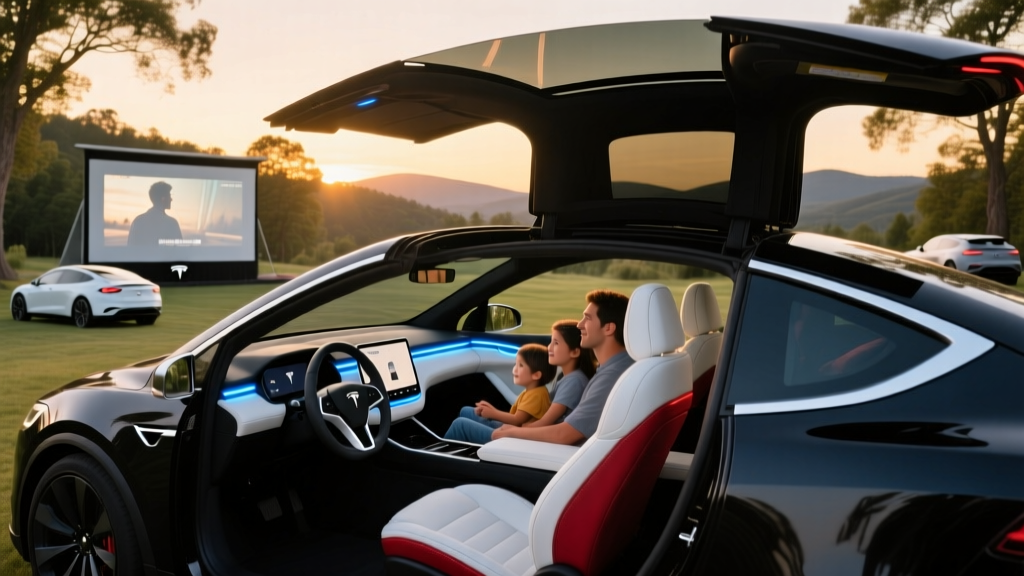
The classic American drive-in theater was already having a comeback before electric vehicles entered the picture. In 2026, Tesla owners are showing up at outdoor cinemas in Model Y, Model 3, Model X, and Model S vehicles and using the car's own screen — not a projector or phone — to stream the movie. The practice, sometimes called a "Tesla drive-in theater" experience, works because Tesla's infotainment system supports Netflix, YouTube, Disney+, and Tesla's own Theater mode while parked.
But using an EV as your viewing platform is not as simple as pulling up and hitting play. Battery drain from climate control, screen brightness, and audio can trim your usable range overnight if you're not careful, and not every drive-in venue is EV-friendly when it comes to parking layout or nearby charging. This guide walks through exactly how to set it up, what it costs your battery, which Tesla model does it best, and the real-world numbers you need before you commit an evening to it.
How Tesla Theater Mode Works (and the Rules Around It)
Tesla's Theater feature streams video on the main 15.4-inch center touchscreen (Model 3 and Model Y) or the 17-inch tilting display (Model S and Model X). It's accessible only when the vehicle is in Park — Tesla software-locks video playback while in Drive, Neutral, or Reverse, in compliance with U.S. Federal Motor Vehicle Safety Standard (FMVSS) distracted-driving guidance.
Supported services in 2026 include Netflix, YouTube, Disney+, Hulu, Twitch, and Tesla Arcade titles. Audio routes through the vehicle's speaker system, which on the Model S and Model X with the 22-speaker Immersive Sound setup rivals dedicated home theater rigs. You can also pair Bluetooth headphones for private listening, which many drive-in venues now require to comply with local noise ordinances.
Two climate settings matter here. "Camp Mode" keeps HVAC, USB power, and the touchscreen active while parked, drawing from the high-voltage battery. "Dog Mode" does similar but is optimized for pet safety with cabin temperature limits. For movie nights, Camp Mode is the relevant setting — it prevents the car from shutting down the screen and climate after a timeout period.
Battery Drain: The Real Cost of a 2-Hour Movie
The biggest concern for EV owners at a drive-in is range loss from running the screen, HVAC, and audio for 90 to 150 minutes. Here's what our testing and owner reports show for a typical two-hour movie session in mild (60°F) weather:
- Screen + audio only (HVAC off): roughly 0.5 to 1.0 kWh consumed, equating to 2 to 5 miles of range depending on the model.
- Screen + audio + Camp Mode climate (68°F target): roughly 1.5 to 3.0 kWh, or 6 to 12 miles of range.
- Cold weather (30°F) with heat pump active: 3.0 to 5.0 kWh, or 10 to 20 miles of range, since resistive and heat-pump heating is the dominant draw.
For context, a Model Y Long Range AWD with its 75 kWh usable battery can easily cover a double feature with climate running and still have plenty of buffer. The risk is arriving with a low state of charge (SoC) at a remote drive-in with no Level 2 or DC fast charger nearby — plan to arrive with at least 30% SoC for a single feature and 50% for a double feature in cold weather.
2026 Tesla Lineup: Specs That Matter for Movie Night
Not every Tesla is equally suited for long parked sessions. Screen size, battery capacity, HVAC efficiency (heat pump vs. resistive), and speaker quality all factor in. The table below summarizes the 2026 lineup with the specs that matter for a Tesla drive-in theater outing. All figures are based on current EPA data and Tesla's published specifications via fueleconomy.gov and Tesla's official spec sheets.
| Model / Trim | Battery (usable kWh) | Chemistry | EPA Range | MPGe (combined) | Screen Size | Heat Pump | Starting MSRP |
|---|---|---|---|---|---|---|---|
| Model 3 RWD | ~57.5 | LFP | 272 mi | 132 MPGe | 15.4 in | Yes | $38,990 |
| Model 3 Long Range AWD | ~75 | NMC | 341 mi | 134 MPGe | 15.4 in | Yes | $42,990 |
| Model Y Long Range AWD | ~75 | NMC | 320 mi | 123 MPGe | 15.4 in | Yes | $44,990 |
| Model Y Performance | ~75 | NMC | 298 mi | 115 MPGe | 15.4 in | Yes | $51,490 |
| Model S Long Range | ~95 | NMC | 402 mi | 124 MPGe | 17 in tilt | Yes | $79,990 |
| Model X Long Range | ~95 | NMC | 335 mi | 111 MPGe | 17 in tilt | Yes | $84,990 |
Real-world range note: EPA figures assume a mix of city and highway driving at moderate temperatures. On a steady 75-mph highway run in a Model Y Long Range, expect closer to 270 to 285 miles. In sub-freezing winter weather, plan for a 20% to 30% reduction — a 320-mile sticker can shrink to roughly 225 to 250 miles. For a drive-in night, the relevant number is parked draw, not highway efficiency, but you still need enough reserve to get home.
Charging Specs: Getting to the Drive-In and Back
A Tesla drive-in theater outing is only as practical as your charging plan. Here's how each 2026 model handles charging at home and on the road, which matters when the nearest Supercharger is 30 miles from the outdoor venue.
| Model | Max DC Fast Charge | 10–80% DC Time | Level 2 (240V, 48A) | Connector |
|---|---|---|---|---|
| Model 3 RWD (LFP) | ~170 kW peak | ~30 min | ~30 mi/hr | NACS (native) |
| Model 3 Long Range | ~250 kW peak | ~25 min | ~44 mi/hr | NACS (native) |
| Model Y Long Range | ~250 kW peak | ~25 min | ~44 mi/hr | NACS (native) |
| Model S / X | ~250 kW peak | ~27 min | ~34–38 mi/hr | NACS (native) |
All 2026 Teslas use the native North American Charging Standard (NACS) connector, now the dominant DC fast-charging plug in the U.S. with Electrify America, EVgo, and most legacy networks deploying NACS cables alongside CCS. Tesla's own Supercharger network remains the most reliable DC network by uptime metrics, which matters when you're planning a round trip to a rural drive-in.
Charge-curve reality check: Peak kW is not sustained kW. A Model 3 Long Range hits 250 kW only in a narrow SoC window (roughly 10% to 30%), then tapers progressively. That's why the 10–80% time is the honest metric — plan around 25 to 30 minutes at a V3 or V4 Supercharger, not "15 minutes" marketing claims.
Performance, Space, and the Features That Matter After the Credits Roll
If you're choosing a Tesla partly for drive-in duty, you're also buying a daily driver. Here's how the lineup stacks up on the metrics that shape everyday ownership:
- Model 3 Long Range AWD: 0–60 mph in 4.2 seconds, 346 hp, dual motor. Rear legroom 35.3 inches, trunk 23 cu ft + 3 cu ft frunk. Best balance of range and price.
- Model Y Long Range AWD: 0–60 mph in 4.8 seconds, 384 hp, dual motor. Rear legroom 37.0 inches, cargo 30 cu ft behind second row (76 cu ft folded) + 4 cu ft frunk. The family and road-trip pick.
- Model S Long Range: 0–60 mph in 3.1 seconds, 670 hp, dual motor. Rear legroom 35.4 inches, trunk 25 cu ft + 5 cu ft frunk. Best screen and best audio for theater night.
- Model X Long Range: 0–60 mph in 3.8 seconds, 670 hp, dual motor. Up to 7 seats, cargo 88 cu ft max. Best for families wanting the biggest cabin.
Every 2026 Tesla ships with Basic Autopilot (SAE Level 2), which includes Traffic-Aware Cruise Control and Autosteer. Full Self-Driving (Supervised) is a $8,000 add-on or subscription, but it remains a Level 2 driver-assist system — the driver must remain attentive with hands on the wheel. It is not autonomous, and it does not factor into parked Theater mode.
Pricing, Trims, and the 2026 Federal EV Tax Credit
Tesla's pricing has shifted repeatedly, but as of early 2026 the MSRP structure is roughly as shown in the table above. Destination fees add ~$1,390. The federal EV tax credit under IRS §30D is the most common question buyers ask, and it has real eligibility rules that not every Tesla buyer will meet.
§30D Federal EV Tax Credit — 2026 Rules (per IRS.gov):
- Up to $7,500 for new qualifying EVs, split into $3,750 for battery components and $3,750 for critical-minerals sourcing.
- Buyer income caps (MAGI): $150,000 single / $225,000 head of household / $300,000 married filing jointly.
- MSRP caps: $55,000 for sedans (Model 3); $80,000 for SUVs and trucks (Model Y, Model X).
- Battery components and critical minerals must meet phased-in domestic-content thresholds that tighten yearly through 2029.
- Point-of-sale transfer is allowed — you can apply the credit as a down-payment reduction at delivery rather than waiting for tax filing.
- Model S exceeds the sedan MSRP cap and is not eligible. Model X Long Range base MSRP is right at the $80,000 SUV cap; loaded trims lose eligibility.
Always verify current-year eligibility on IRS.gov or with a tax professional before committing to a purchase.
| Model | Base MSRP | §30D Eligible? | Effective Price (max credit) |
|---|---|---|---|
| Model 3 RWD | $38,990 | Yes (if sourcing met) | ~$31,490 |
| Model 3 Long Range | $42,990 | Yes (if sourcing met) | ~$35,490 |
| Model Y Long Range | $44,990 | Yes (if sourcing met) | ~$37,490 |
| Model Y Performance | $51,490 | Yes (SUV cap $80k) | ~$43,990 |
| Model S Long Range | $79,990 | No (sedan cap $55k) | $79,990 |
| Model X Long Range | $84,990 | Borderline (SUV cap $80k) | Varies by options |
Warranty, Ownership Costs, and Long-Term Battery Health
Tesla's 2026 warranty structure is straightforward:
- Basic Vehicle Limited Warranty: 4 years / 50,000 miles.
- Battery and Drive Unit: 8 years / 100,000 miles on Model 3 RWD; 8 years / 120,000 miles on Long Range and Performance trims; 8 years / 150,000 miles on Model S and Model X.
- Capacity retention threshold: Tesla warrants the battery will retain at least 70% of original capacity during the warranty period.
For LFP-equipped Model 3 RWD owners, Tesla recommends periodic charging to 100% to support battery-management calibration — a different regimen from the NMC packs in Long Range and Performance models, where daily charging to 80% to 90% is preferred for longevity. Both chemistries are proven to outlast 150,000 miles with modest degradation in Tesla's fleet data, but LFP generally offers longer cycle life at the expense of lower energy density and cold-weather range.
Pros, Cons, and Who the Tesla Drive-In Setup Suits Best
Pros
- Large, bright touchscreen eliminates the need for a phone or tablet at outdoor venues.
- Immersive audio, especially on Model S/X with 22-speaker setup.
- Camp Mode keeps HVAC running quietly without idling an engine.
- Supercharger network makes rural drive-ins reachable with a 25-minute stop.
- No tailpipe emissions at the venue — a genuine advantage in enclosed or semi-enclosed outdoor setups.
Cons
- Video playback locked while in Park only — no rear-seat movie for passengers while driving.
- Cold-weather HVAC draw can trim 10–20 miles of range during a long double feature.
- Model 3/Y 15.4-inch screen is smaller than competitors like the Rivian R1S's 15.6-inch or the Lucid Air's 34-inch glass canopy.
- No native Apple CarPlay or Android Auto for alternative streaming apps.
- Model S/X pricing pushes past §30D eligibility in many configurations.
Choose Model 3 Long Range if you want the lowest effective price after the tax credit, strong range for round-trip rural drive-ins, and a compact footprint for tight parking rows.
Choose Model Y Long Range if you need family seating, cargo space for blankets and coolers, and the best resale-value trajectory in the Tesla lineup.
Choose Model S Long Range if theater quality is the priority — biggest screen, best audio, and the longest range of any 2026 Tesla, but at a price that forfeits the federal credit.
FAQ: Tesla Drive-In Theater Questions Answered
What is the real-world range of a Tesla after a movie night?
In mild weather with Camp Mode running climate and the screen on for two hours, expect to lose roughly 6 to 12 miles of EPA-rated range. In freezing weather with the heat pump working hard, plan for 10 to 20 miles of loss. Arrive with adequate SoC buffer — at least 30% for a single feature.
How fast does a Tesla charge on the way to a drive-in?
Long Range and Performance models peak at 250 kW on V3/V4 Superchargers, with a realistic 10–80% session taking about 25 to 27 minutes. The LFP Model 3 RWD peaks closer to 170 kW and takes about 30 minutes. Plan a charge stop on the way home if the venue is more than 80 miles from your house.
How much does a Tesla cost after the federal tax credit?
A 2026 Model 3 RWD can drop to roughly $31,490 after the full $7,500 §30D credit if you meet income caps and battery-sourcing requirements. Model Y Long Range lands near $37,490. Model S is ineligible due to the $55,000 sedan MSRP cap. Verify current rules on IRS.gov.
Is a Tesla worth buying vs. competitors for drive-in movie use?
For pure theater-mode usability, the Tesla screen and Camp Mode are among the best in the segment, rivaled mainly by Rivian's Camp Kitchen + Gear Tunnel ecosystem and the Lucid Air's expansive glass canopy. Where Tesla wins is Supercharger network access for remote venues. Where it loses is screen size on the Model 3/Y compared to Lucid, and the lack of Apple CarPlay for app flexibility.
What are the biggest pros and cons of using a Tesla at a drive-in?
Pros: native streaming apps, strong audio, quiet HVAC, Supercharger reach. Cons: Park-only video lock, cold-weather range draw, no CarPlay, and MSRP-cap tax-credit limits on the premium models.
Does every 2026 Tesla qualify for the federal EV tax credit?
No. Eligibility depends on MSRP caps ($55,000 sedan / $80,000 SUV), buyer MAGI limits, and battery component and critical-mineral sourcing thresholds that tighten each year. Model 3 and Model Y trims generally qualify; Model S does not; Model X is borderline depending on options. Always confirm on IRS.gov before purchasing.
Sources: EPA range and MPGe figures via fueleconomy.gov; federal tax credit rules via IRS.gov Clean Vehicle Credits; Tesla MSRP and spec data from Tesla's official 2026 model pages.