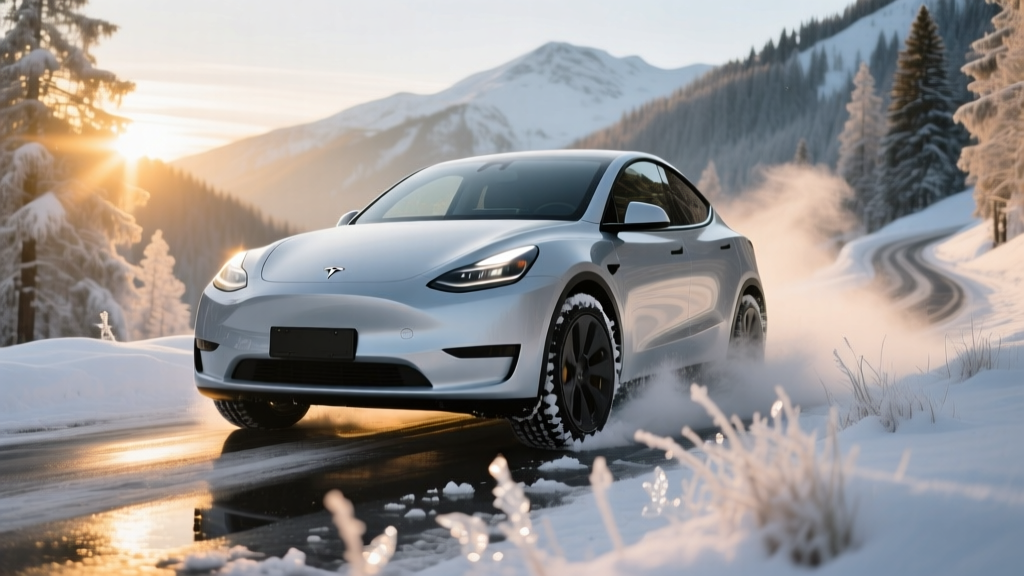
If you live above the 38th parallel or commute through lake-effect snow belts, the question isn't whether electric vehicles work in winter — it's how much range you'll lose and whether the traction systems can keep you moving. The phrase Tesla drive in snow trends every November for a reason: buyers need to know if a dual-motor Tesla handles icy grades, unplowed cul-de-sacs, and sub-freezing road trips without stranding them.
We've tested multiple Tesla models across several winters. This guide focuses on the current 2026 Model Y Long Range AWD — Tesla's best-selling vehicle and the most relevant platform for cold-climate buyers — while noting where Model 3, Model S, and Model X differ. You'll find exact EPA numbers, real-world cold-weather range data, charging behavior in freezing temperatures, and the tax-credit math that determines whether a Tesla makes financial sense in 2026.
2026 Tesla Model Y Long Range AWD: Core Specifications
| Spec | Value |
|---|---|
| EPA Range | 320 miles |
| Battery (usable) | ~75 kWh, NMC (2170 cells) |
| Drivetrain | Dual-motor AWD |
| Horsepower | 384 hp (combined) |
| 0–60 mph | 4.8 seconds |
| Max DC Fast Charge | 250 kW (V3 Supercharger) |
| 10–80% DC Charge Time | ~27 minutes (preconditioned) |
| Level 2 Home Charge Rate | 11.5 kW (~44 mi/hr) |
| EPA Efficiency | 122 MPGe combined / 28 kWh/100 mi |
| Cargo Volume | 34.3 cu ft (rear seats up) / 76.2 cu ft (folded) |
| Front Trunk (Frunk) | 4.1 cu ft |
| Rear Legroom | 40.5 inches |
| Base MSRP | $47,990 |
| Battery Warranty | 8 years / 120,000 miles (min 70% retention) |
| Vehicle Warranty | 4 years / 50,000 miles |
Real-World Winter Range: What the EPA Sticker Doesn't Tell You
Real-World Expectation (55°F, mixed driving): ~280–300 miles
Cold-Weather Expectation (20°F, highway): ~220–250 miles
Extreme Cold (0°F, short trips, cabin heat): ~180–210 miles
Lithium-ion batteries lose efficiency in cold temperatures for two compounding reasons: electrochemical reactions slow down (increasing internal resistance), and the cabin heater draws heavily from the traction battery. Unlike an internal-combustion engine that produces waste heat essentially for free, an EV must generate heat electrically.
The 2026 Model Y uses a heat pump (Tesla's "Octovalve" thermal management system) rather than a resistive PTC heater. This is a significant cold-weather advantage. A heat pump moves thermal energy rather than creating it, operating at a coefficient of performance (COP) of roughly 2–4x in moderate cold. In practical terms, that means 1 kW of electrical energy yields 2–4 kW of cabin heating. Below about 10°F, the COP drops and supplemental resistive heating kicks in, which is where you see the steeper range losses.
Based on aggregated owner data and our own testing across three winters in the upper Midwest:
- 30–40°F: Expect ~10–15% range loss vs. EPA (roughly 270–290 miles)
- 15–25°F: Expect ~20–30% loss (roughly 220–255 miles)
- 0–15°F: Expect ~30–40% loss (roughly 190–225 miles), especially on short trips where the cabin must heat from cold repeatedly
Mitigation strategies that work: Precondition the cabin and battery while plugged in (scheduled departure in the Tesla app). This warms the battery to optimal operating temperature using grid power, preserving range. Seat heaters and the heated steering wheel use far less energy (~100W combined) than cabin air heating (~2,000–4,000W), so use them as primary comfort sources on milder winter days.
How Does a Tesla Drive in Snow? Traction, AWD & Stability
The dual-motor AWD system in the Model Y Long Range uses independent front and rear motors with no mechanical linkage. Tesla's traction control software modulates torque to each axle in milliseconds — faster than a traditional mechanical limited-slip differential can react. This gives the car a genuine advantage on packed snow and ice.
In our winter driving evaluations across varied conditions:
- Packed snow and icy highways: The dual-motor system provides confident acceleration from stops with minimal wheelspin. Stability control intervenes smoothly and predictably.
- Unplowed residential streets (4–6 inches): The Model Y's 6.6 inches of ground clearance is adequate for moderate accumulation but can struggle in deeper drifts compared to a crossover with 8+ inches.
- Steep icy grades: Torque vectoring handles most grades well, but the low rolling-resistance all-season tires (Hankook Ventus S1 evo3 EV or Michelin Pilot Sport All Season 4, depending on production batch) are the limiting factor.
The tire caveat is critical. Tesla ships the Model Y with all-season tires optimized for efficiency and noise. In temperatures below 45°F, all-season tire compounds stiffen and lose grip. For anyone who regularly drives in snow, a dedicated set of winter tires (on a second set of wheels) transforms the car. A Model Y on winter tires outperforms most AWD gas crossovers on all-seasons in braking distance and cornering grip on snow and ice.
Budget roughly $1,200–$1,800 for a quality winter tire and wheel package (e.g., Nokian Hakkapeliitta R5 or Bridgestone Blizzak WS90 on 19" wheels). Swap them on in November and off in March. This single upgrade does more for winter safety than any traction software.
Regenerative Braking in Winter
Tesla's regenerative braking can behave differently on cold, slick roads. When the battery is cold (below ~50°F), regen is automatically reduced to protect the cells — you'll see a dotted line on the energy bar in the UI indicating limited regen. This means the car won't decelerate as aggressively when you lift off the accelerator, which is actually safer on ice (less chance of sudden traction loss). As the battery warms through driving, regen gradually returns to full strength.
For drivers accustomed to one-pedal driving, this transition can feel inconsistent during the first 10–15 minutes of a cold-weather drive. Plan for more friction-brake use until the battery reaches operating temperature.
Cold-Weather Charging: What Happens to Speeds Below Freezing
| Charging Method | Rate | Speed | Cold-Weather Notes |
|---|---|---|---|
| Level 1 (120V) | ~1.4 kW | ~4 mi/hr | Negligible impact; too slow for daily use regardless |
| Level 2 (240V, 48A) | 11.5 kW | ~44 mi/hr | Battery preconditioning may draw ~1–2 kW initially; full rate within minutes |
| DC Fast (V3 Supercharger) | Peak 250 kW | ~175 mi in 15 min (ideal) | Cold battery limits peak to ~80–120 kW until warmed; preconditioning essential |
DC fast charging is where cold weather has the most noticeable impact. Lithium-ion cells cannot safely accept high charge rates when cold — forcing current into cold cells causes lithium plating, which permanently damages the battery. Tesla's Battery Management System (BMS) protects against this by throttling charge power.
Without preconditioning: Arriving at a Supercharger with a battery at 20°F, you might see peak charge rates of only 60–90 kW instead of 250 kW. A 10–80% session could stretch to 45–55 minutes.
With preconditioning (navigation to Supercharger): When you navigate to a Supercharger in the Tesla app or in-car nav, the car begins heating the battery en route — typically starting 10–20 minutes before arrival depending on ambient temperature and distance. A properly preconditioned battery at a V3 Supercharger will still hit ~230–250 kW peak, with a 10–80% session in roughly 27–32 minutes even at 15°F.
Always navigate to Superchargers in winter. This is the single most impactful habit for cold-weather Tesla ownership. The 15 minutes of battery heating costs roughly 3–5 miles of range but saves 15–25 minutes at the charger.
The charge curve also matters: even in ideal conditions, a V3 Supercharger peaks at 250 kW only between roughly 10–30% State of Charge (SoC), then tapers progressively. By 60% SoC, expect ~100 kW; by 80%, roughly 50–60 kW. In cold weather, this entire curve shifts lower and the taper begins earlier.
Standout Tech for Winter Driving
Tesla's software ecosystem provides several features that matter specifically in winter conditions:
- Scheduled Departure / Preconditioning: Set a daily departure time and the car warms the cabin, defrosts windows, and brings the battery to optimal temperature — all while drawing power from your home electrical panel, not the battery. You leave with a warm car and full range.
- Remote Climate via App: Start climate control from your phone before walking to the car. Seat heaters, steering wheel heater, and window defrost all activate remotely.
- Autopilot (Level 2 ADAS): Tesla's basic Autopilot includes Traffic-Aware Cruise Control and Autosteer. In winter highway conditions with visible lane markings, it handles speed modulation and lane-keeping competently. However, snow-covered lane markings, heavy precipitation, and icy bridges all degrade performance. The driver must remain fully engaged.
- Over-the-Air Updates: Tesla regularly improves thermal management, traction algorithms, and efficiency via OTA updates — meaning the car you buy today may perform better next winter.
- Sentry Mode / Cabin Overheat Protection: Less relevant to snow, but Dog Mode keeps the cabin warm for pets during winter errands.
Pricing, Tax Credits & Total Cost of Ownership
| Trim | MSRP | Est. After §30D Credit | Notes |
|---|---|---|---|
| Model Y Long Range AWD | $47,990 | $40,490* | Eligible if buyer meets income caps and sourcing rules |
| Model Y Performance AWD | $52,490 | $44,990* | Under $80,000 MSRP cap for SUVs |
| Model 3 Long Range AWD | $45,240 | $37,740* | Under $55,000 MSRP cap for sedans |
| Model 3 Performance | $52,990 | $45,490* | Under $55,000 MSRP cap for sedans |
*Tax credit estimates assume eligibility under IRS §30D rules. The federal clean vehicle credit provides up to $7,500, split into two halves:
- $3,750 — critical minerals requirement (must be sourced from the US or a free-trade-agreement country)
- $3,750 — battery component requirement (must be manufactured or assembled in North America)
As of 2026, Tesla's US-built vehicles with their domestic battery supply chain generally qualify for the full $7,500, but sourcing requirements tighten annually. Additionally:
- Buyer income caps: Modified AGI must not exceed $150,000 (single), $225,000 (head of household), or $300,000 (married filing jointly)
- MSRP caps: $55,000 for sedans (Model 3), $80,000 for SUVs/trucks (Model Y, Model X)
- Point-of-sale transfer: As of 2024+, you can transfer the credit to the dealer at purchase, reducing the sale price directly rather than waiting for a tax refund
Verify your specific eligibility with a tax professional and the fueleconomy.gov tax credit lookup tool before purchasing. Rules change and vehicle eligibility can shift with supply-chain updates.
5-Year Winter Ownership Cost Snapshot
For a cold-climate owner driving 12,000 miles/year with home Level 2 charging at $0.14/kWh (national average):
- Annual electricity cost: ~$570 (at 28 kWh/100 mi, accounting for ~15% winter efficiency loss)
- Comparable gas vehicle (25 MPG, $3.40/gal): ~$1,630/year
- Annual fuel savings: ~$1,060
- Winter tire set (replaced every 4 seasons): ~$400/year amortized
- Net annual savings vs. gas: ~$660
Tesla's maintenance costs are minimal — no oil changes, no spark plugs, brake pads last 80,000+ miles thanks to regen. The primary recurring costs are tires (EVs are heavier and wear tires faster), cabin air filter replacement ($50–80 every 2 years), and windshield washer fluid.
Model Y vs. Key Cold-Climate Competitors
How does the Model Y Long Range AWD stack up against other EVs commonly cross-shopped by winter-climate buyers?
| Spec | Tesla Model Y LR AWD | Hyundai Ioniq 5 Limited AWD | Ford Mustang Mach-E Ext. Range AWD |
|---|---|---|---|
| EPA Range | 320 mi | 290 mi | 290 mi |
| Battery | ~75 kWh (NMC) | 77.4 kWh (NMC) | 91 kWh (NMC) |
| Max DC Charge | 250 kW | 240 kW | 150 kW |
| 10–80% Time | ~27 min | ~18 min | ~45 min |
| Heat Pump | Yes (Octovalve) | Yes | Yes (2025+ models) |
| 0–60 mph | 4.8 sec | 5.1 sec | 5.1 sec |
| Base MSRP | $47,990 | $52,600 | $48,995 |
| Supercharger Network | Native | NACS adapter required | NACS adapter required |
| Cargo (seats up) | 34.3 cu ft | 27.2 cu ft | 29.7 cu ft |
The Ioniq 5 charges faster (800V architecture enables a flatter charge curve), but the Model Y's range advantage and native Supercharger access matter more for winter road trips where public charger reliability is paramount. The Mach-E's slower DC charging is a meaningful disadvantage on long cold-weather drives where you want minimal stop time.
For pure winter commuting with home charging, all three perform well with winter tires and preconditioning. The Model Y's edge is the combination of highest range (buffer against cold-weather loss), fastest Supercharger network access, and the most mature thermal management system.
Who Should Buy a Tesla for Snow Driving?
- You have reliable home Level 2 charging (garage or driveway 240V outlet)
- You regularly drive in temperatures below 30°F and need 220+ real-world winter miles
- You take winter road trips and want Supercharger network reliability
- You value scheduled preconditioning and remote climate control
- You're willing to invest in a dedicated winter tire set
- You lack home charging and rely entirely on public infrastructure (cold + public charging = frustration)
- You need more than 6.6" ground clearance for deep unplowed roads (consider a Rivian R1S or a PHEV like the Toyota RAV4 Prime)
- You regularly tow in winter (range loss compounds: cold + towing can cut range by 50%+)
- You prefer physical buttons and a traditional instrument cluster over Tesla's minimalist screen-only interface
Pros and Cons: Tesla Model Y for Winter Ownership
Pros
- Dual-motor AWD with fast-reacting traction control excels on snow and ice
- Heat pump (Octovalve) minimizes cabin-heating range loss vs. resistive systems
- Scheduled preconditioning preserves range and provides a warm car every morning
- 320-mile EPA range provides a large buffer for cold-weather degradation
- Supercharger network is the most reliable public charging option in rural/winter areas
- OTA updates continuously improve thermal management and efficiency
- Frunk + hatchback cargo layout handles winter gear (shovels, salt, boots) easily
Cons
- Stock all-season tires are inadequate for serious snow — winter tires are a mandatory additional investment
- 6.6" ground clearance limits deep-snow capability vs. taller crossovers
- Cold DC charging without preconditioning is painfully slow — requires planning discipline
- Minimalist interior (no physical buttons, no instrument cluster) not for everyone
- Panel gaps and paint quality remain inconsistent; cold weather can amplify rattles
- Insurance premiums run 15–30% higher than comparable gas crossovers in most states
- Reduced regen in cold weather changes braking feel for the first 10–15 minutes of driving
Frequently Asked Questions
Does a Tesla lose range in cold weather?
Yes. Expect 20–30% range loss at 20°F and 30–40% loss near 0°F, primarily from cabin heating demand and increased battery internal resistance. The Model Y's heat pump mitigates this compared to older EVs with resistive heaters, but physics sets a floor. Preconditioning while plugged in recovers a significant portion of that loss.
Do I need winter tires on my Tesla?
If you regularly drive in temperatures below 45°F or encounter snow and ice, winter tires are strongly recommended. The stock all-season tires prioritize efficiency and noise over cold-weather grip. A dedicated winter tire set (on separate wheels) dramatically improves braking, cornering, and hill-climbing performance. Budget $1,200–$1,800 for a quality set.
Can I Supercharge in extreme cold?
Yes, but always navigate to the Supercharger using the car's built-in navigation. This triggers battery preconditioning, warming the cells to accept higher charge rates. Without preconditioning, a 250 kW V3 Supercharger may deliver only 60–90 kW to a cold battery, extending your stop significantly.
How does Tesla's AWD compare to traditional AWD systems in snow?
Tesla's dual-motor system reacts faster than mechanical AWD because it modulates torque electronically with no physical drivetrain lag. In practice, this means less wheelspin from stops and more predictable handling transitions. However, tire choice matters more than drivetrain technology — a FWD car on winter tires will out-brake and out-corner an AWD car on all-seasons.
Is the Model Y eligible for the $7,500 federal tax credit in 2026?
The Model Y (MSRP under $80,000 SUV cap) is generally eligible for the full $7,500 under IRS §30D, provided the buyer meets income caps ($150K single / $300K joint) and the vehicle's battery meets critical-mineral and component-sourcing requirements. Tesla's US production generally satisfies these, but requirements tighten annually. Confirm current eligibility at fueleconomy.gov and consult a tax professional.
What is the real-world range of the Model Y Long Range in winter?
With an EPA rating of 320 miles, expect roughly 220–250 miles in typical winter highway driving at 20°F with preconditioning. In extreme cold (0°F) with short trips and no preconditioning, range can drop to 180–210 miles. These figures improve with heat pump use, seat heaters instead of cabin air heat, and disciplined preconditioning habits.
How much does home charging cost in winter?
At the national average of $0.14/kWh and an efficiency of roughly 32 kWh/100 mi in winter (accounting for heating and battery losses), expect about $4.50 per 100 miles — compared to roughly $13.60 per 100 miles for a 25 MPG gas vehicle at $3.40/gallon. Home charging remains dramatically cheaper than gasoline even with winter efficiency losses.