When Tesla introduced Dog Mode, it was hailed as a breakthrough for pet-owning EV drivers: a climate-control setting that keeps the cabin at a safe temperature while you step out, with a prominent on-screen display assuring passersby that your dog is comfortable. But recurring online reports of Tesla Dog Mode failure—cabin temperature spikes, unexpected system shut-offs, and phantom 12V battery drain—have made pet owners rightfully cautious. This review examines the 2026 Tesla Model Y through the lens of climate-system reliability, Dog Mode failure scenarios, and the full ownership picture you need before trusting your pet to software.
How Dog Mode Works—and Where It Can Fail
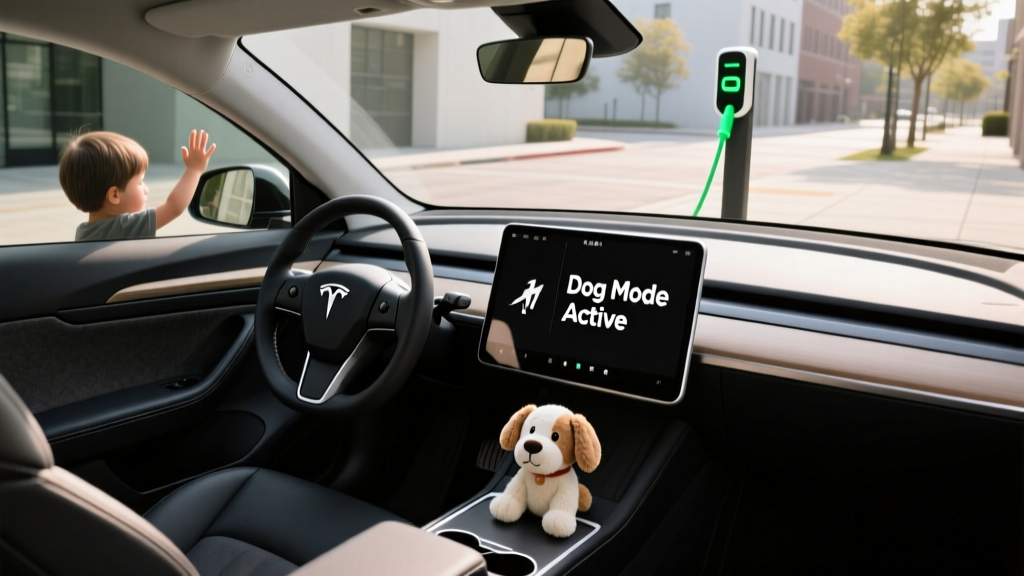
Dog Mode is a sub-function of Tesla's cabin overheat protection and climate-control system. When activated from the touchscreen or the Tesla app, it maintains a user-set cabin temperature (default 68°F/20°C) while the vehicle is parked and locked. The center screen displays the cabin temperature and a message: "My owner will be back soon. Don't worry, the A/C is on."
In practice, Dog Mode relies on three systems working in concert:
- The high-voltage traction battery to power the HVAC compressor
- The 12V lithium auxiliary battery to run the touchscreen and control electronics
- The vehicle's thermal management system to regulate compressor duty cycles
Known Dog Mode failure scenarios documented by owners and Tesla forums include:
- Low-battery shutoff: If the traction battery drops below ~20% SoC, the vehicle may disable Dog Mode to preserve driving range. Tesla added a warning notification, but in hot climates this can happen faster than expected.
- 12V auxiliary battery failure: A depleted or faulty 12V battery can cause the touchscreen and climate controls to reboot or shut down, interrupting Dog Mode. Tesla switched to lithium 12V batteries in recent Model Y builds, which reduced but did not eliminate this risk.
- Software glitches after OTA updates: Some owners report Dog Mode deactivating after over-the-air updates or failing to engage via the app until a vehicle reboot.
- Extreme ambient heat overload: In sustained 100°F+ ambient temperatures with direct sun exposure, the HVAC system may struggle to maintain the set point, particularly in vehicles without tinted glass roofs.
Our recommendation: never leave a pet unattended in any vehicle—EV or gas—without a backup plan. Use the Tesla app to monitor cabin temperature remotely, set SoC thresholds conservatively (keep above 30% when using Dog Mode), and limit unattended time to short errands. Dog Mode is a convenience feature, not a life-safety system.
2026 Model Y: EPA Range, Battery, and Real-World Efficiency
For the 2026 model year, the Tesla Model Y is offered in three primary trims. The Long Range AWD remains the volume seller and the most relevant for pet owners who road-trip with animals.
| Spec | Long Range AWD | Performance AWD |
|---|---|---|
| EPA Range | 320 miles | 295 miles |
| Battery (usable) | ~75 kWh, NMC | ~75 kWh, NMC |
| MPGe (combined) | 111 MPGe | 103 MPGe |
| Efficiency | 28 kWh/100 mi | 30 kWh/100 mi |
| 0–60 mph | 4.8 sec | 3.5 sec |
| Horsepower | 384 hp | 456 hp |
| Drivetrain | Dual-motor AWD | Dual-motor AWD |
| Base MSRP | $44,990 | $48,990 |
The EPA rates the Long Range AWD at 320 miles. In real-world highway driving at 70 mph in moderate temperatures, expect roughly 270–290 miles before needing to charge. In cold weather (below 30°F), range can drop to 230–250 miles due to battery resistance and cabin heating load. If you're running Dog Mode while parked in summer heat, factor in an additional 1–3 kWh per hour of HVAC draw, which can reduce available range by 5–10 miles per hour of use.
The Model Y uses an NMC (nickel manganese cobalt) battery pack, which offers higher energy density than LFP chemistry but is more sensitive to sustained 100% SoC storage. Tesla recommends daily charging to 80% for NMC packs, reserving 100% for road trips. Source: fueleconomy.gov.
Charging Speed: DC Fast Charge and Home Level 2
Charging speed matters for road-trippers with pets—you want short stops, not lengthy sessions at a rest area with a dog waiting in the car. The 2026 Model Y uses the NACS connector natively and can access Tesla's Supercharger network without adapters.
| Level | Power | Speed / Time |
|---|---|---|
| Level 1 (120V) | ~1.4 kW | ~4 mi/hr |
| Level 2 (240V, 48A) | ~11.5 kW | ~34 mi/hr |
| DC Fast Charge (peak) | 250 kW (V3 Supercharger) | 10–80% in ~22 min |
The 250 kW peak rate is achievable only on V3 Superchargers and only at low SoC. The charge curve tapers significantly above 60%, and by 80% you're typically drawing under 80 kW. Plan road-trip stops around the 10–80% window for the fastest sessions. Charging from 80–100% can add another 20+ minutes due to cell-balancing at the top of the curve.
At home on a 48-amp Level 2 circuit (such as the Tesla Wall Connector on a 60A breaker), a full overnight charge from 20% to 80% takes roughly 4–5 hours. This is the practical daily charging setup for most Model Y owners.
Cargo Space, Interior, and Pet-Friendly Features
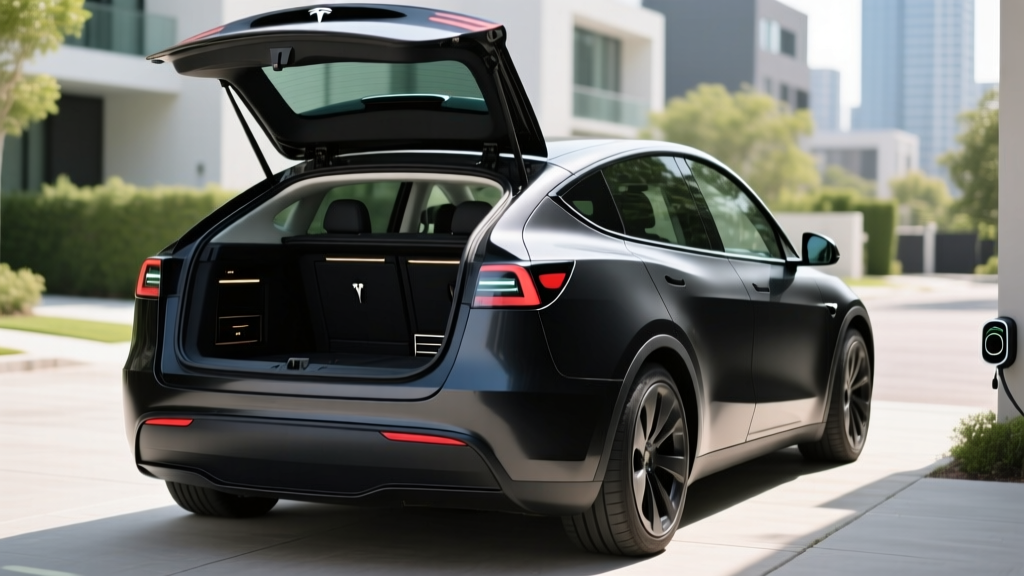
The Model Y's crossover form factor is a big reason pet owners gravitate toward it. Cargo volume behind the second row is 30.2 cubic feet, expanding to 72.1 cubic feet with the rear seats folded. Rear legroom measures 37.6 inches, which accommodates large dog crates in the cargo area with room to spare.
Notable interior and tech features relevant to pet owners:
- Dog Mode with remote cabin-temperature monitoring via the Tesla app
- Cabin Overheat Protection (separate from Dog Mode) activates automatically if interior temperature exceeds 105°F
- HEPA air filtration (Bioweapon Defense Mode) on equipped trims—useful for dusty rest stops
- 15.4-inch center touchscreen with the prominent Dog Mode display for passersby
- Sentry Mode records exterior activity while parked, adding security when you're away from the vehicle
Drawbacks include the all-glass roof, which contributes to solar heat gain in summer (aftermarket ceramic tint is a popular owner upgrade), and the lack of physical buttons for climate control—everything routes through the touchscreen or app.
Pricing, Tax Credit Eligibility, and Ownership Cost
| Trim | Base MSRP | §30D Credit Eligibility | Est. After Credit |
|---|---|---|---|
| Long Range AWD | $44,990 | Eligible (under $80K SUV cap) | ~$37,490* |
| Performance AWD | $48,990 | Eligible (under $80K SUV cap) | ~$41,490* |
*The §30D federal EV tax credit provides up to $7,500, split between a $3,750 critical-minerals requirement and a $3,750 battery-component requirement. Eligibility depends on buyer income limits ($150K single / $300K joint MAGI), vehicle MSRP caps ($80K for SUVs), and North American final assembly. Tesla manufactures the Model Y in Fremont, CA and Austin, TX. Battery sourcing rules are updated annually by the IRS—verify current-year eligibility at irs.gov before purchase. The credit can be transferred to the dealer as a point-of-sale discount as of 2024 onward.
The Model Y's battery and drive unit carry an 8-year/120,000-mile warranty (Long Range) with a minimum 70% capacity retention guarantee. The limited vehicle warranty is 4 years / 50,000 miles. Tesla's warranty terms are competitive within the segment, though Hyundai's 10-year/100,000-mile battery warranty on the Ioniq 5 remains the benchmark.
Autopilot, FSD, and Driver Assistance — What Dog Mode Owners Should Know
Tesla Autopilot and Full Self-Driving (Supervised) are SAE Level 2 driver-assistance systems. The driver must remain fully attentive, hands on or near the wheel, and ready to take over at any moment. These systems are not self-driving. No consumer Tesla vehicle operates at Level 4 autonomy.
For pet owners on long road trips, Autopilot (standard) provides adaptive cruise control and lane centering, which reduces highway fatigue. FSD (Supervised), available as a $8,000 add-on or $99/month subscription, adds automatic lane changes, traffic-light recognition, and city-street navigation. Neither system replaces driver attention, and both require active supervision.
Is the 2026 Model Y Worth It for Pet Owners? Pros, Cons, and Competitors
- Best-in-class Supercharger network access for road trips
- Spacious 30+ cu ft cargo area fits large crates
- Dog Mode with remote app monitoring
- 250 kW peak DC charging; 10–80% in ~22 min
- Strong §30D tax-credit eligibility (under $80K SUV cap)
- 320-mile EPA range (Long Range AWD)
- Dog Mode failure risk from low SoC, 12V faults, or software bugs
- Glass roof increases solar heat gain in summer
- No physical climate buttons—screen-dependent controls
- NMC battery requires 80% daily charge limit for longevity
- FSD is expensive and still Level 2 only
- Insurance premiums above segment average
Key competitors for pet-owning EV buyers:
- Hyundai Ioniq 5: 305-mile EPA range, 800V architecture (10–80% in ~18 min), LFP option available, 10-year battery warranty. No native Dog Mode equivalent, but third-party climate apps exist.
- Ford Mustang Mach-E: 312-mile EPA range (Extended Range), competitive cargo space, but CCS charging (slower network access without NACS adapter).
- Kia EV6: Shares Ioniq 5's 800V platform, 310-mile range, strong cargo area. No dedicated pet mode.
The Model Y's unique advantage for pet owners is the combination of Dog Mode (despite its limitations), the Supercharger network's reliability and density, and the vehicle's cargo dimensions. If Dog Mode failure risk is a dealbreaker, no competitor currently offers a fully equivalent system—but the Ioniq 5's faster charging and LFP battery option (which tolerates 100% SoC without degradation concerns) make it a strong alternative for climate-conscious buyers.
Frequently Asked Questions
Can Dog Mode drain the Model Y's battery completely?
Tesla's software is designed to disable Dog Mode when the traction battery falls below approximately 20% SoC and will send a push notification to the Tesla app. However, in extreme heat (100°F+), the HVAC compressor draws 1.5–3 kW continuously, which can consume 5–10% SoC per hour. Always leave a sufficient battery buffer—at least 30%—and monitor via the app.
Does the Model Y qualify for the full $7,500 federal tax credit in 2026?
The Model Y qualifies for the §30D credit, but the exact amount ($3,750 or $7,500) depends on current-year battery sourcing and critical-minerals requirements set by the IRS. Buyer income caps ($150K single / $300K joint) and the $80K SUV MSRP cap also apply. Check irs.gov for the latest sourcing determinations before purchasing.
How fast does the Model Y charge at home?
On a 48-amp Level 2 home charger (240V), the Model Y adds approximately 34 miles of range per hour at ~11.5 kW. A typical overnight session from 20% to 80% takes about 4–5 hours, which is more than sufficient for daily use.
What should I do if Dog Mode fails or deactivates unexpectedly?
First, check your traction battery SoC—if it dropped below the threshold, Dog Mode will have auto-disabled. Second, check for 12V battery warnings on the touchscreen. Third, try rebooting the vehicle (hold both scroll wheels for ~10 seconds). If the issue persists, schedule a service appointment via the app. In the meantime, do not leave pets unattended in the vehicle.
Is the Model Y the best EV for pet owners in 2026?
It depends on your priorities. The Model Y offers the most integrated pet-climate feature (Dog Mode), the most reliable road-trip charging network (Superchargers), and excellent cargo space. If you prioritize battery longevity and faster DC charging, the Hyundai Ioniq 5 with its LFP option and 800V architecture is a compelling alternative, though it lacks a native pet mode.