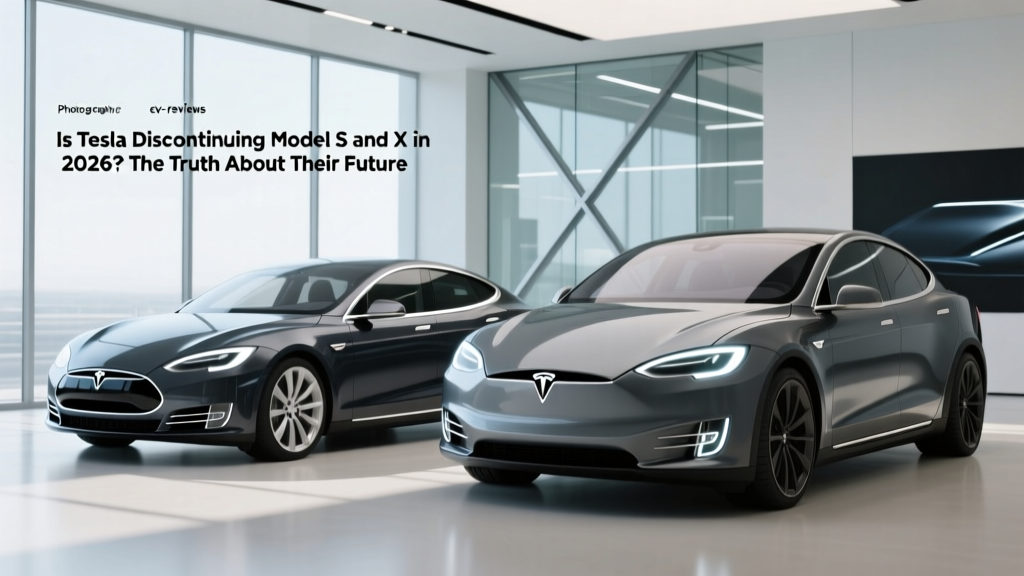
The Rumor: Is Tesla Discontinuing Model S and X?
Search forums and EV communities long enough, and you'll encounter the question: is Tesla discontinuing Model S and X? The short answer as of early 2026 is no — both vehicles remain in production and available for order on Tesla's website. But the longer answer requires examining declining sales volumes, Tesla's shifting strategic priorities toward the Cybertruck, next-generation compact platform, and Optimus robotaxi, and what the future holds for these aging flagship sedans and SUVs.
Model S launched in 2012 and Model X in 2015. Both received a significant "Palladium" refresh in 2021 with new powertrains, interiors, and the controversial yoke steering option. Since then, updates have been incremental. Meanwhile, the Model 3 Highland refresh, Model Y Juniper update, and Cybertruck have absorbed Tesla's engineering focus. That disparity is what fuels discontinuation speculation.
Here's what buyers and enthusiasts need to know about the current state of Model S and Model X in 2026, whether they're still competitive, and whether now is the right time to buy — or wait.
2026 Tesla Model S: Current Specs and Positioning
| Spec | Long Range | Plaid |
|---|---|---|
| Base MSRP | $84,990 | $99,990 |
| EPA Range | 402 miles | 359 miles |
| Battery (usable, est.) | ~100 kWh, NMC | ~100 kWh, NMC |
| Drivetrain | Dual Motor AWD | Tri-Motor AWD |
| Horsepower | 670 hp | 1,020 hp |
| 0-60 mph | 3.1 sec | 1.99 sec |
| MPGe (combined) | 120 MPGe | 116 MPGe |
| Peak DC Charge Rate | 250 kW | 250 kW |
| 10-80% DC Charge Time | ~30 min | ~30 min |
| Level 2 Home Charge | 11.5 kW (~34 mi/hr) | 11.5 kW (~34 mi/hr) |
| Cargo Volume | 28 cu ft (rear seats up) | 28 cu ft (rear seats up) |
| Battery Warranty | 8 yr / 150,000 mi | 8 yr / 150,000 mi |
The Model S remains one of the longest-range EVs on the market, but its 250 kW peak DC charge rate — once class-leading — now trails competitors like the Hyundai Ioniq 5 (350 kW peak on 800V architecture), Lucid Air (300+ kW), and the Porsche Taycan (320 kW). A 10-80% charge in roughly 30 minutes is acceptable for road trips but not exceptional by 2026 standards.
The tri-motor Plaid variant delivers supercar-rivaling acceleration at 1.99 seconds to 60 mph, but sustaining that performance generates significant heat, which can trigger power limiting during repeated hard launches. For most buyers, the Long Range variant's 670 hp and 3.1-second 0-60 time is more than sufficient.
2026 Tesla Model X: Current Specs and Positioning
| Spec | Long Range | Plaid |
|---|---|---|
| Base MSRP | $89,990 | $104,990 |
| EPA Range | 335 miles | 311 miles |
| Battery (usable, est.) | ~100 kWh, NMC | ~100 kWh, NMC |
| Drivetrain | Dual Motor AWD | Tri-Motor AWD |
| Horsepower | 670 hp | 1,020 hp |
| 0-60 mph | 3.8 sec | 2.5 sec |
| MPGe (combined) | 109 MPGe | 103 MPGe |
| Peak DC Charge Rate | 250 kW | 250 kW |
| 10-80% DC Charge Time | ~32 min | ~32 min |
| Level 2 Home Charge | 11.5 kW (~30 mi/hr) | 11.5 kW (~30 mi/hr) |
| Cargo Volume (5-seat) | 88 cu ft (rear seats folded) | 88 cu ft (rear seats folded) |
| Seating Config | 5, 6, or 7 seats | 5, 6, or 7 seats |
| Towing Capacity | 5,000 lbs | 5,000 lbs |
| Battery Warranty | 8 yr / 150,000 mi | 8 yr / 150,000 mi |
The Model X's signature falcon-wing rear doors remain a polarizing feature. They provide excellent third-row access in tight parking spaces but add mechanical complexity, and early-model-year reliability issues with the door actuators have left some used buyers wary. The 2021+ refresh improved the mechanism, but it remains a costlier repair than conventional doors.
Production Volume and Sales Data: The Real Story
Tesla stopped breaking out Model S and X sales separately after 2022, rolling them into an "Other Models" category alongside Cybertruck and Semi in quarterly delivery reports. In Q4 2025, Tesla reported roughly 11,000 deliveries in the "Other Models" bucket globally — a figure that includes Cybertruck, which by multiple estimates accounts for the majority of that volume.
Industry analysts estimate Model S and X combined global deliveries at approximately 20,000-30,000 units annually as of 2025, down from a peak of over 100,000 combined in 2017. For context, Tesla delivered over 1.8 million vehicles total in 2024, meaning S and X represent well under 2% of total volume.
This declining share explains the discontinuation rumors. Maintaining a dedicated production line at Fremont for low-volume models has an opportunity cost, especially as Tesla invests in next-generation platforms. However, Tesla has not announced any discontinuation timeline, and both models remain configurable on Tesla's website as of early 2026.
Tax Credit Eligibility: A Key Disadvantage
- MSRP Cap: Sedans must be under $55,000; SUVs/trucks under $80,000. The Model S at $84,990+ exceeds the sedan cap. The Model X at $89,990+ exceeds the SUV cap.
- Result: Neither the 2026 Model S nor Model X qualifies for the $7,500 federal tax credit.
- Income Caps: Even if pricing were below caps, buyers must earn under $150,000 (single) / $300,000 (joint) modified AGI.
- Battery Sourcing: Critical mineral and battery component sourcing requirements further restrict eligible vehicles regardless of price.
- Point-of-Sale Transfer: Available for qualifying vehicles — but again, S/X do not qualify due to MSRP.
Source: IRS §30D Guidelines. Consult a tax professional for personal eligibility.
This is a significant competitive disadvantage. The Lucid Air Pure starts at $69,900 and qualifies for the full $7,500 credit (subject to buyer income and sourcing rules), effectively pricing it at $62,400 — over $22,000 less than a base Model S. The BMW i5 eDrive40 at ~$67,000 also falls under the sedan cap. Buyers prioritizing value should weigh this carefully.
Model S and X vs. Key 2026 Competitors
| Vehicle | Starting MSRP | EPA Range | Peak DC kW | 10-80% Time | 0-60 mph | Tax Credit? |
|---|---|---|---|---|---|---|
| Tesla Model S LR | $84,990 | 402 mi | 250 kW | ~30 min | 3.1 sec | No (MSRP cap) |
| Lucid Air Pure | $69,900 | 419 mi | 220 kW | ~33 min | 3.8 sec | Yes (if eligible) |
| BMW i5 eDrive40 | $67,000 | 295 mi | 205 kW | ~31 min | 5.7 sec | Yes (if eligible) |
| Mercedes EQS 450+ | $105,550 | 390 mi | 200 kW | ~34 min | 5.9 sec | No (MSRP cap) |
| Tesla Model X LR | $89,990 | 335 mi | 250 kW | ~32 min | 3.8 sec | No (MSRP cap) |
| BMW iX xDrive50 | $87,250 | 324 mi | 200 kW | ~34 min | 4.4 sec | No (MSRP cap) |
| Rivian R1S (Dual) | $79,900 | 352 mi | 220 kW | ~30 min | 4.5 sec | Yes (if eligible) |
The competitive landscape has shifted dramatically since Model S launched with virtually no rivals. The Lucid Air now offers more range at a lower price with tax credit eligibility. The Rivian R1S undercuts Model X on price while offering comparable three-row utility and genuine off-road capability. BMW's i5 and iX provide traditional luxury build quality that Tesla's panel-gap reputation can't match.
Where Model S and X still excel: Supercharger network access (though this is opening to competitors via NACS adoption), over-the-air software updates that add features over time, and Tesla's Autopilot/FSD (Supervised) system — which, while SAE Level 2 and requiring full driver attention, offers extensive highway lane-keeping and navigation-assisted driving.
Who Should Still Consider Model S or Model X in 2026?
Reasons to Buy
- Class-leading 402-mile EPA range (Model S LR) remains among the best in any EV
- Access to Tesla Supercharger network — still the most reliable DC fast-charging network in North America
- Plaid variants offer supercar-level acceleration (1.99 sec 0-60) at a fraction of supercar pricing
- Continuous OTA updates add features; vehicles improve over time
- Model X offers 5,000-lb towing with genuine 3-row seating in a fully electric package
- Strong software integration, Sentry Mode, and Tesla app ecosystem
Reasons to Look Elsewhere
- Neither qualifies for the $7,500 federal EV tax credit due to MSRP caps
- 250 kW peak charge rate trails 800V competitors (Ioniq 5, Taycan, Lucid Air)
- Interior materials and build quality lag BMW, Mercedes, and Lucid at these price points
- Yoke steering is polarizing and not universally preferred; round wheel is optional
- Falcon-wing doors add repair complexity and cost on Model X
- Aging platform design (2012/2015 architecture) with no major refresh since 2021
- Declining production volumes may impact long-term parts availability and resale value
Buy a Model X if: You need three-row electric seating with 5,000-lb towing, want falcon-wing door convenience in tight spaces, and accept the MSRP premium over a Rivian R1S.
Look at competitors if: Tax credit eligibility matters (Lucid Air Pure, BMW i5, Rivian R1S), you want faster peak charging speeds, or you prioritize traditional luxury interior quality.
The Discontinuation Verdict: What to Watch
As of early 2026, Tesla has not announced any discontinuation of Model S or Model X. Both remain available, configurable, and in production at the Fremont factory. However, several signals suggest their long-term future is uncertain:
- Declining sales share: Under 2% of Tesla's total deliveries
- No announced next-generation platform: Tesla's "next-gen" compact vehicle platform (often referred to as the $25,000 Tesla) and Robotaxi efforts are absorbing R&D resources
- Increasing competition: Lucid, BMW, Mercedes, and Rivian offer compelling alternatives at competitive prices
- Fremont factory space: Reallocating S/X production lines to higher-volume models would improve Tesla's manufacturing efficiency
If Tesla does eventually discontinue both models, expect a 12-18 month runway between announcement and final production — giving prospective buyers time to order. For now, if you want one, you can still get one.
Frequently Asked Questions
Is Tesla discontinuing Model S and X in 2026?
No. As of early 2026, both Model S and Model X remain in production and available for order. Tesla has not announced any discontinuation timeline, though declining sales volumes and shifting company priorities fuel ongoing speculation.
What is the real-world range of the 2026 Tesla Model S?
The EPA rates the Model S Long Range at 402 miles. In real-world highway driving at 70-75 mph, expect 320-350 miles. In freezing temperatures with cabin heating, range can drop to 260-280 miles. The Plaid variant's 359-mile EPA rating yields roughly 280-310 highway miles.
How fast does the Model S charge on DC fast chargers and at home?
The Model S peaks at 250 kW on DC fast chargers (V3 Supercharger or equivalent CCS/NACS station), achieving a 10-80% charge in approximately 30 minutes. At home on a Level 2 charger (11.5 kW / 48A), you'll add roughly 34 miles of range per hour, or a full charge overnight in about 10-11 hours.
Does the 2026 Model S or Model X qualify for the federal EV tax credit?
No. Under current IRS §30D rules, sedans must have an MSRP under $55,000 and SUVs under $80,000 to qualify. The Model S starts at $84,990 and the Model X at $89,990, both exceeding their respective caps. Neither vehicle qualifies for the $7,500 federal credit regardless of buyer income.
Is the Tesla Model S still worth buying vs. the Lucid Air?
It depends on priorities. The Lucid Air Pure offers 419 miles of range at $69,900 and qualifies for the $7,500 tax credit, making it significantly more affordable. The Model S offers Supercharger network access, more mature software, and the Plaid's 1.99-second 0-60 time. For range-per-dollar, the Lucid wins. For Tesla ecosystem integration, the Model S remains relevant.
What is the battery warranty on the Model S and Model X?
Tesla covers the battery and drive unit for 8 years or 150,000 miles (whichever comes first), with a guaranteed minimum 70% capacity retention over that period. This warranty is competitive but matches rather than exceeds what most competitors offer. Hyundai and Genesis offer 10-year/100,000-mile battery coverage.
Will Tesla release a next-generation Model S or Model X?
Tesla has not announced any plans for a next-generation successor to either model. The company's publicly stated priorities include scaling Cybertruck production, launching a next-generation compact vehicle, and advancing its Robotaxi platform. A direct S/X successor appears unlikely before 2028 at the earliest.
Is Tesla's Autopilot or FSD self-driving?
No. Tesla's Autopilot and Full Self-Driving (Supervised) are SAE Level 2 driver-assistance systems. The driver must remain fully attentive, keep hands on the wheel, and be prepared to take over at any time. These systems assist with lane-keeping, adaptive cruise control, and navigation-guided lane changes, but they do not make the vehicle autonomous. Only Level 4 services like Waymo operate without a human driver.
Sources: EPA Fuel Economy, IRS New Clean Vehicle Tax Credit, Tesla Model S Official Page, Tesla Model X Official Page.