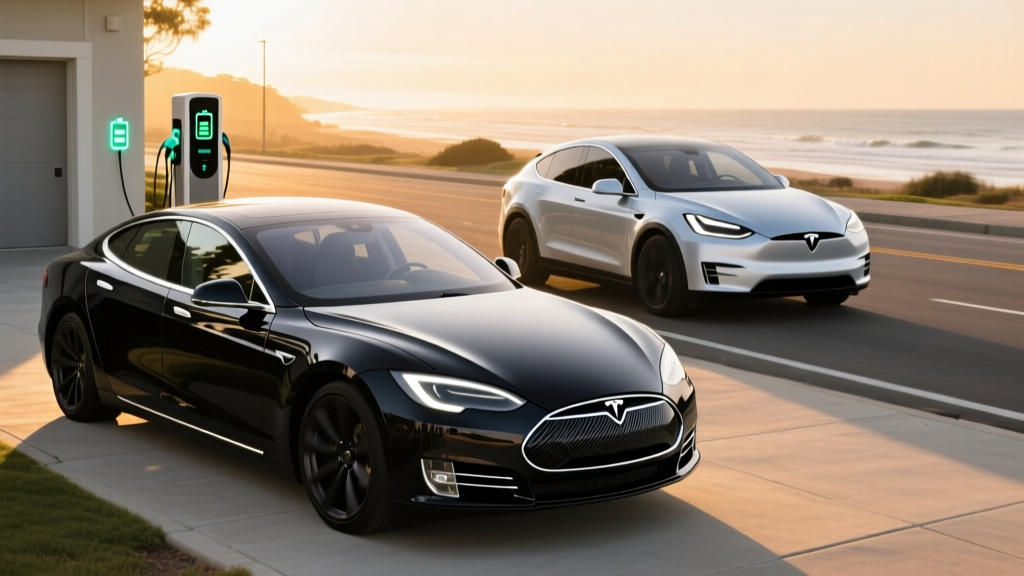
In early 2026, Tesla confirmed what industry watchers had anticipated for months: the Model S and Model X are being phased out of production. The news marks the end of an era for the vehicles that put Tesla on the map as a luxury EV automaker. For buyers, this raises urgent questions about remaining inventory, long-term parts support, residual values, and which alternatives now make more sense.
This guide covers everything you need to know about the discontinuation — final-year specs for the 2025/2026 Model S and Model X, what remaining new and certified pre-owned inventory looks like, how tax credits apply, and which competitors fill the gap Tesla is leaving behind.
Why Tesla Discontinues Model S and Model X in 2026
Tesla's decision to end Model S and Model X production stems from converging pressures: declining sales volume as the lineup aged, the Fremont factory's need to retool for next-generation platforms, and the reality that the Model 3 and Model Y — along with the Cybertruck — now capture the vast majority of Tesla's demand. The Model S, introduced in 2012, and the Model X, launched in 2015, shared an aging platform that never received the structural battery pack or 4680-cell architecture found in newer Tesla vehicles.
According to Tesla's official communications, the company will honor all existing orders and continue to provide service, parts, and over-the-air software updates for Model S and Model X owners. However, no new orders are being accepted for fresh production builds as of Q2 2026.
Final-Year Model S Specs: Range, Battery, and Efficiency
Before we evaluate what comes next, here's exactly what the final production Model S delivered — useful if you're considering remaining dealer or Tesla-direct inventory.
| Spec | Long Range | Plaid |
|---|---|---|
| EPA Range | 402 miles | 396 miles |
| Battery (usable) | ~95 kWh (NMC) | ~95 kWh (NMC) |
| Drivetrain | Dual Motor AWD | Tri-Motor AWD |
| Horsepower | 670 hp | 1,020 hp |
| 0-60 mph | 3.1 sec | 1.99 sec |
| Top Speed | 155 mph | 200 mph |
| MPGe (combined) | 120 MPGe | 116 MPGe |
| Efficiency | 28 kWh/100 mi | 29 kWh/100 mi |
| Base MSRP | $74,990 | $89,990 |
Model X Final Specs: The Family Hauler's Last Stand
| Spec | Long Range | Plaid |
|---|---|---|
| EPA Range | 335 miles | 326 miles |
| Battery (usable) | ~95 kWh (NMC) | ~95 kWh (NMC) |
| Drivetrain | Dual Motor AWD | Tri-Motor AWD |
| Horsepower | 670 hp | 1,020 hp |
| 0-60 mph | 3.8 sec | 2.5 sec |
| MPGe (combined) | 109 MPGe | 105 MPGe |
| Seating | 5, 6, or 7 passengers | 5 or 6 passengers |
| Cargo (max) | 88.1 cu ft | 88.1 cu ft |
| Towing Capacity | 5,000 lbs | 5,000 lbs |
| Base MSRP | $79,990 | $94,990 |
The Model X's falcon-wing rear doors remain a polarizing feature — dramatic at carpool drop-off, but a liability in tight garages with low clearance (they require roughly 12 inches of lateral space and ~72 inches of vertical clearance to open fully). Cargo volume of 88.1 cubic feet with seats folded still outpaces most electric SUVs, and the available third row makes it one of the few three-row EVs in its class.
Charging Speed: What Model S and Model X Owners Get
Both vehicles share Tesla's mature Supercharger ecosystem, which remains one of the strongest ownership advantages even as the platform sunsets.
| Level | Rate | Speed |
|---|---|---|
| Level 1 (120V) | ~1.4 kW | ~3-4 miles/hour |
| Level 2 (240V, 48A) | 11.5 kW | ~34 miles/hour |
| DC Fast Charge (peak) | 250 kW (CCS via adapter or NACS native on newer builds) | 10-80% in ~27 minutes |
| DC Fast Charge (sustained avg) | ~170 kW average 10-80% | ~200 miles in 15 minutes |
The 250 kW peak charge rate was competitive at launch but now trails newer 800V architectures from Hyundai/Kia (350 kW on the Ioniq 5 N and EV6 GT) and Porsche/Audi platforms. The charge curve tapers noticeably above 50% state of charge, which is why the 10-80% time stretches to roughly 27 minutes — adequate for road trips but not class-leading in 2026.
Home charging at 11.5 kW (48 amps on a 60-amp circuit) replenishes a depleted battery in roughly 10 hours, making overnight charging practical for most daily driving needs. A Tesla Wall Connector or any J1772/NACS Level 2 unit will work, though Tesla's native connector (now the North American Charging Standard) is becoming the universal plug as other automakers adopt it.
Federal Tax Credit: Do Remaining Model S and Model X Qualify?
This is where the picture gets complicated for 2026 buyers eyeing remaining new inventory.
- MSRP Cap (§30D): Sedans must be ≤$55,000; SUVs/trucks ≤$80,000. The Model S (starting at $74,990) exceeds the sedan cap — it does NOT qualify for the new-vehicle §30D credit. The Model X Long Range at $79,990 squeaks under the SUV cap, but any options pushing it above $80,000 disqualify it.
- Buyer Income Cap: Modified AGI must not exceed $150,000 (single), $225,000 (head of household), or $300,000 (joint filers).
- Battery Sourcing & Critical Minerals: Vehicles must meet escalating domestic-content thresholds for battery components and critical minerals. Tesla's final-production units were built with varying supply-chain compliance — confirm VIN eligibility at fueleconomy.gov before purchasing.
- Point-of-Sale Transfer: Eligible buyers can apply the credit as an immediate price reduction at the dealer (or Tesla direct), rather than waiting for a tax refund.
Bottom line: Most Model S buyers will not qualify for the federal credit due to the MSRP cap. Some base Model X Long Range buyers may qualify if their income is within limits and the specific VIN meets sourcing requirements. Always verify at irs.gov and with a tax professional.
| Model | Base MSRP | §30D Credit Eligible? | Best-Case Price |
|---|---|---|---|
| Model S Long Range | $74,990 | No (exceeds $55K sedan cap) | $74,990 |
| Model S Plaid | $89,990 | No | $89,990 |
| Model X Long Range | $79,990 | Possibly (under $80K SUV cap) | ~$72,490 (if eligible) |
| Model X Plaid | $94,990 | No (exceeds $80K cap) | $94,990 |
Who Should Still Buy a Model S or Model X in 2026?
Despite the discontinuation, these vehicles aren't bad — they're simply aging in a market that has moved on. Here's who they still serve well:
The Model S is right for you if:
- You want 400+ miles of EPA range and rarely road-trip in extreme cold
- You value Supercharger network access and Tesla's software ecosystem
- You want a luxury performance sedan and don't need the latest interior materials or ambient lighting sophistication of a Lucid Air or Mercedes EQS
- You plan to hold the car 5+ years and are comfortable with potential depreciation risk from discontinuation
The Model X is right for you if:
- You need three-row seating in an EV and find the Rivian R1S too small or the Kia EV9 too mainstream
- You value the falcon-wing doors for easy child-seat access in tight spaces (with adequate overhead clearance)
- You tow up to 5,000 lbs and want an EV that handles it
- You're getting a strong deal on remaining inventory
Biggest Pros and Cons
Pros
- Class-leading EPA range on Model S Long Range (402 mi)
- Access to Tesla Supercharger network (now NACS standard)
- Over-the-air updates continue post-discontinuation
- Model X offers rare 3-row EV seating + 5,000-lb towing
- Plaid variants deliver supercar-rivaling acceleration
- Mature software: Autopilot, FSD (Supervised), Sentry Mode
Cons
- Aging platform — no structural battery pack or 4680 cells
- Interior quality trails Lucid Air, Mercedes EQS, BMW i7
- 250 kW peak DC charging now slower than 800V competitors
- Model S does NOT qualify for §30D federal tax credit
- Discontinuation risk: uncertain long-term resale value
- Falcon-wing doors prone to leaks and sensor issues (Model X)
- FSD (Supervised) is SAE Level 2 — driver must remain engaged at all times
Top Competitors to Consider Instead
If the discontinuation gives you pause — or if you simply want a vehicle with a longer production runway ahead — these alternatives deserve serious consideration:
| Vehicle | EPA Range | Peak DC Charge | 0-60 mph | Starting MSRP |
|---|---|---|---|---|
| Lucid Air Pure | 419 mi | 200 kW | 3.8 sec | $69,900 |
| BMW i7 xDrive60 | 318 mi | 195 kW | 4.5 sec | $105,700 |
| Mercedes EQS 450+ | 390 mi | 200 kW | 5.9 sec | $104,400 |
| Kia EV9 GT-Line AWD | 270 mi | 350 kW (800V) | 5.0 sec | $63,900 |
| Rivian R1S (Dual Max) | 400 mi | 220 kW | 4.5 sec | $79,900 |
The Lucid Air Pure is the most direct Model S successor — more range, competitive pricing, and a fresher platform. The Kia EV9 is the pragmatic Model X alternative for families who don't need falcon-wing theatrics but want three rows and 800V fast-charging. The Rivian R1S splits the difference with genuine off-road capability and strong range, though at a higher price point.
What Discontinuation Means for Current Owners
Tesla has committed to continued parts availability and software support, consistent with its legal obligations and historical precedent. However, history shows that discontinued vehicles — even from healthy companies — tend to experience:
- Accelerated depreciation: Resale values typically drop 10-20% faster than continuing-production models in the first 2-3 years post-discontinuation.
- Longer parts wait times: Body panels, trim pieces, and model-specific components may take longer to source as inventory depletes.
- Insurance premium shifts: Some insurers adjust rates upward for discontinued models due to parts scarcity risk.
- Software support longevity: Tesla's OTA commitment is strong, but eventually the aging hardware (MCU, cameras) will limit new feature rollouts.
If you own a Model S or Model X today, there's no reason to panic-sell. These remain capable, well-supported vehicles. But if you were planning to buy new, the calculus has shifted firmly toward the alternatives listed above.
Frequently Asked Questions
What is the real-world range of the final Tesla Model S?
The EPA rates the Model S Long Range at 402 miles. In real-world highway driving at 70-75 mph in mild weather, expect approximately 330-360 miles. Cold-weather highway driving (below 32°F) reduces this to roughly 280-320 miles due to battery resistance and cabin heating demands. Per fueleconomy.gov, the combined efficiency is 28 kWh/100 mi.
How fast does the Model S and Model X charge?
Both vehicles peak at 250 kW on DC fast chargers, achieving a 10-80% charge in approximately 27 minutes. The sustained average from 10-80% is closer to 170 kW due to charge-curve taper above 50% SoC. At home on a Level 2 (240V, 48A) connection, they charge at 11.5 kW, adding roughly 34 miles of range per hour — a full charge takes about 10 hours.
Does the Tesla Model S qualify for the federal EV tax credit?
No. The §30D credit caps sedan MSRP at $55,000, and the Model S starts at $74,990. The Model X Long Range at $79,990 may qualify under the $80,000 SUV cap, but only if the buyer meets income limits and the specific VIN satisfies battery-sourcing requirements. Always verify eligibility at irs.gov before purchasing.
Is it worth buying a discontinued Model S or Model X?
It depends on the deal and your timeline. If Tesla or a dealer offers significant incentives on remaining inventory (10-15% off MSRP is not uncommon for discontinued models), and you plan to keep the car 5+ years, the value proposition improves. However, expect steeper depreciation than continuing-production competitors. For most buyers, the Lucid Air (sedan) or Kia EV9/Rivian R1S (SUV) offers a more future-proof purchase.
Will Tesla still service the Model S and Model X?
Yes. Tesla has committed to ongoing service, parts supply, and over-the-air software updates. The company is legally required to support safety-related components, and its OTA infrastructure means software features will continue to receive updates. That said, expect longer wait times for model-specific body and trim parts as production tooling is retired.
What is the battery warranty on the final Model S and Model X?
Both vehicles carry Tesla's standard battery and drive unit warranty: 8 years or 150,000 miles (whichever comes first), with a guaranteed minimum 70% battery capacity retention over that period. This warranty transfers to subsequent owners, which provides some protection for used-car buyers even after discontinuation.
What will replace the Model S and Model X?
Tesla has not announced direct successors. The company's focus has shifted to the next-generation compact platform (often called the "Model 2" or "Redwood" platform), the Cybertruck ramp, and the Optimus robotics program. Industry analysts expect Tesla's future sedan and SUV offerings to ride on an entirely new architecture, potentially arriving in 2027-2028, but nothing has been officially confirmed.
The discontinuation of the Model S and Model X closes the chapter on Tesla's original luxury flagship era. These vehicles proved that long-range, high-performance EVs were viable — and forced an entire industry to respond. In 2026, that response has arrived in force, and the alternatives are often better value, faster-charging, and more future-proof. If you can secure a strong deal on remaining inventory and accept the depreciation risk, a final-year Model S or X remains a compelling car. For everyone else, the market has moved on — and so should your shopping list.