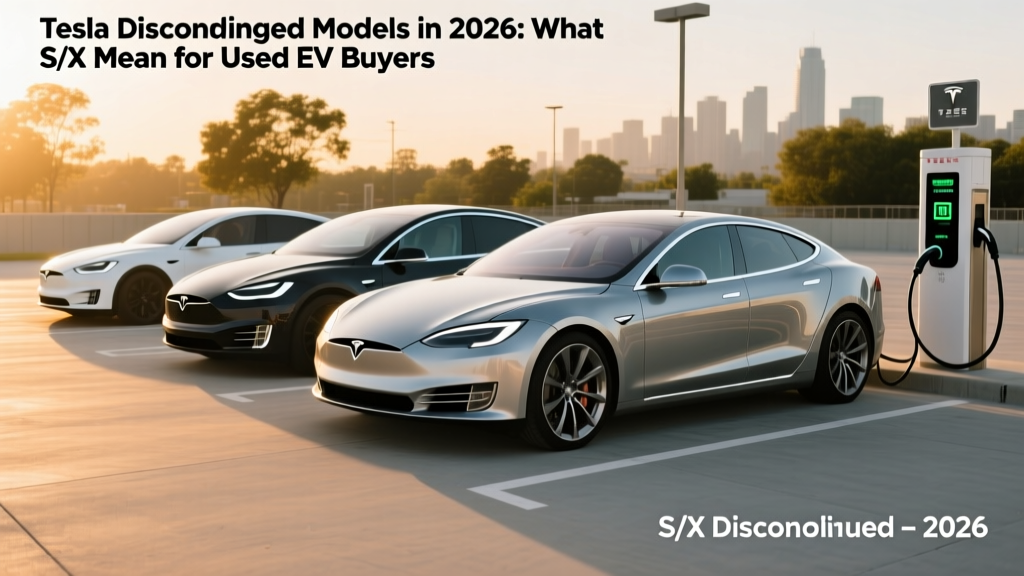
The phrase "Tesla discontinued" has officially entered the EV lexicon. After more than a decade of production, Tesla ended manufacturing of the Model S sedan and Model X SUV in early 2026, consolidating its lineup around the higher-volume Model 3, Model Y, Cybertruck, and next-generation platforms. For prospective buyers, this raises urgent questions: Are these cars still worth purchasing on the used market? How do their specs hold up against 2026's competition? And what does discontinuation mean for parts, service, and software support?
This guide breaks down the final model-year (2025) versions of the Model S and Model X with exact specs, real-world range expectations, charging performance, ownership costs, and a clear verdict on who should — and who shouldn't — consider these now-discontinued EVs.
Final Production Specs: 2025 Tesla Model S and Model X
Before Tesla halted the Fremont production lines for these models, the 2025 Model S and X received minor software and efficiency tweaks but retained the powertrain architecture introduced with the 2021 "Plaid" refresh. Here are the definitive numbers for the last model year available.
| Specification | Model S Long Range | Model S Plaid | Model X Long Range | Model X Plaid |
|---|---|---|---|---|
| EPA Range | 402 mi | 359 mi | 335 mi | 311 mi |
| Battery (usable) | ~95 kWh (NMC) | ~95 kWh (NMC) | ~95 kWh (NMC) | ~95 kWh (NMC) |
| Drivetrain | Dual-Motor AWD | Tri-Motor AWD | Dual-Motor AWD | Tri-Motor AWD |
| Horsepower | 670 hp | 1,020 hp | 670 hp | 1,020 hp |
| 0-60 mph | 3.1 sec | 1.99 sec | 3.8 sec | 2.5 sec |
| Peak DC Charge Rate | 250 kW | 250 kW | 250 kW | 250 kW |
| 10-80% DCFC Time | ~27 min | ~27 min | ~31 min | ~31 min |
| Level 2 Home Charge | 11.5 kW (~34 mi/hr) | 11.5 kW (~34 mi/hr) | 11.5 kW (~30 mi/hr) | 11.5 kW (~30 mi/hr) |
| MPGe (combined) | 120 MPGe | 116 MPGe | 102 MPGe | 98 MPGe |
| Cargo (rear seats up) | 28 cu ft | 28 cu ft | 88 cu ft | 88 cu ft |
| Base MSRP (2025) | $74,990 | $89,990 | $79,990 | $94,990 |
Source: fueleconomy.gov / Tesla Order Archive (2025 model year)
Real-World Range: What the EPA Sticker Doesn't Tell You
Model S Long Range: EPA 402 mi → Expect ~320-350 mi sustained highway driving at 70-75 mph; ~260-290 mi in sub-freezing winter conditions.
Model X Long Range: EPA 335 mi → Expect ~270-300 mi highway; ~220-250 mi cold weather with cabin heating.
The larger frontal area and heavier curb weight of the Model X hit efficiency harder at highway speeds, and the falcon-wing doors add minor aero drag.
Tesla's EPA range estimates for the Model S and X were among the best in the industry, but as with every EV, real-world results depend on speed, temperature, and terrain. The NMC (nickel-manganese-cobalt) chemistry in these packs offers excellent energy density — that's how Tesla crammed ~95 usable kWh into a relatively compact pack — but NMC is more temperature-sensitive than LFP (lithium iron phosphate). In our experience, cold-soaking a Model S below 20°F without preconditioning can temporarily reduce available capacity by 15-20% until the battery warms.
On a 300-mile highway trip at 75 mph in 85°F weather, a Model S Long Range will typically arrive with roughly 15-20% state of charge remaining. The same trip in 25°F weather with the heat pump running may require a brief DC fast-charge stop. Always precondition the battery via the Tesla app or in-car navigation before fast charging — it's the single biggest factor in achieving peak charge speed.
Charging Performance: 250 kW Peak, but Mind the Curve
The 2025 Model S and X peak at 250 kW on V3 Superchargers — a figure Tesla has maintained since the 2021 refresh. While competitors like the Hyundai Ioniq 5 (peak 350 kW on 800V architecture) and Lucid Air (peak 300 kW) now exceed this, the Tesla Supercharger network's reliability remains a meaningful advantage.
| Charge Level | Power | Speed (mi/hr added) | Notes |
|---|---|---|---|
| Level 1 (120V) | ~1.4 kW | ~3-4 mi/hr | Emergency/trickle only |
| Level 2 (240V, 48A) | 11.5 kW | ~34 mi/hr | Full charge in ~9 hrs |
| DC Fast (V3 Supercharger) | Peak 250 kW | ~750 mi/hr (peak) | 10-80% in ~27 min |
| DC Fast (V4 Supercharger) | Up to 250 kW* | Similar to V3 | *Model S limited to 250 kW; no CCS adapter needed at Tesla stalls |
The charge curve tapers significantly above 80% state of charge. The final 80-100% can take an additional 20+ minutes — a reality every EV road-tripper should plan around. For daily driving, charging to 80% at home on a Level 2 Wall Connector is optimal for long-term battery health with NMC chemistry. Tesla recommends daily charge limits of 80-90% for NMC packs, reserving 100% for trips.
Driving Dynamics, Tech, and the Autopilot Reality Check
The Model S Plaid's 1.99-second 0-60 time remains among the quickest production cars ever built. But beyond the headline numbers, these cars deliver genuinely excellent ride quality (the 2021+ adaptive air suspension is a major upgrade over the pre-refresh versions), a yoke-or-wheel steering option, and Tesla's vertically integrated infotainment system with a 17-inch center touchscreen and rear-seat display.
Tesla's Autopilot (included) and Full Self-Driving (Supervised) — even in their final 2025 software versions — are SAE Level 2 driver-assistance systems. This means the driver must remain fully attentive, hands on or near the wheel, at all times. These are not self-driving systems. Level 4 autonomous driving (no driver required) is currently available only through robotaxi services like Waymo in limited metro areas. Do not confuse Tesla's marketing terminology with the SAE automation scale.
Standard Autopilot handles highway lane-keeping and adaptive cruise well. FSD (Supervised) adds city-street navigation, stop-light recognition, and autosteer on surface streets — impressive technology, but one that demands constant vigilance. On the used market, verify whether FSD was purchased outright (transfers with the vehicle) or is a subscription (does not transfer).
Used Market Pricing and Federal Tax Credit Eligibility
With Tesla discontinuing the Model S and X, these vehicles are now exclusively available on the used and certified pre-owned market. Pricing varies widely by mileage, condition, and trim:
| Model/Trim | Original MSRP | Est. Used Price (2026) | Used EV Tax Credit (§25E) | Effective Price |
|---|---|---|---|---|
| Model S Long Range | $74,990 | $52,000-$62,000 | Up to $4,000 | ~$48,000-$58,000 |
| Model S Plaid | $89,990 | $62,000-$75,000 | Up to $4,000 | ~$58,000-$71,000 |
| Model X Long Range | $79,990 | $55,000-$67,000 | Up to $4,000 | ~$51,000-$63,000 |
| Model X Plaid | $94,990 | $65,000-$80,000 | Up to $4,000 | ~$61,000-$76,000 |
Important tax credit note: The federal §30D new EV credit ($7,500) does not apply to discontinued, already-sold vehicles. However, the §25E used EV credit (30% of sale price, up to $4,000) may apply if: the sale price is $25,000 or more; buyer income is ≤$75,000 single / $150,000 joint; the vehicle is at least two model years old; and you purchase from a licensed dealer. Always verify current rules at IRS.gov and consult a tax professional.
Battery Warranty, Degradation, and Long-Term Ownership
Tesla's battery and drive unit warranty for the 2025 Model S and X covers 8 years or 150,000 miles (whichever comes first), with a guaranteed minimum of 70% battery capacity retention over that period. This warranty transfers to subsequent owners, which is a significant advantage on the used market.
Based on fleet data from Teslas with 100,000+ miles, NMC packs in the Model S/X typically show 8-12% degradation over the first 100,000 miles, with the curve flattening thereafter. A 2023 Model S with 40,000 miles might realistically retain 92-95% of its original capacity. The key risk with discontinued models is parts availability for collision repair and body panels — Tesla has committed to supporting service parts for at least 10 years post-discontinuation, but third-party body shops may face longer lead times.
Pros, Cons, and the Competition
- Class-leading EPA range (402 mi on S LR)
- Access to Tesla Supercharger network (most reliable DCFC in the US)
- Tri-Motor Plaid performance is unmatched at any price
- Over-the-air updates continue post-discontinuation
- 8-year/150,000-mi battery warranty transfers to used buyers
- Model X offers falcon-wing doors + up to 7 seats for families
- 250 kW peak charge rate trails 800V competitors (Ioniq 5, Taycan)
- No new-vehicle §30D tax credit — used credit is only $4,000 max
- Long-term parts uncertainty for body/trim components
- Resale depreciation accelerated by discontinuation news
- Yoke steering is polarizing; no traditional stalks for turn signals
- Model X falcon-wing doors can be problematic in tight garages
Key competitors to consider: The Lucid Air (EPA up to 516 mi, 300 kW charging), BMW i5/i7 (more luxurious interior, 800V-ready), and Hyundai Ioniq 6 (361 mi EPA, 350 kW charging, lower price). For SUVs, the Rivian R1S, Kia EV9, and BMW iX offer more modern platforms with current production support.
Who Should Buy a Discontinued Model S or X?
Buy a used Model S if: You want maximum range under $60K, you value Supercharger access, and you prioritize straight-line performance over interior luxury. The Long Range is the value sweet spot.
Buy a used Model X if: You need 6-7 seats in an EV, you want falcon-wing convenience for car seats, and you can accept the range penalty of the larger vehicle.
Look elsewhere if: You want the latest charging architecture (800V), maximum interior refinement, or the peace of mind that comes with a current-production vehicle and full new-vehicle warranty.
Frequently Asked Questions
Why did Tesla discontinue the Model S and Model X?
Tesla consolidated its Fremont factory capacity to focus on higher-volume vehicles (Model 3, Model Y) and next-generation platforms. The Model S and X represented a small fraction of Tesla's total sales — under 5% of deliveries in their final years — and the aging platform architecture didn't justify continued investment versus developing new models on the next-gen vehicle platform.
Will Tesla still service discontinued Model S and X vehicles?
Yes. Tesla has committed to providing service support and parts for at least 10 years after production ends. Software updates (including security patches and Supercharger network compatibility) will continue. However, body panel and trim parts availability may lengthen over time, and independent repair shops may face challenges sourcing Tesla-specific components.
What is the real-world range of the Model S Long Range?
The EPA rates the 2025 Model S Long Range at 402 miles. In real-world highway driving at 70-75 mph in moderate temperatures, expect approximately 320-350 miles. In cold weather (below 32°F), plan for 260-290 miles. Preconditioning the battery and using seat heaters instead of cabin heat can help preserve range in winter.
Does a used Model S or X qualify for any federal tax credit?
Not the $7,500 new-vehicle §30D credit. However, the §25E used clean vehicle credit offers 30% of the sale price, up to $4,000, if the vehicle is purchased from a dealer for $25,000+ and the buyer meets income caps ($75,000 single / $150,000 joint AGI). Confirm details at IRS.gov.
How does the Model S charging speed compare to newer EVs?
The Model S peaks at 250 kW on DC fast chargers. This trails the Hyundai Ioniq 5 and Kia EV6 (350 kW on 800V architecture), the Lucid Air (300 kW), and the Porsche Taycan (320 kW). On a 250 kW Supercharger, the Model S charges from 10-80% in roughly 27 minutes — respectable, but newer 800V vehicles can do the same in 18 minutes or less on compatible chargers.
Is FSD (Full Self-Driving) worth paying extra for on a used Tesla?
If FSD was purchased outright by the original owner (typically $8,000-$15,000 depending on when it was bought), it transfers with the car at no extra cost — that's a value-add. However, FSD (Supervised) remains an SAE Level 2 system requiring full driver attention. It's a sophisticated driver assist, not autonomous driving. If FSD is subscription-only on the vehicle, it will not transfer, and you'd need to subscribe separately.