Tesla's first-ever Diner and Supercharger hub — officially opened in July 2025 at 7001 West Santa Monica Boulevard in Hollywood, California — is equal parts retro drive-in, fast-charging station, and autonomous-vehicle showcase. By early 2026, it has become a case study in what Tesla envisions for the future of EV charging infrastructure. But beyond the Tesla diner robots making headlines on social media, what does this facility actually offer EV owners, and is it worth building into your charging routine?
This guide breaks down the real-world charging performance, the Optimus robot deployment, the Optimus Diner menu and experience, and how the Hollywood Supercharger hub compares to conventional DC fast-charging networks. We'll also cover what this means for Tesla's broader robotaxi ambitions and whether non-Tesla EVs can use the site.
What Is the Tesla Diner and Supercharger Hub?
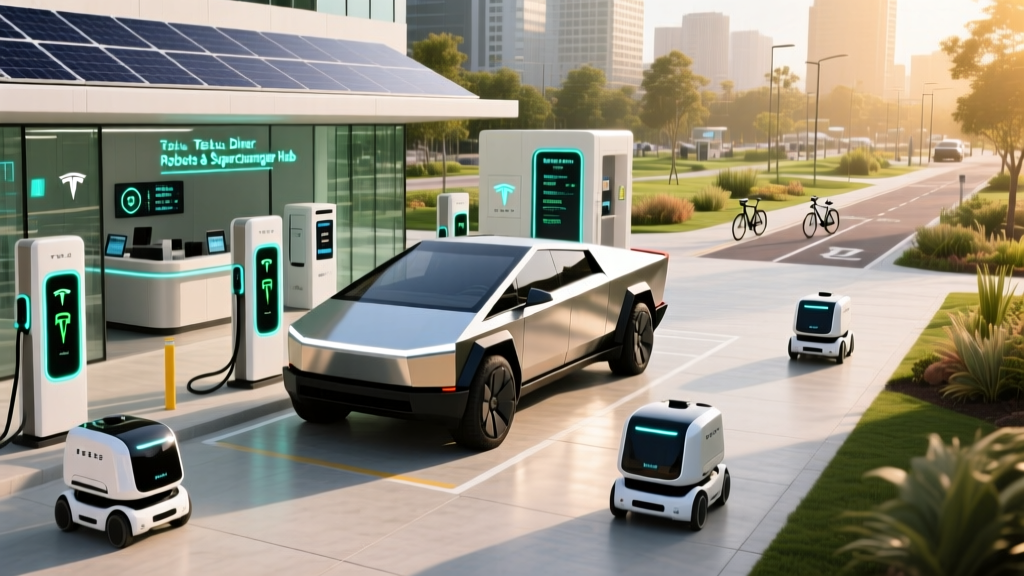
The Tesla Diner is a two-story, retro-themed restaurant and charging destination co-located with a massive V4 Supercharger array. The facility was announced by Elon Musk in 2022 and opened to the public in mid-2025. It features:
- Approximately 80 V4 Supercharger stalls (some reports cite plans for up to 100+), making it one of the largest urban Supercharger stations in North America
- A full-service diner on the upper level with indoor seating, a rooftop bar, and a classic drive-in movie screen visible from charging stalls
- Optimus humanoid robots deployed in limited roles — primarily bussing tables, carrying trays, and basic food-service tasks
- Two massive outdoor video screens showing curated film clips and content, viewable from parked vehicles
- NACS (North American Charging Standard) connectors at all V4 stalls, with CCS1 adapters available on select posts for non-Tesla EVs
The concept positions the site not just as a place to charge, but as a destination — a deliberate contrast to the strip-mall parking lots where most public DC fast chargers live today.
Charging Specs: V4 Supercharger Performance at the Diner Hub
The headline reason any EV owner would visit this facility is the charging hardware. Tesla's V4 Supercharger cabinets deliver significantly more power than the older V3 architecture, and the Hollywood hub is one of the first large-scale deployments.
| Charger Type | Peak Power | Connector | Typical 10-80% Time* | Notes |
|---|---|---|---|---|
| V4 Supercharger (Tesla NACS) | Up to 350 kW | NACS (native) | ~12-15 min (Model 3/Y Long Range) | Requires vehicle capable of 250+ kW peak |
| V4 Supercharger (CCS1 adapter) | Up to 250 kW | CCS1 via adapter post | ~18-22 min (typical CCS1 EV) | Non-Tesla EVs; availability varies by stall |
| V3 Supercharger (legacy on-site) | 250 kW peak | NACS | ~18-25 min | Older stalls retained for overflow |
*10-80% times depend heavily on battery chemistry (LFP vs. NMC), battery temperature, state of charge on arrival, and ambient conditions. Peak kW is sustained only in a narrow SoC window — expect the charge curve to taper significantly above 60-70% SoC.
For context, a 2026 Tesla Model 3 Long Range AWD with its ~82 kWh (usable) NMC battery can accept roughly 250 kW at peak, translating to approximately 200 miles of range added in 15 minutes under ideal conditions. The newer Cybertruck, with its ~123 kWh usable battery and 800V architecture, can sustain higher charge rates longer, making the V4 hardware more impactful for that platform.
The Tesla Diner Robots: Optimus in Action
The Tesla diner robots that generated the most buzz are production-test units of Tesla's Optimus (Gen 3) humanoid robot. At the Hollywood facility, they are deployed in limited, supervised roles:
- Tray carrying and table bussing — Optimus units transport food trays from the kitchen pass-through to designated table zones and collect used dishes
- Basic greeting and wayfinding — stationed at the entrance to direct guests to seating or charging stall information
- Supervised operation only — each unit has a human handler nearby, and the robots operate in defined pathways with geofenced boundaries
It is critical to understand that these Optimus units are not Level 4 autonomous. In robotics terms, they operate at a level roughly analogous to SAE Level 2 in vehicles — they perform defined tasks in structured environments with human oversight. They cannot handle unstructured tasks, complex customer interactions, or operate outside their programmed zones. Tesla has described the Diner deployment as a "real-world training ground" for collecting manipulation and navigation data.
Tesla Diner Menu, Experience, and Pricing
The Diner menu leans into classic American drive-in fare with a modern twist. As of early 2026, the menu includes burgers, shakes, fries, salads, and all-day breakfast items. Pricing is positioned at the premium fast-casual tier — expect $14-$18 for a burger-and-fries combo, comparable to a Shake Shack or In-N-Out with upgrades.
The rooftop bar serves cocktails, beer, and wine with views of the Hollywood Hills and the drive-in screens. Reservations are available via the Tesla app, and walk-in seating is first-come, first-served. During peak weekend evenings, wait times of 45-90 minutes have been reported.
For EV owners charging at the hub, the practical advantage is clear: instead of sitting in your car scrolling your phone for 20 minutes, you can eat a full meal while your vehicle charges. This is exactly the "charging as an experience" model that industry analysts have long predicted would differentiate premium charging networks.
Who Can Charge Here? Non-Tesla EV Access
As of 2026, Tesla has opened select Supercharger stalls to non-Tesla EVs through the Tesla NACS adapter program and built-in CCS1 connectors on some V4 posts. At the Hollywood Diner hub:
- Non-Tesla EVs with NACS charge ports (Ford F-150 Lightning, Rivian R1T/R1S, GM Ultium vehicles with native NACS) can use any V4 stall
- CCS1-equipped EVs (Hyundai Ioniq 5/6, Kia EV6/EV9, VW ID.4, BMW iX) can use stalls with CCS1 adapter cables — approximately 20-30% of stalls at this location
- CHAdeMO vehicles (Nissan Leaf, older Mitsubishi) are not supported at this facility
Non-Tesla EV drivers pay a per-kWh rate that is typically 10-15% higher than the Tesla-member rate. As of early 2026, pricing at this location hovers around $0.48-$0.58/kWh depending on time of day, with off-peak rates dropping to roughly $0.38/kWh after 11 PM.
How the Tesla Diner Hub Compares to Standard Superchargers and Competitor Networks
| Feature | Tesla Diner Hub (Hollywood) | Typical V3 Supercharger | Electrify America Flagship | Ionic / ChargePoint Urban |
|---|---|---|---|---|
| Peak DC Power | Up to 350 kW (V4) | 250 kW | 350 kW (select stalls) | 125-200 kW |
| Stall Count | ~80 | 8-20 typical | 8-16 typical | 4-12 typical |
| Amenities | Full diner, bar, movie screens | Rarely any | Occasional lounge | Rarely any |
| Non-Tesla Access | Yes (NACS + CCS1 select) | Limited (expanding) | Yes (CCS1 native) | Yes (CCS1/J1772) |
| Wait Times (peak) | Moderate (high stall count) | Can be long at small sites | Variable; reliability issues | Short (fewer stalls) |
| Cost per kWh | $0.38-$0.58 | $0.28-$0.48 typical | $0.36-$0.56 | $0.30-$0.50 |
The Hollywood Diner hub's main advantage is stall density and amenities. With 80 chargers, it is far less likely to be completely occupied than a typical 8-stall Supercharger, even in a dense urban market. The trade-off is premium pricing and the destination-oriented location — this is not a highway rest stop; it is designed for LA-area residents and visitors who want to combine charging with dining.
Tesla Robotaxi (Cybercab) Connection
The Hollywood Diner hub is also a proving ground for Tesla's planned Cybercab robotaxi service. Tesla has indicated that large Supercharger hubs with integrated amenities will serve as natural staging and charging areas for autonomous fleets. The concept: Cybercabs charge at V4 stalls during off-peak hours, then deploy for ride-hail service — with the Diner serving as a maintenance and cleaning base.
As of early 2026, no Cybercab robotaxi service is commercially operational at this or any other location. Tesla's Cybercab remains in limited pilot testing in select markets under regulatory review. Any claims that the Diner is a "robotaxi station" are premature — it is infrastructure designed to support a future robotaxi fleet, not one currently in service.
Practical Tips for EV Owners Visiting the Tesla Diner Hub
If you're planning a visit — whether to charge, eat, or see the robots firsthand — here's what to expect and how to optimize your trip:
- Check stall availability in the Tesla app before driving over. The app shows real-time occupancy for each stall type (V4 NACS, V4 CCS1, V3 legacy)
- Precondition your battery by navigating to the Supercharger in your Tesla's navigation system. This warms the battery to optimal charging temperature and can shave 3-5 minutes off your 10-80% time
- Arrive below 15% SoC for the fastest peak charge rates. The charge curve is steepest between 10-40% SoC and tapers sharply above 70%
- Make a diner reservation for weekend visits. Walk-in waits regularly exceed 60 minutes on Friday and Saturday evenings
- Non-Tesla EV drivers: confirm CCS1 adapter stall availability in the Tesla app before arriving. Not all V4 posts at this location have CCS1 cables
- Budget for premium pricing. This is a destination charging experience, and the per-kWh rate reflects that. For routine daily charging, a home Level 2 setup remains far more economical
Tesla Diner Hub: Pros and Cons for EV Owners
Pros
- Massive stall count (~80) reduces wait times vs. typical 8-12 stall sites
- V4 Supercharger hardware delivers class-leading peak charge rates
- Full dining, bar, and entertainment while charging — a genuine destination experience
- Optimus robot deployment is a unique tech spectacle worth seeing once
- Open to non-Tesla EVs (NACS and select CCS1)
- Drive-in movie screens add novelty for evening charging sessions
Cons
- Premium per-kWh pricing ($0.48-$0.58 peak) vs. standard Superchargers
- Urban LA location means traffic congestion on approach, especially weekends
- Diner wait times can negate the time saved by fast charging
- Optimus robots are limited in capability — more novelty than practical service
- No CHAdeMO support for Leaf and older Japanese EVs
- Not positioned for highway road-trip charging — this is a destination, not a corridor stop
Frequently Asked Questions
Can I eat at the Tesla Diner without charging my EV?
Yes. The Diner is open to all guests regardless of whether they are charging a vehicle. You do not need a Tesla or an EV to dine there. However, parking in the Supercharger stalls without actively charging may incur idle fees (up to $1.00/minute at peak occupancy).
Are the Tesla diner robots actually serving food?
Partially. Optimus robots carry trays from the kitchen area to designated table zones and bus used dishes. However, all ordering, food preparation, payment processing, and customer service is handled by human staff. The robots are supervised and operate in defined pathways only.
What is the fastest I can charge at the Tesla Diner Supercharger hub?
With a V4-compatible Tesla (Model 3/Y Long Range or Cybertruck), expect a 10-80% charge in approximately 12-15 minutes under ideal conditions (battery preconditioned, arriving at low SoC, moderate ambient temperature). Older Model S/X vehicles may peak lower and take 18-22 minutes.
Is the Tesla Diner hub open 24 hours?
The Supercharger stalls operate 24/7, as is standard for all Superchargers. The Diner restaurant and rooftop bar have posted hours (typically 7 AM to midnight, with the bar open later on weekends). Check the Tesla app or website for current hours before visiting.
Does Tesla plan more Diner and Supercharger hubs?
Tesla has indicated plans for additional Diner-Supercharger concepts, though no confirmed locations have been announced as of early 2026. The Hollywood facility is being treated as a proof of concept. If successful, expect similar hubs in high-traffic urban and suburban markets — likely near major freeway interchanges in cities like Austin, Miami, and the Bay Area.
Can I use my Tesla Supercharger credits or free charging at the Diner hub?
Yes. Any Supercharger credits, referral credits, or complimentary charging miles on your Tesla account are redeemable at the Diner hub's V4 and V3 stalls, just like any other Supercharger location.
Sources: Tesla Supercharger Network, EPA Fuel Economy for vehicle efficiency data, NHTSA for vehicle safety ratings.