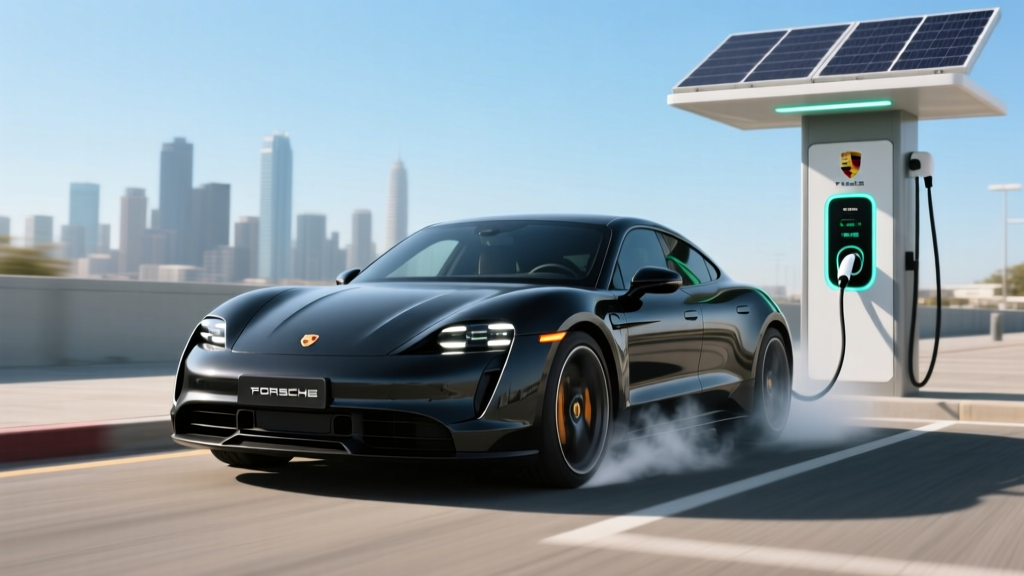
The Porsche Taycan has always been the EV that proves performance and electricity aren't mutually exclusive. For the 2026 model year, Porsche has refined its electric sports sedan with updated battery chemistry, faster charging, and the kind of acceleration figures that embarrass supercars costing three times as much. But beyond the headline-grabbing Taycan 0-60 numbers, how does this car actually live as a daily-driver EV? We break down every trim's performance, real-world range, charging reality, and ownership economics so you can decide if the Taycan earns a spot in your garage.
2026 Taycan Lineup: Trims, 0-60 Times, and Horsepower
Porsche offers the 2026 Taycan in five core trims for the US market, spanning a rear-wheel-drive base model all the way up to the Turbo GT with Weissach Package. The 0-60 mph spread is enormous — from a quick 4.4 seconds in the base RWD to a face-melting 2.1 seconds in the Turbo GT. Here's the full breakdown:
| Trim | Drivetrain | Peak HP (Launch Control) | 0-60 mph | Top Speed |
|---|---|---|---|---|
| Taycan (Base RWD) | RWD / Single Motor | 402 hp | 4.4 sec | 143 mph |
| Taycan 4S | AWD / Dual Motor | 590 hp | 3.5 sec | 155 mph |
| Taycan GTS | AWD / Dual Motor | 690 hp | 3.0 sec | 162 mph |
| Taycan Turbo | AWD / Dual Motor | 870 hp | 2.5 sec | 162 mph |
| Taycan Turbo GT (Weissach) | AWD / Dual Motor | 1,019 hp | 2.1 sec | 190 mph |
All dual-motor trims use Porsche's two-speed transmission on the rear axle — a rarity among EVs — which gives the Taycan its ferocious launch off the line while still maintaining efficiency at highway speeds. The single-motor RWD uses a single-speed reduction gear. Launch Control is required to achieve the published 0-60 times; in normal driving mode, expect roughly 0.3–0.5 seconds added.
Battery, Chemistry, and the 800-Volt Architecture
The 2026 Taycan continues to ride on Porsche's 800-volt J1 platform, which remains one of the highest-voltage architectures in production. This high voltage is the key to both the extreme power delivery and the rapid charging speeds.
Two battery packs are available:
- Performance Battery (base RWD only): 79.2 kWh gross / ~71.0 kWh usable. Uses NMC (nickel manganese cobalt) chemistry.
- Performance Battery Plus (4S, GTS, Turbo, Turbo GT): 105.0 kWh gross / ~97.0 kWh usable. NMC chemistry with updated cell-level thermal management for the 2026 refresh.
Porsche does not offer an LFP (lithium iron phosphate) option in the Taycan. The NMC chemistry prioritizes energy density and peak power delivery — appropriate for a performance sedan, though it means owners should avoid routinely charging to 100% for daily use to maximize long-term battery health. Porsche recommends an 80% daily charge limit, reserving 100% for road trips.
Real-World Range vs. EPA Estimates
EPA Range (2026 Taycan trims):
- Base RWD (79.2 kWh): 252 miles EPA
- 4S (105 kWh): 292 miles EPA
- GTS (105 kWh): 285 miles EPA
- Turbo (105 kWh): 283 miles EPA
- Turbo GT (105 kWh): 269 miles EPA
Real-world expectation: On mixed highway driving at 70–75 mph, expect roughly 85–90% of the EPA sticker — so around 215–260 miles depending on trim. In cold weather (below 32°F), range drops an additional 15–25% due to cabin heating demands and reduced battery efficiency. A 4S in a Minnesota winter may deliver as little as 195–210 miles before requiring a charge.
The Taycan's efficiency, measured by the EPA, ranges from 83 MPGe (Turbo GT) to 92 MPGe (base RWD). In kWh/100 miles terms, that's approximately 36–40 kWh/100mi. These figures are competitive with the Tesla Model S and Audi e-tron GT but trail the more efficiency-focused Lucid Air.
One practical note: the Taycan's range-regeneration system is relatively mild compared to Tesla or Hyundai/Kia EVs. Porsche intentionally tuned the regen to feel like a traditional sports sedan decelerating rather than offering aggressive one-pedal driving. You'll use the brake pedal more than in most EVs, but the blending between regenerative and friction braking is seamless — a hallmark of Porsche engineering.
Charging Speed: DC Fast, Level 2, and the 800V Advantage
Charging is where the Taycan's 800-volt architecture truly pays dividends. Here's what to expect at each charging level:
| Charging Level | Power / Rate | Time / Miles Added | Notes |
|---|---|---|---|
| Level 1 (120V household) | ~1.4 kW | ~4 miles per hour | Emergency/trickle only; 24+ hours for full charge |
| Level 2 (240V home, 48A) | 11.5 kW | ~33 miles per hour; full charge in ~9 hrs (105 kWh) | Requires NEMA 14-50 or hardwired wall connector |
| DC Fast (350 kW capable station) | Peak 320 kW | 10–80% in ~18 min (105 kWh pack) | Requires CCS1 or NACS adapter; preconditioning critical |
| DC Fast (150 kW station) | Sustained ~130 kW | 10–80% in ~33 min | More common at Electrify America, EVgo locations |
The 320 kW peak DC charge rate (on the 105 kWh Performance Battery Plus) is among the fastest in production. However, peak is not sustained. The Taycan holds roughly 270–320 kW from 10% to about 55% SoC, then tapers to ~150 kW through 70%, and drops further above 80%. This charge curve is why Porsche quotes 10–80% times rather than 0–100% — charging above 80% slows dramatically, adding 25–30 minutes for the final 20%.
Preconditioning matters. The Taycan's navigation system will automatically precondition the battery when you route to a DC fast charger. If you arrive at a charger without preconditioning (especially in cold weather), your peak charge rate may be limited to 100–150 kW until the battery warms up. Always navigate to your charger rather than just driving there.
For the 2026 model year, all Taycans sold in the US come with a NACS (Tesla-style) charge port, following Porsche's adoption of the North American Charging Standard. This grants access to Tesla Supercharger stalls (with V3 and V4 hardware) in addition to CCS networks like Electrify America and EVgo via the included adapter.
Pricing, Trims, and Federal Tax Credit Eligibility
The 2026 Taycan is firmly a luxury performance vehicle, and pricing reflects that. Here's the MSRP breakdown by trim, before options and destination:
| Trim | Base MSRP | Typical As-Tested | §30D Federal Credit | Effective Price |
|---|---|---|---|---|
| Taycan (Base RWD) | $99,400 | $108,000–$115,000 | Not eligible (sedan MSRP cap: $55,000) | $99,400+ |
| Taycan 4S | $118,500 | $130,000–$145,000 | Not eligible | $118,500+ |
| Taycan GTS | $141,800 | $155,000–$170,000 | Not eligible | $141,800+ |
| Taycan Turbo | $173,200 | $190,000–$210,000 | Not eligible | $173,200+ |
| Taycan Turbo GT | $233,000 | $240,000+ | Not eligible | $233,000+ |
Federal tax credit reality: The Taycan does not qualify for the IRS §30D new clean vehicle credit. Under current IRS rules, sedans must have an MSRP at or below $55,000 to be eligible, and SUVs/trucks must be at or below $80,000. The Taycan is classified as a sedan, and even the base model starts nearly double the cap. Additionally, the §30D credit requires battery critical-mineral and component sourcing thresholds that European-built vehicles like the Taycan (assembled in Leipzig, Germany) generally do not meet. Buyers should not factor any federal credit into their purchase decision.
State and local incentives may apply depending on your jurisdiction — some states offer rebates or reduced registration fees for EVs regardless of price. Check your state's energy or DMV website for specifics, and consult a tax professional for personalized guidance.
Interior, Cargo, and Daily Livability
The Taycan is a driver's car first, but Porsche hasn't ignored practicality entirely. Interior materials are exceptional — leather, Alcantara, and optional Race-Tex (a recycled microfiber) are available across trims. The dual-screen dashboard (12.6-inch curved instrument cluster + 10.9-inch center touchscreen, with an optional 10.9-inch passenger display) runs Porsche Communication Management (PCM) with wireless Apple CarPlay and Android Auto.
Cargo and passenger dimensions:
- Rear trunk: 14.3 cu ft (sedan); 15.7 cu ft (Cross Turismo / Sport Turismo wagon variants)
- Front trunk (frunk): 2.8 cu ft — enough for a charging cable bag and a small duffel
- Front headroom: 41.1 inches
- Rear headroom: 38.0 inches (sedan); 39.3 inches (Cross Turismo)
- Rear legroom: 32.7 inches — tight for adults over 6 feet on longer trips
The rear seat is the Taycan's most obvious compromise. Two adults fit, but it's snug. The Cross Turismo wagon body style (available on 4S, GTS, and Turbo trims) adds meaningful headroom and cargo space, making it the more practical choice for anyone regularly carrying rear passengers. If family hauling is a priority, the Taycan is not the right EV — look at the Rivian R1S, Tesla Model X, or Kia EV9 instead.
Driver Assistance and Standout Tech
The 2026 Taycan comes standard with Porsche InnoDrive, which includes adaptive cruise control, lane-keeping assist, and predictive speed optimization based on navigation data. This is a SAE Level 2 driver-assistance system — the driver must remain fully engaged with hands on the wheel and eyes on the road at all times. It is not self-driving.
Available tech highlights:
- Rear-axle steering: Turns the rear wheels up to 2.8 degrees, shrinking the turning circle by nearly 3 feet and sharpening high-speed lane changes.
- Porsche Active Ride (Turbo/Turbo GT): Active suspension that counteracts body roll, pitch, and dive in real time — the car stays eerily flat through corners and over bumps.
- Porsche Electric Sport Sound: A synthetic drivetrain sound piped through the cabin speakers. Purists may scoff, but it adds engagement without being obnoxious.
- Night Vision Assist: Thermal camera overlay in the instrument cluster that highlights pedestrians and animals.
- Surround View with 3D rendering: One of the best 360-degree camera implementations in any luxury car.
Notable drawbacks: the Taycan does not offer a head-up display (surprising at this price point), the rear visibility is limited by the sloping roofline, and the infotainment system, while functional, is not as intuitive or responsive as Tesla's or BMW's iDrive. Wireless phone charging is standard but the pad is small and slow.
Warranty and Long-Term Ownership
Porsche provides the following warranty coverage for the 2026 Taycan:
- New vehicle limited warranty: 4 years / 50,000 miles
- Battery warranty: 8 years / 100,000 miles, guaranteeing a minimum of 70% state of health (capacity retention) over that period
- Powertrain warranty: 8 years / 100,000 miles (electric motors, power electronics, two-speed transmission)
- Corrosion warranty: 12 years, unlimited miles
The 70% capacity retention threshold is industry-standard, matching BMW and trailing slightly behind Hyundai/Kia's more generous terms. Real-world data from early Taycan owners (2020–2024 models) suggests degradation is modest — most owners report 94–97% state of health after 30,000–50,000 miles, well above the warranty floor. Porsche's thermal management system is clearly doing its job.
Maintenance costs are lower than a comparable Porsche 911 (no oil changes, no spark plugs, reduced brake wear thanks to regen), but insurance premiums are steep. Expect $3,000–$5,000 annually depending on your state, age, and driving record — get quotes before purchasing.
Taycan vs. Key Competitors: Is It Worth the Premium?
Pros
- Best-in-class driving dynamics — steering feel and chassis balance rival the 911
- Class-leading 320 kW DC fast charging with 800V architecture
- Repeatable performance — no thermal derating after consecutive launches
- Premium interior with genuine craftsmanship
- NACS port for 2026 grants Supercharger access
Cons
- No federal tax credit eligibility (MSRP + sourcing)
- Rear seat is cramped; limited cargo space in sedan
- Real-world range trails EPA estimates on highway drives
- No head-up display available
- High insurance and option costs inflate the price quickly
Choose the Taycan if: You prioritize driving engagement, build quality, and charging speed above all else. The Taycan is the EV for someone who would have bought a Panamera or 911 but wants to go electric — it sacrifices nothing in the dynamics department.
Choose the Tesla Model S Plaid if: You want similar or faster 0-60 times (1.99 sec) at a lower price, superior range (396 mi EPA), and access to the full Tesla software/charging ecosystem — but accept a less refined interior and less communicative steering.
Choose the Audi e-tron GT / RS e-tron GT if: You want the same J1 800V platform in a slightly more comfortable, grand-touring package at a marginally lower price, but accept slower peak charging (270 kW) and a less engaging drive.
Choose the Lucid Air if: Range and efficiency are your top priorities (up to 516 mi EPA on the Grand Touring) and you value rear-seat space, but can accept a smaller service network and newer brand risk.
Frequently Asked Questions
What is the fastest Porsche Taycan 0-60 time?
The 2026 Taycan Turbo GT with Weissach Package achieves a 0-60 mph time of 2.1 seconds using Launch Control. This makes it the quickest-accelerating Porsche ever produced, faster than the 911 Turbo S. The standard Turbo GT (without Weissach) matches this time. Both require the Performance Battery Plus (105 kWh) and pre-conditioned battery for optimal results.
Does the Porsche Taycan qualify for the federal EV tax credit?
No. The 2026 Taycan does not qualify for the IRS §30D new clean vehicle tax credit. The sedan MSRP cap is $55,000 (the Taycan starts at $99,400), and the battery sourcing requirements for critical minerals and components are not met by the Leipzig-built Taycan. No trim level is eligible. State incentives may apply separately.
What is the real-world highway range of the Taycan 4S?
The 2026 Taycan 4S carries a 292-mile EPA estimate. In real-world highway driving at 70–75 mph, expect approximately 245–260 miles in moderate temperatures. In cold weather (below freezing), that drops to roughly 195–220 miles. Using the heat pump (standard on 2026 models) mitigates some cold-weather loss but doesn't eliminate it.
How fast does the Taycan charge at home?
On a Level 2 home charger delivering 11.5 kW (48 amps, 240V), the Taycan adds roughly 33 miles of range per hour. A full charge from 10% to 100% on the 105 kWh battery takes approximately 9 hours. Most owners charge overnight and wake up to a full battery every morning. A dedicated 60-amp circuit with a hardwired EVSE is recommended — consult a licensed electrician for installation, which typically costs $800–$2,000 depending on panel capacity and run length.
Is the Taycan practical as a daily driver?
For a single driver or couple, yes — the front seats are excellent, the ride quality is surprisingly compliant (especially with air suspension), and home charging makes daily use effortless. For families with children or regular rear passengers, the cramped back seat and limited cargo space make the Cross Turismo wagon variant or a competing SUV (like the Cayenne E-Hybrid) a more practical choice. The Taycan is a sports sedan that happens to be electric, not a family hauler.
What is the Taycan's battery replacement cost?
Out of warranty, a full Taycan battery replacement currently costs between $25,000 and $35,000 depending on pack size and labor. However, module-level repairs (replacing individual cell groups rather than the entire pack) are available at Porsche dealers and can reduce costs significantly. Given that real-world degradation data shows strong capacity retention, most owners are unlikely to need a replacement within typical ownership periods.