If you're landing on this page, you've likely been clicking through the Tesla Design Studio, configuring a 2026 Model Y, and reached the trade-in estimator. The trade-in tool is Tesla's built-in mechanism for valuing your current vehicle (EV or gas) and applying that value as a credit toward your new order. But before you finalize a configuration and lock in a trade-in quote, you need to know whether the Model Y itself is the right electric SUV for your daily driving, road-trip habits, and budget—especially once federal tax credits and real-world efficiency enter the equation.
This review breaks down the 2026 Tesla Model Y Long Range AWD and Performance trims with the exact numbers the configurator won't show you: real-world highway range, sustained DC fast-charge curves, true cost after the §30D federal tax credit, and how the trade-in process actually works in practice.
How the Tesla Design Studio Trade-In Tool Works
The Tesla Design Studio trade-in feature is accessible once you've selected your Model Y trim, paint, wheels, and interior. Here's the practical workflow:
- Configure your vehicle: Choose Long Range AWD or Performance, select exterior color, wheel size (19" Gemini or 20" Induction), and interior.
- Access trade-in: After configuration, the "Trade-In" option appears before payment/financing. You enter your current vehicle's VIN, mileage, condition, and upload photos.
- Receive an estimate: Tesla generates a preliminary offer within minutes. This is not a binding quote—it's an estimate that gets finalized after a physical inspection at delivery or a Tesla Service Center.
- Apply to purchase: The trade-in value reduces your out-of-pocket cost or down payment. If you owe more than the trade value, Tesla does not cover negative equity—you'll need to roll it into financing or pay the difference.
Real-world caveat: Tesla's trade-in offers are competitive but rarely top-market. For maximum value, cross-check against Carvana, CarMax, and private-party listings on Autotrader before committing. In our experience, Tesla's offers run 5–12% below private-party retail but are convenient because the transaction happens in one step.
2026 Model Y Specs at a Glance
| Spec | Long Range AWD | Performance |
|---|---|---|
| EPA Range | 320 miles | 293 miles |
| Battery (usable) | ~75 kWh (NMC) | ~75 kWh (NMC) |
| Drivetrain | Dual-Motor AWD | Dual-Motor AWD |
| Horsepower | 384 hp | 456 hp |
| 0–60 mph | 4.8 sec | 3.5 sec |
| Max DC Fast Charge | 250 kW (peak) | 250 kW (peak) |
| 10–80% DC Time | ~25 min | ~25 min |
| Level 2 Home Rate | 11.5 kW (~44 mi/hr) | 11.5 kW (~44 mi/hr) |
| MPGe (combined) | 122 MPGe | 111 MPGe |
| Efficiency | 28 kWh/100 mi | 30 kWh/100 mi |
| Cargo (rear seats up) | 30.2 cu ft | 30.2 cu ft |
| Cargo (rear seats folded) | 72.0 cu ft | 72.0 cu ft |
| Rear Legroom | 41.6 in | 41.6 in |
| Base MSRP | $44,990 | $48,990 |
| Battery Warranty | 8 yr / 120,000 mi | 8 yr / 120,000 mi |
Source: fueleconomy.gov and Tesla Model Y Design Studio.
Real-World Range: What the EPA Sticker Doesn't Tell You
EPA Estimate: 320 miles
Real-World Highway (70 mph, 72°F): ~265–280 miles
Real-World Highway (70 mph, 25°F): ~220–240 miles
City/Commuter Mixed (moderate climate): ~290–310 miles
The Model Y Long Range's 320-mile EPA figure is measured on a blended cycle that favors stop-and-go city driving, where regenerative braking recovers energy. On sustained highway runs at 70+ mph, aerodynamic drag dominates, and you'll see a 12–17% reduction from the sticker.
Cold weather compounds this. At 25°F, expect 25–30% total range loss on highway trips due to battery internal resistance and cabin heating demand. Tesla's heat pump (standard on all 2026 Model Y trims) mitigates this compared to resistive heaters, but physics is physics. If your typical trip is a 200-mile round-trip commute in Midwestern winter, you'll want to charge to at least 85–90% before departure and precondition the battery via the Tesla app.
The Performance trim's 293-mile EPA rating reflects its stickier tires, larger 20" Induction wheels, and more aggressive drive calibration. On the highway, expect ~240–255 miles in moderate weather.
Charging Speed: DC Fast Charge, Home Level 2, and the Curve
| Charging Level | Power (kW) | Miles Added per Hour | Notes |
|---|---|---|---|
| Level 1 (120V outlet) | ~1.4 kW | ~3–5 mi/hr | Emergency only; ~60+ hrs for full charge |
| Level 2 (240V, 48A) | 11.5 kW | ~44 mi/hr | Full charge overnight (~7–8 hrs) |
| DC Fast (Tesla Supercharger V3) | 250 kW peak | ~175 mi in 15 min | 10–80% in ~25 min; tapers above 80% |
| DC Fast (CCS via adapter) | ~150–170 kW typical | Varies by station | Requires Tesla CCS adapter (included with 2026 models) |
The 250 kW peak figure requires specific conditions: a V3 Supercharger stall not shared with another vehicle, a battery preconditioned via navigation routing to the charger, and a state of charge below 30%. In practice, the charge curve ramps quickly to ~200 kW, holds near peak through 50–55% SoC, then tapers progressively. From 80–100%, charging slows dramatically—adding the final 20% can take as long as the first 70%. For road trips, plan stops around the 10–80% window.
For home charging, a NACS Wall Connector on a 60A circuit delivers the full 11.5 kW (48A continuous). A full Level 2 installation typically costs $800–$2,000 including equipment, electrician labor, and permits, depending on panel proximity and whether a panel upgrade to 200A is needed. Consult a licensed electrician for a site-specific quote.
Pricing, Trims, and Federal Tax Credit Eligibility
| Trim | Base MSRP | As-Tested (typical config) | Federal Credit Eligible? | Effective Price After Credit |
|---|---|---|---|---|
| Long Range AWD | $44,990 | $47,490 (w/ FSD, paint) | Yes — up to $7,500 | ~$37,490–$39,990 |
| Performance | $48,990 | $51,490 (w/ FSD, red paint) | Yes — up to $7,500 | ~$41,490–$43,990 |
The 2026 Model Y qualifies for the full $7,500 federal EV tax credit under IRS §30D rules, provided you meet all eligibility criteria:
- MSRP cap: The Model Y is classified as an SUV, so the cap is $80,000. All trims clear this comfortably.
- Buyer income cap: Modified AGI must not exceed $150,000 (single), $225,000 (head of household), or $300,000 (joint filers).
- Battery sourcing: Tesla sources critical minerals and battery components to meet current-year thresholds. The 2026 Model Y assembled at Giga Texas qualifies, but always verify on fueleconomy.gov before purchase, as sourcing rules tighten annually.
- Point-of-sale transfer: You can transfer the credit to Tesla at purchase, reducing your out-of-pocket cost immediately rather than waiting for tax filing.
Trade-in impact: If you trade in a vehicle worth $15,000 and receive the full $7,500 credit, your effective out-of-pocket on a Long Range AWD drops to roughly $22,490–$24,990 before registration and delivery fees. That's the real power of stacking the Design Studio trade-in with the federal credit.
Performance, Tech, and Interior Assessment
The Model Y's dual-motor AWD system provides confident traction in rain and light snow. The Long Range's 4.8-second 0–60 time is more than adequate for highway merging and passing, while the Performance trim's 3.5-second sprint puts it in sports-car territory. Both trims feature Tesla's adaptive damping suspension (updated for the refreshed "Juniper" platform), which improves ride quality substantially over the pre-2025 generation.
Autopilot and FSD (Supervised): Standard Autopilot includes lane-centering and adaptive cruise control—solid SAE Level 2 driver assistance. Full Self-Driving (Supervised) adds automatic lane changes, traffic-light recognition, and navigate-on-autopilot. FSD remains Level 2—you must keep hands on the wheel and eyes on the road at all times. At $8,000 (or $99/month), FSD is a significant add. Most buyers are better served by standard Autopilot unless they regularly drive long highway corridors.
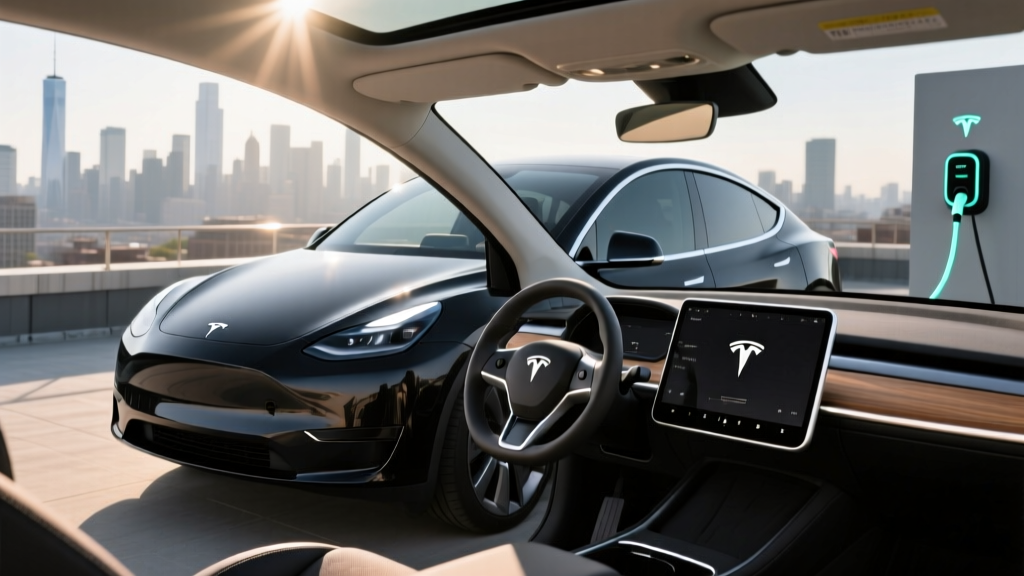
Interior and cargo: The refreshed interior features ventilated front seats, ambient lighting, a rear-seat touchscreen, and improved NVH (noise/vibration/harshness). Cargo space is generous at 30.2 cu ft behind the rear row and 72.0 cu ft with seats folded—enough for camping gear or a week of family luggage. The front trunk (frunk) adds 4.1 cu ft for charging cables or a small bag.
Biggest Pros and Cons
- Supercharger network access (most reliable DC network in North America)
- Class-leading efficiency (28 kWh/100 mi on Long Range)
- Over-the-air updates continuously add features
- Strong resale value relative to EV competitors
- Point-of-sale tax credit reduces upfront cost immediately
- Heat pump standard for cold-climate efficiency
- Turn-signal stalk removed (steering-wheel buttons instead—polarizing)
- No Apple CarPlay or Android Auto
- FSD costs $8,000 extra and remains Level 2 only
- Insurance premiums run 15–25% higher than comparable gas SUVs
- 20" Induction wheels reduce range by ~27 miles vs 19" Gemini
- Trade-in offers often below private-party market value
Who Should Buy the 2026 Model Y?
- You commute 30–60 miles daily and want to charge once or twice per week at home
- You take 2–4 road trips per year and need reliable Supercharger access
- You need a family SUV with 72 cu ft of cargo space and car-seat-friendly rear legroom
- Your household income qualifies for the full §30D credit
- You need 3-row seating (consider the Kia EV9 or Rivian R1S)
- You tow regularly (Model Y is rated for 3,500 lbs; the Ford F-150 Lightning or R1T handle far more)
- You want Apple CarPlay integration (Hyundai Ioniq 5 or BMW iX offer it)
- You lack access to home or workplace charging—public-only charging adds cost and friction
Frequently Asked Questions
What is the real-world range of the 2026 Tesla Model Y?
The Long Range AWD carries a 320-mile EPA rating. Expect ~265–280 miles on highway trips at 70 mph in moderate weather, and ~220–240 miles in cold conditions (25°F). The Performance trim delivers ~240–255 miles highway in moderate weather from its 293-mile EPA rating.
How fast does the Model Y charge at home and on the road?
On a Tesla V3 Supercharger, it peaks at 250 kW and charges from 10–80% in approximately 25 minutes. At home on a Level 2 Wall Connector (11.5 kW), it adds roughly 44 miles of range per hour, fully recharging overnight in 7–8 hours.
How much does the Model Y cost after the federal tax credit and a trade-in?
The Long Range AWD starts at $44,990. With the full $7,500 §30D credit applied at point of sale, the effective price drops to ~$37,490. Adding a $15,000 trade-in brings your out-of-pocket to approximately $22,490 before fees. Actual results depend on your income eligibility, trade-in value, and configuration options.
Does the 2026 Model Y qualify for the full $7,500 federal EV tax credit?
Yes, as of early 2026, the Giga Texas-built Model Y qualifies for the full $7,500 credit. You must meet IRS income caps ($300K joint, $150K single) and the vehicle MSRP must be under $80,000 (SUV cap). Verify current eligibility on fueleconomy.gov before purchasing, as battery-sourcing rules update annually.
Is the Model Y worth buying over the Hyundai Ioniq 5 or Ford Mustang Mach-E?
The Model Y wins on charging infrastructure (Supercharger network), efficiency, and cargo space. The Ioniq 5 offers faster 10–80% charging (~18 min on 350 kW chargers), Apple CarPlay, and a more distinctive design. The Mach-E offers a more traditional driving feel and CarPlay. If Supercharger reliability is your top priority, the Model Y remains the strongest choice.
How accurate is Tesla's Design Studio trade-in estimate?
The online estimate is a starting point, not a final offer. Tesla finalizes the value after a physical inspection at delivery. Expect the final offer to come in within 5–10% of the online estimate if your vehicle condition is accurately represented. If you disagree with the final offer, you can decline the trade-in and sell privately.
What's the battery warranty on the 2026 Model Y?
Tesla covers the battery and drive unit for 8 years or 120,000 miles (whichever comes first), with a minimum 70% capacity retention threshold. If degradation exceeds 30% within the warranty period, Tesla will repair or replace the battery at no cost.