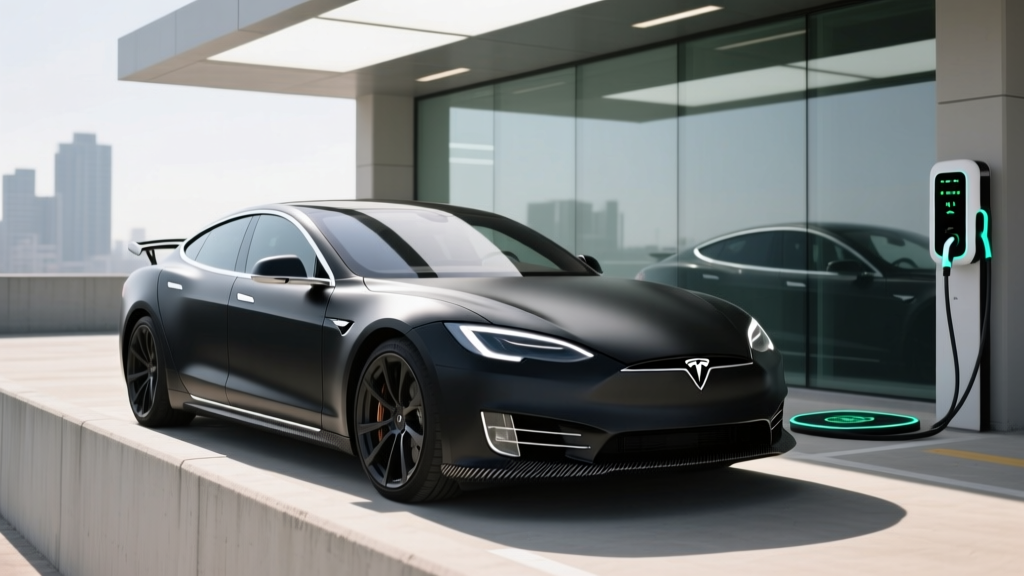
Tesla doesn't design cars the way legacy automakers do. There are no grilles to argue over, no analog gauges to preserve, and almost no physical buttons to learn. Instead, Tesla's design language — both exterior and interior — is engineered around a single obsession: aerodynamic efficiency and software-defined control. For buyers researching Tesla design in 2026, the question isn't just aesthetic. It's whether this radical minimalism actually serves your daily driving, charging, and ownership experience.
This profile examines how Tesla's design philosophy translates into hard numbers across the current lineup — Model 3, Model Y, Model S, and Model X — covering range, charging, performance, cargo, pricing, and the tax-credit landscape that shapes what you actually pay.
Why Tesla Design Is Really About Efficiency
Every Tesla design decision traces back to reducing drag. The flush door handles, the sealed front fascia (no engine intake needed), the flat underbody, and the gently sloping rooflines all target one metric: the coefficient of drag (Cd). The Model 3 achieves a Cd of 0.219, the Model S hits 0.208, and the refreshed Model Y sits around 0.23. For context, most mainstream sedans range from 0.26 to 0.30.
Lower drag directly extends range at highway speeds, where aerodynamic resistance dominates energy consumption. This is why a Tesla Model 3 Long Range can extract 363 miles from a ~79 kWh usable battery, while a competitor with a larger battery but worse aero might deliver less. Tesla's design isn't just styling — it's a range multiplier.
The interior follows the same reductive logic. A single central touchscreen (15.4 inches in Model 3/Y, 17 inches in Model S/X) handles climate, media, navigation, vehicle settings, and even the glovebox release. The absence of physical controls cuts parts count, weight, and assembly complexity, but it also means you'll interact with a screen for tasks that take a knob-twist in other vehicles.
2026 Tesla Lineup: Spec Table
| Spec | Model 3 LR AWD | Model Y LR AWD | Model S LR | Model X LR |
|---|---|---|---|---|
| EPA Range | 363 mi | 320 mi | 402 mi | 335 mi |
| Battery (usable, chemistry) | ~79 kWh, NMC | ~79 kWh, NMC | ~100 kWh, NMC | ~100 kWh, NMC |
| MPGe (combined) | 134 MPGe | 122 MPGe | 124 MPGe | 109 MPGe |
| kWh/100 mi | 25 | 28 | 27 | 30 |
| Peak DC Charge Rate | 250 kW | 250 kW | 250 kW | 250 kW |
| 10–80% DCFC Time | ~27 min | ~27 min | ~35 min | ~35 min |
| Level 2 Home Rate | 11.5 kW (~44 mi/hr) | 11.5 kW (~44 mi/hr) | 11.5 kW (~35 mi/hr) | 11.5 kW (~35 mi/hr) |
| 0–60 mph | 4.2 sec | 4.8 sec | 3.1 sec | 3.8 sec |
| Horsepower | 394 hp | 384 hp | 670 hp | 670 hp |
| Drivetrain | Dual-motor AWD | Dual-motor AWD | Dual-motor AWD | Dual-motor AWD |
| Cargo (rear + frunk) | 23 + 3 cu ft | 34 + 4 cu ft | 28 + 3 cu ft | 88 + 7 cu ft |
| Rear Legroom | 35.3 in | 37.0 in | 35.4 in | 37.1 in |
| Base MSRP (2026) | $47,740 | $48,740 | $79,990 | $84,990 |
| Battery Warranty | 8 yr / 120,000 mi | 8 yr / 120,000 mi | 8 yr / 150,000 mi | 8 yr / 150,000 mi |
Sources: fueleconomy.gov, Tesla spec sheets. RWD trims available at lower prices; Performance trims carry premiums.
Real-World Range vs. the EPA Sticker
Tesla's trip planner and in-car navigation are among the best in the industry at predicting energy use, factoring in elevation, wind, speed, and temperature. On a 300-mile road trip with preconditioning enabled, the car will route you through Superchargers with accurate SoC arrival estimates — usually within 2–3% of predicted. That software integration is a design choice as much as an engineering one.
RWD trims (Model 3 at ~$38,990, Model Y at ~$44,990) use LFP chemistry batteries in some configurations. LFP is heavier and less energy-dense, yielding ~272 miles EPA for the Model 3 RWD, but it tolerates regular 100% charging without degradation concerns — a practical advantage for daily commuters with home charging.
Charging Speed: Supercharger Network and Home Level 2
| Level | Power (kW) | Miles Added per Hour | Use Case |
|---|---|---|---|
| Level 1 (120V) | ~1.4 kW | ~5 mi/hr | Overnight trickle |
| Level 2 (240V, 48A) | 11.5 kW | ~35–44 mi/hr | Daily home charging |
| DC Fast (V3 Supercharger) | Peak 250 kW | ~1,000 mi/hr (peak) | Road trips, 10–80% in ~27 min |
Tesla's NACS (North American Charging Standard) connector is now the industry standard, adopted by Ford, GM, Rivian, Hyundai, and most major automakers. This means Tesla owners benefit from the largest, most reliable DC fast-charging network in North America — over 6,500 V3 Supercharger stalls at up to 250 kW, plus expanding V4 stalls.
Charging-curve reality check: The 250 kW peak only sustains from roughly 10% to 30% SoC. Above 50%, the rate tapers to ~100 kW, and above 80% it drops further to protect the NMC cells. A 10–80% session takes ~27 minutes for Model 3/Y and ~35 minutes for Model S/X (larger batteries). Plan road-trip stops around the 15–20 minute mark to avoid the slow taper zone above 80%.
For home Level 2 charging, Tesla's Wall Connector ($420) delivers up to 11.5 kW on a 60A circuit, adding ~44 miles of range per hour for Model 3/Y. A typical professional installation runs $800–$2,000 depending on panel proximity and local permit requirements. If your home has a 200A panel with spare capacity, installation is straightforward. Older 100A panels may need a $2,000–$4,000 upgrade.
Performance and Drivetrain by Trim
Tesla's dual-motor AWD architecture uses independent front and rear motors for torque vectoring, traction control, and efficiency (the front motor can disconnect under light loads to reduce drag). The Model 3 Long Range hits 0–60 in 4.2 seconds — quicker than most sports sedans — while the Model S Plaid (not reviewed here) drops to 1.99 seconds with tri-motor AWD and 1,020 hp.
Regenerative braking is aggressive enough for one-pedal driving in most conditions, though Tesla removed the user-adjustable regen setting several years ago. The "stop mode" behavior brings the car to a full halt without touching the brake pedal, which most owners adapt to within a week.
Interior, Tech, and the Screen-Everything Approach
Tesla's interior design is polarizing. The minimalist cabin eliminates nearly all physical controls. Climate vents are adjusted by swiping on-screen airflow vectors. Turn signals are on a yoke or steering wheel (depending on model year and configuration), and the Model S/X offer a secondary 8-inch rear touchscreen for passengers.
Standout tech:
- Over-the-air (OTA) updates that add features post-purchase — range optimizations, UI redesigns, new games, Sentry Mode improvements
- Sentry Mode dashcam recording with USB export (saves on aftermarket dashcam installs)
- Dog Mode and Camp Mode for climate control while parked
- Native Spotify, Netflix, YouTube, and Arcade on the center screen (parked only for video)
- Phone-as-key with Bluetooth LE, plus key card backup
Notable drawbacks:
- No Apple CarPlay or Android Auto — Tesla's ecosystem is closed
- Adjusting climate, mirrors, or wiper speed requires screen taps, which can distract during driving
- Build quality (panel gaps, paint) has improved significantly since 2023 but still trails German and Korean competitors on consistency
- No spare tire in any model — Tesla provides a tire inflator kit
Pricing, Trims, and Federal Tax Credit Eligibility
| Model / Trim | Base MSRP | §30D Credit Eligibility | Effective Price (if eligible) |
|---|---|---|---|
| Model 3 RWD | $38,990 | Up to $7,500 (sourcing rules apply) | ~$31,490 |
| Model 3 Long Range AWD | $47,740 | Up to $7,500 (sourcing rules apply) | ~$40,240 |
| Model Y LR AWD | $48,740 | Up to $7,500 (sourcing rules apply) | ~$41,240 |
| Model S LR | $79,990 | Ineligible (MSRP exceeds $55K sedan cap) | $79,990 |
| Model X LR | $84,990 | Ineligible (MSRP exceeds $80K SUV cap) | $84,990 |
IRS §30D rules for 2026: The federal EV tax credit offers up to $7,500 for qualifying new EVs, but eligibility depends on three hurdles: buyer income caps ($150K single / $300K joint MAGI), vehicle MSRP caps ($55,000 for sedans, $80,000 for SUVs/pickups), and battery critical-mineral and component sourcing requirements that tighten annually. Tesla's Model 3 and Model Y have historically qualified for the full or partial credit due to US assembly and improving domestic battery sourcing, but the exact dollar amount varies by build date and supply-chain compliance. Always verify current eligibility on IRS.gov before purchasing, and consult a tax professional. The point-of-sale transfer option lets you apply the credit as a down-payment reduction at the dealer.
Who Should Buy a Tesla — and Who Shouldn't
- Best-in-class Supercharger network with 250 kW V3 stalls nationwide
- Class-leading efficiency (kWh/100 mi) due to aerodynamic design
- OTA updates continuously improve the vehicle post-purchase
- Strong resale value relative to most EV competitors
- Excellent real-world trip planning with accurate energy predictions
- No Apple CarPlay / Android Auto
- Screen-only controls can distract while driving
- Model S/X priced out of federal tax credit eligibility
- Service center wait times can stretch weeks in some metro areas
- No physical buttons for climate or wipers
Choose a Tesla if: You value charging-network reliability, software-first features, and efficiency above traditional luxury materials. The Model 3 and Model Y are strong picks for commuters, small families, and road-trippers who want predictable Supercharger stops. The Model S/X suit buyers who want range (402 mi) and performance but don't need the tax credit.
Look elsewhere if: You want CarPlay, physical knobs, or a dealer service network within 10 minutes of your home. Competitors like the Hyundai Ioniq 6 (361 mi EPA, 800V charging, CarPlay), BMW i4 (307 mi, traditional luxury interior), or Ford Mustang Mach-E (320 mi, BlueCruise hands-free) offer different trade-offs worth cross-shopping.
Frequently Asked Questions
What is the real-world range of a Tesla in 2026?
For the Model 3 Long Range AWD (363 mi EPA), expect ~290–310 miles on highway trips at 75 mph and ~240–270 miles in freezing temperatures. The heat pump reduces cold-weather loss compared to older models, but NMC chemistry still sees 20–25% reduction below 32°F. RWD trims with LFP batteries have lower EPA range (~272 mi) but tolerate daily 100% charging.
How fast does a Tesla charge at home and on the road?
On a V3 Supercharger, Model 3/Y peak at 250 kW and reach 10–80% in ~27 minutes. At home on a 240V/48A Level 2 Wall Connector, they charge at 11.5 kW, adding ~44 miles per hour — enough to fully replenish overnight. Model S/X take ~35 minutes for 10–80% DCFC due to larger ~100 kWh batteries.
Does the Tesla Model 3 or Model Y qualify for the $7,500 federal tax credit?
Both the Model 3 and Model Y have qualified for partial or full §30D credits in recent years, but eligibility depends on your income (under $150K single / $300K joint), the vehicle's MSRP (under $55K sedan / $80K SUV cap), and battery sourcing compliance. The exact credit amount can change based on supply-chain shifts. Verify on IRS.gov and consider the point-of-sale transfer to apply it at purchase. Model S and Model X exceed MSRP caps and are ineligible.
Is Tesla's Autopilot or FSD actually self-driving?
No. Both Autopilot and Full Self-Driving (Supervised) are SAE Level 2 driver-assistance systems. You must remain engaged, hands on or near the wheel, and eyes on the road at all times. Only Level 4 services like Waymo operate without a human driver, and those are geofenced robotaxis — not consumer vehicles.
Is a Tesla worth buying vs. competitors in 2026?
If charging reliability and network coverage matter most, Tesla still leads — the Supercharger network has significantly higher uptime and ease-of-use than Electrify America, EVgo, or ChargePoint for DC fast charging. If you prefer CarPlay, traditional luxury interiors, or hands-free driving (GM Super Cruise, Ford BlueCruise), competitors are compelling. The Model 3 and Model Y remain the efficiency and value benchmarks in their segments.
What is Tesla's battery and powertrain warranty?
Model 3 and Model Y carry an 8-year/120,000-mile battery and drive unit warranty. Model S and Model X extend to 8 years/150,000 miles. The warranty covers defects and capacity degradation below 70% retention. Out-of-warranty battery replacements range from $12,000–$20,000 depending on the model, though most Tesla batteries show 10–15% degradation at 150,000 miles based on fleet data.