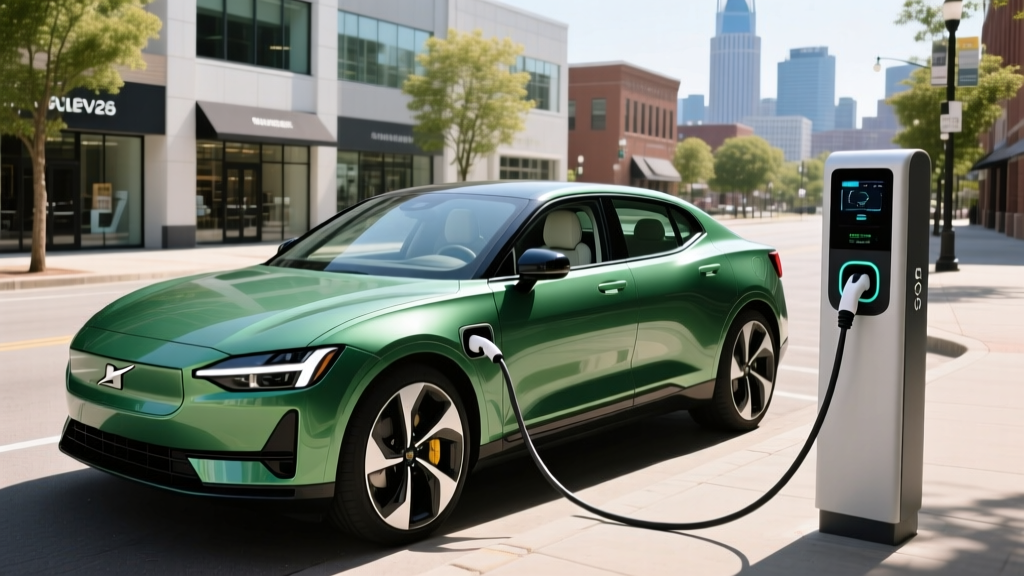
If you are shopping for a premium electric sedan in Middle Tennessee, the 2026 Polestar 2 likely sits on your shortlist alongside the Tesla Model 3, BMW i4, and Hyundai Ioniq 6. But buying an EV in Nashville comes with specific considerations — from summer heat impacts on battery health to the expanding but still uneven public charging network along I-40 and I-65. This profile breaks down everything Nashville-area buyers need to know about the Polestar 2, with exact specs, real-world range expectations, and ownership economics.
2026 Polestar 2 at a Glance: Key Specifications
| Specification | Standard Range SM | Long Range SM | Long Range DM |
|---|---|---|---|
| EPA Range | 276 mi | 320 mi | 298 mi |
| Battery (usable) | 69 kWh (NMC) | 82 kWh (NMC) | 82 kWh (NMC) |
| Horsepower | 299 hp | 299 hp | 421 hp (w/Performance) |
| 0-60 mph | 5.9 sec | 5.9 sec | 4.2 sec (w/Performance) |
| Drivetrain | RWD | RWD | AWD (Dual Motor) |
| Max DC Charge Rate | 135 kW | 205 kW | 205 kW |
| 10-80% DC Time | ~34 min | ~26 min | ~26 min |
| Level 2 Rate | 11 kW | 11 kW | 11 kW |
| MPGe (combined) | 107 MPGe | 111 MPGe | 98 MPGe |
| kWh/100 mi | 31 | 30 | 34 |
| Cargo Volume | 14.4 cu ft (trunk) + 1.4 cu ft (frunk) | ||
| Rear Legroom | 35.7 in | ||
| Battery Warranty | 8 yr / 100,000 mi | ||
| Base MSRP | $49,900 | $53,400 | $58,900 |
Real-World Range for Nashville Drivers
The 82 kWh NMC (nickel-manganese-cobalt) battery pack in Long Range models provides solid energy density, but NMC chemistry is more sensitive to sustained high-temperature exposure than LFP alternatives. For Nashville owners who park outdoors in July and August heat, setting the charge limit to 80-90% for daily use (rather than 100%) and using scheduled departure preconditioning will meaningfully slow long-term degradation. The 69 kWh Standard Range pack uses the same NMC chemistry.
Efficiency-wise, the Long Range SM's 30 kWh/100 mi rating is competitive with the Tesla Model 3 Long Range (25-26 kWh/100 mi) but trails it by about 4-5 kWh/100 mi. That translates to slightly higher per-mile charging costs — roughly $0.04-0.05/mi at typical Tennessee residential electricity rates (~$0.12/kWh), versus $0.03/mi for a Model 3.
Charging Speed: DC Fast and Home Level 2
| Charging Level | Power | Speed (mi/hr) | Notes |
|---|---|---|---|
| Level 1 (120V outlet) | ~1.4 kW | ~4 mi/hr | Emergency/trickle only; ~80 hr for full charge |
| Level 2 (240V, 48A home) | 11 kW | ~32 mi/hr | Full charge in ~8 hr (82 kWh pack) |
| DC Fast (peak) | 205 kW (LR) | ~180 mi/hr at peak | 10-80% in ~26 min; curve tapers significantly above 80% |
| DC Fast (Standard Range) | 135 kW | ~130 mi/hr at peak | 10-80% in ~34 min |
The 205 kW peak DC fast-charge rate on Long Range models is a meaningful upgrade over the pre-2024 Polestar 2 (which maxed at 150 kW). However, peak rate is not sustained rate. In real-world testing at Electrify America and Tesla Supercharger stations (via the built-in NACS port), the Polestar 2 holds above 150 kW from roughly 10-40% State of Charge, then tapers to 80-100 kW through 60%, and drops below 50 kW past 80%. The 10-80% time of approximately 26 minutes is competitive but trails the Hyundai Ioniq 6's 18-minute 10-80% time on its 800V architecture.
For home Level 2 charging in Nashville, the 11 kW onboard charger means you will need a 240V/48A circuit (hardwired) or a 60A breaker to achieve maximum charge speed. Most Nashville homes built after 2000 have 200A electrical panels that can accommodate this, but older homes in areas like East Nashville or The Gulch may require a panel upgrade — budget $1,500-$3,000 for that work on top of $500-$1,200 for the charger and standard installation.
The 2026 Polestar 2 comes equipped with a native NACS (North American Charging Standard) port, giving direct access to Tesla's Supercharger network without an adapter. This is a significant advantage for Tennessee road trips, as Supercharger reliability consistently outperforms CCS-based networks in the Southeast. You will also find Electrify America stations at Nashville-area Walmart and Target locations, plus ChargePoint and EVgo chargers scattered through downtown and suburban shopping centers.
Pricing, Trims, and Federal Tax Credit Eligibility
| Trim | Base MSRP | As-Tested (typical options) | §30D Credit Eligible? |
|---|---|---|---|
| Standard Range SM | $49,900 | $52,000-$54,000 | Potentially up to $7,500* |
| Long Range SM | $53,400 | $56,000-$60,000 | Potentially up to $7,500* |
| Long Range DM | $58,900 | $62,000-$68,000 (w/Performance & Pilot packs) | Potentially up to $7,500* |
* Federal EV tax credit eligibility under IRS §30D depends on multiple factors that change annually. For 2026, the key requirements include:
- MSRP cap: Sedans must be at or below $55,000 MSRP. The Standard Range SM ($49,900) and Long Range SM ($53,400) qualify on price; the Long Range DM ($58,900) exceeds the sedan cap and does not qualify unless reclassified.
- Buyer income limits: Modified AGI must not exceed $150,000 (single), $225,000 (head of household), or $300,000 (joint filers).
- Battery component sourcing: The credit splits into two halves ($3,750 each) — one for battery components manufactured/assembled in North America, and one for critical minerals sourced from the U.S. or FTA partners. Polestar's supply chain has been evolving; verify current-year sourcing compliance on fueleconomy.gov before purchase.
- Point-of-sale transfer: Eligible buyers can transfer the credit to the dealer at purchase, reducing the upfront price rather than waiting for a tax refund.
The Long Range SM at $53,400 MSRP sits just under the $55,000 sedan cap, making it the sweet spot for credit-eligible Nashville buyers. However, adding the Plus or Pilot packages can push the total above the cap. Always confirm the exact MSRP (including factory options but excluding destination) before assuming credit eligibility. Consult a tax professional for your specific situation — this is not tax advice.
Performance and Driving Dynamics
The 2026 Polestar 2's driving character depends heavily on which powertrain you choose. The single-motor variants produce 299 horsepower and 361 lb-ft of torque, delivering a 5.9-second 0-60 mph time. That is brisk but not thrilling — it matches a well-equipped midsize gas sedan more than a sports car. The dual-motor AWD with the Performance Software Upgrade unlocks 421 hp and 487 lb-ft, dropping the 0-60 to 4.2 seconds. The Öhlins dampers included with the Performance Pack add genuinely impressive ride control on Tennessee's rougher secondary roads, though the 20-inch forged wheels do transmit more road noise than the standard 19s.
Ride quality in the Polestar 2 is firm and European-tuned — Nashville's occasional potholes and expansion joints on I-440 are felt but never jarring. The steering is precise and weighted, and the regenerative braking offers a convincing one-pedal driving mode that handles most stop-and-go traffic on Charlotte Pike or Broadway without touching the brake pedal. The low center of gravity from the floor-mounted battery pack gives confident cornering on the Natchez Trace.
Interior, Tech, and Cargo
The Polestar 2 interior is Scandinavian-minimal in the best way — vegan upholstery (WeaveTech or optional Nappa leather), a portrait-oriented 11.2-inch center touchscreen running Polestar's Android Automotive OS with built-in Google Maps navigation, and a 12.3-inch driver display. Google Assistant voice control handles navigation, climate, and media requests naturally. Wireless Apple CarPlay is standard; Android Auto is redundant given the native Google integration.
The Pilot Pack ($3,400) adds Pilot Assist — a SAE Level 2 driver-assistance system combining adaptive cruise control and lane centering. It works well on I-65 and I-24 highway stretches, but this is not autonomous driving. You must keep your hands on the wheel and eyes on the road at all times. The system occasionally hunts lane markings on faded Tennessee highway lines, a common limitation across all Level 2 systems.
Cargo space is the Polestar 2's practical weak point. The 14.4 cu ft trunk (liftback design helps with loading) trails the Tesla Model 3's 23 cu ft and the Hyundai Ioniq 6's 12.3 cu ft (though the Ioniq is a sedan with a conventional trunk, so the Polestar's liftback is more usable than the raw number suggests). The 1.4 cu ft frunk holds charging cables and small items. Rear legroom at 35.7 inches is adequate for adults but tighter than the Model 3's 35.2 inches — and significantly tighter than an SUV alternative like the Polestar 4.
Pros, Cons, and the Verdict
Pros
- NACS port provides native Supercharger access — critical for Southeast road trips
- Build quality and materials rival BMW and Audi at a lower price point
- 205 kW DC fast charging on Long Range trims is competitive
- One-pedal driving is smooth and well-calibrated for city traffic
- Android Automotive OS with Google Maps is the best native EV navigation available
- 8-year/100,000-mile battery and powertrain warranty
Cons
- Cargo space (14.4 cu ft) is tight for a car in this price range
- Efficiency (30-34 kWh/100 mi) trails Tesla Model 3 and Hyundai Ioniq 6
- Firm ride may not suit buyers prioritizing comfort over sportiness
- Long Range DM exceeds $55K MSRP cap — likely ineligible for federal tax credit
- Rear visibility is compromised by the thick C-pillars and small rear window
- No heat pump standard on base trims (reduces winter efficiency)
Who Should Buy the Polestar 2 in Nashville?
Choose the Polestar 2 if:
- You want a premium European-designed sedan without paying BMW i4 or Mercedes EQB prices
- You value build quality, minimalist design, and Google-native infotainment over maximum range
- Your commute is under 80 miles round-trip (Nashville average is ~32 miles, per Census data)
- You can install Level 2 charging at home and want overnight convenience
Look elsewhere if:
- You need maximum cargo or passenger space — consider the Polestar 4, Tesla Model Y, or Hyundai Ioniq 5
- Range-per-dollar is your top priority — the Tesla Model 3 Long Range (363 mi EPA) or Hyundai Ioniq 6 (361 mi EPA) deliver more miles per dollar
- You frequently tow — the Polestar 2 is not rated for towing
For the typical Nashville EV buyer — a professional commuter with home charging access who takes occasional road trips to Chattanooga, Birmingham, or the Smoky Mountains — the Long Range Single Motor at $53,400 is the most rational choice. It qualifies for the MSRP cap, offers 320 miles of EPA range (270-290 real-world), and charges fast enough to make I-40 corridor trips manageable with one 25-minute stop at a Cookeville or Crossville Supercharger.
Frequently Asked Questions
What is the real-world range of the Polestar 2 in Nashville?
The Long Range Single Motor delivers approximately 270-290 miles in mixed Nashville driving (highway and city) during spring and fall. Summer heat has minimal impact thanks to active thermal management, but winter highway driving at 70 mph in 30-40°F weather can drop range to 250-270 miles. The Standard Range model will return about 230-250 miles in similar conditions.
How fast does the Polestar 2 charge at home and on the road?
At home on a 240V/48A Level 2 charger, the Polestar 2 adds roughly 32 miles of range per hour, fully charging the 82 kWh pack in about 8 hours — ideal for overnight charging. On DC fast chargers, the Long Range models peak at 205 kW and charge from 10-80% in approximately 26 minutes. The Standard Range peaks at 135 kW with a 10-80% time of about 34 minutes.
Does the 2026 Polestar 2 qualify for the $7,500 federal EV tax credit?
The Standard Range SM ($49,900) and Long Range SM ($53,400) fall under the $55,000 MSRP cap for sedans and are potentially eligible for up to $7,500 under IRS §30D, pending battery component and critical mineral sourcing verification. The Long Range DM ($58,900) exceeds the sedan MSRP cap and likely does not qualify. All trims are subject to buyer income limits ($150K single / $300K joint). Always verify current eligibility on the IRS website and consult a tax professional before purchasing.
Is the Polestar 2 worth buying over the Tesla Model 3 or Hyundai Ioniq 6?
The Polestar 2 wins on interior material quality, ride refinement, and Scandinavian design appeal. The Tesla Model 3 Long Range wins on range (363 mi EPA), efficiency (25 kWh/100 mi), cargo space (23 cu ft), and price. The Hyundai Ioniq 6 wins on charging speed (18 min 10-80%) and range (361 mi EPA). If build quality and design matter more to you than maximizing range-per-dollar, the Polestar 2 is a compelling choice. If efficiency and space are paramount, the Model 3 or Ioniq 6 are stronger picks.
How reliable is public charging in the Nashville area for Polestar 2 owners?
Nashville's public charging infrastructure has expanded significantly, with Tesla Superchargers (now accessible to the Polestar 2 via its native NACS port) at key locations along I-40, I-65, and I-24. Electrify America, ChargePoint, and EVgo provide additional coverage in suburban shopping centers and downtown garages. However, rural stretches between Nashville and cities like Memphis or Knoxville still have gaps. Plan road trips using the built-in Google Maps EV routing, which accounts for charging stops and preconditioning automatically.