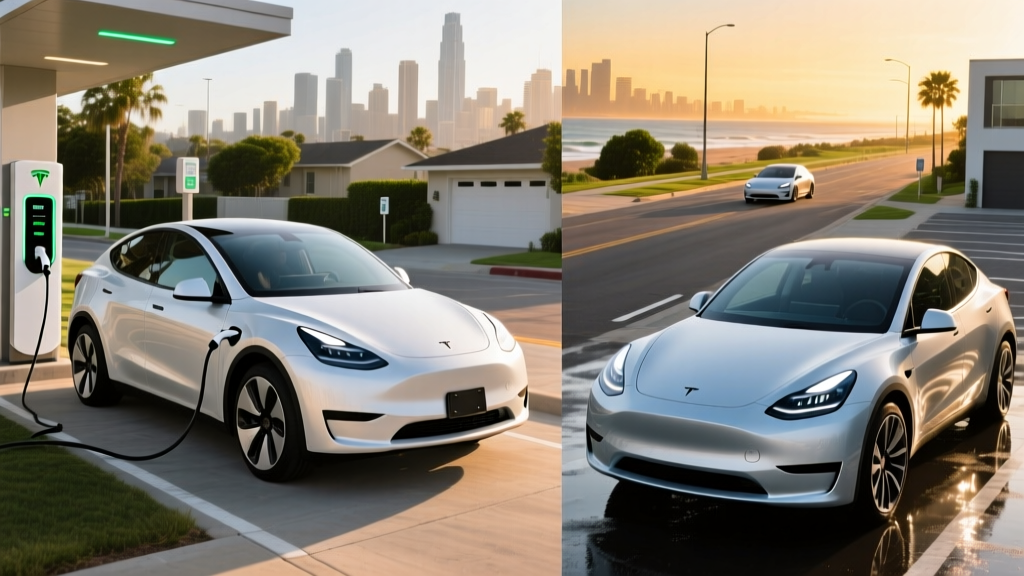
For years, Tesla vehicles were treated almost like tech stocks — holding value better than nearly any other car on the road. But the EV market of 2026 looks nothing like 2021. Aggressive price cuts, an explosion of rival models, and shifting federal tax credit rules have reshaped the used-Tesla landscape. If you're shopping for a Model 3 or Model Y today, understanding Tesla depreciation isn't just an academic exercise — it's the single biggest factor in your true cost of ownership.
This review dissects where Tesla's two highest-volume models stand on resale value in 2026, while delivering the full spec-by-spec breakdown buyers need: real-world range, charging speeds, battery chemistry, tax credit eligibility, and how they compare to the Hyundai Ioniq 5, Ford Mustang Mach-E, and BMW iX.
2026 Tesla Model Y: The Spec Sheet That Drives Resale
Residual value doesn't exist in a vacuum — it's tethered to the underlying product. The 2026 Model Y Long Range AWD remains Tesla's bestseller, and its hardware profile is what underpins (or undermines) its trade-in offer three to five years from now.
| Spec | Value |
|---|---|
| EPA Range | 320 miles |
| Battery (usable) | ~75 kWh, NMC (2170 cells) |
| Drivetrain | Dual-motor AWD |
| Power | 384 hp |
| 0–60 mph | 4.8 seconds |
| Peak DC Fast Charge | 250 kW (Supercharger V3) |
| 10–80% DC Charge | ~27 minutes |
| Level 2 Home Charge | 11.5 kW / ~44 mi/hr |
| Efficiency | 122 MPGe / 28 kWh/100mi |
| Cargo (rear seats up) | 30.2 cu ft |
| Cargo (rear seats folded) | 72.1 cu ft |
| Battery Warranty | 8 years / 120,000 miles (70% retention) |
| Base MSRP | $44,990 |
2026 Model 3 Long Range: Efficiency King, Depreciation Question Mark
The refreshed Model 3 ("Highland" platform carried into 2026) is leaner, quieter, and slightly more efficient than the Model Y. That efficiency edge matters for long-term value — lower running costs tend to support stronger used demand.
| Spec | Value |
|---|---|
| EPA Range | 341 miles |
| Battery (usable) | ~75 kWh, NMC |
| Drivetrain | Dual-motor AWD |
| Power | 346 hp |
| 0–60 mph | 4.2 seconds |
| Peak DC Fast Charge | 250 kW |
| 10–80% DC Charge | ~25 minutes |
| Level 2 Home Charge | 11.5 kW / ~48 mi/hr |
| Efficiency | 132 MPGe / 26 kWh/100mi |
| Cargo (trunk + frunk) | 23 cu ft total |
| Battery Warranty | 8 years / 120,000 miles (70% retention) |
| Base MSRP | $42,490 |
The Model 3 RWD base model, starting at $36,990, uses a ~57.5 kWh LFP (lithium iron phosphate) battery with an EPA range of 272 miles. LFP chemistry trades energy density for superior cycle life — Tesla recommends charging LFP packs to 100% regularly, which simplifies ownership and may reduce long-term degradation anxiety, a factor that subtly supports resale.
Tesla Depreciation by the Numbers: 2026 Market Data
So what does Tesla depreciation actually look like at the three- and five-year marks? Based on aggregated used-market transaction data and residual-value forecasts from industry analysts, here's where the two models land as of early 2026:
| Model | 3-Year Retention | 5-Year Retention | Notes |
|---|---|---|---|
| Model Y Long Range AWD | ~55–60% | ~40–45% | Improved vs 2024 lows; strong used demand as family EV |
| Model 3 Long Range AWD | ~50–55% | ~38–42% | Sedan segment pressure from Ioniq 6, BMW i4 |
| Model 3 RWD (LFP) | ~48–53% | ~35–40% | Lower starting price = smaller absolute $ loss |
For context, the average EV retains roughly 45–50% of value at three years and 30–35% at five years, according to iSeeCars industry data. Teslas now sit near or slightly above the EV average — a sharp reversal from 2022, when the Model 3 led all EVs in retention. What changed?
- Price volatility: Tesla's repeated MSRP cuts in 2023–2025 cratered used values for existing owners. A Model Y bought for $65,000 in 2022 could be had for under $30,000 on the used market by 2025.
- Competitor proliferation: The Hyundai Ioniq 5, Kia EV6, Ford Mustang Mach-E, and Rivian R2 now offer credible alternatives with competitive range and charging.
- Tax credit shifts: As new-EV credits moved to the point of sale under IRS §30D rules, buyers began factoring the $7,500 credit into the effective purchase price — widening the gap between new and used.
Charging Infrastructure: The Hidden Depreciation Shield
One factor working in Tesla's favor: the Supercharger network. With over 30,000 V3/V4 stalls across North America and now open to NACS-equipped competitors (Ford, Rivian, GM), the network remains the most reliable DC fast-charging ecosystem. This ecosystem lock-in provides a floor under Tesla resale values that rivals can't yet match.
| Charging Level | Power | Speed | Typical Use Case |
|---|---|---|---|
| Level 1 (120V) | ~1.4 kW | ~4–5 mi/hr | Emergency / overnight trickle |
| Level 2 (240V, 48A) | 11.5 kW | ~44–48 mi/hr | Home Wall Connector daily |
| DC Fast (Supercharger V3) | Peak 250 kW | 10–80% in ~25–27 min | Road trips |
| DC Fast (Supercharger V4) | Peak 350 kW* | 10–80% in ~18–20 min* | Select corridors |
*V4 speeds require compatible vehicle architecture; current Model 3/Y peak at ~250 kW even on V4 stalls due to onboard charge-rate limits. Always precondition via navigation to a Supercharger for maximum charge speed.
The charging curve matters: Teslas pull peak kW only between roughly 10–30% SoC, then taper progressively. From 80–100%, charging slows dramatically to protect battery health — a final 20% can take as long as the first 70%. For road-trip planning, budget stops around 10–80% rather than full charges.
Tax Credits, Pricing, and the True Cost Equation
Depreciation is a percentage game, but the starting price determines your actual dollar loss. Here's how 2026 pricing and federal incentives shake out:
| Trim | MSRP | §30D Credit Eligible? | Effective Price* |
|---|---|---|---|
| Model 3 RWD | $36,990 | Yes (meets MSRP cap, sourcing TBD) | ~$29,490 |
| Model 3 Long Range AWD | $42,490 | Yes | ~$34,990 |
| Model Y Long Range AWD | $44,990 | Yes | ~$37,490 |
| Model Y Performance | $48,990 | Yes | ~$41,490 |
*Effective price assumes full $7,500 point-of-sale credit. Eligibility depends on buyer income (≤$150K single / $300K joint), vehicle MSRP caps ($55K sedans / $80K SUVs), and battery critical-mineral sourcing requirements per IRS §30D. Confirm eligibility at purchase — rules evolve annually.
- Buyer AGI within limits ($150K single, $225K HOH, $300K joint)
- Vehicle MSRP under cap ($55K for sedans, $80K for SUVs/vans/pickups)
- Battery components manufactured/assembled in North America (phased thresholds)
- Critical minerals sourced from US or FTA partners
- Vehicle assembled in North America (all current Teslas qualify — Fremont, Austin)
- Credit applied at point of sale (dealer transfer) or claimed on tax return
The point-of-sale credit creates a depreciation asymmetry: you pay ~$37,500 for a Model Y after credit, but the used market prices it based on the ~$45,000 MSRP. Your effective depreciation percentage looks worse on paper, but your actual dollars lost are anchored to the lower net price. This is a critical distinction many depreciation calculators miss.
Tech, Interior, and Ownership Drawbacks
Tesla's software-first approach is both its greatest asset and its most polarizing trait. The 15.4-inch center touchscreen handles everything — climate, mirrors, glovebox, wipers — with no physical buttons. For tech-forward buyers, it's seamless. For traditionalists, it's a dealbreaker that suppresses used demand among older demographics.
Standout tech:
- Over-the-air updates that add features post-purchase (range optimizations, UI improvements)
- Tesla Supercharger network integration with automatic routing and payment
- Sentry Mode dashcam surveillance while parked
- Phone-as-key with passive entry
- Autopilot standard (SAE Level 2 lane-keeping + adaptive cruise)
Notable drawbacks:
- No Apple CarPlay or Android Auto — Tesla's closed ecosystem frustrates some buyers
- Minimalist interior feels spartan vs Hyundai/Kia/BMW at similar price points
- Panel gaps and paint quality remain inconsistent, affecting perceived quality on used lots
- Insurance premiums run 20–40% higher than comparable non-Tesla EVs in most states
- No physical instrument cluster — all info lives on the center screen
Tesla Depreciation vs Key Competitors
Depreciation only matters relative to alternatives. Here's how the Model Y's value retention compares to its closest rivals at the three-year mark:
| Model | Starting MSRP | Est. 3-Yr Retention | Est. Dollar Loss |
|---|---|---|---|
| Tesla Model Y LR AWD | $44,990 | ~57% | ~$19,300 |
| Hyundai Ioniq 5 SEL AWD | $47,500 | ~52% | ~$22,800 |
| Ford Mustang Mach-E Premium | $46,995 | ~48% | ~$24,400 |
| Kia EV6 GT-Line AWD | $49,500 | ~50% | ~$24,750 |
| BMW iX xDrive50 | $87,250 | ~44% | ~$48,900 |
The Model Y's dollar loss is among the lowest in the segment — driven by its lower MSRP (after years of price cuts), strong brand recognition, and the Supercharger moat. The Hyundai Ioniq 5 and Kia EV6 offer better interiors and 800V ultra-fast charging (10–80% in ~18 minutes), but their higher starting prices and less mature charging ecosystems weigh on resale.
The BMW iX illustrates the luxury-EV depreciation trap: premium prices collapse faster because luxury buyers demand the latest tech, and a three-year-old BMW feels dated against a new one. Tesla's more utilitarian positioning ironically insulates it from this dynamic.
- Among the lowest dollar-loss depreciation in the EV SUV segment
- Supercharger network remains the gold standard for road-trip reliability
- Class-leading efficiency (122 MPGe) keeps running costs minimal
- OTA updates add value over time — rare in the auto industry
- Strong safety ratings (NHTSA 5-star, IIHS Top Safety Pick+)
- Spacious cargo area (72.1 cu ft) rivals midsize gas SUVs
- Historical price volatility makes used-market forecasting unreliable
- Interior quality lags Hyundai/Kia/BMW at similar price points
- Insurance costs significantly above segment average
- No Apple CarPlay/Android Auto limits appeal to some used buyers
- Peak DC charge rate (250 kW) trails 800V rivals (Ioniq 5: 350 kW peak)
- FSD (Supervised) remains expensive ($8,000) with uncertain long-term value
Who Should Buy a Tesla in 2026 (and Who Shouldn't)
- You road-trip frequently and need reliable DC fast charging across all 50 states
- You want the lowest absolute dollar depreciation in an electric SUV
- You value OTA software improvements and a minimal-maintenance powertrain
- You have home Level 2 charging access and a daily commute under 80 miles
- Interior material quality and traditional controls are high priorities
- You need ultra-fast 800V charging (18-min 10–80%) for frequent long highway drives
- You prefer Apple CarPlay/Android Auto integration
- You want a more distinctive design — Teslas are now ubiquitous in many metro areas
For commuters with home charging, the Model 3 RWD at ~$29,500 after tax credit is arguably the best value-per-mile vehicle in America, gas or electric. For families needing cargo space and road-trip capability, the Model Y remains the default choice. For towing, the Model Y is rated at 3,500 lbs — adequate for a small trailer but well behind the Ford F-150 Lightning or Rivian R1S.
Frequently Asked Questions
What is the real-world range of the 2026 Tesla Model Y?
The EPA rates the Model Y Long Range AWD at 320 miles. In real-world highway driving at 75 mph, expect roughly 265–280 miles. In sub-freezing temperatures, that drops to approximately 210–230 miles due to cabin heating demand and reduced battery efficiency, even with the standard heat pump.
How fast does a Tesla charge at home and on the road?
On a home Level 2 Tesla Wall Connector (240V, 48A), the Model Y adds roughly 44 miles of range per hour — a full overnight session easily replenishes daily driving. On a Supercharger V3, it peaks at 250 kW and charges from 10–80% in approximately 25–27 minutes. Charging above 80% slows significantly to protect the battery.
How much does a 2026 Tesla cost after the federal tax credit?
The Model 3 RWD starts at $36,990 and drops to approximately $29,490 after the $7,500 §30D credit. The Model Y Long Range AWD goes from $44,990 to ~$37,490. Eligibility depends on buyer income caps, vehicle MSRP limits, and battery sourcing requirements — confirm with your tax professional and at point of sale.
Do Teslas depreciate faster than other EVs?
As of 2026, Teslas depreciate at roughly the EV segment average or slightly better. The Model Y retains an estimated 55–60% of value at three years. However, Tesla's history of aggressive price cuts means future depreciation is harder to predict than for legacy automakers with more stable pricing.
Is it worth buying a Tesla vs the Hyundai Ioniq 5 or Kia EV6?
If Supercharger access and proven software reliability are top priorities, Tesla wins. If you value interior quality, ultra-fast 800V charging, and Apple CarPlay, the Ioniq 5 or EV6 may be a better fit. Dollar depreciation slightly favors Tesla due to its lower effective purchase price after credits.
Does the Tesla Model Y qualify for the full $7,500 federal tax credit?
Yes, the Model Y qualifies for the full §30D credit as of early 2026, provided the buyer meets income caps ($300K joint / $150K single) and the vehicle meets battery sourcing requirements. Tesla manufactures the Model Y in Austin, Texas, satisfying North American assembly rules. Always verify current eligibility at irs.gov before purchasing, as sourcing thresholds tighten annually.
What is Tesla's battery warranty, and does it affect resale?
Tesla covers the Model Y and Model 3 Long Range battery and drive unit for 8 years or 120,000 miles, whichever comes first, with a minimum 70% capacity retention guarantee. This warranty is transferable to subsequent owners, which provides a floor of confidence for used buyers and modestly supports resale value.
Tesla depreciation in 2026 tells a story of normalization. The days of Teslas appreciating like collectibles are long gone, replaced by a market where these vehicles depreciate much like any other mass-produced car — with the notable advantage that their lower effective purchase price (after tax credits) and the Supercharger ecosystem keep absolute dollar losses competitive. For data-driven buyers, the math is clear: buy at the post-credit price, charge at home, drive it for five years, and your cost per mile will undercut nearly anything with a gas tank.