Quick Verdict: The Taycan 4 Balances Porsche Dynamics With Genuine Daily Usability
The 2026 Porsche Taycan 4 occupies a narrow but compelling position in the luxury EV sedan market: it's the entry point into all-wheel-drive Taycan ownership, delivering Porsche's signature chassis tuning and class-leading charging speeds without stepping up to the Turbo or Turbo S price brackets. With the 2025 refresh carrying forward into the 2026 model year, the Taycan 4 now offers an EPA-estimated 318 miles of range on the larger Performance Battery Plus, a peak DC fast-charge rate of 320 kW, and a 0-60 mph time of 4.4 seconds.
But the Taycan 4 isn't a range king or a value play. Starting at $99,400 before destination, it exceeds the IRS §30D federal tax credit MSRP cap for sedans ($55,000), meaning no $7,500 credit applies. Buyers are paying for driving dynamics, build quality, and an 800-volt architecture that still outpaces most competitors at the DC fast charger. If those priorities match your checklist, the Taycan 4 delivers. If you need maximum range per dollar or federal incentive eligibility, competitors like the Lucid Air Pure or Tesla Model S warrant a closer look.
Range and Efficiency: EPA Numbers vs. Real-World Expectations
The 2026 Taycan 4 is available with two battery configurations. The standard Performance Battery pairs with a 79.2 kWh gross capacity (approximately 71 kWh usable), while the optional Performance Battery Plus steps up to 105 kWh gross (roughly 97 kWh usable). Both use NMC (nickel manganese cobalt) chemistry, prioritizing energy density and charge-rate performance over the cycle-life longevity associated with LFP packs.
| Metric | Performance Battery | Performance Battery Plus |
|---|---|---|
| Gross Battery Capacity | 79.2 kWh | 105 kWh |
| Usable Battery Capacity | ~71 kWh | ~97 kWh |
| Chemistry | NMC | NMC |
| EPA Estimated Range | ~265 miles | 318 miles |
| Combined MPGe | 83 MPGe | 85 MPGe |
| Efficiency (kWh/100 mi) | ~40 | ~39 |
The EPA's 318-mile figure for the Performance Battery Plus is achievable in mixed city/suburban driving at moderate temperatures. In sustained highway driving at 70-80 mph, expect approximately 260-280 miles before needing to plug in. Cold-weather operation (below 32°F) can reduce range by 15-25%, bringing realistic winter highway range down to roughly 210-240 miles. Porsche's heat pump (standard on the Battery Plus, optional on the standard pack) mitigates some of this loss by scavenging waste heat from the powertrain rather than relying solely on resistive cabin heating. On a fueleconomy.gov comparison, the Taycan 4's efficiency trails the Lucid Air Pure (146 MPGe combined) but edges ahead of the Audi e-tron GT.
One factor working in the Taycan's favor: its two-speed rear axle transmission. The first gear provides aggressive launch acceleration, while the second gear lowers motor RPM at highway speeds, improving efficiency relative to single-speed EV competitors. This engineering choice contributes to the Taycan's relatively modest range drop-off at sustained high speeds compared to direct-drive EVs.
Charging Performance: 800-Volt Architecture Still Sets the Pace
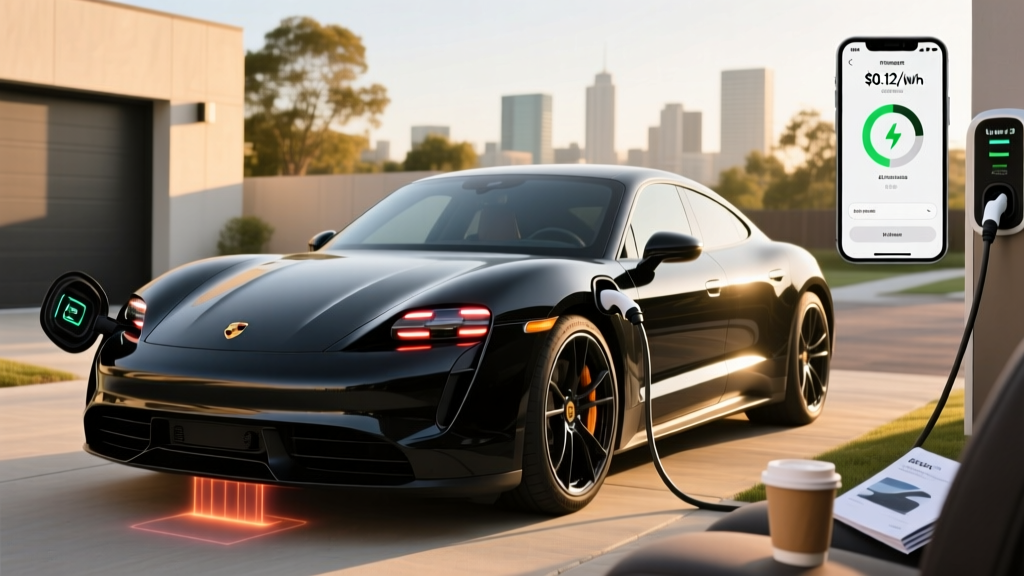
Porsche's 800-volt electrical architecture remains one of the Taycan's strongest differentiators. While most EVs operate on 400-volt systems, the Taycan's higher voltage enables faster charging at lower current, reducing heat buildup and sustaining higher charge rates deeper into the session.
| Charging Level | Power / Rate | Time / Range Added |
|---|---|---|
| Level 1 (120V household) | ~1.4 kW | ~4 miles per hour |
| Level 2 (240V home, 48A) | 11.5 kW | ~34 miles per hour; full charge in ~9 hrs (Plus) |
| DC Fast Charge (peak) | 320 kW (Battery Plus) | 10-80% in approximately 18 minutes |
| DC Fast Charge (standard battery) | 270 kW | 10-80% in approximately 22 minutes |
The 320 kW peak rate applies to the Performance Battery Plus and requires a CCS-equipped DC fast charger capable of delivering that power — currently limited to select Electrify America 350 kW stations and a growing number of Tesla Supercharger V4 stalls (with the NACS adapter Porsche now includes). In practice, peak rate is not sustained rate. The Taycan 4 holds above 250 kW from roughly 10% to 40% state of charge, then tapers progressively. From 80% to 100%, charging slows dramatically to protect battery health — a universal EV behavior, but one that makes 10-80% the meaningful metric for road-trip planning.
For home Level 2 charging, the onboard 11.5 kW AC charger means a full overnight replenishment on a standard 48-amp hardwired wall connector. Porsche includes a mobile charge cord with NEMA 14-50 compatibility, though dedicated home wall units from ChargePoint, Emporia, or Porsche's own branded charger provide a cleaner installation. Expect home charging installation costs between $500 and $2,000 depending on panel proximity and whether your electrical service needs a 200-amp upgrade.
A critical preconditioning note: the Taycan 4 will automatically warm or cool the battery toward its optimal charging temperature when a DC fast-charger destination is entered into the navigation system. Skipping preconditioning — particularly in cold weather — can reduce peak charge rates by 30-50% during the first several minutes of a session.
Performance and Drivetrain: AWD Grip With Porsche Chassis DNA
The Taycan 4 pairs a permanent-magnet synchronous motor on each axle for standard all-wheel drive. Combined output is 402 horsepower (429 with launch control engaged) and 406 lb-ft of torque in overboost mode. The two-speed transmission on the rear axle and single-speed reduction gear on the front axle work in concert with Porsche's torque-vectoring system to distribute power based on traction demand.
| Specification | Value |
|---|---|
| Drivetrain | Dual-motor AWD |
| Horsepower (overboost) | 429 hp |
| Torque (overboost) | 406 lb-ft |
| 0-60 mph | 4.4 seconds |
| Top Track Speed | 143 mph |
| Curb Weight | ~4,930 lbs |
| Adaptive Air Suspension | Standard |
| Rear-Axle Steering | Optional |
The 4.4-second 0-60 time trails the Taycan 4S (3.8 seconds) and significantly trails the Turbo variants, but it outpaces most luxury sedan competitors in the same price range and delivers the linear, instant-torque character that defines EV acceleration. Where the Taycan 4 genuinely separates itself from rivals is chassis composure: the standard adaptive air suspension, low center of gravity from the skateboard-mounted battery, and Porsche's calibration of regenerative braking blending (up to 0.39g of regen before friction brakes engage) create a driving experience that feels closer to a sports sedan than a two-ton electric appliance.
Regenerative braking on the Taycan 4 is notably less aggressive than Tesla's one-pedal driving mode. Porsche deliberately chose a coasting-oriented default, letting the car glide when the driver lifts off the accelerator rather than applying strong regen. Drivers who prefer one-pedal-style deceleration can increase regen through steering-wheel paddles or select a higher regen mode in the drive settings, but the Taycan will not come to a complete stop without brake-pedal input.
Interior, Cargo, and Technology
The Taycan 4's cabin follows Porsche's current design language: a curved 16.8-inch digital instrument cluster, a 10.9-inch central touchscreen running Porsche Communication Management (PCM), and an optional 10.9-inch front-passenger display. Physical controls are minimal — climate, drive modes, and suspension adjustments all route through the touchscreen or haptic-touch panels. This creates a clean aesthetic but adds menu-diving for simple adjustments like fan speed.
Passenger space is competitive with the segment but not generous. Front legroom measures 41.3 inches, while rear legroom is 32.7 inches — adequate for adults on shorter trips but tight for six-footers on long drives. The trunk offers 14.3 cubic feet of cargo volume, supplemented by a front trunk (frunk) of 2.9 cubic feet. Total storage is approximately 17.2 cubic feet — enough for two carry-on suitcases and a couple of duffels, but substantially less than a Tesla Model S (28 cu ft rear) or a Lucid Air (32 cu ft combined).
Standard driver-assistance technology includes forward collision warning with automatic emergency braking, lane-keeping assist, adaptive cruise control with stop-and-go, and parking sensors with a surround-view camera. Porsche's InnoDrive predictive cruise control (optional) uses navigation and traffic-sign data to adjust speed for upcoming curves and speed limits. This system operates at SAE Level 2 — the driver must maintain hands-on-wheel supervision at all times. It is not a self-driving system and does not approach the capability of Level 4 robotaxi services like Waymo.
Pricing, Trim Levels, and Tax Credit Eligibility
The 2026 Taycan 4 carries a base MSRP of $99,400, with destination charges adding approximately $1,650. A well-equipped example with the Performance Battery Plus, Premium Package, rear-axle steering, and metallic paint typically lands between $110,000 and $118,000 before any incentives.
| Item | Amount |
|---|---|
| Base MSRP (Performance Battery) | $99,400 |
| Performance Battery Plus Upgrade | ~$6,000 |
| Destination Charge | $1,650 |
| Typical As-Tested Price | $110,000 – $118,000 |
| Federal §30D Tax Credit | $0 (exceeds sedan MSRP cap) |
Under current IRS §30D rules, new clean vehicle credits are capped at $55,000 MSRP for sedans. The Taycan 4's $99,400 starting price places it well above this threshold, making it ineligible for the up-to-$7,500 federal credit regardless of buyer income or battery sourcing. Buyers seeking to offset purchase cost should investigate state-level incentives (which vary by jurisdiction — check your state energy office or AFDC state incentive database) and consult a tax professional regarding potential benefits of leasing, which may pass through a separate commercial credit under §45W.
Warranty and Long-Term Ownership
Porsche covers the Taycan 4 with a 4-year/50,000-mile limited vehicle warranty and an 8-year/100,000-mile battery warranty. The battery warranty guarantees that the high-voltage pack will retain at least 70% of its original usable capacity over the coverage period. If capacity falls below this threshold due to abnormal degradation, Porsche will repair or replace the battery to restore it above the 70% mark.
The NMC chemistry in the Taycan's battery has demonstrated strong longevity in real-world fleet data. Porsche's thermal management system — which actively liquid-cools and heats the battery to maintain an optimal temperature window — contributes to slower degradation compared to passively cooled packs. Early 2020-2022 Taycan models are showing approximately 3-5% capacity loss after 60,000 miles, though individual results vary based on charging habits, climate, and DC fast-charge frequency.
Maintenance costs are lower than a comparable gasoline Porsche Panamera (no oil changes, fewer brake pad replacements thanks to regen), but insurance premiums run 15-25% higher than the segment average due to repair costs and the vehicle's value. Owners budgeting for a Taycan 4 should expect annual insurance between $3,500 and $5,000 depending on location, driving record, and coverage levels.
Pros and Cons
Pros
- Class-leading 320 kW DC fast-charge capability
- Porsche-tuned air suspension and chassis dynamics
- 318-mile EPA range with Battery Plus is competitive
- Standard AWD with torque vectoring
- 800V architecture sustains high charge rates
- Premium interior materials and build quality
Cons
- No federal tax credit (exceeds $55K sedan MSRP cap)
- Rear seat legroom tight for tall passengers (32.7 in)
- Cargo space trails Model S and Lucid Air
- Regen braking is mild — not true one-pedal driving
- High insurance premiums and option-driven pricing
- Touchscreen-heavy controls add menu complexity
Who Should Buy the Taycan 4 — And Who Should Look Elsewhere
Choose the Taycan 4 if: You prioritize driving dynamics and chassis refinement over maximum range or cargo space. You have reliable access to DC fast charging for road trips and want the fastest 10-80% charge times in the luxury sedan segment. You value Porsche's brand cachet and build quality and are comfortable spending $100K+ without a federal tax credit offset.
Look elsewhere if: You need maximum rear-seat space for family duty (consider the Lucid Air or BMW i7). You want to qualify for the $7,500 federal tax credit (the Tesla Model S and Hyundai Ioniq 6 both fall under the sedan MSRP cap). You prioritize efficiency and MPGe above all else (the Lucid Air Pure's 146 MPGe combined nearly doubles the Taycan's figure). You want genuine one-pedal driving with aggressive regenerative braking (Tesla or Rivian are stronger here).
Frequently Asked Questions
What is the real-world range of the Porsche Taycan 4?
With the Performance Battery Plus, expect 260-280 miles in real-world highway driving at moderate temperatures, and 210-240 miles in cold-weather highway conditions. The 318-mile EPA estimate reflects mixed driving in ideal conditions and is achievable in suburban commuting with regular regenerative braking.
How fast does the Taycan 4 charge at home and on the road?
At home on a 48-amp Level 2 charger, the Taycan 4 adds approximately 34 miles of range per hour, fully replenishing the Battery Plus in about 9 hours. On a 320 kW-capable DC fast charger, the Battery Plus reaches 10-80% in roughly 18 minutes, with peak rates sustained from approximately 10-40% state of charge before tapering.
Does the 2026 Taycan 4 qualify for the federal EV tax credit?
No. The IRS §30D new clean vehicle credit caps eligible sedans at $55,000 MSRP. The Taycan 4 starts at $99,400, well above this limit. State incentives may still apply depending on your jurisdiction, and leasing may unlock a separate commercial credit under §45W — consult a tax professional for your specific situation.
Is the Taycan 4 worth buying versus the Tesla Model S or Lucid Air?
The Taycan 4 wins on charging speed (320 kW vs. 250 kW for Tesla, ~200 kW for Lucid) and chassis dynamics. The Model S wins on range (402 miles EPA Long Range), cargo space, and Autopilot/FSD availability. The Lucid Air Pure wins decisively on efficiency (146 MPGe vs. 85 MPGe) and interior volume. Your priority ranking among driving feel, range, and space will determine the right choice.
What is the battery warranty on the Taycan 4?
Porsche covers the high-voltage battery for 8 years or 100,000 miles, whichever comes first, guaranteeing at least 70% capacity retention. The general vehicle warranty covers 4 years or 50,000 miles.
Can the Taycan 4 use Tesla Superchargers?
Yes. Porsche now includes a NACS adapter with new Taycan vehicles, enabling access to Tesla's Supercharger network (V3 and V4 stalls). The Taycan 4 can also charge natively on CCS-equipped networks like Electrify America and EVgo using its built-in CCS1 port.