The State of Tesla Deals in 2026
For the first time in years, the phrase "Tesla deals" isn't an oxymoron. After aggressive price cuts throughout 2024 and 2025, Tesla has positioned the Model 3 and Model Y as some of the most value-competitive electric vehicles on the market. But finding the actual best deal requires navigating a maze of trim levels, shifting federal tax credit rules, and regional inventory incentives.
This guide breaks down exactly what you'll pay, what you'll get, and whether the current pricing on Tesla's volume sellers represents genuine value or just marketing maneuvering.
Current Tesla Pricing and Available Incentives
Tesla's pricing strategy has shifted dramatically. The days of $50,000+ starting prices for a Model 3 are gone. Here's where the lineup stands for 2026 model-year vehicles:
| Model & Trim | Base MSRP | Federal Tax Credit (§30D) | Effective Price |
|---|---|---|---|
| Model 3 RWD | $38,990 | Up to $7,500 | ~$31,490 |
| Model 3 Long Range AWD | $44,990 | Up to $7,500 | ~$37,490 |
| Model 3 Performance | $52,990 | Up to $7,500 | ~$45,490 |
| Model Y RWD | $44,990 | Up to $7,500 | ~$37,490 |
| Model Y Long Range AWD | $49,990 | Up to $7,500 | ~$42,490 |
| Model Y Performance | $53,990 | Up to $7,500 | ~$46,490 |
Important tax credit caveats: The §30D federal tax credit is not automatic. Eligibility depends on:
- Income caps: Modified AGI must not exceed $150,000 (single), $225,000 (head of household), or $300,000 (joint filers)
- MSRP caps: Vans, SUVs, and pickups capped at $80,000; sedans capped at $55,000
- Battery sourcing: Vehicles must meet critical minerals and battery component requirements that phase in annually through 2032
- Point-of-sale transfer: You can now transfer the credit to the dealer at purchase, reducing your out-of-pocket cost immediately rather than waiting for tax filing
Always verify current eligibility at IRS.gov before committing to a purchase. Tesla's US-built vehicles (Fremont and Austin factories) have historically maintained strong sourcing compliance, but rules tighten each year.
Model 3: The Value Sedan Benchmark
The refreshed Model 3 (internally called "Highland") continues to set the bar for electric sedan efficiency and performance per dollar.
| Specification | RWD | Long Range AWD | Performance |
|---|---|---|---|
| EPA Range | 341 miles | 402 miles | 315 miles |
| Battery Capacity | 60 kWh (LFP) | 79 kWh (NMC) | 79 kWh (NMC) |
| 0-60 mph | 5.8 sec | 4.2 sec | 2.9 sec |
| Horsepower | 283 hp | 346 hp | 510 hp |
| Drivetrain | RWD | AWD (Dual Motor) | AWD (Dual Motor) |
| Efficiency (MPGe) | 132 MPGe | 125 MPGe | 113 MPGe |
| Efficiency (kWh/100mi) | 25 kWh | 27 kWh | 30 kWh |
Real-World Range Reality Check
EPA 341-402 miles depending on trim. In real-world testing:
- Highway driving (75 mph): Expect 85-90% of EPA, so ~290-360 miles
- Cold weather (below 32°F): Range drops 20-30% without preconditioning; 15-20% with heat pump and battery warming
- City/regenerative driving: Often matches or slightly exceeds EPA estimates
The LFP battery in the RWD model is less energy-dense but offers superior longevity and can be charged to 100% daily without degradation concerns—unlike the NMC packs in Long Range and Performance trims, which Tesla recommends keeping at 80% for daily use.
Charging Speed and Infrastructure
| Charging Method | Max Power | Charging Speed | Time |
|---|---|---|---|
| DC Fast Charge (V3 Supercharger) | 170 kW (RWD) / 250 kW (LR/Perf) | ~175 miles in 15 min (LR) | 10-80% in ~25-30 min |
| Level 2 Home (48A Wall Connector) | 11.5 kW | 44 miles per hour | Full charge in ~8-10 hours |
| Level 1 (120V outlet) | 1.4 kW | 3-5 miles per hour | Not practical for full charges |
Charging curve reality: The 250 kW peak on Long Range and Performance models is not sustained. Expect 250 kW only between 10-30% state of charge, tapering to ~150 kW by 50% and ~75 kW above 80%. This is normal lithium-ion physics, not a Tesla-specific limitation.
Interior Space and Practicality
- Passenger volume: 97 cu ft
- Cargo (trunk + frunk): 23 cu ft total (19.8 trunk + 3.1 frunk)
- Rear legroom: 35.2 inches
- Notable: Minimalist interior with single 15.4-inch touchscreen; no traditional instrument cluster; ventilated front seats standard on all trims
Warranty Coverage
- Basic vehicle: 4 years / 50,000 miles
- Battery & drive unit (RWD): 8 years / 100,000 miles (70% capacity retention)
- Battery & drive unit (LR/Performance): 8 years / 120,000 miles (70% capacity retention)
Model Y: The Family Crossover Sweet Spot
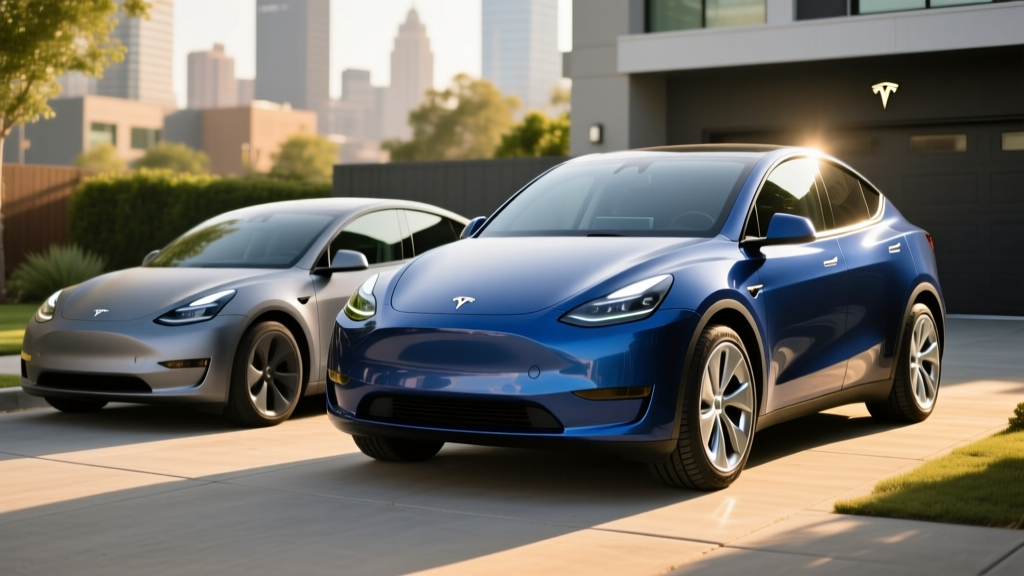
The Model Y remains America's best-selling EV for good reason: it combines SUV practicality with sedan-like efficiency and access to Tesla's Supercharger network.
| Specification | RWD | Long Range AWD | Performance |
|---|---|---|---|
| EPA Range | 302 miles | 330 miles | 285 miles |
| Battery Capacity | 60 kWh (LFP) | 79 kWh (NMC) | 79 kWh (NMC) |
| 0-60 mph | 6.6 sec | 4.8 sec | 3.5 sec |
| Horsepower | 295 hp | 384 hp | 456 hp |
| Drivetrain | RWD | AWD (Dual Motor) | AWD (Dual Motor) |
| Efficiency (MPGe) | 123 MPGe | 117 MPGe | 111 MPGe |
| Efficiency (kWh/100mi) | 27 kWh | 29 kWh | 30 kWh |
| Towing Capacity | 3,500 lbs | 3,500 lbs | 3,500 lbs |
Model Y Real-World Range
EPA 285-330 miles. Practical expectations:
- Highway (70-75 mph): ~245-285 miles depending on trim and conditions
- Cold climate penalty: 20-35% reduction without preconditioning; Model Y's heat pump helps but doesn't eliminate winter range loss
- Loaded with cargo/passengers: Add 5-10% consumption vs. solo driving
For road trips, plan charging stops at 200-250 mile intervals to maintain a comfort buffer and account for elevation changes, HVAC use, and charging curve taper.
Space and Utility
- Passenger volume: 106 cu ft
- Cargo (rear seats up): 30 cu ft
- Cargo (rear seats folded): 72 cu ft
- Frunk: 4.1 cu ft
- Optional third row: Available on Long Range (adds two small seats, reduces cargo to 12 cu ft behind third row)
Charging and Road Trip Viability
Model Y shares the Model 3's charging architecture with one key advantage: access to Tesla's 50,000+ global Supercharger network, which consistently delivers higher uptime and easier plug-and-charge authentication than third-party networks.
With 250 kW V3 Superchargers now widespread and V4 (up to 350 kW) rolling out in select corridors, a Model Y Long Range can add ~200 miles of range in a 15-minute stop—enough for most drivers' bladder-and-stretch breaks.
Autopilot and FSD: What You're Actually Getting
Tesla's driver-assistance technology remains a key differentiator, but clarity on capabilities is essential:
SAE Automation Level: Level 2
Both Autopilot (standard) and Full Self-Driving Supervised ($8,000 option or $99/month) are Level 2 driver-assistance systems. This means:
- The driver must remain fully engaged and monitor the road at all times
- Hands must be on or near the steering wheel (torque-based monitoring)
- The system does NOT make the vehicle autonomous or self-driving
- You are legally and operationally responsible for the vehicle's actions
Autopilot (included): Traffic-aware cruise control, autosteer (lane centering), automatic emergency braking, blind-spot monitoring
FSD Supervised (optional): All Autopilot features plus auto lane change, navigate on Autopilot (highway on/off-ramp assistance), autosteer on city streets, traffic light and stop sign recognition, smart summon
Honest assessment: FSD has improved significantly but remains inconsistent in construction zones, complex intersections, and adverse weather. Most owners use it as an advanced cruise control system, not a replacement for attentive driving. The $8,000 cost is difficult to justify unless you regularly drive long highway routes.
Pros, Cons, and the Verdict
Pros
- Best-in-class efficiency (lowest kWh/100mi in segments)
- Access to Supercharger network (most reliable DC fast-charging infrastructure)
- Over-the-air updates continuously add features
- Strong resale value relative to other EVs
- Minimalist interior reduces complexity and potential failure points
- LFP battery option allows daily 100% charging without degradation worry
Cons
- No physical buttons or stalks (everything via touchscreen)
- Panel gap and build quality inconsistencies still reported
- FSD is expensive and not truly autonomous despite the name
- Limited service center availability in rural areas
- No Apple CarPlay or Android Auto integration
- Rear visibility in Model 3 is compromised by design
Who Should Buy a Tesla in 2026?
Choose Tesla if:
- Commuters: Model 3 RWD offers 341 miles of range and 132 MPGe efficiency for under $32k after tax credits
- Families needing space: Model Y Long Range provides 330 miles, 72 cu ft cargo, and optional third row
- Road trippers: Supercharger network remains the most reliable cross-country charging option
- Tech-forward buyers: OTA updates, app integration, and Sentry Mode offer features competitors haven't matched
Look elsewhere if:
- You prefer traditional controls and instrument clusters (consider Hyundai Ioniq 6 or BMW i4)
- You need a truck bed (Rivian R1T or Ford F-150 Lightning)
- You want luxury materials and dealer service (BMW iX, Mercedes EQE)
- You regularly tow heavy loads (Rivian R1S or F-150 Lightning offer 7,700+ lb capacity)
Competitive Comparison
At current pricing, the Model 3 and Model Y face stiff competition:
| Vehicle | Starting Price | EPA Range | Key Advantage vs Tesla |
|---|---|---|---|
| Hyundai Ioniq 6 | $37,500 | 361 miles | Faster 800V charging (10-80% in 18 min) |
| Ford Mustang Mach-E | $42,995 | 320 miles | More conventional interior, BlueCruise hands-free |
| Chevrolet Equinox EV | $33,000 | 319 miles | Lower base price, traditional dealer network |
| Kia EV6 | $42,600 | 310 miles | 800V architecture, more physical controls |
The Tesla advantage: Efficiency and charging infrastructure. No competitor matches Tesla's kWh/100mi figures, and the Supercharger network's reliability still outpaces Electrify America, EVgo, and ChargePoint in uptime and ease of use.
Frequently Asked Questions
What is the real-world range of Tesla Model 3 and Model Y?
Expect 85-90% of EPA estimates in mixed highway driving, and 70-80% in cold weather without preconditioning. Model 3 Long Range delivers ~340-360 real-world miles; Model Y Long Range delivers ~280-300 miles in typical conditions.
How fast do Teslas charge at home and on the road?
At home with a 48A Wall Connector (11.5 kW), you'll add ~44 miles per hour—enough for a full overnight charge. On DC fast chargers, Model 3/Y Long Range and Performance peak at 250 kW, delivering 10-80% in ~25-30 minutes. The RWD models with LFP batteries peak lower at 170 kW.
How much does a Tesla cost after tax credits?
With the $7,500 federal tax credit (if eligible), a Model 3 RWD drops to ~$31,490 and a Model Y Long Range to ~$42,490. State incentives (California, Colorado, New York, etc.) can reduce prices further, but vary by location and income.
Does Tesla qualify for the federal EV tax credit?
Yes, Tesla's US-manufactured vehicles currently qualify for up to $7,500 under §30D, subject to buyer income limits, MSRP caps, and battery sourcing requirements. Verify eligibility at IRS.gov before purchase, as rules tighten annually.
Is Tesla's Autopilot or FSD actually self-driving?
No. Both are SAE Level 2 driver-assistance systems requiring full driver attention and hands-on-wheel supervision. Only Level 4 robotaxi services like Waymo operate without a human driver.
What are the biggest drawbacks of owning a Tesla?
The touchscreen-only interface frustrates some drivers, build quality can be inconsistent, service centers are sparse outside major metros, and the lack of Apple CarPlay/Android Auto is a dealbreaker for some. FSD's $8,000 cost is hard to justify given its current capabilities.
Should I buy the LFP (RWD) or NMC (Long Range) battery?
Choose LFP if you want to charge to 100% daily, prioritize longevity, and don't need maximum range. Choose NMC if you need the longest possible range, fastest charging speeds, and don't mind limiting daily charges to 80%.
Bottom Line: Are Current Tesla Deals Worth It?
At 2026 pricing, the Model 3 and Model Y represent genuine value—particularly the RWD trims with LFP batteries. The combination of industry-leading efficiency, Supercharger access, and post-tax-credit pricing under $32k (Model 3) or $38k (Model Y) is difficult to beat.
However, "deals" depend on your specific needs. If you prioritize traditional controls, luxury materials, or hands-free driving tech from BlueCruise or Super Cruise, competitors offer compelling alternatives. But for efficiency-focused buyers who value charging infrastructure and software innovation, Tesla's current pricing makes electrification more accessible than ever.
Sources: EPA Fuel Economy, IRS Clean Vehicle Credits, Tesla Owner's Manual