Why Tesla's Data Center Matters to EV Buyers
When most shoppers evaluate a Tesla Model 3 or Model Y, they look at EPA range, 0-60 times, and monthly payments. But a growing slice of buyers are searching for Tesla data center capabilities — and for good reason. Tesla's cloud infrastructure, anchored by its Dojo supercomputer and massive GPU clusters, is the invisible backbone behind Full Self-Driving (Supervised), over-the-air (OTA) updates, battery health analytics, and the energy forecasting that optimizes Supercharger routing on long road trips.
This isn't a review of a single vehicle. It's an owner-focused briefing on how Tesla's data center and AI infrastructure tangibly affect the cars you can buy today — the 2026 Model 3, Model Y, Model S, and Model X — and what that means for range accuracy, charging speed, FSD capability, and long-term ownership value.
The Tesla Data Center Stack: Dojo, Cortex, and the Cloud Behind Your EV
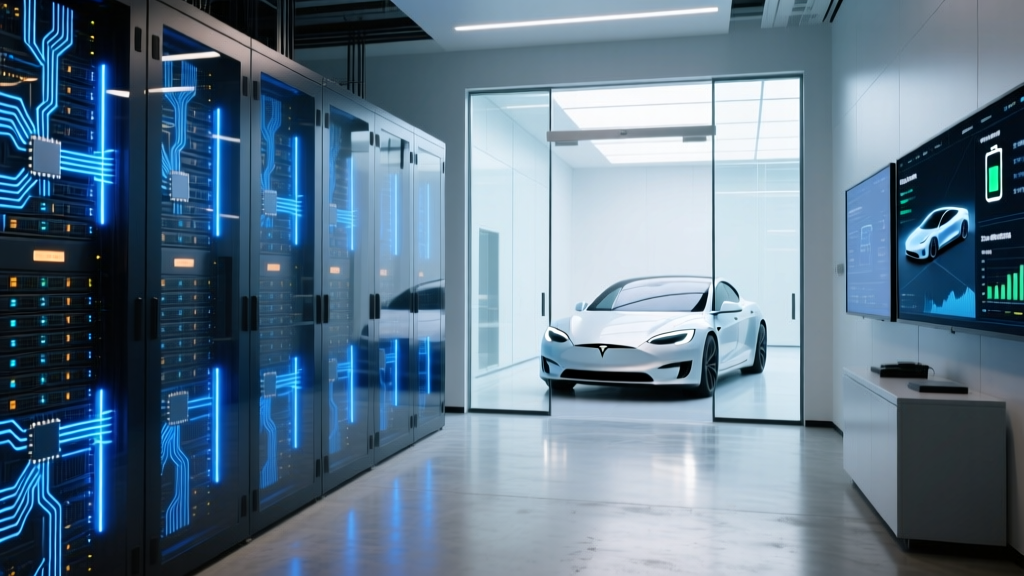
Tesla operates one of the most aggressive AI training pipelines in the automotive industry, built on three pillars:
- Dojo: Tesla's in-house supercomputer, purpose-built to train neural networks on video data captured by Tesla's fleet of millions of vehicles. Dojo uses Tesla's custom D1 chip and is optimized for vision-based autonomous-driving workloads.
- Cortex (NVIDIA GPU clusters): Tesla has deployed tens of thousands of NVIDIA H100 GPUs at its Gigafactory Texas data facility (often referred to internally as "Cortex") for large-scale training of FSD models, including the end-to-end neural net architecture introduced in FSD v12 and refined through 2025-2026.
- Fleet telemetry infrastructure: Every Tesla on the road streams anonymized driving data, battery telemetry, and charging-session metadata back to Tesla's cloud. This data loop is what allows OTA updates to improve range estimation, thermal management, and regen braking profiles without a service-center visit.
For owners, the practical upshot is that a Tesla's software — and therefore its driving behavior, efficiency, and feature set — is continuously refined by a data center processing billions of real-world driving miles. According to Tesla's Autopilot safety report, the fleet has logged well over 10 billion miles on Autopilot, feeding directly into model improvements.
How Tesla's AI Infrastructure Affects the 2026 Fleet
The data center doesn't just power FSD. It shapes the ownership experience across four areas buyers should understand before purchasing:
1. Real-World Range Estimation
Tesla's navigation system uses fleet-derived data to predict energy consumption on specific routes, factoring in elevation, ambient temperature, wind, and traffic. This is why a Tesla's "rated range" display often proves more accurate on road trips than the EPA sticker alone — the car has learned from millions of similar trips taken by other Tesla drivers.
2. Supercharger Routing and Preconditioning
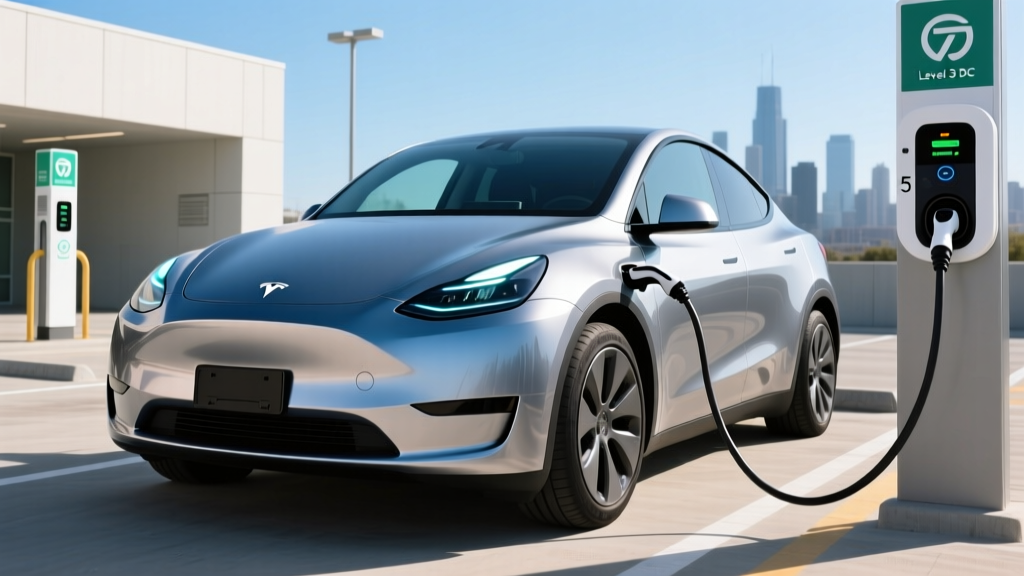
When you navigate to a Supercharger, the car's thermal management system begins preconditioning the battery to hit peak charge rates upon arrival. The exact preconditioning target temperature is refined continuously using fleet charging data — meaning your 2026 Model Y charges slightly faster at a V3 Supercharger than a 2023 Model Y running older firmware, all else being equal.
3. Battery Health Monitoring
Tesla's backend analyzes cell-level voltage variance, internal resistance trends, and charge-cycle history across the fleet. If your battery shows early signs of anomalous degradation, Tesla's system can flag it under warranty before you notice a range drop. This fleet-scale monitoring is a direct product of the data center infrastructure.
4. FSD (Supervised) Capability
Full Self-Driving (Supervised) — which remains an SAE Level 2 driver-assist system requiring active driver supervision — is trained almost entirely on fleet data processed through Dojo and Cortex. The end-to-end neural network architecture replaces legacy rule-based code with models trained on billions of frames of real-world driving video.
2026 Tesla Fleet: Core Specs Table
Here's how the current Tesla lineup stacks up — the vehicles whose performance, charging, and software are directly shaped by Tesla's data center operations.
| Spec | 2026 Model 3 LR AWD | 2026 Model Y LR AWD | 2026 Model S LR | 2026 Model X LR |
|---|---|---|---|---|
| EPA Range | 363 mi | 320 mi | 402 mi | 335 mi |
| Battery (usable) | ~75 kWh (NMC) | ~75 kWh (NMC) | ~95 kWh (NMC) | ~95 kWh (NMC) |
| Peak DC Charge | 250 kW | 250 kW | 250 kW | 250 kW |
| 10-80% DCFC | ~25 min | ~27 min | ~30 min | ~32 min |
| Level 2 Rate | 11.5 kW (~44 mi/hr) | 11.5 kW (~44 mi/hr) | 11.5 kW (~37 mi/hr) | 11.5 kW (~34 mi/hr) |
| 0-60 mph | 4.2 sec | 4.8 sec | 3.1 sec | 3.8 sec |
| Horsepower | ~346 hp | ~384 hp | ~670 hp | ~670 hp |
| Drivetrain | Dual-Motor AWD | Dual-Motor AWD | Dual-Motor AWD | Dual-Motor AWD |
| MPGe (combined) | 132 MPGe | 122 MPGe | 120 MPGe | 102 MPGe |
| Cargo (rear+frunk) | 23 + 3.1 cu ft | 30 + 4.1 cu ft | 28 + 3.1 cu ft | 88 + 6.5 cu ft |
| Base MSRP | $47,740 | $48,990 | $79,990 | $84,990 |
| Battery Warranty | 8 yr / 120,000 mi | 8 yr / 120,000 mi | 8 yr / 150,000 mi | 8 yr / 150,000 mi |
Sources: fueleconomy.gov, Tesla.com specifications. Specs reflect 2026 model year Long Range AWD trims. Prices exclude destination fee.
Real-World Range: What the Data Center Can't Fully Fix
Model 3 LR AWD: EPA 363 mi → expect ~300-320 mi highway at 70 mph; ~260-280 mi in sub-30°F winter conditions.
Model Y LR AWD: EPA 320 mi → expect ~265-285 mi highway; ~230-250 mi in cold weather.
Model S LR: EPA 402 mi → expect ~330-355 mi highway; ~290-310 mi in cold weather.
Model X LR: EPA 335 mi → expect ~275-295 mi highway; ~240-260 mi in cold weather.
Cold-weather range loss of 15-25% is typical for NMC batteries. Tesla's heat pump (standard on all 2026 models) mitigates cabin-heating losses but cannot fully eliminate cell-chemistry efficiency drops in extreme cold.
Tesla's data center improves range prediction — the car's nav will tell you with increasing accuracy whether you'll arrive with 8% or 14% battery remaining. But it cannot change the physics of lithium-ion cells in cold weather or the aerodynamic drag penalty at highway speeds. The Highland-refresh Model 3 and Juniper-refresh Model Y benefit from improved thermal management algorithms trained on fleet data, but buyers in northern climates should still budget 20-25% range loss in winter.
Charging Speed: Where Fleet Data Meets Physics
| Charging Level | Power | Rate (Model 3/Y) | Rate (Model S/X) |
|---|---|---|---|
| Level 1 (120V) | ~1.4 kW | ~3-4 mi/hr | ~3 mi/hr |
| Level 2 (240V, 48A) | 11.5 kW | ~44 mi/hr | ~34-37 mi/hr |
| DC Fast (V3 Supercharger) | Peak 250 kW | ~170 mi in 15 min | ~200 mi in 15 min |
Charging curve reality: The 250 kW peak applies only at low state-of-charge (SoC), typically below 35-40%. Above 50% SoC, charge rate tapers significantly — often dropping to 80-100 kW by 60% and below 50 kW above 80%. This is why Tesla quotes 10-80% times rather than 0-100%. The data center refines the charge-curve algorithm via OTA updates, but battery chemistry and thermal limits are non-negotiable physics.
Tesla's NACS (North American Charging Standard) connector is now the industry standard, with Ford, GM, Rivian, Hyundai, and others adopting it. For Tesla owners, this means the Supercharger network — over 6,000 U.S. stalls as of early 2026 — remains a significant competitive moat, though increased non-Tesla traffic at some stations has raised wait times at popular corridors.
Pricing, Tax Credits, and Total Cost
| Model | Base MSRP | §30D Credit Eligibility | Effective Price (est.) |
|---|---|---|---|
| Model 3 LR AWD | $47,740 | Partial — up to $3,750* | ~$43,990 |
| Model Y LR AWD | $48,990 | Partial — up to $3,750* | ~$45,240 |
| Model S LR | $79,990 | Not eligible (MSRP cap) | $79,990 |
| Model X LR | $84,990 | Not eligible (MSRP cap) | $84,990 |
*Tax credit amounts and eligibility under IRS §30D change frequently based on battery sourcing, critical-mineral requirements, buyer income caps ($150K single / $300K joint AGI), and MSRP caps ($55K sedans / $80K SUVs/trucks). As of 2026, Tesla Model 3 and Model Y may qualify for partial credits depending on battery-component sourcing. Always verify current eligibility at IRS.gov and consult a tax professional. Point-of-sale transfer is available at participating dealers.
Who Should Buy a Tesla in 2026?
Best for: Tech-forward commuters and road-trippers who value the Supercharger network, OTA-driven feature improvements, and the tightest software-hardware integration in the EV market. Model 3 remains the efficiency-per-dollar leader; Model Y suits families needing cargo space and optional third-row seating.
Look elsewhere if: You want the maximum federal tax credit (competitors like the Hyundai Ioniq 5 and Chevrolet Equinox EV may qualify for the full $7,500), you prefer physical controls over touchscreen-only interfaces, or you need a truck (Cybertruck exists but sits outside this comparison).
Pros and Cons
✅ Pros
- Class-leading Supercharger network access (6,000+ U.S. stalls)
- OTA updates continuously improve vehicle via fleet data
- Top-tier energy efficiency (Model 3: 132 MPGe combined)
- Strong resale value relative to most EV competitors
- Dojo/AI pipeline means FSD and safety features improve over time
- Minimalist interior with premium materials (Highland/Juniper refresh)
❌ Cons
- Partial or no federal tax credit on most trims (sourcing rules)
- Touchscreen-only controls frustrate some drivers
- FSD ($8,000 option) remains Level 2 — not autonomous
- 250 kW peak DCFC lags Hyundai/Kia 800V architecture (350 kW)
- Increasing Supercharger congestion from non-Tesla EVs
- No Apple CarPlay / Android Auto integration
Tesla vs. Key Competitors: Where the Data Center Gap Shows
No other automaker currently matches Tesla's vertically integrated data pipeline — from fleet telemetry to in-house supercomputer to OTA deployment. Hyundai's Ioniq 5 charges faster (350 kW peak on 800V architecture, 10-80% in ~18 min) and may qualify for the full $7,500 credit. The BMW i4 offers more traditional luxury with Apple CarPlay. But neither has Tesla's real-time fleet-learning loop.
The question for buyers is whether that data advantage translates to tangible daily value. For FSD users who regularly engage the system on highway commutes, the answer is yes — Tesla's vision-based system handles complex merges and construction zones with increasing competence. For buyers who never plan to use FSD and simply want efficient point-A-to-B transportation, the data center advantage is less decisive, and competitors' lower effective prices (post-credit) become more compelling.
Frequently Asked Questions
What is the real-world range of a 2026 Tesla Model 3 Long Range?
EPA-rated at 363 miles, real-world highway driving at 70 mph yields approximately 300-320 miles in mild weather and 260-280 miles in sub-freezing temperatures. Tesla's navigation system uses fleet data to provide trip-specific range predictions that are generally more accurate than the EPA sticker alone.
How fast does a Tesla charge at home and on the road?
On a Level 2 home charger (11.5 kW / 48A), a Model 3 or Model Y gains roughly 44 miles of range per hour — a full overnight charge is easily achievable. On a V3 Supercharger, peak rate is 250 kW, adding up to 170 miles in 15 minutes at low SoC, though the charge curve tapers significantly above 50% state of charge. Expect 10-80% in approximately 25-27 minutes for Model 3/Y.
How much does a 2026 Tesla cost after tax credits?
The Model 3 LR AWD starts at $47,740 and may qualify for up to $3,750 in federal tax credits under §30D, depending on battery sourcing compliance. The Model Y LR AWD starts at $48,990 with similar partial credit potential. Model S and Model X exceed the MSRP cap and are ineligible. Always verify current rules at IRS.gov — sourcing requirements and credit amounts are subject to change.
Is Tesla's data center advantage worth paying for vs. competitors?
If you value continuous OTA improvement, the most reliable DC fast-charging network, and plan to use Autopilot or FSD regularly, Tesla's data-driven ecosystem provides measurable daily value. If you prioritize maximum tax-credit savings, physical controls, faster peak charging (Hyundai/Kia 800V), or Apple CarPlay, competitors like the Ioniq 5, BMW i4, or Ford Mustang Mach-E may be a better fit.
Does Tesla's Dojo supercomputer make FSD self-driving?
No. FSD (Supervised) is an SAE Level 2 driver-assist system. Regardless of how much computing power Tesla's data center applies to training, the driver must remain fully engaged at all times. Dojo improves the system's capability and edge-case handling, but does not change the legal or practical requirement for human supervision. Only Level 4 services like Waymo operate without a human driver.
What is the battery warranty on a 2026 Tesla?
Model 3 and Model Y carry an 8-year / 120,000-mile battery and drive-unit warranty. Model S and Model X carry 8-year / 150,000-mile coverage. Tesla warrants that the battery will retain a minimum of 70% capacity over the warranty period. Fleet-wide battery health data processed through Tesla's data center enables proactive degradation monitoring and warranty claims.