If you live in the Dallas-Fort Worth metroplex and are considering a Tesla, you're shopping in one of the most EV-active markets in the country. Texas has become a critical battleground for electric vehicle adoption, and Dallas specifically offers a unique mix of long suburban commutes, extreme summer heat, and a rapidly maturing public-charging network. But Dallas also presents challenges that buyers in milder climates don't face: 110°F August afternoons that tax battery thermal management, sprawling highway commutes where efficiency matters more than city regen, and a state with no purchase-time EV rebate to supplement federal incentives.
This guide walks through what it actually means to own a Tesla in Dallas in 2026 — covering the current Model 3 and Model Y lineup (the two vehicles most Dallas buyers cross-shop), real-world range in Texas heat, home and public charging infrastructure across DFW, total cost of ownership, and whether the federal tax credit applies to your situation.
Which Tesla Models Make Sense for Dallas Buyers?
Tesla's 2026 lineup available in Texas centers on two high-volume models and two premium options. For the vast majority of Dallas shoppers, the decision comes down to the Model 3 (sedan) or Model Y (crossover SUV). Both are built at Giga Texas in Austin, meaning delivery times to Dallas are typically short — often 2-4 weeks from order to pickup at the Dallas delivery center.
| Spec | Model 3 Long Range AWD | Model Y Long Range AWD |
|---|---|---|
| EPA Range | 341 miles | 320 miles |
| Battery (usable) | ~75 kWh (NMC) | ~75 kWh (NMC) |
| RWD Base Battery | ~57.5 kWh (LFP) | N/A (AWD only for '26) |
| Peak DC Fast Charge | 250 kW | 250 kW |
| 10-80% DCFC Time | ~25 min | ~27 min |
| Level 2 Home Charge | 11.5 kW (~44 mi/hr) | 11.5 kW (~40 mi/hr) |
| 0-60 mph | 4.2 sec | 4.8 sec |
| Horsepower | 346 hp | 384 hp |
| Drivetrain | Dual Motor AWD | Dual Motor AWD |
| Efficiency (MPGe) | 134 MPGe combined | 122 MPGe combined |
| Efficiency (kWh/100mi) | 25 kWh/100 mi | 28 kWh/100 mi |
| Cargo (rear seats up) | 23 cu ft | 30 cu ft |
| Cargo (seats folded) | ~50 cu ft | ~72 cu ft |
| Rear Legroom | 35.2 in | 41.6 in |
| Battery Warranty | 8 yr / 120,000 mi | 8 yr / 120,000 mi |
| Base MSRP | $42,630 | $44,630 |
Source: fueleconomy.gov and Tesla's official specification pages. Specs reflect the 2026 model year.
The RWD Model 3 (starting around $36,630) uses an LFP (lithium iron phosphate) battery — a chemistry worth understanding before you buy. LFP batteries tolerate being charged to 100% daily without accelerated degradation, making them ideal for commuters who need full range every morning. However, LFP has lower energy density and performs slightly worse in extreme cold. For Dallas, where cold isn't the primary concern, LFP is a strong match. The trade-off: less total range (EPA 272 miles) and slightly slower DC fast charging (~200 kW peak).
Real-World Range in Texas Heat: What the EPA Number Doesn't Tell You
EPA Sticker vs. Dallas Reality
Model 3 Long Range: EPA 341 mi → Expect ~290-310 mi on I-35E at 75 mph in moderate temps; ~260-280 mi in August heat with cabin cooling at max.
Model Y Long Range: EPA 320 mi → Expect ~270-290 mi highway in spring/fall; ~240-260 mi in peak summer.
Winter impact: Dallas rarely drops below freezing for long, so cold-weather range loss is minimal — typically 5-8%, far less than northern states.
Tesla's thermal management system is among the best in the industry, but physics still applies. When ambient temperatures hit 100°F+ along the I-35 corridor in July and August, the battery cooling system draws additional energy to keep the pack in its optimal temperature window. Combined with aggressive A/C use (which typically draws 2-4 kW continuously), expect a 10-15% reduction from EPA range during the worst of Texas summer.
On the positive side, Dallas's flat terrain works in your favor. Unlike buyers in Denver or San Francisco, you won't see dramatic efficiency swings from elevation changes. A steady-speed commute on SH-121 or the George Bush Turnpike at 65-70 mph will return efficiency numbers very close to the EPA's combined rating.
Charging a Tesla in Dallas: Home Setup and the DFW Public Network
Charging infrastructure is where Tesla ownership in Dallas gets compelling — and where some homework pays off.
Home Charging (Where 85%+ of Your Charging Will Happen)
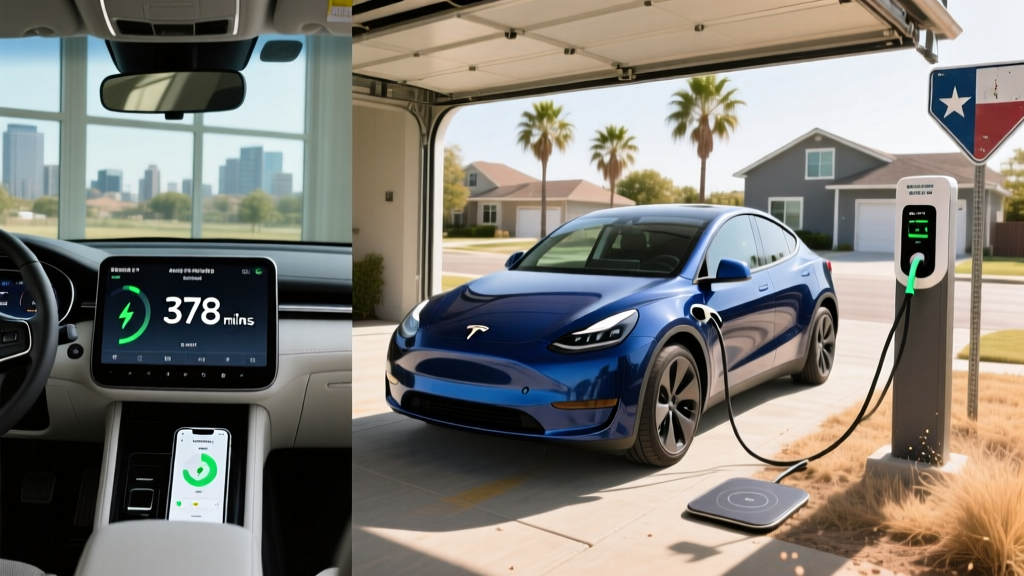
Most Dallas-area homes have 200-amp electrical panels with sufficient capacity for a Level 2 charger installation. Tesla's Wall Connector ($420 for the unit) delivers up to 11.5 kW on a 60-amp circuit (48-amp continuous draw), adding roughly 40-44 miles of range per hour of charging. An overnight session from 10 PM to 6 AM easily replenishes 200+ miles — more than enough for any daily Dallas commute.
| Level | Power | Miles Added/Hour | Best For |
|---|---|---|---|
| Level 1 (120V outlet) | ~1.2 kW | ~3-5 mi/hr | Emergency/trickle |
| Level 2 (240V, 48A) | 11.5 kW | ~40-44 mi/hr | Daily home charging |
| DC Fast (Supercharger) | Up to 250 kW | ~200+ mi in 15 min | Road trips |
Expect to pay $800-$1,800 for a professional Level 2 installation in the DFW area (including the Wall Connector, permit, and electrician labor) if your panel is close to the garage and no upgrade is needed. Homes in older neighborhoods like Lakewood or Highland Park may require a panel upgrade ($1,500-$3,000 additional) if the existing service is 100 amps or the panel is at capacity. Always get a load calculation from a licensed electrician before committing.
Public Charging: Tesla Superchargers Across DFW
The Dallas-Fort Worth metroplex has one of the densest Supercharger networks in the country, with V3 (250 kW) and newer V4 stalls at locations including:
- North Dallas: Galleria area, Addison, Plano (Legacy West)
- South Dallas: I-35E and I-20 corridors
- Fort Worth: Sundance Square, Hulen area
- Suburban ring: Frisco, McKinney, Mansfield, Arlington
At a V3 Supercharger, a Model 3 Long Range will peak at 250 kW and charge from 10-80% in roughly 25 minutes — though the charge curve tapers significantly above 60%, so the last 20% takes disproportionately longer. Tesla's navigation system handles preconditioning automatically when you route to a Supercharger, warming or cooling the battery to optimize charge speed on arrival.
With NACS (North American Charging Standard) now the dominant connector, Tesla owners in Dallas also have growing access to non-Tesla networks. Electrify America, EVgo, and ChargePoint stations with NACS connectors are increasingly available, though reliability and peak speeds still vary compared to Tesla's own Supercharger network.
Pricing, Tax Credits, and True Cost of Ownership in Texas
Understanding what you'll actually pay requires navigating the federal tax credit, Texas's lack of state EV incentives, and the higher insurance premiums that Teslas tend to carry.
Federal §30D Tax Credit: Do You Qualify?
IRS §30D Federal EV Tax Credit Requirements (2026):
- Vehicle MSRP cap: ≤$55,000 for sedans (Model 3); ≤$80,000 for SUVs/trucks (Model Y)
- Buyer income cap: AGI ≤$150,000 (single) / ≤$300,000 (joint)
- Battery sourcing: Critical minerals and battery components must meet escalating domestic-content thresholds per IRS guidelines
- Point-of-sale transfer: Eligible buyers can transfer the credit to the dealer for an immediate price reduction
- Assembly: Vehicle must undergo final assembly in North America (both Model 3 and Model Y qualify — built at Giga Texas)
As of the 2026 model year, the Model Y Long Range AWD qualifies for the full $7,500 federal credit when purchased by an eligible buyer. The Model 3 Long Range AWD also qualifies, though specific trim and battery-sourcing compliance should be verified at the time of purchase, as Tesla's supply chain details shift. The base RWD Model 3 with LFP battery has had more variable credit eligibility due to the LFP cells' overseas sourcing — confirm with Tesla's checkout page and your tax professional before relying on the credit.
| Model / Trim | Base MSRP | After $7,500 Credit* | Typical As-Tested |
|---|---|---|---|
| Model 3 RWD (LFP) | $36,630 | ~$29,130 (if eligible) | $38,000-$40,000 |
| Model 3 Long Range AWD | $42,630 | ~$35,130 | $45,000-$49,000 |
| Model 3 Performance | $52,630 | ~$45,130 | $55,000-$58,000 |
| Model Y Long Range AWD | $44,630 | ~$37,130 | $48,000-$53,000 |
| Model Y Performance | $51,630 | ~$44,130 | $54,000-$57,000 |
*Credit eligibility depends on buyer AGI, battery sourcing compliance, and MSRP caps. Verify at purchase. Texas does not offer a state EV purchase rebate.
Total Cost of Ownership: Dallas-Specific Factors
Electricity costs in the Dallas area (served by Oncor and CoServ among others) average $0.12-$0.16/kWh on standard residential rates, with time-of-use plans offering rates as low as $0.06-$0.08/kWh overnight. Charging a Model Y Long Range from 20-80% at home costs roughly $7-$9 — compared to $45-$55 for a comparable fill-up in a gas-powered RAV4 at $3.10/gallon.
However, Dallas buyers should budget for:
- Insurance: Teslas carry higher premiums in Texas — expect $2,200-$3,200/year for a Model Y in the DFW area (vs. ~$1,600-$2,000 for a comparable gas SUV). Get quotes before ordering.
- Registration: Texas charges an additional $200 annual EV registration fee to offset lost gas tax revenue.
- Tires: Tesla's weight and instant torque accelerate tire wear. Budget $800-$1,200 for a set of four every 30,000-40,000 miles.
- No state rebate: Unlike some states, Texas offers no additional purchase incentive beyond the federal credit.
Autopilot, FSD, and Tech: What Dallas Drivers Actually Get
SAE Automation Level: Level 2 (Driver Assistance, NOT Self-Driving)
Tesla's Autopilot and Full Self-Driving (Supervised) are Level 2 systems per SAE classification. The driver must remain attentive, hands on or near the wheel, and ready to take over at any moment. These systems do not make the vehicle autonomous.
Every 2026 Tesla ships with Basic Autopilot (lane centering, adaptive cruise control, traffic-aware braking) included. The FSD (Supervised) package — currently an $8,000 one-time purchase or $99/month subscription — adds automatic lane changes, navigation-guided on-ramp to off-ramp driving, traffic light and stop sign recognition, and enhanced parking features.
On Dallas highways (I-635, I-35, the Tollway system), Autopilot performs well in clear conditions. FSD handles most highway interchanges competently but requires active supervision, particularly in Dallas's notorious construction zones where lane markings shift and temporary barriers confuse vision systems. In heavy DFW rain, expect more frequent disengagement requests.
Other standout tech:
- 15.4" touchscreen (Model 3 refresh) with responsive UI and integrated navigation with Supercharger routing
- Sentry Mode — valuable in any urban environment; records incidents around the parked car
- Over-the-air updates that regularly add features and refine efficiency
- Dog Mode / Camp Mode — climate control while parked, useful for Texas heat when leaving pets briefly
Notable Drawbacks for Dallas Owners:
- No Apple CarPlay or Android Auto — Tesla uses its proprietary infotainment system exclusively
- No traditional instrument cluster in the Model 3 (all info on center screen)
- Build quality has improved but panel gaps and minor trim issues still surface — inspect carefully at delivery
- Service center wait times in DFW can stretch 2-3 weeks for non-urgent repairs during high-volume periods
- FSD (Supervised) remains a Level 2 system despite the "Full Self-Driving" name — do not expect hands-off driving
Tesla vs. the Competition: How Do Rivals Stack Up in Dallas?
Dallas EV buyers have more choices than ever. Here's how the Tesla Model Y Long Range compares to its most-shopped alternatives:
| Spec | Tesla Model Y LR | Hyundai Ioniq 5 LR | Ford Mustang Mach-E ER |
|---|---|---|---|
| EPA Range | 320 mi | 305 mi | 305 mi |
| Peak DC Charge | 250 kW | 350 kW (800V) | 150 kW |
| 10-80% DCFC | ~27 min | ~18 min | ~40 min |
| Connector | NACS (native) | NACS (2026) | NACS (2026) |
| Base MSRP | $44,630 | $46,500 | $43,995 |
| Charging Network | Supercharger (best) | Supercharger + public | Supercharger + public |
| Cargo (rear up) | 30 cu ft | 27 cu ft | 29.7 cu ft |
The Hyundai Ioniq 5's 800-volt architecture gives it a clear DC fast-charging advantage — 18 minutes from 10-80% versus Tesla's 27. On road trips along I-35 to Austin or I-45 to Houston, those faster stops add up. However, Tesla's Supercharger network remains more reliable and widespread in Texas than any third-party network, even as competitors gain NACS access.
Choose the Tesla Model Y if:
- Supercharger reliability is your top priority for Texas road trips
- You want the lowest kWh/100mi efficiency in the segment
- Over-the-air updates and software integration matter to you
- You value Tesla's mobile service and expanding DFW service footprint
Choose the Hyundai Ioniq 5 if:
- Fastest possible DC charging speed is critical (800V architecture)
- You prefer a more traditional crossover interior with physical controls
- Apple CarPlay/Android Auto is non-negotiable
Choose the Ford Mach-E if:
- You prefer Ford's dealer service network for peace of mind
- You want a sportier driving feel and BlueCruise on compatible highways
Pros, Cons, and the Bottom Line for Dallas Buyers
Pros
- Class-leading efficiency (25-28 kWh/100 mi) keeps operating costs low
- Supercharger network is the most reliable in Texas — no adapter needed
- Built in Austin — short delivery times, strong regional support
- Excellent thermal management handles 110°F summers well
- OTA updates continuously improve the vehicle
- $7,500 federal credit available (eligibility dependent)
- Strong resale value relative to most EV competitors
Cons
- No Apple CarPlay / Android Auto
- Insurance premiums 30-50% higher than comparable gas vehicles in DFW
- Service center wait times can be long for non-critical issues
- FSD name is misleading — remains Level 2 driver assist
- Panel gap and build quality inconsistencies still surface
- Texas $200 annual EV registration fee
- LFP base battery (Model 3 RWD) has lower range and DC charge speed
For Dallas buyers, a Tesla — particularly the Model Y Long Range AWD — remains one of the most rational EV purchases available. The combination of Giga Texas proximity, Supercharger density across DFW and the state, best-in-class efficiency, and available federal tax credit creates a compelling ownership proposition. The biggest friction points are insurance costs, the proprietary infotainment ecosystem, and the reality that Tesla service infrastructure in DFW, while growing, still lags behind legacy dealer networks in convenience.
If your daily commute is under 60 miles round-trip (typical for Plano-to-downtown or Arlington-to-Fort Worth), even the base RWD Model 3 with its LFP battery covers your needs with margin to spare. If you regularly drive Dallas-Houston or Dallas-Austin, the Long Range AWD variants provide the buffer you need to handle summer heat range loss without stress.
Frequently Asked Questions
What is the real-world range of a Tesla in Dallas summers?
Expect 10-15% below EPA ratings during July and August when temperatures exceed 100°F. A Model Y Long Range rated at 320 miles EPA will typically deliver 260-280 miles of real highway range in peak summer heat with A/C running. Spring and fall efficiency is much closer to the EPA sticker.
How much does it cost to charge a Tesla at home in Dallas?
On a typical DFW residential rate of $0.13/kWh, fully charging a Model Y Long Range (~75 kWh usable) from empty costs about $9.75. On a time-of-use plan with overnight rates around $0.07/kWh, that drops to roughly $5.25. Most daily top-ups cost $2-$4.
Does the Tesla Model Y qualify for the $7,500 federal tax credit in 2026?
Yes, the Model Y Long Range AWD currently qualifies for the full $7,500 §30D credit for eligible buyers (AGI ≤$300K joint / ≤$150K single). The credit can be transferred at point of sale for an immediate price reduction. Verify battery-sourcing compliance on Tesla's checkout page at time of purchase, as requirements evolve. Consult a tax professional for your specific situation.
Is Tesla's Supercharger network better than other charging networks in Dallas?
For reliability and coverage, yes. Tesla's Supercharger network in DFW has consistently higher uptime and more predictable charge speeds than Electrify America, EVgo, or ChargePoint stations. While non-Tesla networks are adding NACS connectors, real-world reliability still lags. This remains Tesla's strongest competitive advantage.
How long does a Tesla battery last, and what does replacement cost?
Tesla warranties the battery for 8 years or 120,000 miles (whichever comes first) with a minimum 70% capacity retention threshold. Real-world data from high-mileage Teslas suggests 10-15% total degradation over 150,000-200,000 miles is typical. Out-of-warranty battery replacement currently costs $12,000-$16,000 depending on the model, though prices are declining as battery technology matures.
Is FSD worth buying for Dallas driving?
For highway commuting on I-635, I-35E, or the Tollway, the included Basic Autopilot handles lane-keeping and adaptive cruise well. FSD (Supervised) adds useful highway interchange automation but still requires constant supervision and struggles in construction zones. At $8,000 or $99/month, it's a personal value judgment — try the monthly subscription before committing to a purchase.