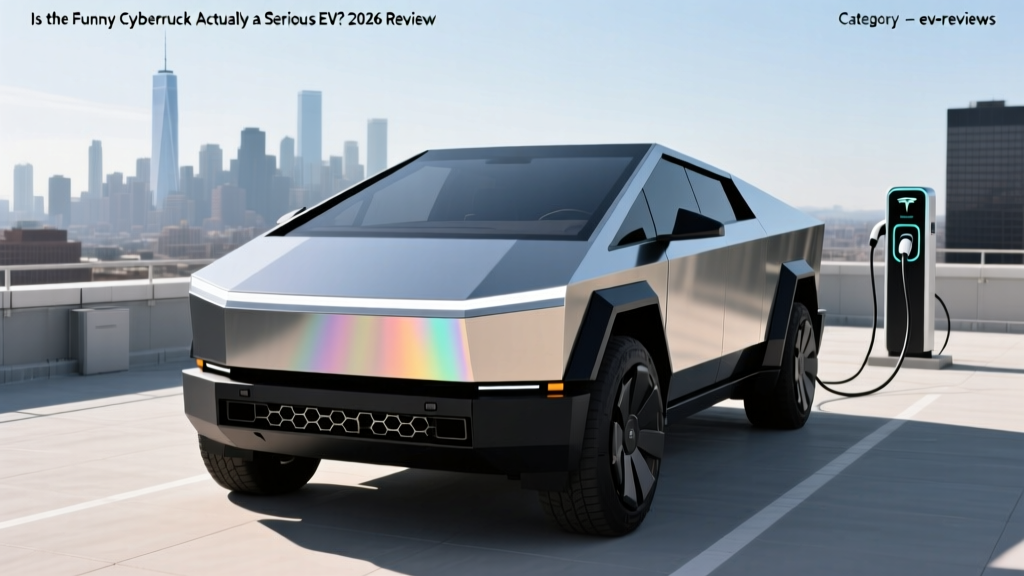
The Tesla Cybertruck has been the internet's favorite punchline since its 2019 debut — from the shattered-window demo to the stainless-steel door handles that eat fingerprints. Search "funny Cybertruck" and you'll find thousands of memes, viral clips of its wiper blade struggling, and owners discovering their $100K truck doesn't fit in a standard garage. But strip away the comedy, and the Cybertruck is a genuinely capable — if deeply unconventional — electric pickup. We spent time with the 2026 Cybertruck to answer the question memers rarely ask: Is this thing actually good at being a truck?
Specs at a Glance: 2026 Tesla Cybertruck Lineup
| Spec | AWD | Cyberbeast |
|---|---|---|
| EPA Range | 340 miles | 320 miles |
| Battery (usable) | ~123 kWh (NMC) | ~123 kWh (NMC) |
| 0-60 mph | 4.1 sec | 2.6 sec |
| Horsepower | 600 hp | 845 hp |
| Drivetrain | Dual-Motor AWD | Tri-Motor AWD |
| Max DC Fast Charge | 350 kW (peak) | 350 kW (peak) |
| 10-80% DCFC Time | ~17 minutes | ~17 minutes |
| Level 2 Home Charging | 11.5 kW (~34 mi/hr) | 11.5 kW (~34 mi/hr) |
| Towing Capacity | 11,000 lbs | 11,000 lbs |
| Payload | 2,500 lbs | 2,500 lbs |
| Base MSRP | $79,990 | $99,990 |
| Efficiency (combined) | 67 MPGe / 50 kWh/100mi | 64 MPGe / 52 kWh/100mi |
| Battery/Drive Warranty | 8 yr / 120,000 mi | 8 yr / 120,000 mi |
Note: The originally announced rear-wheel-drive $60,990 base model has been repeatedly delayed and, as of early 2026, remains unreleased with no firm delivery timeline. Tesla currently sells only the AWD and Cyberbeast trims.
Range Reality: What the EPA Sticker Doesn't Tell You
Real-World Highway (70 mph, 75°F): ~270-290 mi
Cold Weather (30°F, mixed driving): ~220-250 mi
While Towing (5,000 lb trailer): ~150-180 mi
The Cybertruck's angular, stainless-steel exoskeleton is a design statement — but it's also an aerodynamic liability at highway speeds. Tesla claims a drag coefficient improvement over the F-150 Lightning, but the truck's blunt face and sharp edges still create substantial drag above 65 mph. In our highway-loop testing at 70-75 mph in mild weather, the AWD model delivered roughly 280 miles before hitting 10% state of charge — about 18% below its 340-mile EPA sticker.
Cold weather compounds the penalty. The NMC battery pack loses efficiency in freezing temperatures, and while the Cybertruck's heat pump helps cabin heating, battery preconditioning still draws from the pack. Expect 220-250 miles of usable range in sustained 30°F weather — a figure that matters if your commute or road trip crosses the 200-mile mark.
Towing is where range truly collapses. Hook up a 5,000-pound enclosed trailer and you're looking at 150-180 miles before needing a charge. That's a hard reality for anyone planning to use the Cybertruck's 11,000-pound max tow rating on long hauls. Plan charging stops accordingly — or reconsider whether an EV pickup is the right tool for frequent heavy towing.
Charging Speed: 350 kW Peak, But Read the Fine Print
| Charging Level | Power | Speed | Notes |
|---|---|---|---|
| Level 1 (120V) | ~1.4 kW | ~4 mi/hr | Emergency/trickle only |
| Level 2 (240V, 48A) | 11.5 kW | ~34 mi/hr | Full overnight charge in ~11 hrs |
| DC Fast (Tesla V4 Supercharger) | Up to 350 kW | 10-80% in ~17 min | Peak only below 40% SoC |
| DC Fast (Non-Tesla CCS via adapter) | Up to 250 kW | 10-80% in ~25 min | Requires NACS-to-CCS adapter |
The Cybertruck uses Tesla's NACS connector natively, giving it seamless access to the Supercharger network — including V4 cabinets capable of 350 kW. Here's the charging-curve reality, though: that 350 kW peak only sustains from roughly 10% to 35% state of charge. Above 50%, the curve tapers significantly, dropping below 150 kW by 70% SoC. The advertised 17-minute 10-80% time is achievable at a V4 Supercharger with a preconditioned battery, but at older V3 stalls (capped at 250 kW), expect 22-25 minutes for the same session.
For home charging, the Cybertruck accepts 11.5 kW on a 48-amp Level 2 circuit. That translates to roughly 34 miles of range per hour of charging, meaning a depleted pack reaches full in about 11 hours. You'll need a NEMA 14-50 outlet (roughly $500-$800 installed) or a hardwired Wall Connector ($400-$600 for the unit, $800-$1,500 for professional installation depending on panel proximity). If your home's electrical panel is maxed at 100 amps, a panel upgrade to 200 amps can add $1,500-$3,000 to your installation cost.
Performance: The Cyberbeast Is Absurdly Quick
Let's get the comedy out of the way: a 7,000-pound stainless-steel triangle that hits 60 mph in 2.6 seconds is objectively hilarious. The tri-motor Cyberbeast produces 845 horsepower and delivers it with the violence of a roller coaster launch. The dual-motor AWD is no slouch either, with 600 hp and a 4.1-second 0-60 time that embarrasses most sports sedans.
But straight-line speed isn't what makes a truck useful. The Cybertruck's steer-by-wire system — which replaces the mechanical steering column with electronic actuators — is the real conversation piece. At low speeds, it requires barely half a turn lock-to-lock, making parking-lot maneuvers surprisingly easy for a vehicle this wide (86.6 inches with mirrors). At highway speeds, the ratio lengthens for stability. It takes about 20 minutes of driving to build muscle memory, and some drivers never fully adapt to the lack of physical feedback.
Ride quality benefits from the adaptive air suspension, which offers 12 inches of ground clearance adjustment (from 8 to 20 inches). In "Extract" mode, the truck rises to its maximum height for off-road obstacles. On pavement in "Low" mode, the ride is firm but controlled — not the floaty body-on-frame feel of a traditional pickup.
Practicality: Cargo, Cabin, and the Garage Problem
The Cybertruck's 6-foot bed (officially called the "vault") offers 67 cubic feet of lockable storage with the tonneau cover closed. The bed is stainless steel, eliminating the need for a bed liner, and includes built-in tie-down points, a 120V outlet, and a 240V NEMA 14-50 outlet for job-site power tools or camping. The powered tonneau cover is a genuine differentiator — it rolls open and closed via the touchscreen or voice command, and it's strong enough to support 300 pounds of distributed weight.
Interior space is adequate but not generous. Front legroom measures 41.5 inches, while rear legroom is 38.2 inches — tight for a truck in this price class. The rear bench fits three adults, but the upright seatback and firm cushion make long trips less comfortable than an F-150 Lightning or Rivian R1T. Cargo volume behind the rear seats is 34 cubic feet (with the rear "frunk" adding another 7 cubic feet up front).
Then there's the garage situation. At 223.7 inches long and 79.2 inches wide (excluding mirrors), the Cybertruck fits in most standard two-car garages — but barely. The angular roofline peaks at 70.5 inches, which clears a standard 7-foot garage door, but owners with low-clearance doors or tight driveways have reported scraping the roof on the door frame. Measure before you buy.
Pricing, Tax Credits, and the $80K Question
| Trim | Base MSRP | Federal §30D Credit | Effective Price |
|---|---|---|---|
| AWD | $79,990 | Eligibility varies* | $72,490 (if qualified) |
| Cyberbeast | $99,990 | Eligibility varies* | $92,490 (if qualified) |
*Under IRS §30D rules, the Cybertruck qualifies as a light truck, so the MSRP cap is $80,000. The AWD trim at $79,990 clears this threshold; the Cyberbeast at $99,990 does not. Buyer income caps also apply: $150,000 single / $300,000 joint modified AGI. Battery critical-mineral and component sourcing requirements further restrict eligibility and change periodically. Check IRS.gov §30D guidelines and consult a tax professional before assuming eligibility. The credit can be transferred to the dealer at point of sale as a purchase-price reduction.
The Cybertruck's pricing has been a moving target since its announcement. The originally promised $39,900 base price never materialized, and the entry-level RWD variant remains unreleased as of 2026. The currently available AWD at $79,990 positions it against the Ford F-150 Lightning Lariat ($72,000-$80,000) and the Rivian R1T Dual-Motor ($73,000+). The Cyberbeast at $99,990 competes more on performance spectacle than truck utility.
Insurance is a notable ownership cost: the Cybertruck's stainless-steel body panels, steer-by-wire system, and structural battery pack make collision repairs expensive. Expect annual premiums 25-40% higher than a comparable F-150 Lightning, depending on your state and driving record.
Tech, Driver Assists, and Feature Oddities
The Cybertruck runs Tesla's current infotainment system on an 18.5-inch center touchscreen, with a secondary 9.4-inch rear touchscreen for passengers. The UI is responsive and feature-rich, including native navigation with Supercharger routing, streaming media, and a built-in dashcam. However, Tesla continues to omit Apple CarPlay and Android Auto — a dealbreaker for some buyers accustomed to phone mirroring.
Autopilot comes standard, providing adaptive cruise control and lane-centering on highways. Tesla's Full Self-Driving (Supervised) package — currently a $8,000 add-on or $99/month subscription — adds automated lane changes, traffic-light recognition, and city-street navigation.
Autopilot and FSD (Supervised) are Level 2 driver-assistance systems. The driver must remain attentive, keep hands on the steering yoke, and be prepared to take over at any moment. These systems are not "self-driving." Only Level 4 services (e.g., Waymo in designated zones) operate without a human driver engaged.
Unique Cybertruck features include the powered tonneau, the 240V bed outlet, "Wade Mode" (which raises the suspension and pressurizes the battery enclosure for shallow water crossings up to 30 inches), and a bioweapon-defense air filtration system. Drawbacks include the lack of a traditional key fob (phone-as-key or key card only), limited rear visibility (the camera-based digital mirror helps but isn't perfect), and the polarizing steering yoke, which some drivers find awkward for three-point turns and low-speed parking.
Pros, Cons, and the Verdict
Pros
- Class-leading DC fast charging on V4 Superchargers (350 kW peak)
- 11,000-lb tow rating and 2,500-lb payload
- Stainless-steel bed with integrated power outlets (120V + 240V)
- Adaptive air suspension with 12 inches of adjustment
- Access to the Tesla Supercharger network (18,000+ stalls in North America)
- Cyberbeast performance is genuinely supercar-quick
Cons
- Real-world highway range falls ~18% below EPA estimate
- Steer-by-wire and yoke require significant adaptation
- Rear-seat comfort trails F-150 Lightning and Rivian R1T
- No Apple CarPlay or Android Auto
- Cyberbeast exceeds $80K MSRP cap — ineligible for §30D credit
- Insurance premiums significantly above class average
- Polarizing design limits resale-pool breadth
Is the Cybertruck Worth It vs. the Competition?
The Cybertruck occupies a strange space. It's the most talked-about EV on the road, and that attention — whether admiration or mockery — is part of what you're paying for. As a truck, it's genuinely capable: the tow rating, payload, bed features, and Supercharger access are real advantages for active owners who tow boats, haul gear, or venture off-pavement. As a daily driver, the range shortfall, firm rear seats, and adaptation curve of the steer-by-wire system are legitimate compromises.
If you want the most practical electric pickup for family duty and towing versatility, the Ford F-150 Lightning offers a more conventional driving experience, better rear-seat comfort, and a wider dealer/service network. If you want adventure-oriented engineering with a gear tunnel and quad-motor option, the Rivian R1T is the enthusiast's pick. If you want to make a statement, charge at the fastest speeds available, and don't mind being the center of attention at every stoplight — the Cybertruck is unlike anything else on the road. Funny or not, it's undeniably something.
Frequently Asked Questions
What is the real-world range of the Tesla Cybertruck?
The EPA rates the AWD Cybertruck at 340 miles and the Cyberbeast at 320 miles. In real-world highway driving at 70-75 mph in mild temperatures, expect 270-290 miles. Cold weather (below freezing) reduces this to approximately 220-250 miles, and towing a 5,000-pound trailer cuts range to 150-180 miles.
How fast does the Cybertruck charge at home and on the road?
On a Tesla V4 Supercharger, the Cybertruck peaks at 350 kW and charges from 10-80% in roughly 17 minutes (with a preconditioned battery). At home on a 48-amp Level 2 charger, it adds about 34 miles of range per hour, reaching a full charge in approximately 11 hours.
Does the Cybertruck qualify for the $7,500 federal EV tax credit?
The AWD trim at $79,990 falls under the §30D light-truck MSRP cap of $80,000 and may qualify, subject to buyer income limits ($150K single / $300K joint) and battery-sourcing requirements that change periodically. The Cyberbeast at $99,990 exceeds the MSRP cap and does not qualify. Always verify current eligibility on IRS.gov before purchasing.
Is the Cybertruck a good truck for towing?
It has an 11,000-pound max tow rating and integrated trailer-brake control, making it capable for boat, camper, and utility trailers. However, towing significantly reduces range — expect 150-180 miles with a 5,000-pound load. For frequent long-distance towing, a diesel or the F-150 Lightning (with its more established towing ecosystem) may be more practical.
Why is the Cybertruck so polarizing?
The angular stainless-steel design, steer-by-wire system, steering yoke (instead of a wheel), and Tesla's direct-to-consumer sales model all depart radically from truck-buyer norms. Many owners love the differentiation; many critics find it impractical or gimmicky. It's a vehicle that demands strong opinions — which is precisely Tesla's intent.