Quick Verdict: Is the F-150 Lightning Worth the Deal in 2026?
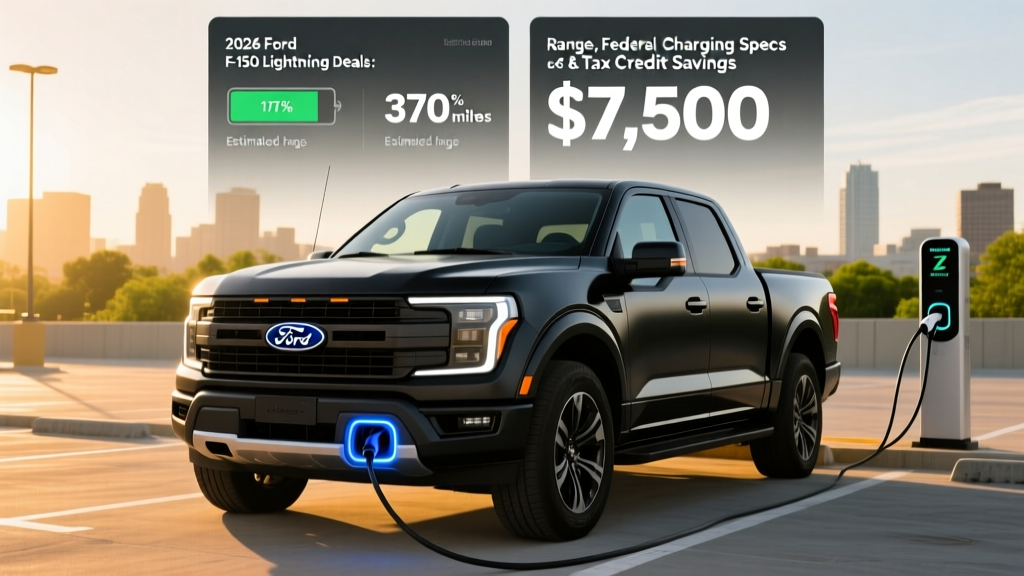
The Ford F-150 Lightning remains one of the most practical electric trucks on the market, balancing genuine work capability with daily-driver comfort. With EPA ranges spanning 230 to 320 miles depending on battery pack, available 150 kW DC fast charging, and a starting MSRP around $54,995 before incentives, the Lightning occupies a unique space: a full-size, body-on-frame electric pickup that can actually tow, haul, and power your home during an outage.
For 2026, Ford has streamlined the trim lineup and continued production ramp-up at the Rouge Electric Vehicle Center, meaning dealer inventory has improved significantly over prior years. That translates into real negotiating leverage for buyers — and genuine Ford F-150 Lightning deals if you know where to look and what to ask for. Below, we break down every spec that matters: real-world range, charging speed, tax credit math, and whether the Lightning beats the Rivian R1T and Chevrolet Silverado EV for your use case.
Ford F-150 Lightning Spec Table: 2026 Model Year at a Glance
| Specification | Standard Range | Extended Range |
|---|---|---|
| EPA Range | 230 miles | 320 miles |
| Battery Capacity (usable) | 98 kWh (NMC) | 131 kWh (NMC) |
| Drivetrain | Dual-motor AWD | Dual-motor AWD |
| Horsepower | 452 hp | 580 hp |
| Torque | 775 lb-ft | 775 lb-ft |
| 0–60 mph | ~5.0 sec | ~3.8 sec |
| Max DC Fast Charge | 150 kW | 150 kW |
| 10–80% DC Charge Time | ~44 min | ~49 min |
| Level 2 Home Charge Rate | 11.3 kW (30 mi/hr) | 19.2 kW (52 mi/hr)* |
| Efficiency (MPGe combined) | 76 MPGe | 70 MPGe |
| Max Towing Capacity | 7,700 lbs** | 10,000 lbs** |
| Max Payload | 2,235 lbs | 1,800 lbs |
| Base MSRP (Pro trim) | $54,995 | $69,995 |
*19.2 kW Level 2 requires the optional 80A Ford Charge Station Pro and a dedicated 100A circuit. Standard mobile charger delivers 30A (7.2 kW).
**Towing capacity requires the Max Trailer Tow Package. Towing significantly reduces range — see real-world notes below.
Real-World Range: What the EPA Number Doesn't Tell You
EPA Estimate: 230 mi (Standard Range) / 320 mi (Extended Range)
Real-World Highway (70 mph, 75°F): ~190–210 mi / ~260–285 mi
Cold Weather (30°F, mixed driving): ~150–175 mi / ~210–240 mi
While Towing (5,000 lb trailer): ~100–130 mi / ~140–180 mi
The F-150 Lightning's boxy aerodynamics and 6,000+ pound curb weight work against it at highway speeds. According to fueleconomy.gov, the Extended Range model achieves 70 MPGe combined (48 kWh/100 mi), which means sustained 75-mph highway driving will consume energy faster than the EPA's mixed-cycle test suggests.
In practice, owners on long road-trip routes consistently report 260–285 highway miles from the 131 kWh Extended Range pack in moderate temperatures. That's a meaningful ~10–18% drop from the sticker. In winter conditions, lithium-ion chemistry and cabin heating demands can push losses to 25–35%, depending on whether you precondition the battery and cabin while still plugged in.
The critical caveat for truck buyers: towing cuts range roughly in half. A 5,000-pound enclosed trailer at 65 mph turns the Extended Range Lightning into a ~150-mile vehicle between charges. If your use case involves frequent long-distance towing, plan your routes around DC fast chargers carefully — or consider the Lightning primarily as a local work truck with occasional towing duty.
Charging Speed: DC Fast, Level 2, and Home Setup
| Charging Level | Power | Speed (Extended Range) | Use Case |
|---|---|---|---|
| Level 1 (120V household) | ~1.4 kW | ~3 miles/hour | Emergency/top-off only |
| Level 2 (240V, 30A mobile) | 7.2 kW | ~20 miles/hour | Basic overnight charging |
| Level 2 (240V, 48A Wall Connector) | 11.5 kW | ~30 miles/hour | Standard home setup |
| Level 2 (240V, 80A Charge Station Pro) | 19.2 kW | ~52 miles/hour | Optimal home/V2H ready |
| DC Fast Charge | Up to 150 kW peak | 10–80% in ~49 min | Road trips, public stations |
The Lightning's 150 kW peak DC fast-charge rate is its most debated specification. Competitors like the Rivian R1T (peak ~200 kW on newer packs) and the Chevrolet Silverado EV (peak ~350 kW on certain trims) charge substantially faster on compatible infrastructure. At a 150 kW CCS station, the Extended Range Lightning's massive 131 kWh battery takes roughly 49 minutes to go from 10% to 80% — adequate for a lunch stop, but not class-leading.
The charging curve matters more than the peak number. The Lightning sustains near-peak power from roughly 10–50% State of Charge, then tapers progressively. Above 80%, charging slows dramatically to protect the NMC cells — adding those last 20% can take as long as the first 70%. For road trips, plan to charge to 80% and drive on; don't sit at the charger waiting for a full battery.
At home, the 19.2 kW Ford Charge Station Pro (included with some trims, available as an accessory) is the gold standard. It requires a dedicated 100-amp circuit installed by a licensed electrician — expect $1,500–$3,500 for the installation depending on your panel capacity and conduit run. Budget for a potential panel upgrade ($1,000–$2,500 additional) if your home has a 100A main service. The payoff: a full overnight charge in roughly 7 hours for the Extended Range pack, and access to Ford's Intelligent Backup Power (V2H) feature, which can power your home for up to three days during an outage.
2026 Pricing, Trim Levels, and Tax Credit Eligibility
| Trim | Battery | MSRP | Est. After §30D Credit* |
|---|---|---|---|
| Pro (Standard Range) | 98 kWh | $54,995 | ~$47,495 |
| XLT (Standard Range) | 98 kWh | $59,995 | ~$52,495 |
| Lariat (Extended Range) | 131 kWh | $74,995 | ~$67,495 |
| Platinum (Extended Range) | 131 kWh | $89,995 | ~$82,495 |
*Federal tax credit amounts shown assume full $7,500 eligibility under IRS §30D. Actual eligibility depends on buyer income, battery component sourcing, and MSRP caps. See details below. Credit can now be transferred to the dealer at point of sale as an upfront discount per IRS rules.
Federal EV Tax Credit (§30D) Checklist for the Lightning
- MSRP Cap: The F-150 Lightning qualifies as a truck/SUV, so the MSRP cap is $80,000. The Pro, XLT, and most Lariat builds clear this threshold. The Platinum trim at $89,995 does not qualify for the new-vehicle credit.
- Buyer Income Limits: Modified adjusted gross income must not exceed $300,000 (married filing jointly), $225,000 (head of household), or $150,000 (single). Check your prior-year or current-year MAGI — whichever is lower.
- Battery Sourcing Requirements: The credit is split into two $3,750 halves — one for critical minerals sourcing and one for battery component manufacturing. Ford has worked to shift supply chains, but the exact credit amount ($0, $3,750, or $7,500) depends on current-year sourcing compliance. Verify the specific VIN's eligibility on the dealer's Monroney sticker or via the DOE's qualified vehicles list.
- Point-of-Sale Transfer: You can elect to transfer the credit to the dealer at purchase, reducing your out-of-pocket cost immediately rather than waiting to claim it on your tax return. The dealer must be IRS-registered.
- State Incentives: Many states offer additional rebates ($1,000–$7,500 depending on jurisdiction). Check your state's environmental agency or DMV for current programs.
For buyers who don't meet income requirements or want a Platinum trim, the used EV tax credit (§25E) offers up to $4,000 (or 30% of the sale price, whichever is lower) on qualifying pre-owned Lightnings priced under $25,000 — a threshold that early 2022–2023 Standard Range models are beginning to approach in the used market.
Performance, Cargo, and Standout Technology
The dual-motor all-wheel-drive powertrain is standard across every Lightning trim. The Standard Range model delivers 452 hp and 775 lb-ft of torque — enough for a ~5.0-second 0–60 mph sprint, which feels genuinely quick in a full-size truck. The Extended Range bumps output to 580 hp and drops 0–60 to approximately 3.8 seconds, rivaling performance SUVs.
Cargo capability is where the Lightning differentiates from unibody electric trucks:
- Bed: 5.5-foot box with 52.8 cu ft of volume and a max payload of 2,235 lbs (Standard Range). The bed floor sits lower than a gas F-150 thanks to the absence of a rear axle hump.
- Mega Power Frunk: 14.1 cu ft of front trunk space with 400 lbs of capacity — large enough for tools, groceries, or a full set of golf clubs. Includes a drain plug for use as a cooler.
- Pro Power Onboard: Available 2.4 kW or 9.6 kW of onboard power output via 120V and 240V outlets in the bed and cabin. The 9.6 kW option (standard on Lariat/Platinum) can run power tools, a welder, or essential home circuits.
- Passenger Space: SuperCrew cab with 43.3 inches of rear legroom — identical to the gas F-150 SuperCrew. Comfortable for five adults on longer drives.
- Towing: Up to 10,000 lbs with the Extended Range and Max Trailer Tow Package. Standard towing is rated at 7,700 lbs.
Technology highlights include the available 15.5-inch SYNC 4A touchscreen (shared with the Mustang Mach-E), a 12-inch digital instrument cluster, BlueCruise hands-free highway driving assist (SAE Level 2 — driver supervision required at all times), over-the-air software updates, and Ford's Intelligent Backup Power vehicle-to-home (V2H) capability.
Notable drawbacks: The Lightning's regenerative braking is less aggressive than some EVs, and true one-pedal driving requires a specific mode selection. The 150 kW DC charge ceiling lags behind newer competitors. And at over 6,000 lbs curb weight, tire wear is accelerated — budget for replacement rubber sooner than you would on a gas F-150.
Pros and Cons: The Honest Assessment
- Genuine truck capability: 10,000-lb towing, 2,235-lb payload, real bed
- Mega Power Frunk (14.1 cu ft) is genuinely useful
- Pro Power Onboard (9.6 kW) eliminates generator needs on job sites
- Intelligent Backup Power (V2H) for home outage protection
- Quiet, smooth daily-driver comfort with instant torque
- Available BlueCruise for highway driving relief
- Strong federal tax credit eligibility on most trims
- 150 kW peak DC charging lags Silverado EV (~350 kW) and R1T (~200 kW)
- Range drops sharply when towing (expect 50% loss)
- Highway efficiency poor (~70 MPGe) due to size and aero
- Platinum trim exceeds $80K MSRP cap — no federal credit
- Requires 100A electrical circuit for optimal 19.2 kW home charging
- Cold-weather range loss of 25–35% is significant
- Tire wear accelerates on 6,000+ lb truck
Lightning vs. R1T vs. Silverado EV: Which Truck Earns Your Money?
The Lightning's closest competitors each serve a slightly different buyer:
Ford F-150 Lightning is the best fit if you want a traditional full-size truck experience — body-on-frame, SuperCrew cab, familiar F-150 dimensions, and a dealer network for service. It's the value leader, especially after the federal tax credit, and the Pro Power Onboard + V2H features are unmatched for job-site and home-backup utility.
Rivian R1T suits buyers who prioritize on-road performance, tech-forward design, and adventure features (the gear tunnel is brilliant). The R1T starts around $69,900, offers faster DC charging on newer packs, and is more efficient per mile — but it's a midsize truck with less cabin room and no V2H capability. It also does not qualify for the new-vehicle federal credit at most trims due to MSRP.
Chevrolet Silverado EV offers the longest range in the segment (up to ~400 miles on the 4WT Extended Range model) and blistering 350 kW DC charging on compatible stations. However, the 4WT work truck starts at a high MSRP, the RST luxury trim has faced delays, and real-world availability remains limited compared to the Lightning.
Choose the F-150 Lightning if: You need full-size truck capability, want V2H home backup, value dealer service access, and your budget is $55K–$75K after incentives.
Choose the Rivian R1T if: You want a premium midsize truck for adventure and daily driving, prioritize efficiency and faster charging, and can forgo V2H and the federal credit.
Choose the Silverado EV if: Maximum range and fastest DC charging are your top priorities, you can find inventory, and you're willing to pay a premium for the 4WT or wait for broader RST availability.
Who Should Buy the F-150 Lightning?
The Lightning makes the most sense for three buyer profiles:
The home-based worker or contractor who needs a truck bed daily, values Pro Power Onboard for running tools without a generator, and can charge overnight on Level 2. If your daily drive is under 150 miles round-trip, the Standard Range model covers your needs with margin, and the tax credit brings the effective price into compelling territory.
The suburban homeowner with solar or outage concerns who wants a dual-purpose vehicle: daily commuter and home battery on wheels. The Intelligent Backup Power system, paired with the Ford Charge Station Pro, can power essential home circuits (HVAC, refrigerator, lights) for up to three days. That's peace of mind that no gas truck can match without a separate generator.
The family that needs space and comfort and wants to reduce fuel costs. The SuperCrew cab is as roomy as a gas F-150, the ride quality is noticeably smoother (independent rear suspension replaces the leaf springs), and "fueling" at home for $0.12–$0.16/kWh translates to roughly $0.05–$0.07 per mile — versus $0.18–$0.22 per mile for a gas F-150 at current fuel prices.
The Lightning is not ideal for long-distance towing enthusiasts (range drops too sharply) or buyers in extreme cold climates without garage parking (expect significant winter range loss). If your typical week involves 500+ highway miles or frequent 8,000-lb trailer towing, a diesel F-250 may still be the pragmatic choice.
Warranty and Long-Term Ownership
Ford backs the Lightning with competitive warranty coverage:
- Battery/Powertrain: 8 years / 100,000 miles (whichever comes first), covering defects and capacity loss below 70% of original capacity.
- Bumper-to-Bumper: 3 years / 36,000 miles.
- Corrosion Perforation: 5 years / unlimited miles.
- Roadside Assistance: 5 years / 60,000 miles.
The 70% capacity retention threshold is industry-standard but worth noting: if your 131 kWh pack degrades to 91.7 kWh within 8 years, Ford considers that within spec. Real-world data from early 2022–2023 Lightning owners suggests NMC degradation is tracking well, with most high-mileage trucks retaining 90%+ capacity after two years. The liquid-cooled thermal management system and Ford's conservative charge-buffer strategy appear to be protecting long-term cell health.
For total cost of ownership, factor in: home charger installation ($1,500–$3,500), potential electrical panel upgrade ($1,000–$2,500), higher-than-average insurance premiums (EV truck insurance runs 15–25% above gas F-150 equivalents in most states), and accelerated tire replacement. Offset these with dramatically lower fuel costs, near-zero scheduled maintenance (no oil changes, no transmission fluid, minimal brake wear thanks to regen), and the available federal tax credit.
Frequently Asked Questions
What is the real-world range of the F-150 Lightning?
The Extended Range (131 kWh) model carries a 320-mile EPA rating, but expect 260–285 miles in real-world highway driving at 70 mph and 210–240 miles in cold weather (30°F or below). The Standard Range (98 kWh) model rates at 230 EPA miles with roughly 190–210 real-world highway miles. Towing a 5,000-lb trailer cuts range approximately in half.
How fast does the F-150 Lightning charge?
On DC fast charging, the Lightning peaks at 150 kW, achieving a 10–80% charge in approximately 44–49 minutes depending on battery pack. At home on Level 2, speeds range from 20 miles/hour (30A mobile charger) to 52 miles/hour (80A Charge Station Pro requiring a 100A dedicated circuit). Level 1 (120V) adds only ~3 miles per hour and is suitable for emergency use only.
How much does the F-150 Lightning cost after tax credits?
The 2026 Lightning Pro starts at $54,995 MSRP. With full $7,500 federal tax credit eligibility (subject to income limits, battery sourcing rules, and the $80,000 truck MSRP cap), the effective price drops to approximately $47,495. State incentives can reduce this further. The Platinum trim at $89,995 exceeds the MSRP cap and does not qualify for the new-vehicle federal credit.
Does the F-150 Lightning qualify for the federal EV tax credit?
Most trims qualify for up to $7,500 under IRS §30D, provided the buyer meets income limits ($150K single / $300K joint), the specific VIN's battery components meet critical-mineral and manufacturing sourcing thresholds, and the MSRP stays under the $80,000 truck/SUV cap. The credit can be transferred to the dealer at point of sale for an immediate price reduction. Always verify eligibility for your specific VIN at purchase and consult a tax professional for your individual situation.
Is the F-150 Lightning worth buying vs. the Rivian R1T or Silverado EV?
The Lightning wins on value (lowest entry price after incentives), full-size truck utility (payload, towing, SuperCrew space), and unique features like Pro Power Onboard and V2H home backup. The Rivian R1T is more efficient and charges faster but is a midsize truck at a higher price without the federal credit. The Silverado EV offers superior range (~400 mi) and 350 kW DC charging but has limited availability and higher pricing. For most traditional truck buyers, the Lightning remains the most practical and cost-effective electric pickup in 2026.
Can the F-150 Lightning power my home during an outage?
Yes. With the available Ford Charge Station Pro (19.2 kW bidirectional charger) and the truck's Intelligent Backup Power system, the Extended Range Lightning can supply up to 9.6 kW to essential home circuits for approximately three days. This requires professional installation of the Charge Station Pro with a transfer switch integrated into your home's electrical panel. It is not a whole-home solar-replacement solution, but it covers critical loads (heat, refrigeration, lighting, communications) during multi-day outages.