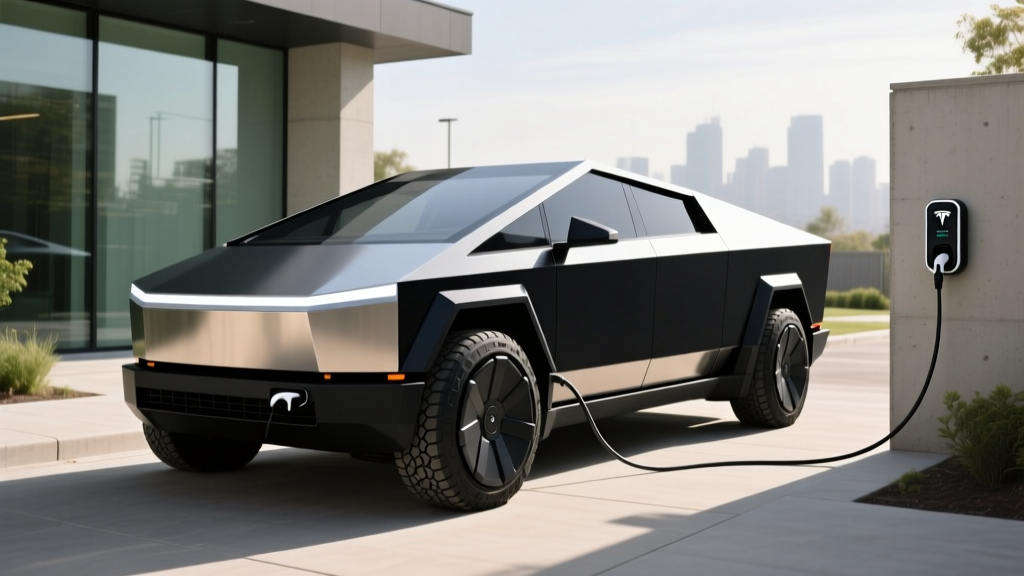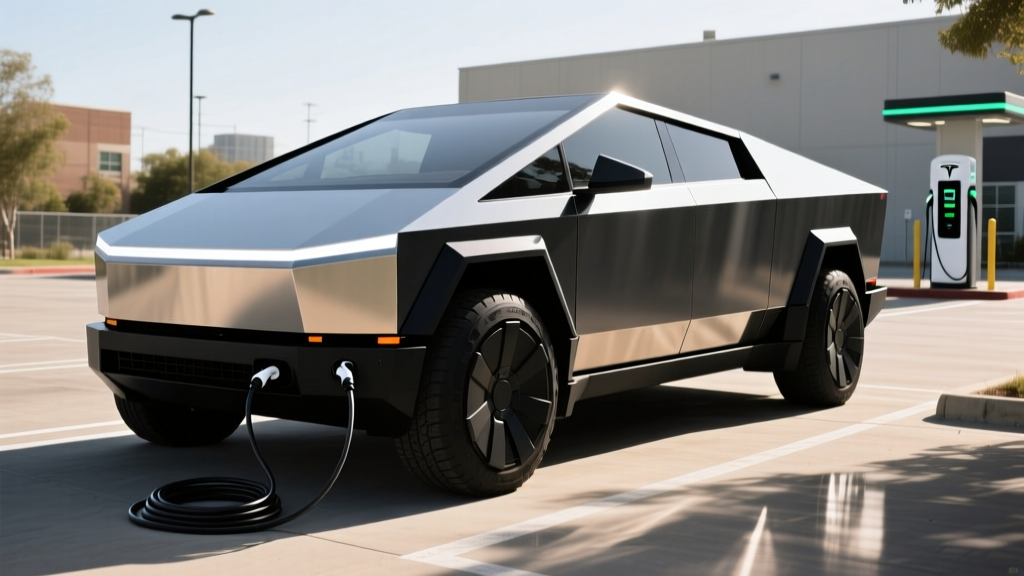
The Tesla Cybertruck is impossible to ignore — and impossible to call light. With a curb weight starting around 6,843 pounds for the All-Wheel Drive (AWD) model and climbing past 6,890 pounds for the Cyberbeast, Tesla's stainless-steel pickup is one of the heaviest consumer EVs on the road. That mass shapes everything: energy consumption, tire wear, braking distance, real-world range, and even the tax-credit math. If you've been searching for a deep breakdown of Tesla Cybertruck weight and how it translates into daily ownership, this review connects the spec-sheet numbers to the reality of driving, charging, and towing a nearly 7,000-pound electric truck.
For 2026, Tesla offers three Cybertruck configurations: the Long Range AWD, the AWD (formerly the base dual-motor), and the tri-motor Cyberbeast. We'll focus primarily on the volume-selling AWD trim while calling out Cyberbeast differences where they matter. All figures reflect the latest EPA data and Tesla's published specifications as of early 2026.
Full Tesla Cybertruck Spec Sheet at a Glance
| Specification | AWD (Dual-Motor) | Cyberbeast (Tri-Motor) |
|---|---|---|
| Curb Weight | ~6,843 lbs | ~6,890 lbs |
| GVWR | ~9,100 lbs | ~9,100 lbs |
| EPA Range | 340 miles | 320 miles |
| Battery (usable) | ~123 kWh, NMC | ~123 kWh, NMC |
| Peak DC Fast Charge | 250 kW | 250 kW |
| 10–80% DC Time | ~28 min | ~28 min |
| Level 2 Charge Rate | 11.5 kW (~37 mi/hr) | 11.5 kW (~37 mi/hr) |
| 0–60 mph | 4.1 sec | 2.6 sec |
| Horsepower | 600 hp | 845 hp |
| Drivetrain | Dual-Motor AWD | Tri-Motor AWD |
| MPGe (combined) | 79 MPGe | 74 MPGe |
| Efficiency | 43 kWh/100 mi | 46 kWh/100 mi |
| Max Towing | 11,000 lbs | 11,000 lbs |
| Payload | ~2,500 lbs | ~2,500 lbs |
| Bed Length | 6 ft (72 in) | 6 ft (72 in) |
| Cargo Volume (bed + frunk) | ~67 cu ft bed + ~7 cu ft frunk | ~67 cu ft bed + ~7 cu ft frunk |
| Base MSRP | $79,990 | $99,990 |
| Battery/Drive Unit Warranty | 8 yr / 120,000 mi | 8 yr / 120,000 mi |
Why Tesla Cybertruck Weight Matters for Range and Efficiency
At 6,843 pounds, the dual-motor AWD Cybertruck is roughly 1,500 pounds heavier than a Ford F-150 Lightning Extended Range and over 1,000 pounds heavier than the Rivian R1T Dual-Motor Max. That mass isn't just a trivia number — it's the single largest factor driving the truck's energy consumption.
The EPA rates the AWD Cybertruck at 79 MPGe combined, which translates to approximately 43 kWh per 100 miles. For comparison, the lighter and more aerodynamic Tesla Model X Plaid achieves around 39 kWh/100 mi. When you're pushing nearly 7,000 pounds of stainless-steel exoskeleton down the highway, every acceleration event and every hill demands serious energy.
The EPA rates the Cybertruck AWD at 340 miles of range. In real-world conditions, plan for:
- Highway cruising (70–75 mph, moderate temps): ~270–295 miles
- Mixed city/suburban driving: ~310–330 miles
- Cold weather (below 32°F): ~230–270 miles (LFP-adjacent NMC packs lose 20–30% in deep cold without preconditioning)
- Towing (near max 11,000 lbs): ~130–170 miles — towing essentially halves range
The Cybertruck's angular stainless-steel body creates a drag coefficient significantly higher than a sleek sedan, compounding the weight penalty at highway speeds. Source: fueleconomy.gov.
The ~123 kWh usable battery pack uses NMC (nickel-manganese-cobalt) chemistry, chosen for its higher energy density compared to LFP. Tesla needs every watt-hour of density to offset the truck's mass. NMC does, however, degrade slightly faster than LFP over thousands of charge cycles — something to consider if you plan to keep the truck past 150,000 miles.
Charging Speed: DC Fast Charge and Home Level 2
Pushing electrons into a 123 kWh battery at a truck this heavy requires serious charging infrastructure. Here's what the Cybertruck supports across all three charging levels:
| Charging Level | Power (kW) | Speed (miles of range per hour) | Notes |
|---|---|---|---|
| Level 1 (120V, 12A) | ~1.4 kW | ~3 mi/hr | Emergency/trickle only; full charge in ~90 hours |
| Level 2 (240V, 48A) | 11.5 kW | ~37 mi/hr | Full charge in ~11 hours; requires NACS connector or J1772 adapter |
| DC Fast Charge (V3/V4 Supercharger) | Peak 250 kW | Up to ~185 mi in 15 min | 10–80% in ~28 min; tapers significantly above 80% |
A few real-world charging nuances worth understanding:
- Charge curve taper: The Cybertruck peaks at 250 kW only when the battery is between roughly 10–35% State of Charge (SoC) and properly preconditioned. Above 60% SoC, the rate drops to ~100 kW, and above 80% it falls below 50 kW. This is why Tesla (and every EV maker) quotes 10–80% times — the final 20% takes almost as long as the first 70%.
- Preconditioning is critical: Navigate to a Supercharger using the truck's built-in navigation, and the battery thermal management system will warm or cool the pack for optimal charge acceptance. Skip preconditioning on a cold day and your peak rate might drop from 250 kW to 120 kW or less.
- NACS native: The Cybertruck uses the North American Charging Standard (NACS) connector natively — no adapter needed at Tesla Superchargers. For Electrify America or other CCS networks, you'll need a NACS-to-CCS adapter (Tesla sells one for ~$250).
- Home charging reality: At 11.5 kW Level 2, overnight charging adds roughly 300 miles in an 8-hour window — enough to replenish most daily driving. Plan on a 60-amp dedicated circuit with a Tesla Wall Connector (~$425 for hardware, $800–$2,000 for electrician installation depending on panel proximity).
Performance: Tri-Motor Cyberbeast vs. Dual-Motor AWD
The Cybertruck's weight doesn't stop it from being shockingly quick. Tesla's electric motors deliver instant torque regardless of mass, and the result is sports-car acceleration from a truck that outweighs most of them.
The dual-motor AWD model produces 600 horsepower and hits 0–60 mph in 4.1 seconds — quicker than a Porsche Cayenne Turbo. The Cyberbeast, with its tri-motor setup and 845 horsepower, drops that to 2.6 seconds, putting it in supercar territory. Both models carry an electronically limited top speed of 130 mph (AWD) and 130 mph (Cyberbeast, though Tesla initially quoted higher).
Handling is where the weight shows. The Cybertruck uses a steer-by-wire system with a yoke-style steering wheel (a conventional round wheel is now available as an option). The steer-by-wire eliminates the mechanical connection between the wheel and the rack, allowing variable steering ratios — fewer turns lock-to-lock at low speeds, more stability at highway speeds. It takes adaptation, and opinions among owners remain divided.
The adaptive air suspension provides up to 16 inches of ground clearance in Extract mode (for off-road use) and automatically lowers at highway speeds to reduce drag. Ride quality is firm but controlled — the truck's mass means the suspension works hard, and you'll feel sharp impacts more than in a lighter vehicle.
Interior, Cargo, and Everyday Practicality
The Cybertruck seats five across two rows. Rear legroom measures approximately 38 inches — adequate for adults but tighter than an F-150 Lightning's back seat. The minimalist interior centers on an 18.5-inch touchscreen that controls nearly every vehicle function, including glove-box release and mirror adjustments. There are no physical stalks for turn signals — they're buttons on the yoke/wheel — which remains a polarizing choice.
Cargo capacity breaks down as follows:
- Bed: 6 feet long, ~67 cu ft with the motorized tonneau cover closed
- Frunk (front trunk): ~7 cu ft, lockable, with a drain plug for use as a cooler
- Sail pillars / vault: The angular C-pillars create enclosed storage areas behind the rear seats, accessible from the bed
- Towing: 11,000 lbs maximum (requires the included tow hitch and integrated trailer brake controller)
The stainless-steel exoskeleton is dent-resistant and doesn't require paint — the raw 30X cold-rolled steel is the finish. However, it shows fingerprints, can develop surface rust staining in humid climates, and panel-gap consistency has been a known quality-control discussion point among early owners.
Pricing, Trims, and Federal Tax Credit Eligibility
The Cybertruck's pricing has been a moving target since its 2023 reveal. As of the 2026 model year, here's where the lineup stands:
| Trim | Base MSRP | Federal §30D Credit Eligible? | Effective Price (if eligible) |
|---|---|---|---|
| AWD (Dual-Motor) | $79,990 | No — exceeds $80,000 truck MSRP cap | $79,990 |
| Cyberbeast (Tri-Motor) | $99,990 | No — exceeds $80,000 truck MSRP cap | $99,990 |
| Long Range AWD | $84,990 (est.) | No — exceeds $80,000 truck MSRP cap | $84,990 |
This is the critical detail many shoppers miss: under IRS §30D rules, the federal EV tax credit caps eligible pickup trucks (classified as light trucks) at an $80,000 MSRP. Every current Cybertruck trim exceeds that threshold, meaning no Cybertruck qualifies for the $7,500 federal tax credit as of 2026. Even the point-of-sale transfer option, which lets buyers apply the credit as a down-payment reduction at the dealer, doesn't apply here because the vehicle itself is ineligible.
Additionally, §30D imposes buyer income caps ($150,000 single / $300,000 joint modified AGI) and battery critical-mineral and component sourcing requirements — but those are moot when the MSRP cap already disqualifies the vehicle. Always verify current rules at IRS.gov, as regulations can shift.
Some buyers may qualify for state-level incentives (California's CVRP, Colorado's innovative motor vehicle credit, etc.), but these vary by jurisdiction and often have their own price caps. Check your state's energy office or DMV for current programs.
Tech, Driver Assistance, and Standout Features
The Cybertruck ships with Tesla's latest hardware suite (HW4/AI4), including higher-resolution cameras and improved neural-net processing. Standard features include:
- Autopilot (SAE Level 2): Adaptive cruise control, lane-centering, and automatic emergency braking. The driver must remain fully engaged — hands on the wheel, eyes on the road. This is not self-driving.
- Full Self-Driving (Supervised): Available as a $8,000 option or $99/month subscription. Adds traffic-light recognition, city-street navigation, and automatic lane changes. Still SAE Level 2 — you are the driver at all times.
- 18.5-inch touchscreen: Controls all vehicle functions, navigation, media, and climate. Includes gaming capability (up to 10 teraflops of processing).
- Powered frunk and tonneau: Both operate via the touchscreen or the Tesla app.
- Bioweapon Defense Mode: HEPA-grade cabin air filtration with positive pressure.
- Onboard air compressor: Built into the bed for tire inflation or pneumatic tools.
- 120V/240V bed outlets: Up to 9.6 kW of vehicle-to-load (V2L) power for job-site tools or camping.
Tesla's Autopilot and Full Self-Driving (Supervised) are classified as SAE Level 2 driver-assistance systems. The driver must continuously supervise the system, keep hands on the steering wheel, and be prepared to take over instantly. Only Level 4 services like Waymo's driverless robotaxis operate without a human driver. Misuse of Level 2 systems has resulted in documented NHTSA investigations. Never treat any current consumer vehicle as autonomous. Source: NHTSA.gov.
Notable drawbacks include the yoke's learning curve (especially for three-point turns and parking), the absence of Apple CarPlay/Android Auto, limited rear visibility due to the bed sail pillars (mitigated by a rear camera), and the fact that the stainless-steel body, while dent-resistant, is difficult and expensive to repair if damaged in a collision.
Warranty, Ownership Costs, and Long-Term Outlook
Tesla covers the Cybertruck's battery and drive units for 8 years or 120,000 miles, whichever comes first, with a minimum 70% battery capacity retention threshold. The limited vehicle warranty runs 4 years / 50,000 miles.
Ownership economics to factor in:
- Charging cost: At the national average of ~$0.16/kWh for home electricity, a full 123 kWh charge costs roughly $19.70 — yielding a cost-per-mile of about $0.058. Public DC fast charging at $0.35–$0.48/kWh pushes that to $0.12–$0.17 per mile.
- Insurance: Cybertruck insurance premiums run significantly higher than average — often $2,500–$4,000+ annually depending on state, age, and driving record. The stainless-steel body's repair complexity and the truck's performance both drive rates up. Get quotes before committing.
- Tires: The Cybertruck uses 35×8.5R20 all-terrain tires — expect replacement costs of $1,200–$1,800 per set, with a lifespan of 25,000–40,000 miles given the truck's weight and torque.
- Depreciation: Early Cybertruck resale values have been volatile. Some 2024 models sold above MSRP initially, then depreciated sharply as production scaled. Long-term depreciation data is still limited for this model.
Who the Cybertruck Is For — and Who Should Look Elsewhere
Choose the Cybertruck if:
- You want a statement vehicle with supercar-level acceleration and genuine truck utility (11,000-lb towing, 6-foot bed, V2L power)
- You have reliable home charging and mostly drive under 250 miles per day
- You value Tesla's Supercharger network for road trips
- You're comfortable with the yoke/steer-by-wire interface and minimal physical controls
Look elsewhere if:
- You need maximum range for frequent 350+ mile road trips without charging stops (Rivian R1T Max Pack: 420 mi; consider the Ford F-150 Lightning Extended Range at 320 mi with a lower price)
- You're counting on the $7,500 federal tax credit to make the math work (no Cybertruck qualifies)
- You need a comfortable, quiet highway cruiser — the Cybertruck's wind noise and angular aero are noticeable at 75+ mph
- You want a traditional truck experience with physical controls, conventional mirrors, and a round steering wheel as standard
Pros and Cons Summary
- Tri-motor Cyberbeast: 845 hp, 2.6-sec 0–60 in a pickup
- 11,000-lb towing with integrated trailer brake controller
- 9.6 kW V2L power for job-site or camping use
- Access to Tesla Supercharger network (17,000+ stalls in the US)
- Stainless-steel exoskeleton is dent- and corrosion-resistant
- Adaptive air suspension with up to 16 inches of ground clearance
- No federal tax credit eligibility (all trims above $80K MSRP cap)
- Real-world highway range drops to ~270–295 miles, less in cold
- Heavy at 6,843+ lbs — impacts tire wear, braking, and efficiency
- Yoke/steer-by-wire requires adaptation and polarizes owners
- Insurance premiums significantly above average for the segment
- No Apple CarPlay or Android Auto
- Panel gaps and build consistency remain owner discussion points
Frequently Asked Questions
What is the real-world range of the Tesla Cybertruck?
The EPA rates the AWD Cybertruck at 340 miles. In real-world mixed driving, expect 310–330 miles. At sustained highway speeds of 70–75 mph, plan for 270–295 miles. In cold weather below freezing, range can drop to 230–270 miles without preconditioning. When towing near the 11,000-lb maximum, range falls to approximately 130–170 miles.
How fast does the Cybertruck charge at home and on the road?
At a V3/V4 Tesla Supercharger, the Cybertruck peaks at 250 kW and charges from 10–80% in approximately 28 minutes (with proper battery preconditioning). At home on a 240V Level 2 charger (48A/11.5 kW), it adds about 37 miles of range per hour, fully recharging in roughly 11 hours. On a standard 120V outlet, expect just ~3 miles per hour.
How much does the Cybertruck cost after tax credits?
As of 2026, no Cybertruck trim qualifies for the $7,500 federal §30D tax credit because all trims exceed the $80,000 MSRP cap for light trucks. The AWD starts at $79,990 and the Cyberbeast at $99,990 — both are the prices you'll pay before any state incentives, which vary by location.
Does the Cybertruck qualify for the federal EV tax credit?
No. Under current IRS §30D rules, pickup trucks must have an MSRP at or below $80,000 to be eligible. Every 2026 Cybertruck trim exceeds this cap. Additionally, buyer income limits ($150K single / $300K joint) and battery sourcing requirements apply to the credit generally, but the MSRP cap alone disqualifies the Cybertruck. Verify current rules at IRS.gov.
Is the Cybertruck worth buying vs. the F-150 Lightning or Rivian R1T?
It depends on your priorities. The F-150 Lightning Lariat Extended Range (~$70K) offers 320 miles of range, a more traditional truck experience, and some trims may qualify for the federal credit. The Rivian R1T Max Pack ($87,000+) offers up to 420 miles of range and superior off-road capability, but also exceeds the tax-credit MSRP cap. The Cybertruck wins on acceleration, Supercharger access, and V2L power output, but loses on price, real-world range efficiency, and tax-credit eligibility. Test-drive all three before deciding.
What are the biggest Cybertruck ownership concerns?
Insurance costs are the most common surprise — expect $2,500–$4,000+ annually. Tire wear is accelerated by the truck's weight and instant torque. The stainless-steel body, while dent-resistant, is expensive to repair after collisions. Build quality and panel alignment have improved since early production but remain a topic in owner forums. And without federal tax credit eligibility, the total cost of ownership is higher than similarly capable electric trucks that may qualify.