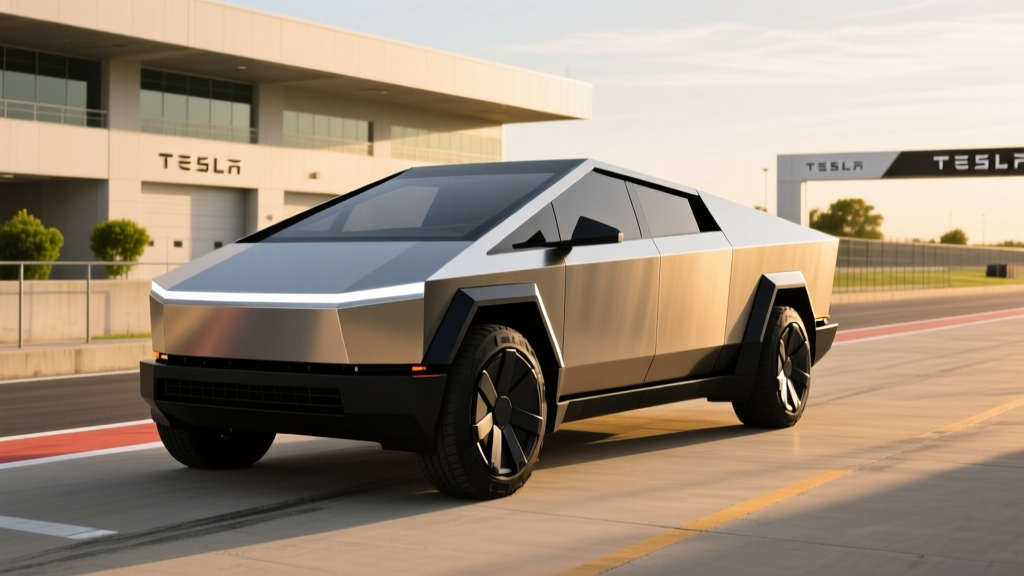
The Tesla Cybertruck is one of the heaviest consumer vehicles on the road — and that mass shapes everything from its real-world range to its tire wear and braking distances. If you've been searching how much does a Tesla Cybertruck weigh, the short answer is between 6,583 and 6,843 pounds depending on the trim. But understanding what that weight means for daily driving, efficiency, and ownership costs requires a deeper look at the specs beneath the stainless-steel exoskeleton.
This review covers every 2025/2026 Cybertruck trim — the Rear-Wheel Drive, All-Wheel Drive, and Cyberbeast — with exact EPA range figures, battery capacity, charging speeds, performance data, cargo dimensions, and federal tax credit eligibility under current IRS §30D rules.
Tesla Cybertruck Weight by Trim: Curb Weight Breakdown
The Cybertruck's curb weight is a direct result of its 48-volt electrical architecture, stainless-steel body panels, large battery pack, and dual- or tri-motor powertrains. Unlike most unibody EVs that use aluminum or stamped steel, the Cybertruck's cold-rolled stainless exterior adds mass but eliminates the need for a traditional paint shop. Here's how each trim stacks up:
| Trim | Curb Weight (lbs) | Drivetrain | Motors | GVWR (lbs) |
|---|---|---|---|---|
| Rear-Wheel Drive (RWD) | ~6,583 | RWD | Single (rear) | ~8,400 |
| All-Wheel Drive (AWD) | ~6,603 | AWD | Dual (front + rear) | ~8,500 |
| Cyberbeast | ~6,843 | AWD | Tri (1 front + 2 rear) | ~8,700 |
For context, a Ford F-150 Lightning Extended Range weighs roughly 6,171 lbs, while a Rivian R1T Dual-Motor Large Pack sits at about 7,148 lbs. The Cybertruck falls squarely in the heavy-duty EV truck segment, but its lower-slung battery pack gives it a comparatively low center of gravity for its class.
Battery Capacity, Chemistry, and Efficiency
Tesla equips the Cybertruck with a structural battery pack that uses a mix of cell chemistries. The AWD and Cyberbeast trims feature a ~123 kWh (total) / ~120 kWh (usable) NMC (nickel manganese cobalt) pack, chosen for its higher energy density needed to push the heavier tri-motor configuration to competitive range numbers. The RWD trim uses a slightly smaller pack, estimated at ~100 kWh usable.
Efficiency is where weight matters most. The Cybertruck AWD achieves a combined MPGe of approximately 66 MPGe (or roughly 51 kWh/100 miles), according to fueleconomy.gov. That's notably thirstier than a Tesla Model Y Long Range (~122 MPGe combined) and reflects the physics of pushing nearly 6,600 lbs of stainless steel through the air at highway speeds.
The Cybertruck AWD carries an EPA-estimated range of 340 miles (with the range-extender battery option). The base AWD without the extender is rated at ~318 miles EPA. The Cyberbeast is rated at ~320 miles EPA. However, in real-world highway driving at 70-75 mph, expect approximately 260-290 miles of usable range. In cold weather (below 32°F), range can drop an additional 15-25%, bringing effective highway range to roughly 210-250 miles depending on conditions and cabin heat usage. The Cybertruck's angular shape and 6,600+ lb mass compound energy consumption at speed and in low temperatures.
Charging Speed: DC Fast Charging and Home Level 2
Charging a vehicle this heavy and battery-dense requires serious infrastructure. The Cybertruck supports Tesla's NACS connector natively and can access the Supercharger network, which remains the most reliable DC fast-charging ecosystem in the U.S.
| Charging Level | Power / Rate | Time or Miles Added | Connector |
|---|---|---|---|
| Level 1 (120V household) | ~1.4 kW | ~3-4 miles per hour | NACS (mobile connector) |
| Level 2 (240V home, 48A) | ~11.5 kW | ~30-34 miles per hour (~11-13 hours 0-100%) | NACS (Wall Connector) |
| DC Fast Charge (V3 Supercharger) | Peak ~250 kW | 10-80% in ~30 minutes | NACS |
| DC Fast Charge (V4 Supercharger) | Peak ~325 kW (limited availability) | 10-80% in ~25 minutes (est.) | NACS |
Charging curve reality: Like all large-battery EVs, the Cybertruck's peak 250 kW rate is not sustained across the full session. The truck typically holds peak speed from roughly 10-35% State of Charge, then tapers progressively. By 60% SoC, you're typically seeing ~120-140 kW, and above 80% the rate drops below 50 kW. This is why the 10-80% metric is the most useful real-world benchmark — plan for ~30 minutes at a V3 Supercharger, not the "15 minutes of range" marketing headlines suggest.
For home charging, Tesla's Wall Connector on a 60-amp circuit (48A continuous) is the practical standard. Expect to fully replenish the AWD's ~120 kWh usable pack in roughly 12-13 hours from near-empty. Most owners who plug in nightly will never need a full recharge cycle — a typical 40-mile daily commute consumes roughly 20 kWh, easily replenished in under 2 hours on Level 2.
Performance: 0-60 mph, Horsepower, and Drivetrain
Despite weighing as much as some heavy-duty diesel trucks, the Cybertruck delivers sports-car acceleration — a testament to instant electric torque overcoming mass.
| Trim | 0-60 mph | Horsepower | Torque (lb-ft) | Top Speed |
|---|---|---|---|---|
| RWD | ~6.5 sec | ~315 hp | ~420 | 110 mph |
| AWD | ~3.9 sec | ~600 hp | ~740 | 130 mph |
| Cyberbeast | ~2.6 sec | ~845 hp | ~740 | 130 mph |
The Cyberbeast's 2.6-second 0-60 time is remarkable for a 6,843-lb vehicle — it outpaces a Porsche 911 Carrera to 60 mph. But that mass also means longer braking distances (70-0 mph braking is roughly 190-200 feet) and higher tire wear rates. Replacement tires for the Cybertruck's unique 35-inch diameter, 285/65R20 fitment are expensive and currently limited in selection.
The Cybertruck's steer-by-wire system eliminates the mechanical connection between the steering yoke and the front wheels, using redundant electronic actuators instead. This allows a variable steering ratio — fewer than one full turn lock-to-lock — which makes parking easier but requires an adjustment period for drivers accustomed to traditional steering feel.
Cargo Space, Passenger Room, and Utility
The Cybertruck is a five-seat crew cab with a 6-foot composite bed. Here are the key dimensions:
- Bed length: 72 inches (6 feet) with tailgate up; ~83 inches with tailgate down
- Bed volume: ~67 cu ft (with tonneau cover closed)
- Front headroom: ~40.8 inches
- Front legroom: ~41.2 inches
- Rear headroom: ~38.1 inches
- Rear legroom: ~38.5 inches
- Frunk (front trunk): ~7.1 cu ft (lockable, with drain)
- Towing capacity: Up to 11,000 lbs (AWD and Cyberbeast)
- Payload capacity: ~2,500 lbs
The motorized tonneau cover is a standout feature — it's power-operated, lockable, and can support up to 300 lbs of distributed weight. Combined with the sealed bed and frunk, the Cybertruck offers more secure, weather-protected storage than any conventional open-bed truck.
However, the angular roofline and thick A-pillars reduce outward visibility compared to a traditional F-150 or Silverado. The camera-based "virtual" side mirrors (replacing conventional mirrors with camera feeds on the central screen) are standard, which some drivers find intuitive and others find disorienting — particularly in heavy rain where the cameras can accumulate water.
Pricing, Trim Levels, and Federal Tax Credit Eligibility
| Trim | Base MSRP (2025) | Typical As-Tested | Federal §30D Credit Eligibility |
|---|---|---|---|
| RWD (expected 2025-2026) | ~$60,990 | ~$62,000-$65,000 | Not eligible (above MSRP cap for trucks) |
| AWD | ~$79,990 | ~$82,000-$95,000 | Not eligible (above MSRP cap for trucks) |
| Cyberbeast | ~$99,990 | ~$102,000-$115,000 | Not eligible (above MSRP cap for trucks) |
Federal tax credit reality: Under current IRS §30D rules, the Cybertruck is classified as a light truck, which carries an MSRP cap of $80,000. Only the RWD trim, once it becomes widely available, may approach that threshold — but even with destination charges and common options, it is likely to exceed $80,000 and lose eligibility. The AWD at $79,990 base technically sits at the cap, but any added options, paint protection, or accessories push it over. The Cyberbeast is far above the cap.
Additionally, §30D requires the buyer to meet income thresholds (modified AGI of $150,000 single / $300,000 joint filers or less) and the vehicle must meet critical-mineral and battery-component sourcing requirements that shift annually. As of 2025, no Tesla vehicle qualifies for the full $7,500 credit due to battery-sourcing rules. Always verify current eligibility on IRS.gov or consult a tax professional before relying on the credit in your purchase decision.
Standout Technology and Notable Drawbacks
Standout features:
- Steer-by-wire: No mechanical linkage; variable ratio, less than 1 turn lock-to-lock
- 48-volt electrical architecture: Industry-first for a production vehicle, reducing wiring harness weight and enabling higher-power accessories
- Stainless-steel exoskeleton: Ultra-hard 30X cold-rolled stainless steel, dent-resistant, no paint required
- Bioweapon Defense Mode: HEPA air filtration system
- 18.5-inch central touchscreen + 9.4-inch rear touchscreen
- Power-operated tonneau cover with 300-lb load rating
- Air suspension: Adaptive with up to 16 inches of ground clearance in Extract Mode
- Autowash Mode: Closes windows, locks charge port, disables wipers for car washes
Notable drawbacks:
- No Apple CarPlay or Android Auto — Tesla's proprietary infotainment only
- Camera-based side mirrors require adaptation and can be affected by weather
- Yoke steering is standard — no round wheel option, which complicates low-speed maneuvers for some drivers
- Limited service center capacity — body repairs on stainless steel panels are slow and expensive
- Tire availability — proprietary 35-inch tire sizes have limited aftermarket options
- Weight-related wear — expect faster tire and brake component wear than lighter EVs
The Cybertruck ships with Tesla's Autopilot (basic adaptive cruise + lane centering) and offers Full Self-Driving (Supervised) as a $8,000 add-on or $99/month subscription. Despite the name, FSD is an SAE Level 2 driver-assistance system — the driver must remain fully attentive, hands on the yoke (monitored by cabin camera), and ready to take over at any moment. This is not autonomous driving. Only Level 4 services like Waymo operate without driver supervision in geofenced areas.
Warranty Coverage
Tesla's warranty for the Cybertruck is in line with its other vehicles:
- Basic Vehicle Limited Warranty: 4 years / 50,000 miles
- Battery and Drive Unit Warranty: 8 years / 120,000 miles (whichever comes first), with a minimum 70% battery capacity retention guaranteed over the warranty period
- Restraint System: 5 years / 60,000 miles
- Corrosion Perforation: 12 years (limited, given stainless body panels)
The 8-year/120,000-mile battery warranty is competitive and slightly more generous in mileage than the Model 3 RWD's 100,000-mile battery warranty. Tesla's structural battery pack is designed to be a stressed member of the chassis, which means a full pack replacement (if ever needed outside warranty) is estimated at $15,000-$25,000+ — a significant out-of-warranty cost to be aware of for long-term ownership planning.
Who Should Buy the Tesla Cybertruck?
Choose the Cybertruck if:
- You want a distinctive, conversation-starting truck with sports-car acceleration
- You need secure, lockable, weather-sealed bed storage (tonneau cover standard)
- You tow heavy loads (11,000-lb capacity) and want EV torque for trailer pulling
- You live in an area with robust Supercharger access for road trips
- You value Tesla's software ecosystem, over-the-air updates, and Supercharger network
Look elsewhere if:
- You need maximum real-world range for long highway stretches between chargers
- You prefer Apple CarPlay/Android Auto integration
- You want a conventional steering wheel and side mirrors
- You need easy, affordable body-shop repairs in case of collision damage
- Federal tax credit eligibility is a dealbreaker for your purchase budget
How the Cybertruck Compares to Key Rivals
| Spec | Tesla Cybertruck AWD | Ford F-150 Lightning Ext. Range | Rivian R1T Dual-Motor Max |
|---|---|---|---|
| Curb Weight | ~6,603 lbs | ~6,171 lbs | ~7,148 lbs |
| EPA Range | ~318 mi | ~320 mi | ~410 mi |
| Battery (usable) | ~120 kWh (NMC) | ~131 kWh (NMC) | ~149 kWh (NMC) |
| Peak DC Fast Charge | ~250 kW | ~150 kW | ~220 kW |
| 0-60 mph | ~3.9 sec | ~4.5 sec | ~3.5 sec |
| Towing Capacity | 11,000 lbs | 10,000 lbs | 11,000 lbs |
| Base MSRP | ~$79,990 | ~$77,995 | ~$99,900 |
The Cybertruck's weight sits between its two main electric truck rivals. It charges faster than the Lightning at DC stations, but the Rivian R1T Max offers substantially more EPA range thanks to its larger battery pack. The Lightning remains the lightest and most traditionally "truck-like" of the three, while the Cybertruck is the most technologically unconventional.
Frequently Asked Questions
What is the real-world range of the Tesla Cybertruck?
The Cybertruck AWD is EPA-rated at ~318 miles (or ~340 miles with the range-extender option). In real-world highway driving at 70+ mph, expect 260-290 miles. In cold weather below freezing, effective range can drop to 210-250 miles. The Cybertruck's weight and angular aerodynamics penalize highway efficiency more than city driving, where regenerative braking recovers energy.
How fast does the Cybertruck charge at home and on the road?
At home on a Level 2 Tesla Wall Connector (48A/240V), the Cybertruck adds ~30-34 miles of range per hour, requiring roughly 12-13 hours for a full charge. On a V3 Supercharger (250 kW peak), a 10-80% session takes approximately 30 minutes. The charging curve tapers significantly above 60% SoC — don't expect sustained peak speeds.
Does the Tesla Cybertruck qualify for the federal EV tax credit?
As of 2025, the Cybertruck does not qualify for the $7,500 federal §30D tax credit. The AWD and Cyberbeast exceed the $80,000 MSRP cap for light trucks, and the RWD trim (once available) is likely to exceed it with destination and options. Additionally, Tesla's battery sourcing does not currently meet the critical-mineral and component requirements. Always check IRS.gov for the latest eligibility.
Why does the Cybertruck weigh so much?
The Cybertruck's ~6,600-6,843 lb curb weight comes from several factors: the stainless-steel exoskeleton body panels are heavier than aluminum or painted steel; the large ~120-123 kWh battery pack is dense; and the tri-motor Cyberbeast adds a third motor and associated hardware. The 48-volt architecture actually saves some wiring weight, but the overall package remains heavy for its footprint.
Is the Cybertruck worth buying vs. the F-150 Lightning or Rivian R1T?
The Cybertruck suits buyers who prioritize Tesla's Supercharger network, rapid DC charging, aggressive acceleration, and secure bed storage. The F-150 Lightning is better for buyers who want a more traditional truck experience, CarPlay support, and a lighter, more familiar platform. The Rivian R1T Max wins on range (~410 miles EPA) and off-road capability but costs significantly more. None of these trucks currently qualify for the federal tax credit.
How much does a Tesla Cybertruck weigh compared to gas trucks?
The Cybertruck (6,583-6,843 lbs) weighs roughly 1,000-1,500 lbs more than a comparably equipped gas-powered F-150 SuperCrew (~5,000-5,400 lbs) due to the heavy battery pack. However, it's comparable to or lighter than other large-battery electric trucks like the GMC Hummer EV Pickup (~9,000+ lbs) and similar to the Rivian R1T (~7,100 lbs). This extra weight increases tire wear and affects handling dynamics, but the low-mounted battery keeps the center of gravity lower than a gas truck with a full bed.