The Cybertruck Van: Separating Rumor from Reality
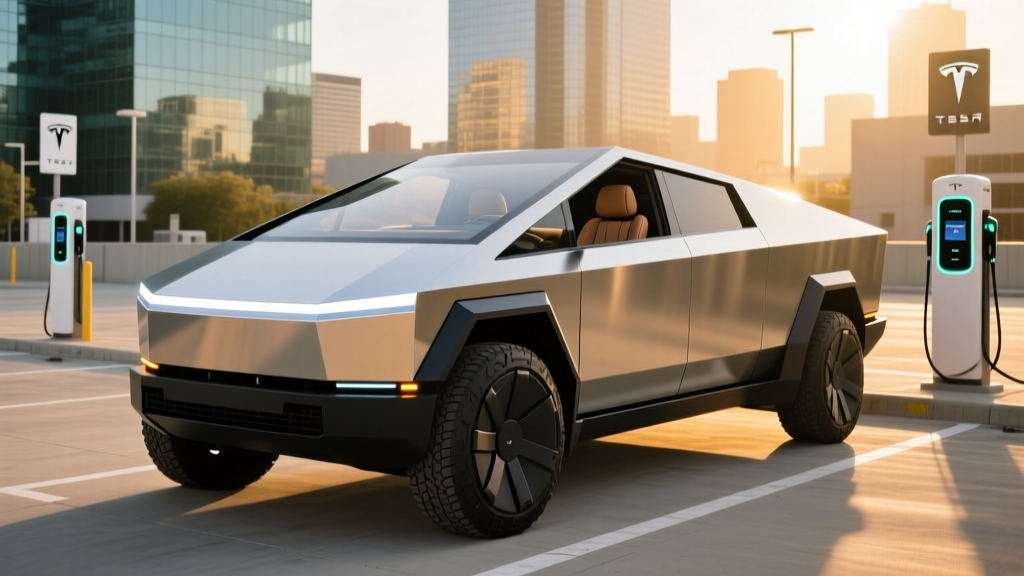
Search forums, Reddit threads, and EV Facebook groups and you'll find persistent speculation about a "Cybertruck van" — a hypothetical passenger-van or cargo-van variant of Tesla's angular electric pickup. As of early 2026, Tesla has not announced, previewed, or confirmed any Cybertruck van model. What exists is the Cybertruck pickup in three trims (Rear-Wheel Drive, All-Wheel Drive, and Cyberbeast), plus a growing ecosystem of third-party camper and upfit conversions that push the platform toward van-like utility.
This profile examines what a Cybertruck-based van would need to deliver based on the current Cybertruck platform's known engineering, projects realistic specs if Tesla were to greenlight such a variant, and evaluates the third-party conversions already bending the Cybertruck toward van duty. Every projected figure is clearly labeled as estimated or preliminary.
Current Cybertruck Platform: The Foundation for Any Van Variant
Any future Cybertruck van would share the structural skateboard, battery architecture, and powertrain options already in production. Here are the confirmed 2026 specs for the Cybertruck lineup that would underpin a van derivative:
| Spec | RWD (Base) | AWD | Cyberbeast |
|---|---|---|---|
| EPA Range | ~250 mi (est.) | 340 mi | 320 mi |
| Battery (usable) | ~85 kWh (est.) | ~123 kWh | ~123 kWh |
| Chemistry | NMC (est.) | NMC 4680 cells | NMC 4680 cells |
| Horsepower | ~315 hp | 600 hp | 845 hp |
| 0-60 mph | ~6.5 sec (est.) | 4.1 sec | 2.6 sec |
| Max DC Fast Charge | ~250 kW | ~250 kW | ~250 kW |
| 10-80% DCFC Time | ~30 min (est.) | ~28 min | ~28 min |
| Level 2 Home Rate | 11.5 kW (~30 mi/hr) | 11.5 kW (~30 mi/hr) | 11.5 kW (~30 mi/hr) |
| Towing Capacity | 7,500 lbs | 11,000 lbs | 11,000 lbs |
| Base MSRP (2026) | $60,990 | $79,990 | $99,990 |
Sources: Tesla Cybertruck specs, EPA fueleconomy.gov. RWD figures are preliminary estimates for the base model entering production in 2026.
Projected Cybertruck Van Specs: What the Physics Suggest
If Tesla were to engineer an enclosed van body on the Cybertruck skateboard — whether a passenger shuttle, cargo hauler, or campervan-ready platform — the added weight and aerodynamic penalty of a taller, boxier body would measurably impact range and efficiency. Here's a grounded projection based on the known AWD platform:
EPA Estimate (projected): ~290–310 miles
Real-World Highway (70 mph, 75°F): ~240–265 miles
Cold-Weather Highway (30°F, heater on): ~195–220 miles
Loaded/Towing Scenario (near GVWR): ~170–200 miles
Why the drop from the pickup's 340 mi? A van body adds roughly 300–500 lbs of structure and increases frontal area by ~10–15%. The Cybertruck's stainless-steel exoskeleton already carries a weight premium; enclosing the bed into a full van volume compounds this. Tesla's heat pump helps mitigate cold-weather losses, but physics still dominates at highway speeds in freezing temps.
| Charging Method | Power / Rate | Miles Added per Hour | Notes |
|---|---|---|---|
| Level 1 (120V household) | ~1.4 kW | ~3–4 mi/hr | Emergency/trickle only; full charge takes days |
| Level 2 (240V, 48A home charger) | 11.5 kW | ~28–32 mi/hr | Overnight full charge in ~10–12 hours |
| DC Fast Charge (Tesla Supercharger V3/V4) | Peak ~250 kW | ~750+ mi/hr (peak) | 10–80% in ~28 min; tapers sharply above 80% |
| DC Fast Charge (CCS adapter, non-Tesla) | Up to ~150–200 kW | ~450–600 mi/hr (peak) | Speed limited by adapter and station output |
Charging speeds assume battery preconditioning is active (automatic when navigating to a Supercharger). kW = power (rate of energy delivery); kWh = energy (battery capacity). A 250 kW peak rate is not sustained across the full session — expect an average of ~130–160 kW over a 10–80% session.
Pricing, Tax Credits, and the MSRP Cap Problem
Even if a Cybertruck van variant launched, federal tax credit eligibility under IRS §30D would face a fundamental hurdle: the MSRP cap.
- Vehicle MSRP Cap: ≤ $80,000 for vans, SUVs, and pickups — ≤ $55,000 for sedans
- Buyer Income Cap (MAGI): ≤ $300,000 (joint) / $225,000 (head of household) / $150,000 (single)
- Battery Sourcing: Critical minerals and battery components must meet escalating domestic/free-trade-partner thresholds (phased in annually through 2029)
- Final Assembly: Must occur in North America
- Point-of-Sale Transfer: Eligible buyers can transfer the credit to the dealer for an instant price reduction
Note: The Cybertruck AWD at $79,990 squeaks under the $80K van/truck cap. The Cyberbeast at $99,990 does not qualify. A van variant with added body structure would likely push MSRP above $80K, potentially disqualifying it unless Tesla prices aggressively. Always verify current eligibility at fueleconomy.gov and consult a tax professional.
| Scenario | Est. MSRP | §30D Credit | Effective Price | Eligible? |
|---|---|---|---|---|
| Cybertruck RWD (current) | $60,990 | Up to $7,500 | ~$53,490 | ✅ (if sourcing rules met) |
| Cybertruck AWD (current) | $79,990 | Up to $7,500 | ~$72,490 | ⚠️ At cap limit |
| Cybertruck Van (projected cargo) | $75,000–$85,000 | $0–$7,500 | $75,000–$85,000 | ⚠️ Depends on final MSRP |
| Cybertruck Van (projected passenger) | $85,000–$95,000 | $0 | $85,000–$95,000 | ❌ Exceeds $80K cap |
Third-Party Conversions: The Closest Thing to a Cybertruck Van Today
Since Tesla hasn't built a van, the aftermarket has stepped in. Several companies now offer enclosed toppers, camper shells, and full van-conversion kits for the Cybertruck's 6-foot bed:
- Basecamp-style camper toppers — Hard-shell enclosures with pop-up roofs, adding ~200–350 lbs and ~$8,000–$18,000. Brands like Space Camp and Atmos have shown Cybertruck-compatible prototypes. These effectively create a small enclosed sleeping/cargo volume behind the cab.
- Enclosed utility toppers — Commercial-grade caps (e.g., from LEER or ARE) adapted for the Cybertruck's stainless bed, creating a weatherproof cargo area. Cost: ~$3,000–$6,000 installed.
- Full campervan upfits — Companies like Lightship and the broader overlanding community are developing integrated systems with auxiliary batteries, induction cooktops, and water tanks that leverage the Cybertruck's Powershare vehicle-to-load (V2L) capability, which can output up to 11.5 kW (240V) to run tools and appliances.
The Cybertruck's 6.5-foot bed (with tailgate down) and 67 cubic feet of enclosed vault space (under the tonneau) provide a starting point, but none of these match a true van's interior volume. For reference, a Ford E-Transit cargo van offers 246.7–487.3 cu ft of cargo space — vastly more than any Cybertruck conversion can achieve.
Interior, Tech, and Driver-Assistance Features
A Cybertruck van variant would inherit the current truck's interior architecture:
- Front seating: 3-across bench (6-passenger capacity with the current 2-row layout)
- Infotainment: 18.5-inch center touchscreen running Tesla's proprietary OS; no Apple CarPlay or Android Auto
- Rear screen: 9.4-inch touchscreen for rear passengers (current AWD/Cyberbeast)
- Audio: 15-speaker premium system with active noise cancellation
- Connectivity: Wi-Fi, LTE, Bluetooth; Tesla app integration for preconditioning, charging monitoring, and Sentry Mode
Driver Assistance — Autopilot & FSD (Supervised):
Tesla Autopilot and Full Self-Driving (Supervised) are Level 2 driver-assistance systems, not self-driving. The driver must remain fully engaged — hands on the steering wheel (or torque-confirmed via Tesla's camera-based monitoring), eyes on the road — at all times. The system handles steering, acceleration, and braking on mapped roads but cannot navigate unmapped construction zones, severe weather, or complex urban scenarios without intervention. Tesla's FSD (Supervised) costs $8,000 one-time or $99/month as of 2026.
Warranty, Battery Longevity, and Ownership Costs
| Coverage | Term |
|---|---|
| Basic Vehicle Limited Warranty | 4 years / 50,000 miles |
| Battery & Drive Unit Warranty | 8 years / 120,000 miles (min. 70% capacity retention) |
| Restraint System | 5 years / 60,000 miles |
| Corrosion Perforation | 12 years / unlimited miles |
The 4680 NMC cells in the AWD and Cyberbeast use Tesla's tabless electrode design, which improves thermal management and theoretically supports faster charging with less degradation. Real-world data on 4680 longevity is still accumulating (the Cybertruck launched in late 2023), but Tesla's warranty guarantees at least 70% State of Health (SoH) over 8 years / 120,000 miles. Independent fleet data from Tesla's 4680-equipped vehicles suggests degradation of ~5–8% over the first 50,000 miles — within acceptable bounds but slightly higher than the LFP packs in the Model 3 RWD.
Estimated 5-Year Cost of Ownership (AWD, 15,000 mi/yr, national avg electricity):
- Electricity (home + public charging): ~$4,200–$5,500
- Insurance: ~$12,000–$16,000 (Cybertruck premiums run 40–60% above comparable EVs due to repair costs)
- Maintenance (tires, cabin filter, wiper fluid): ~$1,800–$2,500
- Depreciation: ~$25,000–$35,000 (highly variable; Cybertruck resale has been volatile)
Who Should Wait for a Cybertruck Van — and Who Should Buy Now?
- You need an enclosed, weatherproof cargo area with at least 150+ cu ft of interior volume
- You want Tesla's Supercharger network + Powershare V2L in a commercial fleet application
- You're willing to wait 2–4+ years with no guarantee Tesla will build this vehicle
- You need van cargo space today: Ford E-Transit (126 mi range, ~$47K, qualifies for §30D) or Mercedes eSprinter (~200 mi range, ~$57K)
- You want Cybertruck capability in a package that exists: Buy the Cybertruck AWD and add an aftermarket enclosed topper (~$5K–$18K)
- You need passenger van seating for 7+: No EV passenger van currently exists in the US market; the closest electric option is the VW ID. Buzz (234 mi range, 7 seats, ~$60K)
- 11.5 kW Powershare V2L — run power tools, appliances, or campsite equipment
- Supercharger network access (17,000+ stalls in North America)
- Stainless steel body resists dents and corrosion
- 11,000-lb towing (AWD/Cyberbeast)
- Air suspension adjusts ride height for loading
- No factory van model exists — only aftermarket workarounds
- Bed volume (67 cu ft under tonneau) far less than a true cargo van
- Insurance premiums significantly above segment average
- Cyberbeast exceeds §30D MSRP cap — no tax credit
- No Apple CarPlay/Android Auto
- Panel gap and build-quality concerns persist from early production
Frequently Asked Questions
Has Tesla officially announced a Cybertruck van?
No. As of 2026, Tesla has not announced, teased, or filed EPA paperwork for any Cybertruck van variant. Elon Musk has occasionally referenced a "Cybertruck van" or bus concept in informal settings (social media posts, interviews), but no production timeline, pricing, or specifications have been confirmed. Treat any leaked renders or speculative articles as unofficial.
What is the real-world range of the current Cybertruck, and how would a van version compare?
The Cybertruck AWD achieves an EPA-estimated 340 miles. In real-world highway driving at 70 mph in moderate temperatures, expect ~270–295 miles. In cold weather (below freezing), that drops to ~220–250 miles. A hypothetical van variant, with its added weight and frontal area, would likely lose 10–15% of that — putting real-world highway range at roughly 230–260 miles in fair conditions, and potentially under 200 miles in freezing temps.
How fast does the Cybertruck charge at home and on the road?
On a 240V Level 2 home charger at 48 amps (11.5 kW), the Cybertruck adds roughly 30 miles of range per hour — a full overnight charge takes about 10–12 hours for the ~123 kWh battery. On a Tesla Supercharger V3/V4, it peaks at ~250 kW, reaching 10–80% in approximately 28 minutes. However, the charge curve tapers significantly above 80% — a 10–90% session takes closer to 40–45 minutes. Always enable battery preconditioning (automatic when navigating to a Supercharger) to achieve peak charge rates.
Does the Cybertruck qualify for the $7,500 federal EV tax credit?
It depends on the trim and your income. The RWD ($60,990) and AWD ($79,990) fall under the $80,000 MSRP cap for trucks/vans under §30D. The Cyberbeast ($99,990) does not qualify. You must also meet income limits ($300K joint / $150K single MAGI), and the vehicle must satisfy battery-sourcing and critical-minerals requirements that tighten annually. Check current eligibility at fueleconomy.gov and consult a tax professional before relying on the credit.
What's the best electric van available right now if I can't wait?
For cargo: the Ford E-Transit (126 mi EPA range, starting ~$47K, qualifies for §30D) is the most widely available electric cargo van in the US, though its limited range suits urban delivery routes rather than long hauls. The Mercedes-Benz eSprinter (~200 mi range, ~$57K) offers more range and cargo volume at a premium. For passengers: the VW ID. Buzz (234 mi EPA, 7 seats, ~$60K) is the only electric passenger van currently sold in the US.
Could Tesla use LFP batteries in a Cybertruck van to lower the price?
It's technically possible and strategically logical. LFP (lithium iron phosphate) chemistry is cheaper per kWh, more durable (3,000+ cycle life vs ~1,500 for NMC), and avoids cobalt/nickel sourcing constraints. The trade-off is lower energy density — roughly 15–20% less range for the same pack size. A cargo-focused Cybertruck van prioritizing cost and longevity over maximum range could be a strong LFP candidate. Tesla already uses LFP in the Model 3 RWD and Model Y Standard Range.