Quick Verdict: The Mustang Mach-E's Cargo Story and Overall Value
If you've landed here searching for details on the Mustang Mach-E trunk, you're not alone. Cargo capacity is one of the most practical differentiators among electric SUVs, and Ford's electric pony delivers a compelling mix of rear storage, a front trunk (frunk), and a versatile cabin. But beyond the tape measure, the 2026 Mustang Mach-E has evolved into a mature EV platform with competitive range, improved DC fast-charging speeds, and one of the most refined infotainment systems in the segment.
This review covers every dimension a buyer needs — from the exact cargo cubic feet behind the second row to the battery chemistry under the floor, the real-world range you can expect on a winter highway, and whether the Mach-E still qualifies for the federal §30D tax credit in 2026.
Mustang Mach-E Trunk and Cargo Dimensions: What Actually Fits
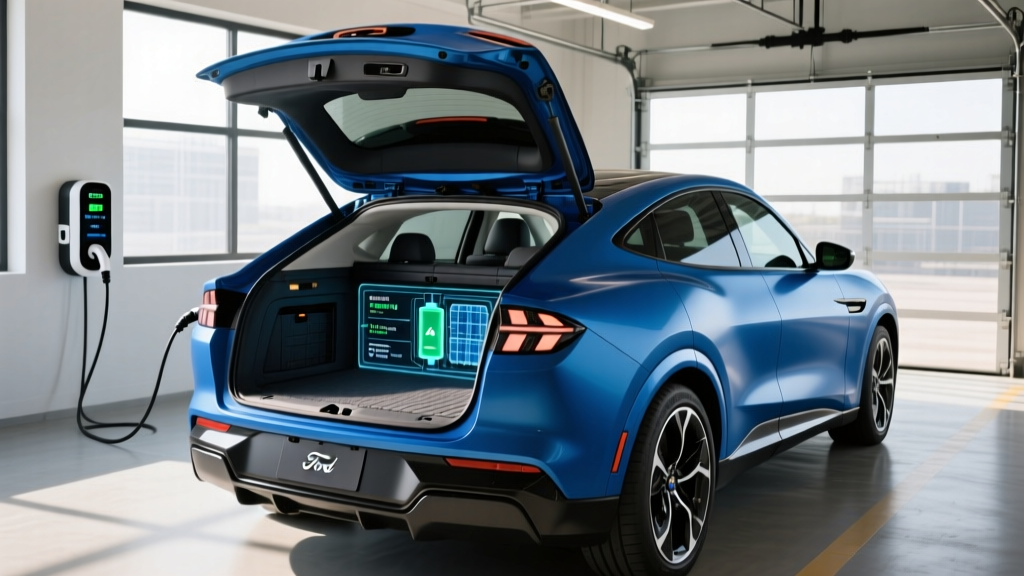
The headline number for the Mustang Mach-E trunk is 29.7 cubic feet of cargo volume behind the second-row seats, according to Ford's official specifications. Fold the 60/40 split rear bench flat, and that expands to approximately 59.7 cubic feet — competitive with the Tesla Model Y (30.2 / 72.1 cu ft) and slightly less than the Hyundai Ioniq 5 (27.2 / 59.3 cu ft).
| Measurement | Specification |
|---|---|
| Cargo behind 2nd row | 29.7 cu ft |
| Cargo, seats folded | 59.7 cu ft |
| Front trunk (frunk) | 4.7 cu ft (drainable, lockable) |
| Rear legroom | 38.9 in |
| Front headroom | 40.4 in |
| Rear headroom | 38.2 in |
| Cargo floor width (between wheel wells) | ~41 in |
The Mach-E's frunk deserves special mention. At 4.7 cubic feet, it's smaller than the F-150 Lightning's mega-frunk but larger than most EV competitors that have abandoned front trunks entirely. Ford includes a drain plug, making it practical for tailgating ice storage or muddy gear. The power liftgate opens to a low load floor — roughly 28 inches from the ground — which helps when loading heavy items like dog crates or coolers.
Cargo Strengths
- Low, flat load floor with minimal intrusion
- Drainable frunk with 12V outlet
- Under-floor rear storage cubby for smaller items
- 60/40 split-folding rear seats with near-flat result
Cargo Limitations
- 29.7 cu ft trails the Model Y by ~0.5 cu ft
- No spare tire — tire-inflation kit only
- Rear visibility is compromised by the sloping roofline
- Frunk is too small for a carry-on suitcase
EPA Range, Battery Specs, and Real-World Expectations
The 2026 Mustang Mach-E is offered with two battery options. The Standard Range pack is a 70 kWh usable lithium-ion battery using NMC (nickel manganese cobalt) chemistry. The Extended Range pack bumps usable capacity to 91 kWh, also NMC. Ford has not adopted LFP (lithium iron phosphate) for the Mach-E as of the 2026 model year, which means owners should follow the 80% daily-charge recommendation to preserve long-term battery health — unlike LFP packs that tolerate regular 100% charges.
| Trim / Drivetrain | Battery (kWh usable) | EPA Range | MPGe (combined) | kWh/100 mi |
|---|---|---|---|---|
| Select RWD (Std Range) | 70 | 250 mi | 101 MPGe | 33 |
| Premium RWD (Ext Range) | 91 | 320 mi | 101 MPGe | 33 |
| Premium AWD (Ext Range) | 91 | 290 mi | 94 MPGe | 36 |
| GT AWD (Ext Range) | 91 | 280 mi | 90 MPGe | 37 |
Real-World Range Reality Check
The EPA sticker says 320 miles for the Premium RWD Extended Range. In mixed highway driving at 70-75 mph in moderate temperatures (60-75°F), expect 275-295 miles before needing a charger. In cold weather (below 30°F), cabin heating and battery thermal management can reduce range by 20-30%, bringing real-world figures down to 220-250 miles. City driving with regenerative braking recovers energy and can match or slightly exceed the EPA estimate. The Mach-E's heat pump (standard on Extended Range trims) helps mitigate cold-weather losses compared to resistive heating systems.
Charging Speed: DC Fast Charge, Level 2, and Home Setup
The 2026 Mach-E supports DC fast charging at a peak rate of 150 kW on Extended Range models (Standard Range peaks at ~115 kW). Ford quotes a 10-80% charge time of approximately 36 minutes on a capable 150+ kW DC station. This is adequate but trails segment leaders — the Hyundai Ioniq 5 peaks at 240 kW (10-80% in ~18 min), and the Tesla Model Y on V3 Superchargers manages similar speeds.
| Charging Level | Power (kW) | Speed / Time |
|---|---|---|
| Level 1 (120V household) | ~1.4 kW | ~3 mi/hr added |
| Level 2 (240V, 32A Ford Mobile Charger) | ~7.7 kW | ~22 mi/hr added |
| Level 2 (240V, 48A Ford Connected Charge Station) | ~11.5 kW | ~33 mi/hr added |
| DC Fast Charge (Std Range peak) | 115 kW | 10-80% in ~42 min |
| DC Fast Charge (Ext Range peak) | 150 kW | 10-80% in ~36 min |
One practical advantage: the 2026 Mach-E ships with the NACS (North American Charging Standard) port natively, replacing the previous CCS1 connector. This grants direct access to Tesla Supercharger stations without an adapter — a significant real-world benefit for road-trip charging reliability. According to Ford's official specs, the onboard charger is 10.5 kW for Level 2 AC charging.
Home charging reality: On a 48-amp Level 2 home charger (the Ford Connected Charge Station or a third-party unit like the ChargePoint Home Flex), the Extended Range battery replenishes roughly 33 miles of range per hour, or a full 0-100% in about 9-10 hours. Budget $500-$1,200 for professional installation of a 240V/60A circuit, depending on your electrical panel's capacity and the distance from panel to garage. A panel upgrade to 200A service, if needed, can add $1,500-$3,000.
Performance: 0-60, Horsepower, and Drivetrain Options
The Mach-E lineup covers a wide performance spectrum. The base Select RWD produces 266 horsepower and 317 lb-ft of torque, hitting 0-60 mph in approximately 6.3 seconds. The Premium AWD bumps output to 346 hp and 428 lb-ft (0-60 in ~5.1 seconds). At the top, the GT trim delivers 480 hp and 634 lb-ft with the Performance Upgrade, dropping the 0-60 sprint to 3.5 seconds — firmly in sports-car territory.
| Trim | Drivetrain | Horsepower | Torque (lb-ft) | 0-60 mph |
|---|---|---|---|---|
| Select | RWD (single motor) | 266 | 317 | 6.3 sec |
| Premium | RWD or AWD | 266-346 | 317-428 | 5.1-6.3 sec |
| California Route 1 | RWD (Ext Range) | 290 | 317 | 5.8 sec |
| GT | AWD (dual motor) | 480 | 634 | 3.5 sec |
All trims feature a single-speed reduction gear (no traditional transmission) and one-pedal driving mode that enables near-complete stops using regenerative braking alone. The GT's MagneRide adaptive suspension is a standout, providing composed handling without the harsh ride common in performance SUVs. Towing capacity maxes out at 2,300 pounds (AWD with the towing package) — sufficient for a light utility trailer but not a boat or camper.
Pricing, Trim Levels, and Federal Tax Credit Eligibility
The 2026 Mustang Mach-E starts at $42,995 MSRP for the Select RWD with Standard Range battery (including destination charge). The volume-selling Premium RWD Extended Range lists at $48,995, and the GT tops out near $62,995 before options.
| Trim | Base MSRP | §30D Credit Eligible? | Effective Price (if eligible) |
|---|---|---|---|
| Select RWD (Std Range) | $42,995 | Yes — up to $7,500 | ~$35,495 |
| Premium RWD (Ext Range) | $48,995 | Yes — up to $7,500 | ~$41,495 |
| Premium AWD (Ext Range) | $51,995 | Yes — up to $7,500 | ~$44,495 |
| GT AWD (Ext Range) | $62,995 | Yes — up to $7,500 | ~$55,495 |
Federal tax credit details (§30D): As of 2026, the Mach-E qualifies for up to $7,500 in federal tax credits, provided the buyer meets all IRS requirements. Key eligibility rules per IRS guidelines:
- MSRP cap: SUVs/vans must have an MSRP at or below $80,000 — all Mach-E trims qualify.
- Income cap: Modified adjusted gross income (MAGI) must not exceed $150,000 (single), $225,000 (head of household), or $300,000 (joint filers).
- Battery sourcing: A percentage of critical minerals and battery components must be sourced from the U.S. or free-trade-agreement countries. Ford has worked to meet these thresholds, but exact eligibility can shift by production batch — confirm with your dealer and reference the VIN on the IRS qualified vehicles list.
- Point-of-sale transfer: Since 2024, buyers can transfer the credit to the dealer at purchase, receiving the discount upfront rather than waiting to claim it on their tax return.
Always consult a tax professional and verify your specific VIN on fueleconomy.gov before relying on credit eligibility.
Technology, Safety, and Driver Assistance
The Mach-E's centerpiece is a 15.5-inch vertical touchscreen running Ford's SYNC 4A system — responsive, logically organized, and supporting wireless Apple CarPlay and Android Auto. A 10.2-inch digital instrument cluster sits behind the steering wheel. Over-the-air (OTA) updates continue to add features; Ford's BlueCruise hands-free driving system (SAE Level 2) covers over 130,000 miles of pre-mapped divided highways in the U.S. and Canada.
SAE Automation Level: Level 2
BlueCruise is a Level 2 driver-assistance system, not a self-driving feature. The driver must remain attentive, keep eyes on the road (monitored by an infrared camera), and be prepared to take over at any time. It does not navigate city streets, construction zones, or unmapped roads autonomously.
Standard safety features include Ford Co-Pilot360 2.0: automatic emergency braking with pedestrian detection, blind-spot monitoring, rear cross-traffic alert, lane-keeping assist, and evasive steering assist. The Mach-E earned a 5-star overall safety rating from NHTSA and a Top Safety Pick designation from IIHS.
Warranty, Ownership Costs, and Long-Term Battery Outlook
Ford covers the Mach-E with a 3-year/36,000-mile bumper-to-bumper warranty and a 5-year/60,000-mile powertrain warranty. The high-voltage battery is warranted for 8 years or 100,000 miles (whichever comes first), retaining at least 70% of original capacity. This is industry-standard, matching Tesla, Hyundai, and most competitors.
| Component | Coverage |
|---|---|
| Bumper-to-bumper | 3 yr / 36,000 mi |
| Powertrain | 5 yr / 60,000 mi |
| High-voltage battery | 8 yr / 100,000 mi (≥70% capacity) |
| Corrosion perforation | 5 yr / unlimited mi |
| Roadside assistance | 5 yr / 60,000 mi |
Long-term battery degradation data for the Mach-E is still maturing — the model launched for the 2021 model year, so the oldest examples have roughly 5 years of real-world data. Early reports from high-mileage owners and fleet data suggest NMC packs in the Mach-E are holding up well, with most vehicles retaining 90%+ state of health (SoH) after 60,000 miles. A full battery replacement, if ever needed outside warranty, is estimated at $12,000-$18,000 based on current Ford parts pricing — though this figure should decrease as battery costs continue their long-term decline.
Insurance premiums for the Mach-E tend to run 10-20% higher than comparable gas-powered SUVs, reflecting higher repair costs and EV-specific parts pricing. Shop quotes from EV-friendly insurers (Geico, Progressive, State Farm) before purchase.
Who Should Buy the Mustang Mach-E — and Who Should Look Elsewhere
Buy the Mach-E If:
- You want a sporty-driving electric SUV with genuine performance (especially the GT)
- 320 miles of EPA range covers your commute and weekend trips without range stress
- You value Supercharger access via NACS without needing an adapter
- You need a drainable frunk and flexible cargo for active lifestyles
- You qualify for the $7,500 federal credit, bringing the effective price into the low $35Ks
Look Elsewhere If:
- Maximum cargo space is paramount — the Model Y offers more total volume
- You need the fastest DC charging — Ioniq 5 and EV6 charge nearly twice as fast
- You want LFP chemistry for 100% daily charging convenience
- You regularly tow more than 2,300 lbs
- Third-row seating is required — the Mach-E is strictly a two-row SUV
Frequently Asked Questions
What is the real-world range of the Mustang Mach-E?
The EPA rates the Premium RWD Extended Range at 320 miles. In real-world highway driving at 70-75 mph, expect 275-295 miles in moderate weather. Cold weather (below 30°F) can reduce range to 220-250 miles due to cabin heating demands and battery chemistry limitations. City driving with regenerative braking may match or slightly exceed the EPA figure.
How fast does the Mustang Mach-E charge?
On a DC fast charger, the Extended Range model peaks at 150 kW, achieving a 10-80% charge in approximately 36 minutes. At home on a 48-amp Level 2 charger, expect about 33 miles of range added per hour, or a full charge overnight in 9-10 hours. Level 1 (120V) adds roughly 3 miles per hour — suitable only for overnight top-ups.
How much does the Mustang Mach-E cost after tax credits?
The base Select RWD starts at $42,995 MSRP. With the full $7,500 federal §30D credit applied at point of sale, the effective price drops to approximately $35,495. Eligibility depends on buyer income (MAGI caps), battery sourcing requirements, and the $80,000 MSRP cap for SUVs. Verify your VIN on the IRS qualified vehicle list before purchase.
Is the Mustang Mach-E worth buying vs the Tesla Model Y or Hyundai Ioniq 5?
The Mach-E competes closely with both. It offers more engaging driving dynamics than the Ioniq 5 and a more traditional SUV interior than the Model Y. However, the Model Y provides more cargo space (72.1 cu ft max) and access to the Supercharger network (though the Mach-E now has native NACS access too). The Ioniq 5 charges significantly faster (240 kW peak). The Mach-E is the pick for drivers who prioritize ride quality, BlueCruise highway driving, and Ford dealer service proximity.
Does the Mustang Mach-E qualify for the federal EV tax credit?
Yes, the 2026 Mach-E qualifies for up to $7,500 under IRS §30D, subject to buyer income limits ($150K single / $300K joint MAGI), the $80K MSRP cap (all trims qualify), and battery critical-mineral sourcing requirements that can vary by production batch. The credit can be transferred to the dealer at point of sale for an immediate price reduction. Always confirm eligibility with your dealer and a tax professional.
How much cargo fits in the Mustang Mach-E trunk?
The Mustang Mach-E trunk offers 29.7 cubic feet behind the second row and 59.7 cubic feet with the rear seats folded. The drainable front trunk (frunk) adds 4.7 cubic feet. That's enough for four carry-on suitcases in the rear, plus a cooler or gym bags in the frunk. The low load floor and wide opening make bulky items manageable.