Quick Verdict: A Capable Tow Rig With a Range Reality Check
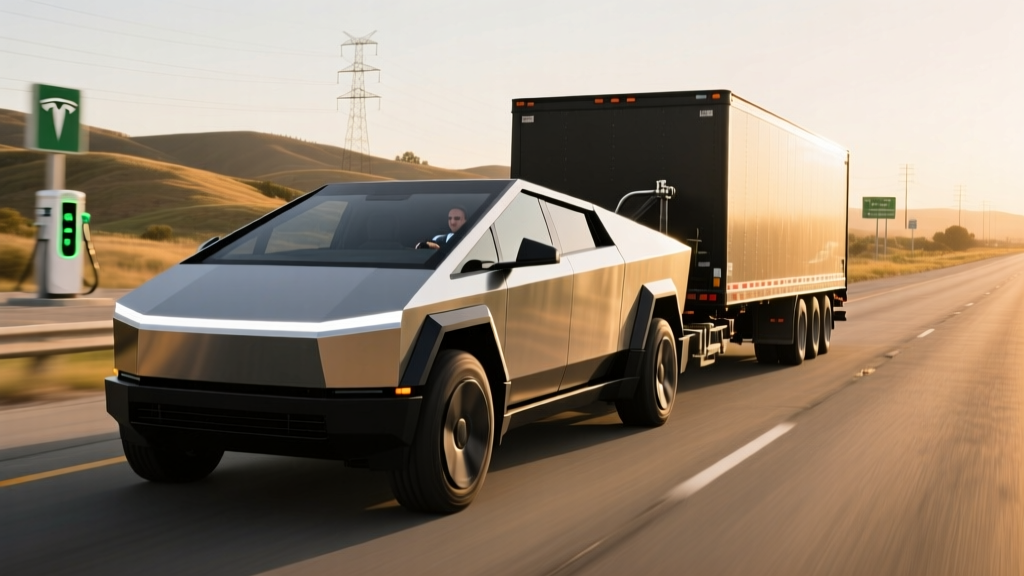
The Tesla Cybertruck's angular, stainless-steel exoskeleton grabs headlines, but for truck buyers, the question is practical: can it actually tow? The short answer is yes — with a maximum tow rating of 11,000 pounds on dual- and tri-motor trims, the Cybertruck is competitive with mid-duty pickups. But towing is where an EV's limitations become most visible. Range drops dramatically under load, charging infrastructure for trailers is still maturing, and the Cybertruck's polarizing design introduces real-world compromises in bed utility and visibility. This review breaks down everything truck buyers need to know — from real-world towing range to tax-credit eligibility — so you can decide if the Cybertruck earns a spot in your driveway.
Tesla Cybertruck Specs at a Glance
| Specification | AWD (Dual Motor) | Cyberbeast (Tri-Motor) |
|---|---|---|
| EPA Range | 340 miles | 320 miles |
| Battery Capacity (usable) | ~123 kWh (NMC) | ~123 kWh (NMC) |
| Horsepower | 600 hp | 845 hp |
| 0–60 mph | 4.1 sec | 2.6 sec |
| Max Tow Rating | 11,000 lbs | 11,000 lbs |
| Max Payload | 2,500 lbs | 2,500 lbs |
| Bed Length | 6 ft (72 in) | |
| Cargo Volume (bed + frunk) | ~67 cu ft bed + 7 cu ft frunk | |
| Drivetrain | Dual-Motor AWD | Tri-Motor AWD |
| Max DC Fast Charge | ~250 kW (peak) | |
| 10–80% DC Charge Time | ~28 minutes | |
| Level 2 Home Charging | 11.5 kW (~37 mi/hr) | |
| EPA Efficiency | 68 MPGe / 50 kWh/100mi | 65 MPGe / 52 kWh/100mi |
| Battery/Drive Unit Warranty | 8 years / 120,000 miles | |
| Base MSRP (2026) | $79,990 | $99,990 |
Real-World Range — Especially While Towing
EPA Estimated Range: 340 mi (AWD) / 320 mi (Cyberbeast)
Real-World Expectation (no trailer): 280–310 mi highway at 70+ mph; 300–330 mi mixed city/highway. Cold weather (below 32°F) can reduce range by 15–30%, depending on cabin heating and battery preconditioning.
Towing Range (loaded trailer, ~7,500 lbs): Expect 130–170 miles at highway speeds on flat terrain. Hilly routes or sustained 75+ mph speeds can push that below 120 miles. A near-max 11,000-lb load will reduce range further.
The Cybertruck's ~123 kWh usable battery is one of the largest in any production EV, but physics is unforgiving. Towing a heavy, boxy trailer increases aerodynamic drag and rolling resistance simultaneously. Independent tests by outlets like Motor Trend and real-world owner logs consistently show a 45–60% range reduction when pulling 7,000–10,000 lbs at highway speed. This isn't unique to Tesla — the Ford F-150 Lightning and Rivian R1T show similar losses — but it demands trip planning.
The Cybertruck's available range-extender battery pack (announced for future availability) could add roughly 130+ miles of range under normal driving, but as of 2026, it is not yet available for order. If you plan to tow regularly beyond 100-mile round trips, you'll need reliable DC fast charging at your destination or along your route.
Charging Speed: At Home and on the Road
| Charging Level | Power / Rate | Miles Added per Hour | Notes |
|---|---|---|---|
| Level 1 (120V outlet) | ~1.4 kW | ~3–4 mi/hr | Emergency/trickle only |
| Level 2 (240V, 48A) | 11.5 kW | ~37 mi/hr | Full charge in ~11 hours |
| DC Fast Charge (V3 Supercharger) | Peak ~250 kW | ~175 mi in 15 min (ideal) | 10–80% in ~28 min; tapers sharply above 80% |
| DC Fast Charge (V4 Supercharger) | Peak ~325 kW (capable) | Marginally faster | Cybertruck architecture supports higher rates; real-world gains depend on state of charge and temperature |
At home, a Level 2 Tesla Wall Connector on a 60-amp circuit delivers 11.5 kW, adding roughly 37 miles of range per hour. An overnight charge from 20% to full takes about 9–10 hours — adequate for daily use and pre-tow top-ups.
On the road, the Cybertruck charges at up to ~250 kW on Tesla V3 Superchargers, with a 10–80% session taking approximately 28 minutes under optimal conditions (warm battery, low state of charge). However, the charge curve tapers significantly past 80%. If you're towing and need a full battery, budget 40–45 minutes for a 10–95% session. The Cybertruck's NACS connector gives it native access to the entire Tesla Supercharger network — a significant advantage, as the NACS standard has been adopted by most major automakers, though third-party chargers with NACS connectors are still rolling out through 2026.
Towing-specific charging reality: Most Supercharger stalls are not designed for pull-through parking with a trailer. You may need to unhook your trailer or find a charger with pull-through access (increasingly common at Electrify America and some newer Tesla locations, but still not the norm).
Towing Capability: What the Numbers Mean
The Cybertruck's 11,000-lb tow rating places it squarely in the half-ton truck conversation. Here's how it compares to key EV and ICE competitors:
- Ford F-150 Lightning (Extended Range): 10,000 lbs max tow; EPA range up to 320 mi
- Rivian R1T (Dual-Motor Max Pack): 11,000 lbs max tow; EPA range up to 410 mi
- Chevrolet Silverado EV (4WT): 10,000 lbs (standard), up to 12,500 lbs with max tow package; EPA range up to 440 mi
- Ford F-150 (3.5L EcoBoost, gas): Up to 14,000 lbs; no range anxiety but $50+ fill-ups
The Cybertruck's standard integrated trailer brake controller, rear-view camera with trailer-assist guidelines, and torque-vectoring AWD make it stable under load. The tri-motor Cyberbeast's 845 hp and instantaneous torque deliver confident highway merging and hill climbing — areas where even turbocharged gas trucks can feel strained.
However, the 6-foot bed is shorter than the 6.5- or 8-foot beds common on competing trucks, limiting what you can haul without a trailer. The composite bed floor is durable but lacks a traditional tailgate — the power-operated tonneau cover and fold-down ramp are clever but not a substitute for a full tailgate when loading ATVs or pallets. Payload capacity of 2,500 lbs is competitive but not class-leading.
Pricing, Tax Credits, and Ownership Costs
| Trim | Base MSRP | Federal Tax Credit (§30D) | Effective Price |
|---|---|---|---|
| AWD (Dual Motor) | $79,990 | Up to $7,500 (if eligible) | ~$72,490 |
| Cyberbeast (Tri-Motor) | $99,990 | Up to $7,500 (if eligible) | ~$92,490 |
Federal tax credit eligibility (IRS §30D) is not guaranteed. To qualify for the full $7,500 credit in 2026, you must meet all of the following criteria, per IRS guidelines:
- MSRP Cap: The vehicle must have an MSRP at or below $80,000 for trucks/vans/SUVs. The AWD Cybertruck at $79,990 qualifies; the Cyberbeast at $99,990 does not qualify for the new-vehicle credit.
- Buyer Income Cap: Modified adjusted gross income must not exceed $150,000 (single), $225,000 (head of household), or $300,000 (joint filers).
- Battery Sourcing: Critical minerals and battery components must meet phased-in domestic/free-trade-partner sourcing requirements. Tesla's supply chain has been adapting, but eligibility can shift — always verify the specific VIN on fueleconomy.gov before purchasing.
- Point-of-Sale Transfer: As of 2024+, eligible buyers can transfer the credit to the dealer at purchase, reducing the upfront cost rather than waiting for a tax refund.
Bottom line: Only the base AWD trim, bought by an income-eligible buyer with a VIN that meets sourcing rules, qualifies for the full credit. Always confirm eligibility with your tax professional before relying on the $7,500 figure.
Interior, Tech, and Daily Livability
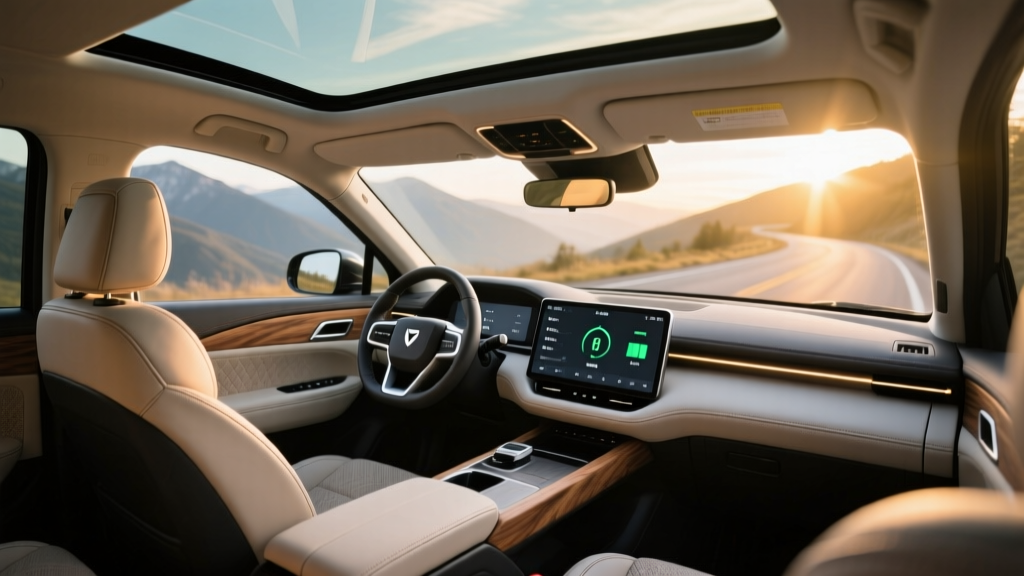
The Cybertruck's cabin is minimalist even by Tesla standards. An 18.5-inch center touchscreen handles all infotainment, climate, and vehicle controls — there are no physical buttons, no instrument cluster, and no traditional stalks (turn signals are on the steering wheel rim, a controversial choice). Rear passengers get a 9.4-inch touchscreen for climate and media.
Passenger space: Front legroom is generous at ~41.5 inches; rear legroom is approximately 38.5 inches — adequate for adults on shorter trips but tighter than a full-size crew cab like the F-150 or Silverado. The rear bench fits three, but the center position is best for a child seat.
Cargo: The 6-foot vault-style bed with a power tonneau offers ~67 cu ft of enclosed, lockable storage — weather-sealed and secure, a genuine advantage over an open bed. The 7 cu ft front trunk (frunk) handles groceries or a charging cable kit. A rear under-bed storage bin adds additional concealed space.
Driver Assistance: The Cybertruck ships with Tesla's basic Autopilot (adaptive cruise + lane centering, SAE Level 2). Full Self-Driving (Supervised) — Tesla's advanced Level 2 system — is available as an $8,000 add-on or subscription. FSD is not autonomous driving. The driver must remain fully attentive and is legally responsible for the vehicle at all times. Only Level 4 services like Waymo operate without a human driver.
Notable drawbacks: The yoke-style or round steering wheel (depending on build date) and button-mounted turn signals require an adjustment period. The stainless-steel body panels resist dents but show fingerprints constantly and cannot be repaired by traditional body shops — Tesla-certified collision centers are required. The large footprint and limited rear visibility (even with the digital rear-view mirror) make urban parking challenging.
Pros and Cons
Pros
- 11,000-lb tow rating with integrated trailer brake controller and torque-vectoring AWD
- Tri-motor Cyberbeast delivers 845 hp and a 2.6-sec 0–60 — fastest truck on the market
- ~123 kWh battery provides strong baseline range (340 mi EPA for AWD)
- Native NACS / Supercharger access — best charging network in North America
- Secure, lockable vault-style bed with power tonneau
- Stainless-steel exoskeleton is dent- and corrosion-resistant
- OTA software updates continuously add features
- Bioweapon Defense Mode (HEPA filtration) standard
Cons
- Towing range drops to 130–170 mi under load — requires careful trip planning
- Cyberbeast trim ($99,990) exceeds the $80,000 §30D MSRP cap — no federal tax credit
- 6-foot bed is shorter than most competitors; no traditional tailgate
- Stainless panels show smudges, are difficult to repair, and polarize aesthetically
- Rear visibility is poor; relies heavily on camera-based mirror
- Steering-wheel turn signals and lack of physical controls are divisive
- Supercharger stalls often lack pull-through access for trailers
- Insurance premiums run 25–40% higher than comparable gas trucks
Who the Cybertruck Suits Best
Choose the Cybertruck if:
- You tow moderately (boats, car trailers, campers under 8,000 lbs) on trips within 100–150 miles or have destination charging
- You want a secure, lockable bed for tools, gear, or job-site equipment
- You value performance — the Cyberbeast's acceleration is unmatched in the truck segment
- You already use the Tesla ecosystem (Superchargers, Powerwall, solar) and want seamless integration
- You're drawn to the design and want a truck that stands out
Look elsewhere if:
- You regularly tow near the 11,000-lb limit over long distances — the Rivian R1T Max Pack (410 mi EPA) or Silverado EV (440 mi) offer more range headroom
- You need a full-size bed (6.5+ ft) for pallets, ATVs, or construction materials
- You want a traditional truck experience with physical controls, a tailgate, and conventional body repair options
- The Cyberbeast's $99,990 price is in your budget but you expected the federal tax credit to apply (it doesn't above $80,000 MSRP)
Frequently Asked Questions
What is the real-world range of the Cybertruck while towing?
With a 7,000–8,000 lb trailer on flat highway at 65 mph, expect 130–170 miles from a full charge. Heavier loads, higher speeds, or hilly terrain will reduce that further. Always plan charging stops conservatively — arriving at a DC fast charger with 10–15% remaining is safer than running the battery to near-zero.
How fast does the Cybertruck charge at home and on the road?
On a Level 2 home charger (11.5 kW), the Cybertruck adds ~37 miles of range per hour, reaching a full charge overnight in about 10–11 hours. On a Tesla V3 Supercharger (peak 250 kW), a 10–80% session takes roughly 28 minutes. Charging slows significantly above 80% to protect the battery — a 10–95% session takes approximately 40–45 minutes.
Does the Tesla Cybertruck qualify for the federal EV tax credit?
The AWD trim at $79,990 MSRP can qualify for the full $7,500 §30D credit if the buyer meets income caps ($150K single / $300K joint) and the vehicle's battery meets critical-mineral and component sourcing requirements for the model year. The Cyberbeast at $99,990 exceeds the $80,000 truck MSRP cap and does not qualify for the new-vehicle credit. Always verify the specific VIN on fueleconomy.gov and consult a tax professional.
Is the Cybertruck worth buying over the F-150 Lightning or Rivian R1T?
It depends on your priorities. The F-150 Lightning offers a more traditional truck experience with a longer bed and available Pro Power Onboard for job-site use, but slightly less tow rating (10,000 lbs). The Rivian R1T with the Max Pack delivers 410 miles of EPA range — a major advantage for towing — plus a quad-motor option and a more refined interior, though at a higher starting price. The Cybertruck wins on raw performance, Supercharger access, and bed security. Test-drive all three before deciding.
How does the Cybertruck's battery hold up long-term?
Tesla covers the battery and drive units with an 8-year / 120,000-mile warranty, guaranteeing at least 70% capacity retention. The ~123 kWh NMC battery is liquid-cooled with active thermal management, which helps mitigate degradation. Real-world data from Tesla's fleet suggests an average degradation of 10–15% over 150,000 miles for NMC packs, though heavy towing and frequent DC fast charging can accelerate wear slightly. Avoid routinely charging to 100% for daily use; Tesla recommends 80% for NMC batteries unless a full charge is needed for a trip.
Can I use non-Tesla chargers with the Cybertruck?
Yes. The Cybertruck uses the NACS (North American Charging Standard) connector natively. As of 2026, a growing number of third-party networks — including Electrify America, EVgo, and ChargePoint — are deploying NACS-equipped stalls. You can also use a NACS-to-CCS adapter for older CCS stations, though charging speeds may be limited by the adapter's rating. Tesla Superchargers remain the most reliable and widespread option.
What's the insurance cost for a Cybertruck?
Insurance premiums for the Cybertruck are notably higher than the average pickup — typically 25–40% above a comparably priced gas truck, driven by the vehicle's repair costs (stainless-steel panels require Tesla-certified shops), high replacement parts costs, and performance profile. Expect annual premiums of $3,000–$4,500 depending on your state, driving record, and coverage level. Get quotes before ordering — insurance is a significant ownership cost that many buyers overlook.