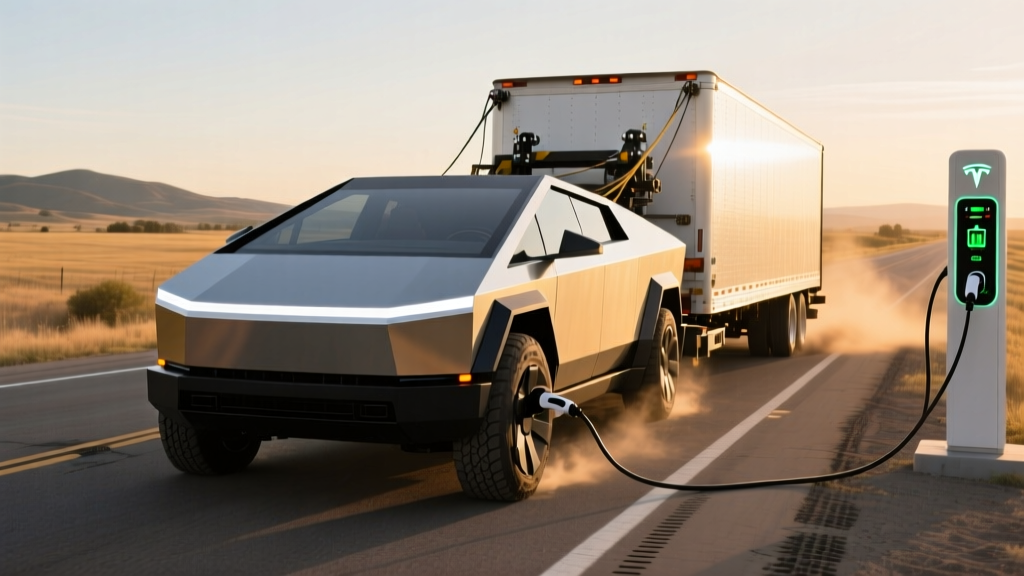
The viral images of a Tesla Cybertruck struggling on a trailer hill — or running out of charge mid-tow — sparked a debate that won't quiet down. Search "tesla cybertruck towing fail" and you'll find dashcam footage of range plummeting, Supercharger detours, and frustrated owners. But separating internet theater from engineering reality requires hard data. This review dissects the Cybertruck's actual towing capability, range degradation under load, charging infrastructure realities, and whether it's a viable tow rig in 2026.
Quick Verdict: Can the Cybertruck Actually Tow?
Yes — but with severe range penalties that most buyers underestimate. The Cybertruck AWD and Cyberbeast carry an 11,000-pound maximum towing rating, which is competitive with full-size gas pickups. The problem isn't capability; it's energy consumption. Towing a 7,000-pound enclosed trailer can cut the Cybertruck's range by 40–55%, turning a 340-mile EPA sticker into a 150–190-mile reality. That's not a defect — it's physics. But it is the root cause of most viral "towing fail" stories.
EPA Estimated: 340 miles (AWD, 20" wheels) | 320 miles (Cyberbeast)
Real-World Unloaded: ~280–310 miles highway at 70 mph; ~300–330 miles mixed city/highway
Real-World Towing (5,000–7,000 lb trailer): ~150–200 miles depending on speed, terrain, and trailer aerodynamics
Cold-Weather Impact (below 32°F): Subtract 15–25% from all figures above due to battery resistance and cabin heating load
Battery, Powertrain, and Efficiency Specs
The Cybertruck uses an estimated ~123 kWh usable battery pack (Tesla has not officially published the exact figure, but teardown analysis and EPA filing data point to this number). The chemistry is a nickel-based NMC (nickel manganese cobalt) cell — chosen for energy density over the LFP (lithium iron phosphate) chemistry Tesla uses in standard-range Model 3/Y vehicles. NMC delivers more range per pound but is more sensitive to sustained 100% state-of-charge storage and extreme heat cycling.
| Spec | Cybertruck AWD | Cyberbeast |
|---|---|---|
| Drivetrain | Dual-Motor AWD | Tri-Motor AWD |
| Horsepower | 600 hp | 845 hp |
| 0–60 mph | 4.1 seconds | 2.6 seconds |
| Battery (est. usable) | ~123 kWh NMC | ~123 kWh NMC |
| EPA Range | 340 miles | 320 miles |
| MPGe (combined) | 79 MPGe | 74 MPGe |
| kWh/100 mi | 43 kWh | 46 kWh |
| Max Towing | 11,000 lbs | 11,000 lbs |
| Payload | 2,500 lbs | 2,500 lbs |
| Bed Length | 6 ft (72 in) | 6 ft (72 in) |
| Cargo Volume (bed) | ~67 cu ft | ~67 cu ft |
| Frunk | 7.1 cu ft (eFrunk) | 7.1 cu ft (eFrunk) |
The 43–46 kWh/100 mi efficiency figure is already poor by EV standards — the aerodynamics of a stainless-steel trapezoid don't help. When towing, that number can spike to 80–110 kWh/100 mi, meaning you're burning through roughly 1 kWh every mile. A 123 kWh battery divided by 1 kWh/mile gives you ~120 miles in worst-case towing scenarios. This is the math behind every Cybertruck towing fail video.
Charging Speed: The Bottleneck Behind Towing Failures
When range drops to 150 miles under tow, charging frequency doubles. That's where the Cybertruck's charging architecture becomes critical to the towing experience.
| Charging Level | Power | Speed | Notes |
|---|---|---|---|
| Level 1 (120V) | ~1.4 kW | ~3–4 miles/hour | Emergency only; impractical for daily use |
| Level 2 (240V, 48A) | 11.5 kW | ~29 miles/hour | Home charging; ~10–12 hours for full charge |
| DC Fast Charge (V4 Supercharger) | Peak 250 kW | 10–80% in ~28 min | Peak rate only; tapers significantly above 60% |
| DC Fast Charge (older V3) | Peak 250 kW | 10–80% in ~32 min | CCS adapter required on non-Tesla networks |
The Cybertruck charges at a peak of 250 kW on Tesla's V3 and V4 Superchargers. That's adequate but not class-leading — the Hyundai Ioniq 5 peaks at 240 kW on a lighter vehicle, and the Ford F-150 Lightning peaks at 150 kW but has a larger ~131 kWh pack. The critical issue for towers: the Cybertruck's charge curve tapers aggressively above 60% state-of-charge. In real-world testing, the last 20% (60–80%) can take nearly as long as the first 50% (10–60%).
When towing, you'll arrive at chargers at very low SoC (10–15%) more frequently, which actually lets you take advantage of peak charge rates. But you'll also need to charge more often — every 120–180 miles instead of every 250–300. A road trip towing a trailer that would take 6 hours in a gas truck can stretch to 9–10 hours with charging stops factored in.
Pros
- 11,000-lb towing capacity is genuinely competitive
- Tri-motor Cyberbeast delivers supercar acceleration even under load
- Stainless-steel exoskeleton resists dents and corrosion
- Standard air suspension self-levels under trailer tongue weight
- 48-volt electrical architecture enables powerful accessories
- Powershare bi-directional charging (V2L) can run job-site tools or camp power
- Integrated trailer brake controller and tow/haul drive mode
Cons
- Range cut by 40–55% when towing — the #1 pain point
- 250 kW peak charge rate is below expectations for a $100K+ truck
- Bed is only 6 feet — shorter than any full-size gas pickup
- Rear visibility is poor; relies heavily on cameras
- No rear windshield wiper (camera-only solution)
- Steer-by-wire feels artificial to some drivers
- Panel gaps and early-build quality issues persist in 2024–2025 units
- No Apple CarPlay or Android Auto
Pricing, Trims, and Federal Tax Credit Eligibility
The Cybertruck launched at prices far above Tesla's original 2019 promises. For 2026, pricing has stabilized but remains premium.
| Trim | Base MSRP | As-Tested (typical) | Federal Credit (§30D) | Effective Price |
|---|---|---|---|---|
| AWD (Dual-Motor) | $79,990 | $84,000–$88,000 | Not eligible* | $79,990+ |
| Cyberbeast (Tri-Motor) | $99,990 | $105,000–$115,000 | Not eligible* | $99,990+ |
*Tax Credit Ineligibility: The Cybertruck does not qualify for the $7,500 federal EV tax credit under IRS §30D rules. The law caps eligible trucks, vans, and SUVs at an $80,000 MSRP. The AWD trim's $79,990 MSRP technically sits at the threshold, but Tesla has structured options and destination charges that push it over. The Cyberbeast at $99,990 is well above the cap. Additionally, buyers must meet income limits ($150K single / $300K joint for 2026) and the battery must satisfy critical-mineral and battery-component sourcing requirements. Always verify current eligibility on the IRS website or with a tax professional before purchasing.
Interior, Cargo, and Technology
The Cybertruck seats up to six (bench front seat option) or five (bucket seats). Rear legroom measures approximately 38.5 inches — adequate for adults but not class-leading versus the F-150 Lightning's ~41 inches. The 6-foot bed holds roughly 67 cubic feet of cargo with the tonneau closed, and the powered eFrunk adds 7.1 cubic feet of secure front storage.
The 18.5-inch center touchscreen runs Tesla's proprietary OS — no CarPlay, no Android Auto. Navigation includes trip planning with automatic Supercharger routing and battery preconditioning (the truck warms the battery en route to a fast charger for optimal charge speed). The digital instrument cluster is a 9.4-inch touchscreen positioned directly ahead of the driver, replacing traditional gauges entirely.
Driver assistance comes via Tesla's Autopilot (standard) and Full Self-Driving Supervised ($8,000 option or $99/month). Both are SAE Level 2 systems — the driver must remain engaged, hands on the yoke (or steering wheel), and eyes on the road at all times. These are not autonomous driving systems.
The Towing Fail Problem: What's Really Happening
The viral "tesla cybertruck towing fail" incidents typically involve one or more of these scenarios:
1. Range miscalculation. Tesla's trip planner estimates range based on historical driving data — but towing a heavy trailer is a fundamentally different energy profile. Early Cybertruck software versions were poor at predicting range under tow, leading drivers to overshoot their charge. Tesla has since improved tow-mode range estimation, but it remains optimistic in mountainous or headwind conditions.
2. Charging infrastructure gaps. Most Supercharger stalls aren't designed for pull-through towing. A Cybertruck with a 25-foot trailer often can't fit in a standard stall, requiring the driver to unhook or find a dedicated pull-through charger. Electrify America and other networks have begun adding pull-through stalls, but coverage is sparse in rural areas.
3. Speed and aerodynamics. Towing at 75 mph versus 65 mph can mean a 15–20% difference in range. The Cybertruck's flat, angular shape creates significant drag even without a trailer. Add a box trailer and the combined aero penalty is brutal.
4. Cold-weather compounding. Battery efficiency drops 10–20% in freezing temperatures. Combined with towing losses, a Cybertruck towing in 20°F weather might see only 120–140 miles of effective range.
None of this makes the Cybertruck a "bad" tow vehicle — it makes it a different tow vehicle. A gas F-150 with a 36-gallon tank and a 7,000-lb trailer gets roughly 300 miles before refueling. The Cybertruck with the same trailer gets ~170 miles. The difference is manageable with planning, but punishing without it.
Warranty and Long-Term Ownership
Tesla covers the Cybertruck with:
- Basic Vehicle Warranty: 4 years / 50,000 miles
- Battery & Drive Unit Warranty: 8 years / 120,000 miles (minimum 70% capacity retention)
- Restraint System: 5 years / 60,000 miles
The 120,000-mile battery warranty is shorter than the 150,000-mile coverage Tesla offers on Model S/X, likely reflecting the Cybertruck's heavier use profile. NMC chemistry degrades faster than LFP when routinely charged to 100%, so Tesla recommends daily charging to 80–90% unless a full charge is needed for a trip. Frequent towing — which demands full charges and high discharge rates — may accelerate degradation over the vehicle's life.
Should You Buy the Cybertruck for Towing?
- You tow occasionally (boat, small camper) and mostly drive unloaded
- You have reliable home Level 2 charging and tow within ~150-mile radius
- You value the tech integration, Powershare V2L capability, and stainless body
- You're willing to plan charging stops carefully on longer tow trips
- You tow frequently or long-distance and need maximum range buffer
- You need a full 6.5- or 8-foot bed
- You want a more conventional pickup driving experience
- Tax credit eligibility matters to your purchase decision (Lightning qualifies)
- You tow 7,000+ lbs over 200+ miles regularly in rural areas with limited charging
- You cannot install a home Level 2 charger
- Charging stop frequency on road trips is unacceptable for your schedule
Frequently Asked Questions
What is the real-world range of the Tesla Cybertruck when towing?
Expect 150–200 miles when towing a 5,000–7,000 lb trailer at highway speeds. Heavier loads, mountainous terrain, cold weather, and high speeds can push range below 140 miles. The EPA sticker of 340 miles applies only to unloaded driving.
How fast does the Cybertruck charge at home and on the road?
At home on a Level 2 (240V/48A) charger, the Cybertruck adds roughly 29 miles of range per hour, taking 10–12 hours for a full charge. On a V3/V4 Supercharger, it peaks at 250 kW and reaches 10–80% in approximately 28–32 minutes. Charge speed tapers significantly above 60% SoC.
Does the Cybertruck qualify for the $7,500 federal EV tax credit?
No. Under current IRS §30D rules, trucks must have an MSRP at or below $80,000 to qualify. The Cybertruck AWD starts at $79,990 but options push it over, and the Cyberbeast at $99,990 is well above the cap. Income limits and battery sourcing requirements add further restrictions. Verify current eligibility with the IRS or a tax professional.
Is the Cybertruck worth buying versus the F-150 Lightning or Rivian R1T?
It depends on your priorities. The F-150 Lightning offers a longer bed, better rear-seat room, Pro Power Onboard, and federal tax credit eligibility at a lower starting price. The Rivian R1T provides a more refined interior, a quad-motor option, and better off-road capability. The Cybertruck wins on stainless durability, V2L Powershare, and sheer acceleration (Cyberbeast). For towing specifically, the Lightning's larger battery option and established pull-through charging infrastructure give it an edge.
What are the biggest pros and cons of the Cybertruck?
Pros: 11,000-lb towing, tri-motor performance, stainless-steel body, V2L Powershare, air suspension, and unique design. Cons: Severe range loss when towing (40–55%), 250 kW charge ceiling, short 6-foot bed, poor rear visibility, no CarPlay/Android Auto, and no federal tax credit.
Why do Cybertruck towing fail videos keep going viral?
Most viral incidents stem from range miscalculation — drivers expecting near-EPA range while towing a heavy trailer at highway speed. Combined with limited pull-through Supercharger stalls and aggressive charge-curve tapering, unprepared owners get caught short. The truck isn't defective; the energy math of towing with a 123 kWh battery is unforgiving without careful trip planning.
Sources: EPA Fuel Economy, IRS Clean Vehicle Credit, Tesla official specifications.