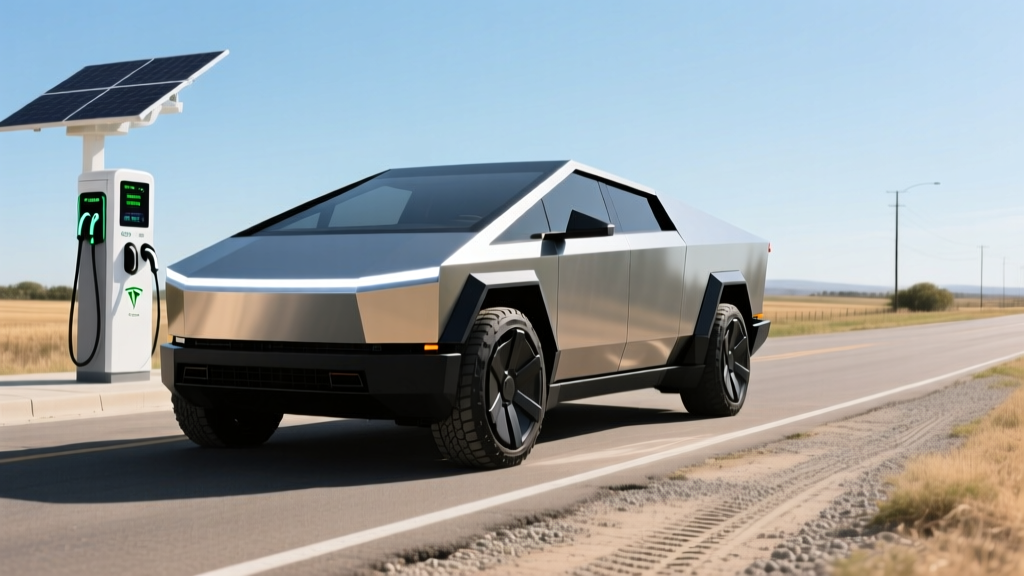
The Tesla Cybertruck arrived with more hype than perhaps any vehicle in modern history, and its polarizing stainless-steel wedge shape still turns heads three years after first deliveries. But beneath the exoskeleton and the memes lies a serious electric pickup — one whose headline numbers around acceleration and towing demand a closer look. In this review, we break down the Tesla Cybertruck's torque output, real-world range, charging behavior, pricing, and daily-ownership practicality so you can decide whether it earns a spot in your driveway.
Tesla Cybertruck Torque and Performance: By the Numbers
The Cybertruck lineup currently spans three trims: the single-motor Rear-Wheel Drive (RWD), the dual-motor All-Wheel Drive (AWD), and the tri-motor Cyberbeast. The keyword on most buyers' minds — Tesla Cybertruck torque — varies dramatically across these configurations.
| Spec | RWD | AWD | Cyberbeast |
|---|---|---|---|
| Drivetrain | Rear-Wheel Drive | Dual-Motor AWD | Tri-Motor AWD |
| Horsepower | ~600 hp | 600 hp | 845 hp |
| Torque (lb-ft) | ~590 lb-ft | 743 lb-ft | 743 lb-ft |
| 0-60 mph | ~6.5 sec | 4.1 sec | 2.6 sec |
| Top Speed | 112 mph | 112 mph | 130 mph |
| Max Towing | 7,500 lbs | 11,000 lbs | 11,000 lbs |
| Payload Capacity | 2,500 lbs | 2,500 lbs | 2,500 lbs |
The AWD and Cyberbeast trims share the same 743 lb-ft peak torque figure because Tesla limits the front motor's contribution to protect drivetrain longevity; the Cyberbeast's advantage lies in its tri-motor horsepower, which enables that staggering 2.6-second 0-60 run. For context, 743 lb-ft exceeds the torque output of most heavy-duty diesel pickups at the wheels, and it arrives instantaneously — no turbo spool-up, no downshift delay.
In real-world driving, that torque translates to confident highway merging even with a loaded bed. Towing near the 11,000-pound maximum will naturally reduce acceleration, but the instant torque delivery means you're never waiting for the powertrain to respond on grades.
Battery, Range, and Real-World Efficiency
Tesla equips the Cybertruck AWD and Cyberbeast with an estimated 123 kWh battery pack (usable capacity) using a structural 4680-cell architecture. The chemistry is nickel-based (NMC-type), chosen for its high energy density — necessary to move a vehicle with a curb weight approaching 7,000 pounds.
EPA Estimated Range:
- AWD: 340 miles
- Cyberbeast: 320 miles
- RWD: ~250 miles (announced, limited availability)
Real-World Notes: On highway loops at 70-75 mph, expect approximately 270-290 miles from the AWD and 255-275 from the Cyberbeast. Cold-weather driving (below 32°F) can reduce range by 20-30%, bringing effective winter highway range down to roughly 210-240 miles for the AWD. The Cybertruck's large frontal area and angular shape create significant aerodynamic drag, which hits efficiency hardest at sustained highway speeds.
Efficiency lands around 2.0-2.2 kWh/mile (roughly 46-50 MPGe combined) in mixed driving, per EPA data on fueleconomy.gov. That's thirsty by EV standards — comparable to the GMC Hummer EV pickup and considerably less efficient than a Tesla Model Y or Ford F-150 Lightning. If electricity costs $0.15/kWh at home, you're paying roughly $0.30-$0.33 per mile to drive the Cybertruck AWD, versus about $0.10-$0.12/mile for a Model Y.
Charging Speed: DC Fast Charge and Home Level 2
The Cybertruck uses the North American Charging Standard (NACS) connector natively — no adapter needed at Tesla Superchargers, and an increasing number of third-party networks (Electrify America, EVgo) now offer NACS cables as well.
| Charging Level | Power / Rate | Speed (mi/hr added) | Notes |
|---|---|---|---|
| Level 1 (120V) | ~1.4 kW | ~2-3 mi/hr | Emergency/trickle only |
| Level 2 (240V, 48A) | 11.5 kW | ~33-37 mi/hr | Home Wall Connector; ~10 hrs for full charge |
| DC Fast Charge (peak) | 250 kW | ~150+ mi/hr (peak) | 10-80% in ~28-30 minutes |
On a V3 or V4 Tesla Supercharger, the Cybertruck peaks near 250 kW but sustains that rate only briefly. The charge curve tapers meaningfully above 50% state of charge (SoC), and charging from 80-100% can add another 25-30 minutes. For road-trip planning, budget roughly 30 minutes per stop for a 10-80% charge — slightly longer than a Model Y or Model 3, owing to the Cybertruck's larger battery and less optimal thermal profile under heavy load.
At home on a 48-amp Level 2 Tesla Wall Connector, a full charge from near-empty takes roughly 10-11 hours. Most owners who plug in nightly will never need a full charge, but this is worth knowing if you plan to tow and need a full battery by morning. Preconditioning the battery before a DC fast-charge session (via navigation to a Supercharger) remains essential for achieving peak charge rates.
Pricing, Trims, and Federal Tax Credit Eligibility
The Cybertruck's pricing has shifted since initial deliveries, and as of the 2026 model year, here is where each trim stands:
| Trim | Base MSRP | §30D Tax Credit Eligible? | Effective Price (if eligible) |
|---|---|---|---|
| RWD | ~$60,990 | Potentially (truck MSRP cap: $80,000) | ~$53,490 |
| AWD | $79,990 | Potentially (at MSRP cap limit) | ~$72,490 |
| Cyberbeast | $99,990 | No (exceeds $80K truck cap) | $99,990 |
Under current IRS §30D rules, the federal EV tax credit offers up to $7,500, but eligibility depends on multiple factors:
- MSRP Cap: Trucks, SUVs, and vans must be under $80,000 MSRP. The AWD trim sits right at this threshold — options and destination charges can push it over.
- Buyer Income Cap: Modified adjusted gross income (MAGI) must not exceed $150,000 (single), $225,000 (head of household), or $300,000 (joint).
- Battery Sourcing: Critical minerals and battery components must meet escalating domestic-content thresholds. Tesla's 4680 cells are manufactured in Texas, but mineral sourcing compliance varies by production batch — confirm current eligibility on the fueleconomy.gov credit lookup before purchasing.
- Point-of-Sale Transfer: Eligible buyers can transfer the credit to the dealer at purchase, reducing the upfront cost rather than waiting for a tax refund.
The Cyberbeast, at $99,990, categorically exceeds the $80,000 truck MSRP cap and does not qualify for the federal credit regardless of buyer income. The RWD trim, if and when it ships at ~$60,990, would be the most credit-eligible variant — but availability remains limited.
Interior, Cargo, and Daily Practicality
The Cybertruck seats five across two rows. Front legroom is generous at approximately 41.3 inches, while rear legroom measures around 38.4 inches — adequate for adults but tighter than a Ford F-150 Lightning or Rivian R1T. The rear bench is relatively upright, which some passengers find fatiguing on longer trips.
Cargo volume in the 6-foot bed totals roughly 67 cubic feet with the tonneau cover closed. The power-retractable stainless-steel bed cover is a standout feature — it seals the bed from weather and adds security, though it does limit hauling tall items. The bed also features a built-in ramp and 120V/240V outlets (up to 11.5 kW of vehicle-to-load power), making it functional for job-site use or tailgating. The front trunk (frunk) offers approximately 7 cubic feet of additional lockable storage.
Inside, the minimalist dashboard centers on an 18.5-inch touchscreen that handles virtually all vehicle controls — there are no physical buttons for climate, mirrors, or glovebox release. A rear 9.4-inch touchscreen serves second-row passengers. Build quality has improved noticeably since early 2024 deliveries, though panel-gap consistency still doesn't match legacy luxury trucks.
Driver Assistance and Standout Technology
Tesla's Autopilot and Full Self-Driving (Supervised) are SAE Level 2 driver-assistance systems. The driver must remain fully attentive, hands on the wheel (or providing steering-torque input), and ready to take over at any moment. These are not autonomous or "self-driving" systems. Only Level 4 services like Waymo operate without a human driver in defined areas.
The Cybertruck ships with Tesla's Autopilot suite, including adaptive cruise control, lane-centering, and automatic emergency braking. Full Self-Driving (Supervised), available as a paid upgrade, adds automated lane changes, intersection handling, and parking assistance — impressive in capability but still requiring constant supervision.
Other notable tech includes steer-by-wire (no physical connection between the steering yoke and the wheels), which enables variable steering ratios — fewer turns lock-to-lock at low speeds, more stability at highway speeds. It's a genuine innovation, though it requires an adjustment period. Four-wheel steering (rear wheels turn up to 10 degrees) dramatically tightens the turning circle to approximately 37 feet, making the Cybertruck surprisingly maneuverable in parking lots despite its 231-inch overall length.
- Steer-by-wire feels unnatural for the first several drives; plan an adjustment period.
- The stainless-steel body cannot be painted conventionally — wraps and PPF are the only color-change options.
- Visibility is compromised by the thick A-pillars and angular rear profile; rely heavily on cameras.
- Towing significantly impacts range — expect a 40-50% reduction when towing near max capacity at highway speeds.
Warranty and Ownership Costs
Tesla covers the Cybertruck with the following warranty terms:
- Basic Vehicle: 4 years / 50,000 miles
- Battery & Drive Unit: 8 years / 120,000 miles (with minimum 70% capacity retention)
- Rear Torque Converter (Cyberbeast):strong> 8 years / 120,000 miles
The 8-year/120,000-mile battery warranty is competitive, though the 70% retention threshold means Tesla will only replace a pack that has degraded beyond 30% — a significant loss. Based on Tesla's historical degradation data for NMC packs, most owners can expect roughly 10-12% range loss over 100,000 miles under normal use.
Insurance costs for the Cybertruck run higher than average — early quotes have ranged from $2,500 to $4,500 annually depending on location and trim, driven by the vehicle's high repair costs (stainless-steel body panels, steer-by-wire components) and performance profile. Always get personalized quotes before committing.
- Class-leading torque delivery (743 lb-ft instant, AWD/Cyberbeast)
- Unique integrated bed cover and 11.5 kW V2L power
- Four-wheel steering yields a tight turning circle
- NACS-native access to the Tesla Supercharger network
- Stainless-steel exoskeleton resists dents and scratches
- High energy consumption (~2.1 kWh/mi) limits real-world range
- Cyberbeast ineligible for federal tax credit (MSRP cap)
- Steer-by-wire requires an adjustment period
- Rear-seat comfort and visibility trail conventional pickups
- Insurance premiums significantly above segment average
Who Should Buy the Tesla Cybertruck?
The Cybertruck makes the most sense for buyers who:
- Want a performance truck: No body-on-frame pickup delivers a 4.1-second 0-60 (AWD) or 2.6-second 0-60 (Cyberbeast) with instant torque.
- Value the Supercharger network: NACS-native charging access remains a major road-trip advantage, even as competitors gain NACS compatibility.
- Need V2L / job-site power: The 11.5 kW onboard power output can run tools, appliances, or even provide limited home backup.
- Prioritize security and durability: The armored stainless-steel body and lockable bed cover are genuine differentiators.
It's a harder recommendation if you need maximum range efficiency, maximum rear-seat comfort, or the lowest possible cost of ownership. For those priorities, the Ford F-150 Lightning, Rivian R1T, or even a Tesla Model Y (if you don't need a bed) may serve better.
Frequently Asked Questions
What is the real-world range of the Tesla Cybertruck?
The AWD is EPA-rated at 340 miles, but real-world highway driving at 70-75 mph typically yields 270-290 miles. In cold weather (below freezing), expect 210-240 miles on the highway. The Cyberbeast's EPA rating is 320 miles, with real-world highway figures around 255-275 miles.
How fast does the Cybertruck charge?
On a Tesla V3/V4 Supercharger, the Cybertruck peaks at approximately 250 kW DC fast charging. A 10-80% session takes roughly 28-30 minutes, though the charge curve tapers significantly above 50% SoC. At home on a 48-amp Level 2 charger (11.5 kW), expect roughly 33-37 miles of range per hour of charging.
Does the Tesla Cybertruck qualify for the federal EV tax credit?
It depends on the trim and your income. The AWD trim at $79,990 sits right at the $80,000 MSRP cap for trucks under IRS §30D — adding options may disqualify it. The Cyberbeast at $99,990 exceeds the cap and is ineligible. The RWD at ~$60,990 would likely qualify, assuming buyer income limits are met and battery-sourcing requirements are satisfied. Always verify current eligibility on fueleconomy.gov and consult a tax professional.
How much Tesla Cybertruck torque does each trim produce?
The AWD produces 743 lb-ft of torque, the Cyberbeast also produces 743 lb-ft (its advantage is 845 hp from the tri-motor setup), and the RWD is estimated at approximately 590 lb-ft. All torque is delivered instantaneously from standstill.
Is the Cybertruck worth buying vs. the Ford F-150 Lightning or Rivian R1T?
If raw performance, Supercharger access, and the stainless-steel design are your top priorities, the Cybertruck stands alone. If you prioritize range efficiency, a more conventional driving experience, rear-seat comfort, or a lower starting price with broader tax-credit eligibility, the F-150 Lightning or Rivian R1T are strong alternatives. Cross-shop all three and test-drive before deciding.
What is the Cybertruck's towing range impact?
Towing near the 11,000-pound maximum at highway speeds can reduce range by 40-50%. A 340-mile EPA-rated AWD Cybertruck may deliver only 170-200 miles while towing a heavy trailer. Plan charging stops accordingly and use Tesla's trip planner for towing route estimates.