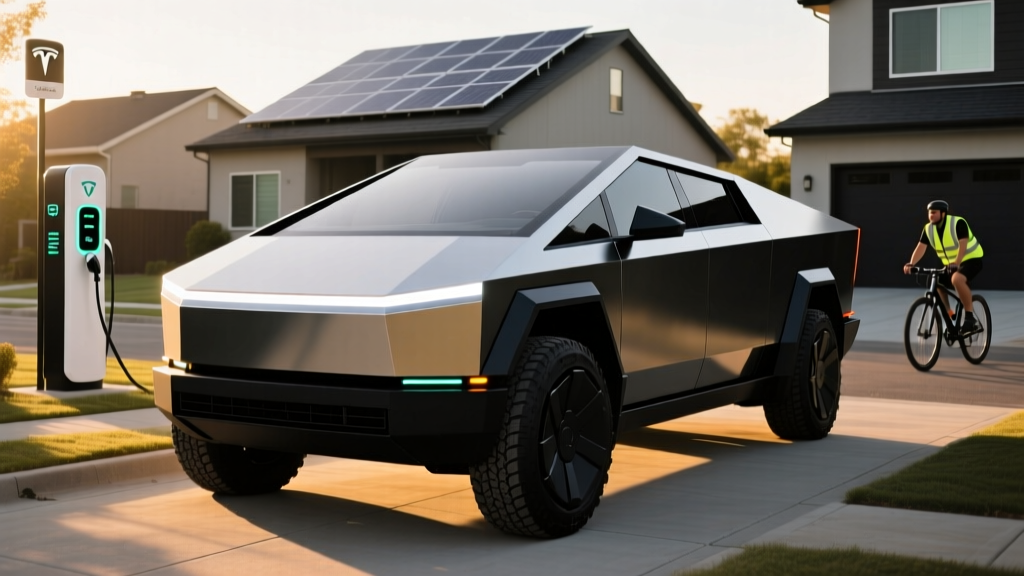
When Tesla finally began delivering the Cybertruck in late 2023, it was the most polarizing vehicle launch of the decade. Now, with thousands of units on the road and real-world data in hand, we can separate the stainless-steel hype from the daily-driver reality. This review covers the launch-year 2023 Tesla Cybertruck — the Dual Motor All-Wheel Drive and the tri-motor Cyberbeast — examining what owners actually experience in 2026 for range, charging, ownership costs, and whether this angular pickup still holds up against a rapidly maturing electric truck market.
EPA-estimated range: 340 miles (Dual Motor AWD) / 320 miles (Cyberbeast).
Expect ~270–300 miles on highway trips at 70+ mph, and ~230–260 miles in freezing weather with cabin heat running. The stainless-steel exoskeleton adds mass that hurts efficiency at speed. Plan charging stops accordingly on long hauls.
Range, Efficiency, and the Battery Behind the Steel
The 2023 Tesla Cybertruck launched with two powertrain options. The Dual Motor AWD pairs front and rear permanent-magnet synchronous motors for a combined 600 horsepower, while the Cyberbeast adds a third rear motor to push output to 845 hp. Both variants use a structural battery pack with an estimated ~123 kWh usable capacity built on Tesla's 4680 cell architecture.
Tesla has not officially published the exact kWh figure or confirmed the cathode chemistry for the Cybertruck pack, though teardown analysis and supply-chain reporting indicate an NMC (nickel manganese cobalt) formulation optimized for energy density rather than the LFP chemistry found in the Model 3 Standard Range. This matters: NMC packs offer higher energy density (more range per pound) but require careful state-of-charge management — Tesla recommends daily charging to 80–90% and periodic 100% calibration charges, unlike LFP packs that tolerate regular 100% fills.
| Spec | Dual Motor AWD | Cyberbeast (Tri-Motor) |
|---|---|---|
| EPA Range | 340 mi | 320 mi |
| Battery (usable, est.) | ~123 kWh NMC | ~123 kWh NMC |
| Horsepower | 600 hp | 845 hp |
| 0–60 mph | 3.9 sec | 2.6 sec |
| Efficiency (EPA) | 69 MPGe / 48 kWh/100mi | 67 MPGe / 50 kWh/100mi |
| Max Tow Capacity | 11,000 lbs | 11,000 lbs |
| Base MSRP (2023 launch) | $79,990 | $99,990 |
Efficiency is the Cybertruck's Achilles' heel. At 48–50 kWh per 100 miles, it consumes significantly more energy per mile than a Rivian R1T (~43 kWh/100mi) or a Ford F-150 Lightning Extended Range (~45 kWh/100mi), per fueleconomy.gov. The angular stainless-steel body creates more aerodynamic drag than conventional truck shapes, and that drag penalty compounds at highway speeds. If most of your driving is suburban or city, the range holds closer to the EPA sticker. Sustained 75–80 mph interstate driving is where you'll see the biggest drop-off.
Charging Speed: 800-Volt Architecture in Practice
The Cybertruck uses an 800-volt electrical architecture, the same platform introduced with the Model S Plaid refresh. This enables faster DC fast charging with less current (and therefore less heat), but real-world charging performance depends heavily on the station and battery preconditioning.
| Charge Level | Max Power (kW) | Speed / Time | Connector |
|---|---|---|---|
| Level 1 (120V) | ~1.4 kW | ~3 mi/hr | NACS (native) |
| Level 2 (240V, 48A) | 11.5 kW | ~26 mi/hr | NACS (native) |
| DC Fast (V4 Supercharger) | 250 kW peak | 10–80% in ~27 min | NACS (native) |
| DC Fast (CCS adapter) | ~150–175 kW typical | 10–80% in ~38 min | CCS via adapter |
The Cybertruck ships with the NACS (North American Charging Standard) connector natively — no adapter needed at Tesla Superchargers. At a V3 or V4 Supercharger with the battery properly preconditioned (navigating to the station via the built-in nav triggers this automatically), the truck peaks around 250 kW. However, that peak is short-lived. The charge curve tapers noticeably above 50% state of charge, and the 10–80% session takes roughly 27 minutes under ideal conditions. In cold weather without adequate preconditioning, expect 35–45 minutes for the same range recovery.
For non-Tesla DC fast chargers (Electrify America, EVgo, ChargePoint), Tesla sells a CCS adapter. Through that adapter, speeds are typically limited to 150–175 kW depending on the station, making long road trips on third-party networks noticeably slower. The Level 2 home charging rate of 11.5 kW is competitive, adding about 26 miles of range per hour — an overnight charge from 20% to 80% takes roughly 6–7 hours on a Wall Connector.
Performance, Towing, and Payload
The Cyberbeast's 2.6-second 0–60 mph time makes it one of the quickest production trucks ever built, rivaling supercars that cost three times as much. The Dual Motor AWD's 3.9-second sprint is still blistering for a 6,800-pound vehicle. Both trims feature adaptive air suspension with up to 16 inches of ground clearance in Off-Road mode and a self-leveling system that adjusts for payload.
Towing capacity is rated at 11,000 pounds for both trims, competitive with the F-150 Lightning and Rivian R1T. However, towing at max capacity cuts range roughly in half — expect 150–180 miles before needing a charge when pulling a heavy trailer. The 6.5-foot composite bed (marketed as the "vault") offers 67 cu ft of volume with the tonneau cover closed, and the powered roll-up cover is standard. A front trunk (frunk) adds additional sealed storage.
Payload capacity is listed at 2,500 pounds. The steer-by-wire system — the first in a mass-production vehicle sold in the US — replaces the mechanical steering column with electronic actuators. It takes some acclimation: the yoke-style steering wheel requires less than one full turn lock-to-lock, which makes parking maneuvers quick but feels alien at first on winding roads.
Interior, Tech, and Daily Usability
The Cybertruck's cabin is minimalist even by Tesla standards. An 18.5-inch center touchscreen handles virtually all vehicle functions, media, and navigation. A smaller 9.4-inch rear touchscreen serves back-seat passengers. There are no physical buttons for climate or audio — everything routes through the screen, which frustrates some owners and delights others.
Seating fits five adults, though the rear seat is tighter than a full-size F-150 or Silverado. Rear legroom measures approximately 38.2 inches, and the roofline's angular geometry limits headroom for taller passengers. The front seats are heated and ventilated on all trims; the rear seats are heated. Cargo space behind the rear seats is limited — this is a truck, not an SUV, and the bed is the primary cargo area.
Tesla's Autopilot comes standard, providing adaptive cruise control and lane-keeping at SAE Level 2 — meaning the driver must keep hands on the yoke and eyes on the road at all times. Full Self-Driving (Supervised) is an optional add-on ($8,000 purchase or $99/month as of 2026 pricing) that adds automated lane changes, city-street navigation, and parking maneuvers, but it remains a Level 2 system requiring constant driver supervision. It is not autonomous driving.
Pricing, Trims, and Federal Tax Credit Eligibility
The Cybertruck launched with a dual-motor AWD at $79,990 and the Cyberbeast at $99,990, both before destination fees. Tesla later introduced a single-motor rear-wheel-drive variant at a lower price point for subsequent model years. Early "Foundation Series" deliveries carried a significant premium (roughly $20,000 above base) for bundled options including FSD, all-weather floor liners, and exclusive badging.
| MSRP Cap (trucks/vans) | $80,000 |
| Dual Motor AWD ($79,990) | ✅ Under cap — potentially eligible |
| Cyberbeast ($99,990) | ❌ Exceeds MSRP cap — NOT eligible |
| Buyer Income Cap (MFJ) | $300,000 AGI (married filing jointly) |
| Buyer Income Cap (individual) | $150,000 AGI |
| Battery Sourcing Requirement | Must meet critical minerals + battery component thresholds per IRS §30D rules |
⚠️ Only the Dual Motor AWD at base MSRP qualifies under the $80K truck cap. Adding options that push the MSRP above $80,000 can disqualify the vehicle. Battery sourcing and critical-mineral requirements also apply — consult a tax professional and verify current-year eligibility on irs.gov before purchasing. Point-of-sale transfer is available if all criteria are met.
The Cyberbeast, at $99,990, exceeds the §30D MSRP cap for trucks and does not qualify for the federal credit regardless of buyer income. The Dual Motor AWD, at $79,990, sits just under the $80,000 threshold — but only at base MSRP. Adding any factory options, packages, or destination charges that push the sticker above $80,000 will disqualify it. This makes trim and option selection critical for credit-seeking buyers.
Warranty and Long-Term Battery Outlook
Tesla covers the Cybertruck with a 4-year/50,000-mile basic vehicle warranty and an 8-year/120,000-mile battery and drive unit warranty. The battery warranty guarantees a minimum of 70% capacity retention over the coverage period. If degradation exceeds 30% within 8 years or 120,000 miles, Tesla will repair or replace the pack.
The 4680 cells in the Cybertruck are still relatively new in mass production, so long-term degradation data is limited compared to the well-studied 2170 cells in the Model 3 and Model Y. Early owner reports through 2025 suggest degradation curves in line with Tesla's NMC packs — roughly 5–8% loss in the first 30,000 miles, then a slower linear decline. The stainless-steel body panels carry a separate corrosion warranty, though real-world reports of panel discoloration and surface rust spots have surfaced in online owner forums, particularly in salt-belt states.
Cybertruck vs. the Competition: Rivian R1T and F-150 Lightning
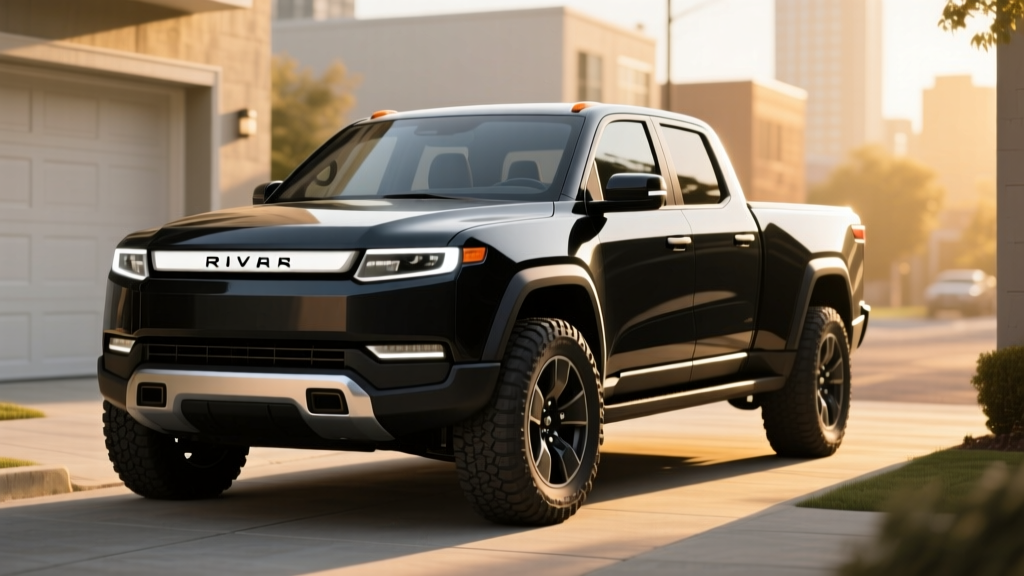
The Cybertruck competes in a small but growing electric pickup segment. The Rivian R1T Dual-Motor starts around $69,900 (2026 pricing) with EPA range up to 352 miles on the Max Pack, a more conventional truck layout, and a well-regarded adventure-oriented platform. The Ford F-150 Lightning (now in its updated second generation) offers a more familiar full-size truck experience with a base price well below the Cybertruck and broader dealer service coverage.
Where the Cybertruck wins: raw acceleration (no truck matches the Cyberbeast's 2.6 seconds), the Supercharger network advantage (still the most reliable DC fast-charging network in the US), and the polarizing design that owners either love or build their identity around. Where it loses: efficiency (higher kWh/100mi than both competitors), rear-seat comfort, service-center availability (Tesla's body shop network struggles with stainless-steel panel repairs), and the fact that the Cyberbeast is ineligible for the federal tax credit.
- Class-leading acceleration (Cyberbeast: 2.6s 0–60)
- Native NACS — seamless Supercharger access
- 800V architecture enables 250 kW DC fast charging
- 11,000-lb towing, 2,500-lb payload
- Steer-by-wire is quick and precise once acclimated
- Stainless-steel body is dent-resistant
- Poor efficiency (48–50 kWh/100mi) hurts real-world range
- Cyberbeast exceeds $80K MSRP cap — no federal tax credit
- Rear seat is cramped vs. full-size trucks
- Steer-by-wire and yoke require significant adaptation
- Stainless-steel body panels complicate collision repair
- Minimal physical controls — screen-dependent interface
- Towing cuts range to ~150–180 miles
Who Should Buy the 2023 Tesla Cybertruck?
The Cybertruck is best suited for buyers who prioritize performance and technology over traditional truck utility. If you want the fastest truck on the road, value the Supercharger network for road trips, and are drawn to the futuristic design, it delivers on those promises. It works well as a daily commuter with home Level 2 charging, a weekend toy hauler for moderate loads, and a conversation piece that no other vehicle can match.
It is not the right choice if you need maximum rear-seat space for a family, plan to tow heavy trailers long distances regularly (the range penalty is severe), or want a truck that can be serviced at any local body shop. Buyers seeking a more practical electric work truck should cross-shop the F-150 Lightning and Rivian R1T seriously before committing.
What is the real-world range of the 2023 Tesla Cybertruck?
The EPA rates the Dual Motor AWD at 340 miles and the Cyberbeast at 320 miles. In real-world highway driving at 70–75 mph, expect 270–300 miles. In freezing temperatures with cabin heat, range drops to approximately 230–260 miles. Towing a heavy trailer reduces range further to roughly 150–180 miles.
How fast does the Cybertruck charge at home and on the road?
At home on a 240V/48A Level 2 Wall Connector, the Cybertruck charges at 11.5 kW, adding roughly 26 miles of range per hour (a 20–80% session takes about 6–7 hours). On a Tesla V3/V4 Supercharger, it peaks at 250 kW and charges from 10–80% in approximately 27 minutes under ideal conditions. Non-Tesla DC chargers via CCS adapter typically deliver 150–175 kW.
How much does the Cybertruck cost after federal tax credits?
The Dual Motor AWD at its base MSRP of $79,990 may qualify for up to $7,500 under §30D if the buyer meets income requirements and the vehicle meets battery-sourcing rules, potentially bringing the effective price to ~$72,490. The Cyberbeast at $99,990 exceeds the $80,000 truck MSRP cap and does not qualify. Always verify current eligibility on irs.gov and consult a tax professional.
Is the Cybertruck worth buying vs. the Rivian R1T or F-150 Lightning?
If acceleration, Tesla's Supercharger network, and the distinctive design are top priorities, yes. If you need more rear-seat room, better efficiency, easier service access, or a lower price point, the Rivian R1T or F-150 Lightning may serve you better. Cross-shop all three with your specific use case in mind.
Does the 2023 Cybertruck qualify for the federal EV tax credit?
Only the Dual Motor AWD at base MSRP ($79,990) falls under the $80,000 MSRP cap for trucks. The Cyberbeast does not qualify. Even for the AWD, eligibility depends on buyer AGI limits ($150K individual / $300K MFJ), battery critical-mineral sourcing, and component manufacturing requirements. Rules are subject to change — verify before purchase.
What is the Cybertruck's battery warranty?
Tesla provides an 8-year/120,000-mile battery and drive unit warranty guaranteeing at least 70% capacity retention. The basic vehicle warranty is 4 years/50,000 miles.