Quick Verdict: The Cybertruck Is Absurdly Quick — But Should You Buy One?
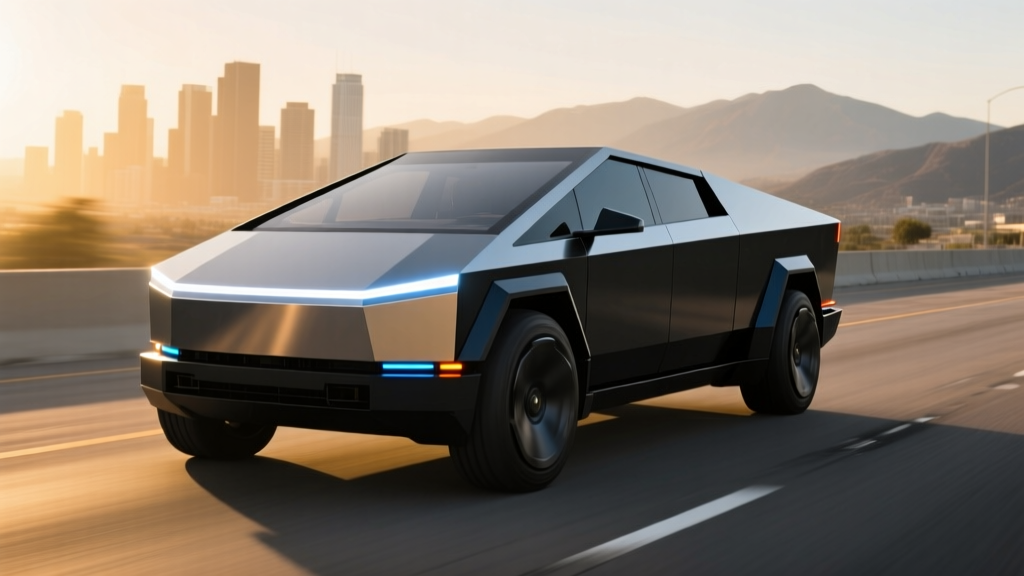
If you've ever watched a 6,800-pound stainless-steel triangle launch from a stoplight and thought, "I need to know exactly how fast that thing goes," you're not alone. The 2026 Tesla Cybertruck remains one of the most polarizing vehicles on the road — and one of the quickest production trucks ever built. But speed is only one chapter in a story that includes real-world range compromises, a polarizing design, and a price tag that pushes well into luxury territory.
This review covers every current Cybertruck trim — the Long Range AWD, the All-Wheel Drive (dual-motor), and the tri-motor Cyberbeast — with exact specs on acceleration, EPA range, charging speeds, interior dimensions, tax-credit eligibility, and the ownership realities Tesla's marketing won't highlight. Whether you're cross-shopping the Rivian R1T, the Ford F-150 Lightning, or the Chevrolet Silverado EV, the data below gives you what you need to decide.
| Spec | Long Range AWD | All-Wheel Drive | Cyberbeast (Tri-Motor) |
|---|---|---|---|
| 0-60 mph | 4.1 sec | 3.9 sec | 2.6 sec |
| Horsepower | ~600 hp | ~600 hp | 845 hp |
| Drivetrain | Dual-Motor AWD | Dual-Motor AWD | Tri-Motor AWD |
| EPA Range | 340+ mi (est.) | 340 mi | 320 mi |
| Battery (usable, est.) | ~123 kWh | ~123 kWh | ~123 kWh |
| Battery Chemistry | NMC (2170 cells, structural pack) | NMC (2170 cells, structural pack) | NMC (2170 cells, structural pack) |
| Max DC Fast Charge | ~250 kW | ~250 kW | ~250 kW |
| 10-80% DC Fast Charge | ~30 min | ~30 min | ~30 min |
| Level 2 Home Charging | 11.5 kW (~37 mi/hr) | 11.5 kW (~37 mi/hr) | 11.5 kW (~37 mi/hr) |
| MPGe (combined, est.) | ~67 MPGe | ~67 MPGe | ~61 MPGe |
| Efficiency (kWh/100 mi) | ~50 kWh | ~50 kWh | ~55 kWh |
| Towing Capacity | 11,000 lbs | 11,000 lbs | 11,000 lbs |
| Payload Capacity | 2,500 lbs | 2,500 lbs | 2,500 lbs |
| Base MSRP | $79,990 | $79,990 | $99,990 |
| Battery/Drive Unit Warranty | 8 yr / 120,000 mi | 8 yr / 120,000 mi | 8 yr / 120,000 mi |
How Fast Can a Cybertruck Go? 0-60 Times, Top Speed, and Quarter-Mile Data
The headline number: the Cyberbeast tri-motor variant hits 60 mph in 2.6 seconds, making it one of the quickest production vehicles sold at any price, let alone a pickup truck. Tesla achieves this through three independent motors — one front, two rear — delivering a combined 845 horsepower with torque-vectoring capability. The Cyberbeast also posts a quarter-mile time in the low 10-second range, a figure that embarrasses most sports cars.
The dual-motor All-Wheel Drive trim manages a 3.9-second 0-60 time with approximately 600 hp, while the Long Range AWD (prioritizing efficiency over peak output) clocks in at 4.1 seconds. Both dual-motor variants share the same battery pack and drivetrain hardware; the AWD trim's slightly quicker time comes from software-tuned torque delivery.
Top speed is electronically governed across all trims. The Cyberbeast tops out at 130 mph, while the dual-motor variants are limited to approximately 112-125 mph depending on configuration. For a truck with a drag coefficient around 0.34 Cd (low for a pickup, high for a sedan), these limits are both sensible and traction-limited.
Real-world context: These 0-60 figures require a prepped surface, warm tires, and a battery state of charge above 50%. On a cold morning with a 30% SoC, expect 0-60 times to stretch by 0.3-0.8 seconds. The Cyberbeast's launch control is genuinely violent — the truck's 6,800-pound curb weight becomes irrelevant when instant electric torque meets all-wheel grip.
Real-World Range: What the EPA Sticker Doesn't Tell You
EPA Estimated Range: 340 miles (AWD/Long Range) / 320 miles (Cyberbeast)
Real-World Highway (70 mph, 72°F): ~270-290 miles (AWD) / ~250-270 miles (Cyberbeast)
Real-World Cold Weather (32°F, mixed driving): ~220-250 miles (AWD) / ~200-230 miles (Cyberbeast)
Towing a 5,000-lb Trailer (65 mph, flat terrain): ~150-170 miles (all trims)
The Cybertruck's EPA range figures look competitive on paper, but real-world efficiency tells a more nuanced story. The truck's angular stainless-steel exoskeleton creates more aerodynamic drag than a rounded body like the Rivian R1T or the Ford F-150 Lightning at highway speeds. At 70 mph, the Cybertruck consumes roughly 50-55 kWh per 100 miles depending on trim — translating to about 1.8-2.0 miles per kWh.
In moderate temperatures with mixed city/highway driving, owners report consistently achieving 80-85% of the EPA sticker. Highway-only trips at sustained 75+ mph drop that to roughly 75-80%. The Cyberbeast, with its third motor and heavier curb weight, runs about 10% less efficiently than the dual-motor variants under identical conditions.
Cold-weather impact: Like all EVs, the Cybertruck loses range in freezing temperatures. Tesla's heat pump and battery preconditioning mitigate this somewhat, but expect a 20-30% range reduction at 20°F compared to the EPA figure. That means a Cyberbeast rated at 320 miles could realistically deliver 220-240 miles of range on a cold winter road trip before requiring a charge.
Towing reality: If you plan to tow, plan to stop often. At highway speeds with a mid-weight trailer, range drops by 45-55%. This isn't unique to the Cybertruck — it's physics — but it means a 340-mile rated truck becomes a 160-mile truck with a boat behind it.
Charging Speed: DC Fast Charging and Home Level 2 Setup
The Cybertruck uses the North American Charging Standard (NACS) connector natively — no adapter needed for Tesla Superchargers. With the broader industry adopting NACS through 2025-2026, this also means growing compatibility with Electrify America, ChargePoint, and other networks as they deploy NACS-equipped stalls.
| Charging Level | Power (kW) | Speed (miles of range per hour) | Time to Charge |
|---|---|---|---|
| Level 1 (120V standard outlet) | ~1.4 kW | ~3-4 mi/hr | ~90+ hours (0-100%) |
| Level 2 (240V, 48A home charger) | 11.5 kW | ~37 mi/hr | ~10-11 hours (0-100%) |
| DC Fast Charge (V3 Supercharger) | Peak ~250 kW | ~200+ mi in 15 min | ~30 min (10-80%) |
| DC Fast Charge (V4 Supercharger) | Peak ~250-350 kW* | Up to ~250 mi in 15 min | ~25 min (10-80%)* |
*V4 Supercharger speeds depend on site deployment and vehicle acceptance rate; sustained peak varies.
The charging curve matters more than peak kW. The Cybertruck peaks at roughly 250 kW at a low state of charge (below 20%), but like all lithium-ion packs, charging speed tapers significantly above 60% SoC and drops sharply past 80%. On a V3 Supercharger, the 10-80% sprint takes approximately 30 minutes. The last 20% (80-100%) can take an additional 25-35 minutes — which is why Tesla recommends charging to 80% for daily use and road trips unless you specifically need the full pack.
Home charging setup: The Cybertruck accepts up to 11.5 kW on Level 2 AC, which requires a 60-amp dedicated circuit (48A continuous draw). Tesla's Wall Connector costs approximately $420 for the unit. Professional installation typically runs $500-$1,500 depending on your electrical panel's capacity and the run distance from panel to garage. If your home has a 100-amp main panel, expect a potential panel upgrade ($1,500-$3,000) before adding a 60-amp EV circuit.
At 37 miles of range per hour of Level 2 charging, an overnight session (8-10 hours) replenishes 290-370 miles — more than enough for daily commuting and most road-trip recovery needs.
Interior, Cargo Space, and Daily Livability
The Cybertruck's interior is minimalism taken to an extreme. A single 18.5-inch touchscreen dominates the dashboard, handling everything from climate controls to the glovebox release. There are no physical buttons, no instrument cluster, and no traditional stalks — turn signals are on the steering wheel rim, and the gear selector is a touchscreen swipe (with a backup overhead button panel).
Passenger space:
- Front headroom: ~41.0 inches
- Front legroom: ~41.5 inches
- Rear headroom: ~38.2 inches
- Rear legroom: ~37.0 inches
- Seating: 5 passengers (bench front seat with fold-down center armrest)
Rear-seat comfort is adequate for adults on shorter trips but not class-leading. The rear seatback angle is relatively upright, and the floor is high due to the structural battery pack beneath, creating a knees-up seating position. Compared to the Rivian R1T's rear seat, the Cybertruck offers less thigh support and a more confined feeling.
Cargo dimensions:
- Bed length: 6 feet (with tailgate closed); extends to ~8 feet with tailgate down
- Bed width (between wheel wells): ~48 inches
- Bed cargo volume: ~67 cu ft (bed only)
- Front trunk (frunk): ~7.1 cu ft
- Under-bed rear storage (vault): ~10.5 cu ft
- Total enclosed/covered cargo: ~84+ cu ft
The powered retractable tonneau cover is a standout feature — it's lockable, supports distributed loads up to 300 lbs on top, and provides weather-sealed storage. However, it reduces vertical clearance for tall items. The bed itself is stainless steel, eliminating the need for a liner but showing scratches readily.
Notable drawbacks: The yoke-style steering wheel (standard on Cyberbeast, optional elsewhere) is controversial and impractical for low-speed parking maneuvers. Visibility is compromised by the thick A-pillars and small rear window. The windshield is enormous and expensive to replace — early owner reports cite $1,500-$2,200 for windshield replacement.
Pricing, Trims, and Federal Tax Credit Eligibility
| Trim | Base MSRP | As-Tested (typical options) | Federal §30D Credit Eligibility | Effective Price (if eligible) |
|---|---|---|---|---|
| Long Range AWD | $79,990 | $82,000-$85,000 | Subject to income & sourcing rules* | ~$72,490-$77,490 |
| All-Wheel Drive | $79,990 | $82,000-$85,000 | Subject to income & sourcing rules* | ~$72,490-$77,490 |
| Cyberbeast | $99,990 | $103,000-$108,000 | Subject to income & sourcing rules* | ~$92,490-$100,490 |
Federal tax credit (§30D) — key rules for 2026:
- MSRP Cap: Pickup trucks must have an MSRP at or below $80,000 to qualify. This means the Long Range AWD and AWD trims at $79,990 base are eligible, but the Cyberbeast at $99,990 is not eligible for the federal credit.
- Buyer Income Cap: Modified adjusted gross income must not exceed $150,000 (single), $225,000 (head of household), or $300,000 (married filing jointly).
- Battery Sourcing Requirements: A percentage of critical minerals and battery components must be sourced from the US or free-trade-agreement countries. These thresholds increase annually. Check the latest IRS guidance for current-year specifics, as Tesla's supply chain compliance can change.
- Point-of-Sale Transfer: Eligible buyers can transfer the credit to the dealer at purchase, reducing the purchase price directly rather than waiting for a tax refund.
- One Credit Per VIN, Per Taxpayer: The §30D credit can only be claimed once every three years per taxpayer.
Bottom line on pricing: The dual-motor trims barely clear the $80,000 MSRP cap, making the federal credit possible if all other criteria are met. But adding any significant options (FSD, premium wheels, wraps) can push the transaction price well above $80,000 — and it's the MSRP that matters for eligibility, not the negotiated price. Always verify current-year eligibility on fueleconomy.gov before committing to a purchase.
The Cyberbeast, at $99,990, is categorically excluded from the federal credit due to the MSRP cap. Buyers in states with additional EV incentives (California, Colorado, etc.) may still qualify for state-level rebates — consult your state's energy office or a tax professional.
Driver Assistance, Tech, and the Autopilot Reality
SAE Automation Level: Level 2
Tesla's Autopilot and Full Self-Driving (Supervised) are Level 2 driver-assistance systems, not autonomous driving. The driver must remain attentive, keep hands on the wheel (or demonstrate engagement via camera monitoring), and be prepared to take over at any moment. No currently available Tesla vehicle is "self-driving."
The Cybertruck ships with Basic Autopilot standard (traffic-aware cruise control and autosteer on marked highways). Enhanced Autopilot ($6,000) adds auto lane change, autosteer on city streets, navigate on Autopilot, and smart summon. Full Self-Driving (Supervised) ($8,000 or $99/month subscription) extends capability to traffic light and stop sign recognition, with the system making more autonomous routing decisions — but always under driver supervision.
Standout tech features:
- 18.5-inch center touchscreen with Tesla's latest UI
- Rear-seat 9.4-inch touchscreen for passengers
- Dashcam and Sentry Mode with multiple cameras
- Bioweapon Defense Mode (HEPA air filtration)
- Powered frunk, powered tonneau, powered vault storage
- Air suspension with adaptive damping and adjustable ride height (up to 16 inches of ground clearance)
- Steer-by-wire system (no mechanical connection between yoke and wheels)
- Vehicle-to-load (V2L) capability — power tools, appliances, or a campsite from the bed outlet
Steer-by-wire caveat: The Cybertruck uses a fully electronic steer-by-wire system with no mechanical backup link to the front wheels. While this enables the yoke steering wheel's limited rotation (~340 degrees lock-to-lock) and variable ratio, it introduces a single-point-of-failure concern. Tesla uses redundant motor controllers and a backup power system, but this is a fundamentally different architecture from conventional steering. Some drivers find the yoke unintuitive for three-point turns and parking.
Cybertruck vs. Rivian R1T, Ford F-150 Lightning, and Chevy Silverado EV
The Cybertruck occupies a unique niche. Here's how it stacks up against its primary electric-truck competitors on the metrics that matter most:
| Metric | Tesla Cybertruck AWD | Rivian R1T Dual-Motor | Ford F-150 Lightning Lariat | Chevy Silverado EV 4WT |
|---|---|---|---|---|
| Base MSRP | $79,990 | $69,900 | $69,995 | $74,900 |
| EPA Range | 340 mi | ~352 mi (Max Pack) | ~320 mi (Ext. Range) | ~450 mi (Max Range) |
| 0-60 mph | 3.9 sec | ~4.5 sec | ~4.0 sec | ~4.5 sec |
| Max DC Charge | ~250 kW | ~220 kW | ~150 kW | ~350 kW |
| Towing Capacity | 11,000 lbs | 11,000 lbs | 10,000 lbs | 12,500 lbs |
| Bed Length | 6 ft | 4.5 ft (bed) + gear tunnel | 5.5 ft | 5.5 ft |
| Federal Credit Eligible | Yes (base MSRP ≤$80K) | Yes | Yes | Yes (select trims) |
Where the Cybertruck wins: Acceleration (especially the Cyberbeast), Supercharger network access, over-the-air update cadence, and the powered tonneau/vault storage system.
Where it loses: Rear-seat comfort, practical bed length (6 feet is shorter than most competitors), polarizing design that limits resale predictability, and a higher starting price than the R1T or F-150 Lightning.
Who the Cybertruck suits best: Tech-forward buyers who prioritize performance, Tesla ecosystem integration, and distinctive design over traditional truck utility. If you need a workhorse for job-site duty with a full-size bed and maximum towing range, the Silverado EV or F-150 Lightning serve better. If you want an adventure-oriented truck with superior rear-seat comfort and a clever gear tunnel, the Rivian R1T is the more practical choice. The Cybertruck is for the buyer who wants to go 0-60 in under 4 seconds in a stainless-steel polygon — and there's nothing wrong with that, as long as you know what you're signing up for.
Pros, Cons, and Ownership Costs
Pros
- Blistering acceleration — Cyberbeast hits 60 mph in 2.6 seconds
- Access to the Tesla Supercharger network (35,000+ stalls globally)
- Powered retractable tonneau cover with lockable security
- Air suspension with up to 16 inches of ground clearance
- V2L capability — power devices from the truck's battery
- Stainless-steel exoskeleton resists dents (though not scratches)
- Over-the-air software updates continuously add features
- 8-year/120,000-mile battery and drive unit warranty
Cons
- Base price of $79,990+ is steep for a pickup
- 6-foot bed is shorter than most full-size trucks
- Rear-seat comfort is below Rivian R1T and F-150 Lightning
- Yoke steering is impractical for parking and low-speed maneuvers
- Highway efficiency (~50 kWh/100mi) lags behind more aerodynamic trucks
- Windshield replacement costs $1,500-$2,200
- Steer-by-wire system has no mechanical backup
- Polarizing design may affect long-term resale value
- Build quality inconsistencies reported by early owners (panel gaps, trim)
Five-year ownership estimate: According to fueleconomy.gov data and typical electricity rates ($0.15/kWh national average), fueling a Cybertruck AWD costs approximately $1,500-$1,800 per year for 15,000 miles of driving — compared to $2,400-$3,000 for a gas-powered F-150 at $3.50/gallon. However, insurance premiums for the Cybertruck run 20-40% higher than comparable trucks due to repair costs and the vehicle's performance profile. Factor in $2,500-$3,500 annually for insurance, and the fuel savings narrow considerably.
Frequently Asked Questions
What is the real-world range of the Tesla Cybertruck?
The EPA rates the dual-motor Cybertruck AWD at 340 miles and the Cyberbeast at 320 miles. In real-world highway driving at 70 mph in moderate temperatures, expect approximately 270-290 miles from the AWD and 250-270 from the Cyberbeast. Cold weather (below freezing) reduces range by 20-30%, and towing cuts range roughly in half.
How fast does the Cybertruck charge at home and on the road?
On a Level 2 home charger (11.5 kW), the Cybertruck adds approximately 37 miles of range per hour, fully charging in 10-11 hours. On a Tesla V3 Supercharger (up to 250 kW DC), a 10-80% charge takes approximately 30 minutes. Charging slows significantly above 80% to protect battery longevity.
Does the Cybertruck qualify for the $7,500 federal EV tax credit?
The dual-motor trims (AWD and Long Range AWD) at $79,990 base MSRP meet the $80,000 MSRP cap for pickup trucks under IRS §30D rules. The Cyberbeast at $99,990 does not qualify. All buyers must also meet income caps ($150K single / $300K married filing jointly) and the vehicle must meet battery critical-mineral and component sourcing requirements. Verify current eligibility on irs.gov before purchasing.
Is the Cybertruck worth buying over the Rivian R1T or F-150 Lightning?
The Cybertruck is worth considering if you prioritize acceleration, Tesla's Supercharger network, and distinctive design. The Rivian R1T offers a more practical adventure-truck layout with a gear tunnel and better rear seating, starting at a lower price. The F-150 Lightning provides the most conventional truck experience with a familiar form factor. Your choice depends on whether you value performance and tech ecosystem (Cybertruck), adventure utility (R1T), or traditional truck practicality (Lightning).
What is the Cybertruck's battery warranty?
Tesla covers the Cybertruck's battery and drive units for 8 years or 120,000 miles, whichever comes first. The warranty guarantees a minimum of 70% battery capacity retention over that period. The structural battery pack uses 2170-format NMC cells integrated into the vehicle's frame, which makes out-of-warranty replacement costly — estimated at $15,000-$25,000+ based on current Tesla battery replacement pricing for large packs.
Can the Cybertruck tow, and how does towing affect range?
Yes, all Cybertruck trims are rated to tow up to 11,000 pounds. However, towing at highway speeds reduces range by approximately 45-55%. A 340-mile rated truck will deliver roughly 150-170 miles with a 5,000-pound trailer at 65 mph on flat terrain. Plan charging stops accordingly and use Tesla's built-in trailer routing, which factors elevation and load into range estimates.
Is Tesla's Full Self-Driving actually self-driving?
No. FSD (Supervised) is an SAE Level 2 driver-assistance system. It can navigate highways, city streets, and intersections with impressive capability, but the driver must remain fully attentive and ready to intervene at any time. Tesla's camera-monitoring system enforces driver engagement. No production Tesla is autonomous — Level 4 self-driving (no driver required) is currently only available through robotaxi services like Waymo in limited metro areas.