Quick Answer: What Is an Electric Hydrofoil?
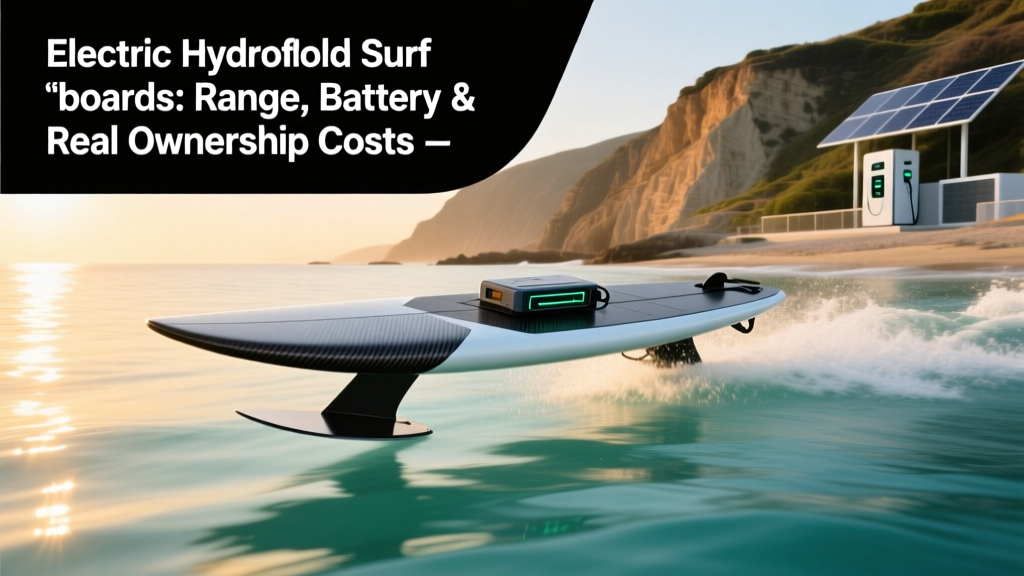
An electric hydrofoil (or eFoil) is a battery-powered surfboard that uses a submerged hydrofoil wing and electric motor to lift the rider above the water, eliminating hull drag. Current 2026 models from brands like Lift Foils, Fliteboard, and Awake deliver 60–90 minutes of ride time on a single charge, with battery capacities between 1.5 kWh and 3.5 kWh, top speeds of 25–35 mph, and base prices from $6,500 to $15,000+. They produce zero on-water emissions and require no fuel, oil changes, or winterization — but they are not road vehicles, do not qualify for the federal §30D EV tax credit, and demand a meaningful upfront investment.
If you landed here searching for an electric hydrofoil, you already know the appeal: silent, wave-independent riding that feels closer to flying than boating. But the buying decision involves real numbers — battery chemistry, charge times, replacement costs, and how an eFoil stacks up against a gas-powered personal watercraft (PWC) like a Sea-Doo or Jet Ski. This guide breaks down every spec that matters before you spend five figures.
Electric Hydrofoil Specs That Actually Matter
Unlike EVs measured in EPA range miles, eFoils are rated by ride time and energy capacity. Here's the critical distinction: kWh (kilowatt-hours) measures total battery energy — how long you can ride. kW (kilowatts) measures motor power — how fast you can go and how quickly the board accelerates onto foil. Confusing the two is the most common buyer mistake.
| Model | Battery (kWh) | Motor Power | Ride Time | Top Speed | Charge Time (0–100%) | Starting MSRP |
|---|---|---|---|---|---|---|
| Lift Foils 5 | 2.1 kWh (LFP option) | ~5 kW peak | ~90 min (eco mode) | ~30 mph | ~2.5 hours | $8,900 |
| Fliteboard Ultra L | 1.9 kWh (NMC) | ~4.5 kW peak | ~75 min (mixed riding) | ~28 mph | ~2 hours | $10,490 |
| Awake Ravik 300 | 3.2 kWh (NMC) | ~11 kW peak | ~50 min (aggressive) | ~35 mph | ~3 hours | $14,900 |
| Mercer x Flite (Pro) | 2.4 kWh (NMC) | ~6 kW peak | ~80 min | ~30 mph | ~2.5 hours | $12,200 |
Real-world caveat: Manufacturers quote maximum ride time at low speed in calm water. Expect 40–60 minutes of actual mixed riding (starts, turns, higher throttle) before the battery hits its low-voltage cutoff. Cold water (below 55°F / 13°C) reduces effective capacity by roughly 10–15% due to increased water density and battery internal resistance — the same physics that reduces EV range in winter.
Battery Chemistry: LFP vs NMC in an eFoil
Electric hydrofoils use two primary lithium chemistries, each with distinct trade-offs:
| Factor | LFP (Lithium Iron Phosphate) | NMC (Nickel Manganese Cobalt) |
|---|---|---|
| Energy Density | Lower — heavier for same kWh | Higher — lighter board, easier to carry |
| Cycle Life | 2,000–3,000+ cycles to 80% SoH | 800–1,500 cycles to 80% SoH |
| Thermal Stability | Excellent — lower fire risk | Good but requires active BMS monitoring |
| Weight Impact | Board ~5–8 lbs heavier | Lighter, better for travel |
| Best For | Daily riders, longevity priority | Performance riders, weight-sensitive use |
If you plan to ride 3–4 times per week and want the battery to last 5+ years without replacement, LFP is the practical choice despite the weight penalty. If you travel with the board or prioritize top-end performance, NMC's energy density wins — but budget for a replacement battery around year 4 or 5.
Electric Hydrofoil vs Gas PWC: Cost & Ownership Breakdown
The most common comparison question: how does an eFoil stack up against a gas-powered personal watercraft? The answer depends entirely on how you ride.
| Cost Category | Electric Hydrofoil (~$9,000) | Gas PWC (~$7,500 new) |
|---|---|---|
| Purchase Price | $9,000 | $7,500 |
| Fuel / Electricity (5 yrs, 100 hrs/yr) | ~$375 (at $0.15/kWh, ~2.5 kWh/session) | ~$2,250 (at $4.00/gal, ~4.5 gal/hr) |
| Maintenance (5 yrs) | ~$200 (prop inspection, seals) | ~$2,500 (oil, impeller, winterization, engine service) |
| Insurance (5 yrs) | ~$1,500 (specialty marine) | ~$1,750 |
| Battery Replacement (if needed) | $1,500–$3,000 (year 4–5 for NMC) | N/A |
| 5-Year Total | ~$12,575–$14,075 | ~$14,000 |
| Trailer Required? | No — fits in SUV or roof rack | Yes — adds $1,000–$2,000 + registration |
| Noise | Near-silent | 75–85 dB at throttle |
| Emissions (on-water) | Zero | Unburned hydrocarbons, CO₂ |
The crossover point is roughly year 3. After that, the eFoil's near-zero running costs offset its higher purchase price. But this assumes you're a solo rider — a gas PWC carries two passengers and covers longer distances, which an eFoil cannot do.
Charging an eFoil: What You Actually Need
Electric hydrofoils charge from standard 120V household outlets using proprietary chargers. There is no Level 2 or DC fast charging infrastructure for eFoils — and there doesn't need to be. A 2 kWh battery charging at ~800W from a wall outlet takes roughly 2.5 hours, which is sufficient for the typical ride-rest-ride pattern.
Practical considerations:
- Marina/outlet access: If you ride at a marina, confirm 120V GFCI outlet availability before buying. Some marinas prohibit charging due to liability.
- Generator workaround: For remote lake sessions, a small portable power station (e.g., 2 kWh EcoFlow or Bluetti, ~$1,200–$1,800) can recharge one full battery in the field.
- Spare battery strategy: Many riders buy a second battery ($1,500–$3,000) and swap between sessions rather than waiting for a charge.
- Storage charging: Never store an eFoil battery at 100% or 0% for extended periods. Keep at 50–60% SoC for long-term storage to minimize degradation.
Tax Credits, Incentives, and Common Misconceptions
Let's address the questions that come up most often:
| Myth | Fact |
|---|---|
| "eFoils qualify for the $7,500 federal EV tax credit." | They do not. The IRS §30D credit applies to qualified on-road motor vehicles with 4+ wheels. eFoils are classified as marine recreation equipment. |
| "Electric hydrofoils are self-driving or have autopilot." | No. They are rider-controlled with no autonomous capability. Some models include auto-shutoff when the rider falls (magnetic leash or Bluetooth dead-man switch), but this is a safety feature, not automation. |
| "You need a boating license to ride an eFoil." | Varies by state. In most US states, eFoils are classified as vessels and require the same boating safety certification as a PWC. Check your state boating requirements before riding. |
| "The battery will die in 2 years." | Modern BMS-protected lithium batteries retain 80%+ capacity for 800–3,000 charge cycles depending on chemistry. At 100 sessions/year, an LFP battery can last 20+ years; NMC lasts 8–15 years before noticeable degradation. |
| "eFoils are banned everywhere." | Few outright bans exist, but some jurisdictions restrict eFoils to specific zones or require them to stay 200+ feet from swimmers. Always check local waterway regulations. |
Decision Framework: Should You Buy an Electric Hydrofoil?
Choose an Electric Hydrofoil If:
- You ride solo and value silence and zero on-water emissions
- You don't want to deal with fuel, winterization, trailer registration, or engine maintenance
- You have access to calm, open water (lakes, bays, ocean swell) and 120V charging nearby
- Your budget accommodates $7,000–$15,000 upfront with no tax credit offset
- You want a craft that fits in an SUV or on a roof rack without a trailer
Choose a Gas PWC or Boat Instead If:
- You need to carry passengers (eFoils are single-rider only)
- You want to cover long distances (20+ miles) between points
- Your budget is under $5,000
- You ride in areas with no electrical access and no feasible portable power solution
- You need a vessel recognized for towing sports (water skiing, wakeboarding with a rope)
Frequently Asked Questions
How long does an electric hydrofoil battery last before replacement?
With proper storage (50–60% SoC) and regular use, an LFP battery retains 80% capacity for 2,000–3,000 cycles — translating to 15–25+ years at typical usage. NMC batteries reach 80% at 800–1,500 cycles, or roughly 8–15 years. Replacement batteries cost $1,500–$3,000 depending on the brand and capacity.
Can I charge an electric hydrofoil from my car or solar panel?
Not directly. eFoil chargers require 120V AC input. However, a portable power station with AC output (EcoFlow Delta Pro, Bluetti AC200, etc.) can charge a depleted eFoil battery in the field. Some power stations accept solar input, enabling off-grid charging — but expect 4–6 hours of solar collection for a single full charge.
Are electric hydrofoils safe for beginners?
They have a significant learning curve — expect 3–5 supervised sessions before consistent foiling. Most brands include beginner speed modes (limited to ~10–12 mph) and auto-shutoff safety leashes. Taking a certified lesson ($150–$250 for 90 minutes) dramatically reduces the crash-and-learn phase and is strongly recommended.
What's the real top speed I can expect?
Published top speeds assume ideal conditions (flat water, lightweight rider, fully charged battery). Real-world sustained speed for an average 175-lb rider is 20–28 mph for most models. The Awake Ravik 300 can hit 35 mph but drains its battery in under 30 minutes at that pace.
Do electric hydrofoils work in saltwater?
Yes, but saltwater accelerates corrosion on all metal components. Rinse the entire board, mast, fuselage, and propeller with fresh water after every saltwater session. Most premium brands use marine-grade stainless steel and sealed motor housings, but neglect will void warranties.
Electric hydrofoils occupy a unique niche: they're the closest thing to a zero-maintenance, zero-emission watercraft available today, but they demand a premium purchase price, offer no tax incentives, and serve a single rider in calm conditions. If that matches your use case, the 5-year ownership cost rivals or beats a gas PWC — and the experience is something no combustion engine can replicate.