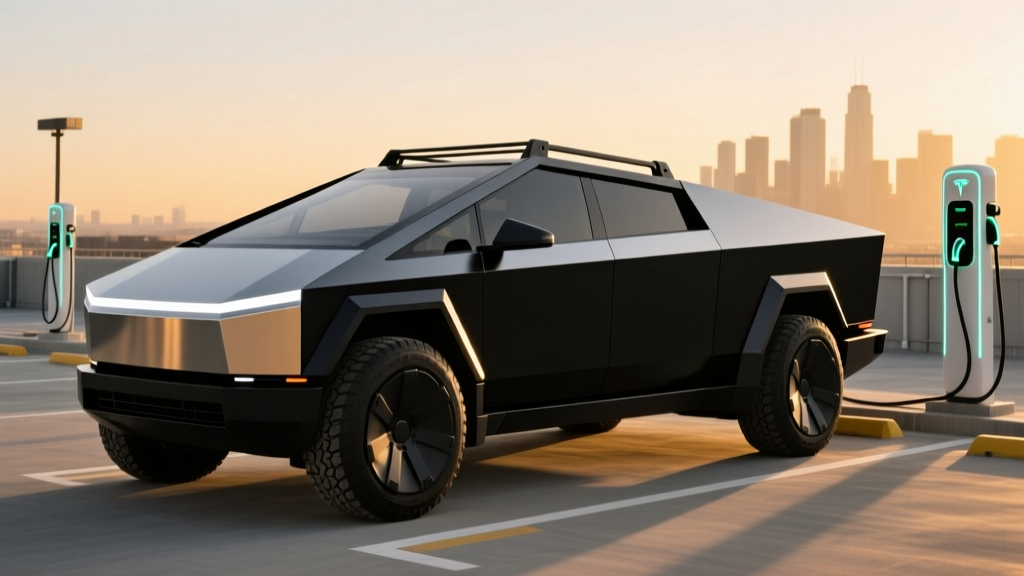
The Tesla Cybertruck remains one of the most polarizing electric vehicles on the road. Its angular stainless-steel exoskeleton turns heads from every angle, but the Tesla Cybertruck side view is where the truck's proportions, bed geometry, and sheer scale become fully apparent. Beyond the design debate, buyers need hard data: real-world range, charging speeds, towing capability, and total cost. This profile covers the 2026 Cybertruck lineup with the exact numbers you need before signing a purchase agreement.
Design and the Tesla Cybertruck Side View Profile
Seen from the side, the Cybertruck's trapezoidal silhouette is unlike any other pickup. The flat stainless-steel panels (cold-rolled, ultra-hard 30X grade) eliminate traditional body lines, creating a monolithic wedge. Key exterior dimensions visible from the side profile include:
- Overall length: 223.6 inches
- Wheelbase: 141.7 inches
- Height: 70.5 inches (standard ride height)
- Bed length: 6 feet (72 inches) with the tonneau closed
- Approach/departure angles: 35°/30° (with adaptive air suspension raised)
The side view also reveals the Cybertruck's steer-by-wire architecture — there is no mechanical linkage between the yoke and the wheels, which allows the front wheels to turn sharply without a traditional steering column intruding into the cabin. The rear-wheel steering (up to 10°) is visible in action during low-speed maneuvers, tightening the turning circle to a sedan-like 34.0 feet despite the truck's length.
Range, Efficiency, and Real-World Expectations
The Cybertruck is offered in three trims for 2026, each with distinct range profiles. The stainless-steel body adds weight, and the angular shape creates more aerodynamic drag than a curved body at highway speeds — both factors compress real-world range below EPA estimates.
| Trim | EPA Range | Real-World Highway (70 mph) | Cold Weather (32°F) |
|---|---|---|---|
| AWD (Dual Motor) | 340 mi | ~275-290 mi | ~230-250 mi |
| Cyberbeast (Tri Motor) | 320 mi | ~260-275 mi | ~215-235 mi |
| RWD (2026+) | 250 mi (est.) | ~205-220 mi | ~175-190 mi |
Highway estimatess assume 70 mph sustained in moderate temperatures. Cold-weather figures include cabin heating load and battery resistance. Source: fueleconomy.gov and owner-reported data.
Efficiency for the AWD trim lands at approximately 56 MPGe combined (roughly 60 kWh per 100 miles), which is poor by EV standards but competitive for a 6,800+ lb electric truck. The Cyberbeast dips to around 51 MPGe due to the third motor's parasitic losses and more aggressive performance tuning.
Battery Chemistry, Capacity, and Longevity
Tesla has not officially published the Cybertruck's exact usable battery capacity, but teardowns and EPA filing data point to a ~123 kWh usable pack (approximately 135 kWh gross) for the AWD and Cyberbeast trims. The pack uses Tesla's in-house 4680-format NMC (nickel manganese cobalt) cells in a structural battery configuration where the cells serve as a stressed chassis member.
| Attribute | Cybertruck (NMC 4680) | Typical LFP Pack |
|---|---|---|
| Energy Density | High (~260 Wh/kg cell-level) | Lower (~170 Wh/kg) |
| Fast-Charge Tolerance | Excellent (800V architecture) | Moderate |
| Calendar Degradation | ~10-12% over 100k mi | ~6-8% over 100k mi |
| Recommended Daily SoC | 80% (set charge limit) | 100% (LFP prefers full) |
| Cold Performance | Good with preconditioning | Reduced in extreme cold |
The Cybertruck's battery and drive unit warranty covers 8 years or 120,000 miles, whichever comes first, with Tesla guaranteeing a minimum of 70% capacity retention over that period. This is slightly more generous than the Model 3/Y Long Range warranty (8 yr/100,000 mi) owing to the truck's heavier-duty positioning.
Charging Speed: DC Fast, Level 2, and Home Setup
The Cybertruck uses an 800-volt electrical architecture — the first Tesla vehicle to do so — enabling higher charge rates with lower current and less heat generation. It ships with the NACS (North American Charging Standard) connector natively, meaning it accesses Tesla Superchargers without an adapter and can use CCS stations via a NACS-to-CCS adapter.
| Charging Level | Power | Rate / Time |
|---|---|---|
| Level 1 (120V household) | ~1.4 kW | ~3-4 mi/hr |
| Level 2 (240V, 48A Wall Connector) | 11.5 kW | ~34 mi/hr (full in ~12 hr) |
| DC Fast Charge (V4 Supercharger) | Peak 350 kW | 10-80% in ~15 min; 80-100% tapers sharply |
| DC Fast Charge (third-party 150 kW) | ~150 kW sustained | 10-80% in ~35 min |
The 350 kW peak rate is only achievable at V4 Supercharger stalls with the latest cabinet hardware. On a typical road trip mixing 150 kW and 250 kW chargers, expect 10-80% sessions to average 20-25 minutes. The 800V architecture keeps the charge curve relatively flat through 60% SoC before tapering begins — a meaningful advantage over 400V competitors that peak early and taper aggressively.
For home charging, the Tesla Wall Connector at 48 amps (11.5 kW) is the practical choice. A full overnight charge from 20% to 80% takes roughly 7 hours. Installation typically requires a 60A dedicated circuit — budget $800-$2,000 for electrician labor depending on panel proximity, plus $450 for the Wall Connector unit.
Performance, Towing, and Drivetrain Specs
| Specification | AWD (Dual Motor) | Cyberbeast (Tri Motor) |
|---|---|---|
| Horsepower | 600 hp | 845 hp |
| 0-60 mph | 3.9 seconds | 2.6 seconds |
| Top Speed | 130 mph | 130 mph |
| Drivetrain | Dual-motor AWD | Tri-motor AWD (torque vectoring rear) |
| Towing Capacity | 11,000 lbs | 11,000 lbs |
| Payload Capacity | 2,500 lbs | 2,500 lbs |
| Curb Weight | ~6,740 lbs | ~6,870 lbs |
The Cyberbeast's 2.6-second 0-60 time makes it the quickest production pickup ever built, but the more relevant performance metric is towing. At 11,000 lbs max tow rating, the Cybertruck matches heavy-duty gas trucks, but expect range to drop by 40-55% when towing a loaded trailer at highway speeds. A 340-mile AWD Cybertruck towing 8,000 lbs will realistically deliver 150-180 miles between charges — plan Supercharger stops accordingly.
The adaptive air suspension offers 12 inches of travel, from a 4-inch lowering for highway efficiency to an 8-inch raise for off-road clearance. In Extract mode (off-road), ground clearance reaches approximately 17 inches, exceeding a Ford F-150 Raptor.
Cargo, Interior Space, and Practicality
The Cybertruck seats five across two rows. Interior volume is generous up front but the rear seat is tighter than a full-size F-150 or Silverado:
- Front legroom: 41.5 inches
- Rear legroom: 36.2 inches
- Front headroom: 40.8 inches
- Rear headroom: 38.1 inches
- Bed volume: 67 cu ft (with tonneau closed)
- Front trunk (frunk): 7.1 cu ft
- Hidden under-bed storage: 5.2 cu ft (accessible from bed floor)
The motorized tonneau cover is load-rated to 300 lbs (you can stand on it) and seals the bed from weather. The vault-style bed lacks traditional tie-down hooks — Tesla provides integrated L-track rails instead. For buyers who frequently haul lumber, ATVs, or job-site materials, the 6-foot bed length and angular wheel wells limit what fits compared to a conventional 6.5-foot bed with flat floors.
Pricing, Trim Levels, and Federal Tax Credit
| Trim | Base MSRP | §30D Credit Eligibility | Effective Price (est.) |
|---|---|---|---|
| RWD (2026+) | ~$60,990 | Eligible (under $80K truck cap) | ~$53,490* |
| AWD (Dual Motor) | $79,990 | Eligible (at truck MSRP cap) | ~$72,490* |
| Cyberbeast (Tri Motor) | $99,990 | NOT eligible (exceeds $80K cap) | $99,990 |
*Effective price assumes full $7,500 federal credit applied at point of sale. Eligibility depends on buyer income caps ($150K single / $300K joint AGI), battery component and critical mineral sourcing requirements, and MSRP limits ($80,000 for trucks per IRS §30D rules). Verify current-year sourcing compliance before purchase — rules change as supply chains shift.
The Cyberbeast, at $99,990, exceeds the $80,000 MSRP cap for trucks and does not qualify for the federal credit. The AWD trim sits right at the $80K cap, making it the top eligible configuration — but any dealer-installed accessories that push MSRP above $80K will disqualify it. The RWD model, expected for broader availability in 2026, is the value play for fleet and commercial buyers.
- Buyer AGI: ≤$150K (single) / ≤$225K (head of household) / ≤$300K (joint)
- Vehicle MSRP: ≤$80,000 (truck classification)
- Final assembly: North America ✓ (Austin, TX)
- Battery components: must meet escalating domestic-content thresholds
- Critical minerals: must meet sourcing requirements (updated annually by IRS)
- Transfer to dealer at point of sale: available since Jan 2024
Technology, Autopilot, and Standout Features
The Cybertruck's cabin centers on an 18.5-inch front touchscreen and a 9.4-inch rear passenger display. Tesla's infotainment runs the same Tesla OS found in Model 3/Y refreshes, including Netflix/YouTube streaming while parked, Tesla Arcade gaming, and a customizable dash display. Notable unique features include:
- Steer-by-wire: No mechanical connection; variable ratio adjusts with speed. Takes 1-2 weeks to build muscle memory.
- Rear-wheel steering: Up to 10° for tight turning radius and high-speed lane-change stability.
- Bioweapon Defense Mode: HEPA cabin filtration with positive pressure.
- Powered frunk and tonneau: Both open/close via app or touchscreen.
- 120V/240V bed outlets: Up to 9.6 kW continuous power output (V2L capability) — enough to run power tools or a campsite.
- Armor glass: Laminated stainless-steel-backed glass; survived early demonstration impacts (with revisions).
On the driver-assist front, the Cybertruck ships with Basic Autopilot (traffic-aware cruise control and lane centering) and offers Full Self-Driving (Supervised) as a $8,000 option or $99/month subscription.
Despite the "Full Self-Driving" name, FSD (Supervised) is an SAE Level 2 driver-assist system. The driver must remain fully engaged, hands on the yoke, eyes on the road at all times. The Cybertruck does NOT drive itself. Only Level 4 services like Waymo operate without a human driver — and those are limited to geofenced urban areas.
- Does not reliably handle construction zones, unmapped roads, or adverse weather
- Requires constant driver supervision — disengagement logs show frequent takeovers
- Not a substitute for attentive driving; NHTSA continues to investigate Autopilot/FSD incidents
- Performance degrades in heavy rain, fog, or when cameras are obscured
Pros and Cons at a Glance
- 350 kW peak DC charging via 800V architecture — among the fastest in production trucks
- 11,000-lb tow rating with integrated trailer brake controller
- 9.6 kW vehicle-to-load (V2L) power output for job sites and camping
- Stainless-steel body resists dents, scratches, and corrosion
- Rear-wheel steering gives a remarkably tight turning circle
- Supercharger network access (largest reliable DC network in the US)
- Real-world range drops sharply when towing (40-55% loss)
- Rear seat legroom is tight for a full-size truck class
- Steer-by-wire and yoke require significant adaptation
- Cyberbeast trim ($99,990) does not qualify for federal tax credit
- Stainless-steel panels show fingerprints and are difficult to repair after dents
- No Apple CarPlay or Android Auto — Tesla ecosystem only
- Insurance premiums run 20-35% higher than comparable F-150 Lightning
Who Should Buy the Cybertruck?
Choose the Cybertruck AWD if: You need a daily-drivable electric truck with strong towing, access to the Supercharger network for road trips, and V2L capability for work sites — and you can stay within the $80K tax-credit cap.
Choose the Cyberbeast if: Performance is the priority, budget is flexible, and the $7,500 credit is irrelevant to your purchase decision.
Look at the Ford F-150 Lightning or Rivian R1T instead if: You need a conventional steering wheel, a larger rear seat, more dealership service options, or a longer bed.
Frequently Asked Questions
What is the real-world range of the Tesla Cybertruck?
The AWD Cybertruck carries an EPA rating of 340 miles. In real-world highway driving at 70 mph in moderate temperatures, expect 275-290 miles. In cold weather (below freezing) with cabin heat, range drops to roughly 230-250 miles. Towing a trailer cuts range by 40-55%.
How fast does the Cybertruck charge at home and on the road?
At home on a 48A Level 2 Tesla Wall Connector (11.5 kW), the Cybertruck adds approximately 34 miles of range per hour, fully charging overnight in about 12 hours. On a V4 Supercharger (350 kW peak), a 10-80% session takes approximately 15 minutes. On a 150 kW third-party DC charger, 10-80% takes roughly 35 minutes.
How much does the Cybertruck cost after tax credits?
The AWD Dual Motor at $79,990 MSRP may qualify for the full $7,500 federal §30D credit (bringing the effective price to ~$72,490), provided the buyer meets income caps and the vehicle meets current-year battery sourcing requirements. The $99,990 Cyberbeast exceeds the $80K truck MSRP cap and is ineligible. The upcoming RWD trim (~$60,990) should qualify for the full credit.
Does the Cybertruck qualify for the federal EV tax credit?
The AWD and RWD trims can qualify, but eligibility depends on three factors: (1) buyer income below IRS thresholds, (2) MSRP at or below $80,000 (truck cap), and (3) battery component and critical mineral sourcing meeting current-year requirements. Always verify sourcing compliance on the specific VIN with the dealer before purchase. Check IRS §30D guidance for current rules.
Is the Cybertruck worth buying vs. the Ford F-150 Lightning or Rivian R1T?
The Cybertruck wins on charging speed (800V architecture), V2L power output, and Supercharger network access. The F-150 Lightning offers a more conventional truck experience, larger rear seat, and wider dealer service network. The Rivian R1T provides a more refined interior, better off-road capability with quad-motor torque vectoring, and a more practical bed. Test-drive all three — the Cybertruck's steer-by-wire and yoke are deal-breakers for some buyers and a revelation for others.
What are the biggest Cybertruck pros and cons?
Top pros: 350 kW charging, 11,000-lb tow rating, 9.6 kW V2L, rear-wheel steering, Supercharger access. Top cons: severe range loss when towing, tight rear seat, yoke adaptation curve, Cyberbeast ineligibility for tax credits, high insurance costs, no CarPlay.