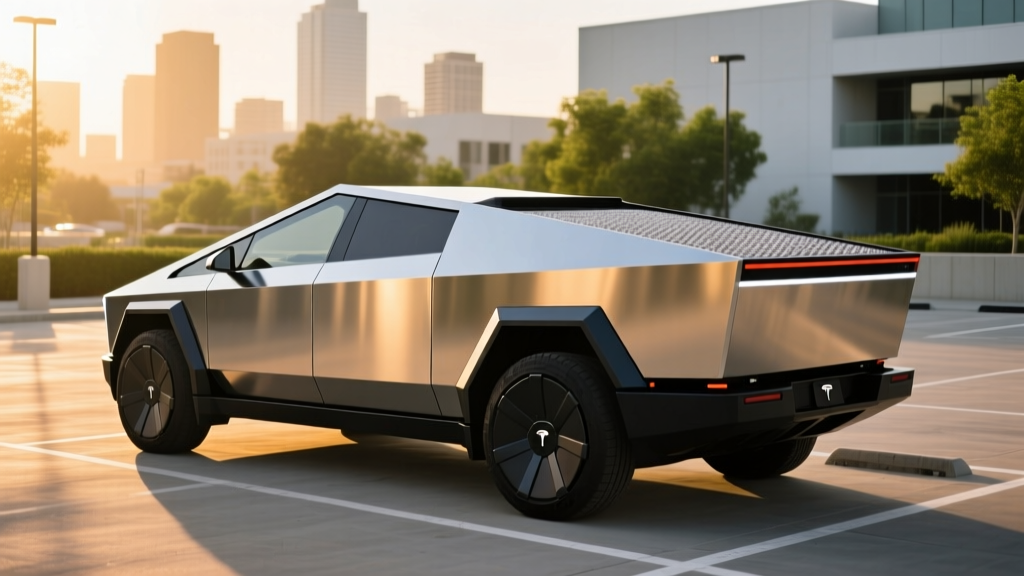
Tesla Cybertruck sales in 2025 defied skeptics. After a rocky launch year marked by production bottlenecks, recall campaigns, and polarized public reaction, the stainless-steel pickup crossed an inflection point: Tesla delivered an estimated 45,000–55,000 Cybertrucks through 2025, making it one of the best-selling electric pickups in the U.S. and a genuine rival to the Ford F-150 Lightning and Rivian R1T in volume. For 2026, Tesla has streamlined the trim lineup, quietly improved build consistency, and expanded service-center capacity — but the Cybertruck remains a deeply specific vehicle that rewards certain buyers and frustrates others.
This review dissects what 2025's sales momentum means for anyone considering a Cybertruck in 2026. We cover real-world range and efficiency, the 800-volt charging architecture, interior practicality, federal tax credit eligibility under current IRS §30D rules, and the honest trade-offs that determine whether this truck belongs in your driveway.
2026 Tesla Cybertruck Specifications at a Glance
| Spec | Long Range (AWD) | Cyberbeast (Tri-Motor AWD) |
|---|---|---|
| EPA Range | 340 miles | 320 miles |
| Battery (usable) | ~123 kWh (NMC) | ~123 kWh (NMC) |
| Drivetrain | Dual-motor AWD | Tri-motor AWD |
| Horsepower | 600 hp | 845 hp |
| 0–60 mph | 3.9 sec | 2.6 sec |
| Max DC Fast Charge | 350 kW peak | 350 kW peak |
| 10–80% DC Charge | ~17 min (peak conditions) | ~17 min (peak conditions) |
| Level 2 Home Charge | 11.5 kW (~37 mi/hr) | 11.5 kW (~37 mi/hr) |
| MPGe (combined) | 67 MPGe | 62 MPGe |
| Efficiency | 50 kWh/100 mi | 54 kWh/100 mi |
| Tow Rating | 11,000 lbs | 11,000 lbs |
| Payload | 2,500 lbs | 2,500 lbs |
| Bed Length | 6 ft (72 in) | 6 ft (72 in) |
| Cargo Volume (bed) | ~67 cu ft | ~67 cu ft |
| Frunk | 7.1 cu ft | 7.1 cu ft |
| Base MSRP | $79,990 | $99,990 |
| Battery/Drive Warranty | 8 yr / 120,000 mi | 8 yr / 120,000 mi |
| Basic Warranty | 4 yr / 50,000 mi | 4 yr / 50,000 mi |
Range and Efficiency: EPA vs. the Real World
Real-World Expectation: 260–290 miles at sustained highway speeds (70–80 mph); 220–250 miles in freezing temperatures; up to ~200 miles when towing a 5,000-lb trailer.
The Cybertruck's angular, stainless-steel exoskeleton creates a drag coefficient of approximately 0.34 — worse than the Ford F-150 Lightning's ~0.44 Cd is sometimes cited, but the Cybertruck's large frontal area (roughly 36 sq ft) means total aerodynamic drag is substantial. At highway speeds, that drag dominates energy consumption. On fueleconomy.gov, the Long Range AWD model is rated at 67 MPGe combined (50 kWh/100 mi), which is notably less efficient than the Rivian R1T Dual-Motor (73 MPGe) and far behind the F-150 Lightning Extended Range (70 MPGe) on a per-mile basis.
In real-world mixed driving — suburban errands with moderate highway stints — most owners report 280–310 miles before needing a charge. Cold weather is the Cybertruck's enemy: lithium-ion cells lose 15–25% of usable capacity below 32°F, and the cabin heater (resistance-based, not a heat pump in all configurations) draws additional energy. If you commute in Minnesota winters, plan for 220–250 miles of practical range.
Towing is where range collapses entirely. A 6,000-lb enclosed trailer at 65 mph can halve effective range. Tesla's in-dash range estimator accounts for terrain and speed, but physics is unforgiving: expect 150–200 miles between charges on a tow-heavy road trip.
Charging Speed and Infrastructure
The Cybertruck uses an 800-volt electrical architecture — a meaningful technical advantage that allows higher charge power at lower current, reducing heat and cable weight. On a Tesla V4 Supercharger or compatible 350 kW station, the Cybertruck peaks near 350 kW, though sustained rates taper significantly above 50% state of charge (SoC).
| Charge Level | Power (kW) | Miles Added per Hour | Notes |
|---|---|---|---|
| Level 1 (120V / 12A) | 1.4 kW | ~3 mi/hr | Emergency/trickle only |
| Level 2 (240V / 48A) | 11.5 kW | ~37 mi/hr | Full charge in ~10–11 hrs |
| DC Fast (V4 Supercharger) | Up to 350 kW peak | ~140 mi in 15 min (10–50% SoC) | 10–80% in ~17 min (ideal); taper above 50% |
| DC Fast (50 kW public) | 50 kW | ~100 mi/hr | 10–80% in ~90 min |
The 10–80% claim of ~17 minutes assumes ideal conditions: a V4 Supercharger capable of 350 kW, battery preconditioned via navigation routing, and ambient temperatures above 60°F. In practice, at a 250 kW V3 Supercharger — still the majority of Tesla's network — expect 20–25 minutes for 10–80%. The charge curve tapers hard above 80%, so plan to unplug at 80% on road trips rather than waiting for a full charge.
The Cybertruck ships with the NACS (North American Charging Standard) connector natively. This is a strategic advantage in 2026: the NACS plug is now the de facto standard, with Ford, GM, Rivian, and others adopting it. You will never need an adapter on the Supercharger network.
Home charging on a 48-amp Level 2 circuit (requiring a 60-amp breaker) adds roughly 37 miles of range per hour. A full overnight charge from 20% to 100% takes about 10 hours. Most owners charge to 80% daily and reserve 100% for road trips, which is sound practice for NMC chemistry longevity.
Performance and Driving Dynamics
The Cyberbeast's 2.6-second 0–60 mph time is supercar territory in a 6,800-lb stainless-steel wedge. It is genuinely startling and remains one of the quickest production vehicles ever sold, regardless of powertrain. The Long Range AWD's 3.9-second time is scarcely less impressive and more than adequate for any real-world merging or passing scenario.
Both trims use Tesla's adaptive air suspension, which provides up to 16 inches of ground clearance in Off-Road mode and drops the ride height at highway speeds for aerodynamic efficiency. Steering is rear-wheel-steer-assisted, giving the 20-foot-long truck a surprisingly tight turning circle of 40.2 feet — comparable to a midsize sedan.
The by-wire steering system (no mechanical linkage between the yoke and the wheels) remains controversial. It is precise and quick, but lacks the feedback that traditional rack-and-pinion systems provide. Most owners adapt within a week; some never do. Test-drive before committing.
Ride quality is firm. The stainless-steel body panels and heavy battery pack result in a truck that transmits road imperfections more than an F-150 Lightning on its independent rear suspension. On smooth pavement, the Cybertruck is composed and quiet; on broken pavement, you will feel the weight.
Pricing, Tax Credits, and Total Cost
| Trim | Base MSRP | Destination | Est. As-Tested | §30D Credit Eligible? |
|---|---|---|---|---|
| Long Range AWD | $79,990 | $1,995 | $85,000–$92,000 | Yes — up to $7,500 (see rules below) |
| Cyberbeast (Tri-Motor) | $99,990 | $1,995 | $105,000–$115,000 | Yes — up to $7,500 (see rules below) |
Both Cybertruck trims fall under the IRS §30D MSRP cap of $80,000 for pickup trucks (the truck classification gives it a higher cap than sedans, which are limited to $55,000). However, eligibility for the full $7,500 credit depends on three additional factors per current IRS rules:
- Buyer income caps: Modified AGI must not exceed $300,000 (joint), $225,000 (head of household), or $150,000 (single).
- Battery component sourcing: A percentage of battery components must be manufactured or assembled in North America, and critical minerals must be sourced from the U.S. or free-trade-agreement countries. These thresholds increase annually; verify current-year compliance on the IRS qualified vehicles list.
- Point-of-sale transfer: As of 2024, buyers can transfer the credit to the dealer at purchase, reducing the out-of-pocket price immediately — rather than waiting to claim it on a tax return.
Consult a tax professional before relying on the credit. Eligibility rules have shifted yearly, and battery-sourcing compliance can change mid-model-year as Tesla adjusts supply chains.
Total cost of ownership favors the Cybertruck over gas-powered full-size trucks for high-mileage drivers. At $0.14/kWh (national average home electricity), charging costs roughly $0.07/mile — versus $0.20–$0.25/mile for an F-150 at 18 MPG and $3.75/gallon. Over 15,000 miles/year, that is a $2,000–$2,700 annual fuel savings. Insurance, however, is steep: Cybertruck premiums average 30–50% higher than comparable F-150 Lightning policies, driven by repair costs for the stainless-steel body and by-wire components.
Interior, Tech, and Practicality
The Cybertruck's cabin is minimalist to the point of austerity. An 18.5-inch center touchscreen handles nearly every vehicle function — climate, glovebox, mirror adjustment, wiper speed — with no physical buttons. A rear 9.4-inch touchscreen serves back-seat passengers. The yoke-style steering wheel is standard; a conventional round wheel is not available.
Front seats are well-bolstered and heated/ventilated. Rear legroom is 38.4 inches — adequate for adults on shorter trips but less generous than the F-150 Lightning's 43.6 inches. The rear bench fits three adults in a pinch but is better suited to two.
The 6-foot bed is enclosed by a motorized tonneau cover (the "sail pillars" and sloping roofline give the Cybertruck its signature profile). The bed is rated for 2,500 lbs of payload, and the motorized cover can support 300 lbs of distributed weight. The 7.1-cu-ft frunk is useful for groceries or charging cables but smaller than the Lightning's massive front trunk.
Tech highlights:
- Tesla Autopilot (SAE Level 2 driver assist) is standard — adaptive cruise, lane centering, automatic emergency braking.
- Full Self-Driving (Supervised) is a $8,000 option or $99/month subscription. Despite the name, FSD remains Level 2: you must keep hands on the yoke and eyes on the road at all times.
- Sentry Mode dashcam recording, Dog Mode climate, and over-the-air software updates.
- Vehicle-to-load (V2L) capability via the Powershare feature: up to 11.5 kW of 240V output, enough to run power tools at a job site or back up essential home circuits during an outage.
Pros, Cons, and Verdict
Pros
- Class-leading DC fast charging (350 kW peak, 800V architecture)
- Stunning acceleration (2.6 sec 0–60 Cyberbeast)
- 11,000-lb tow rating; V2L Powershare for job-site or home backup
- Native NACS connector — seamless Supercharger access
- Over-the-air updates continuously add features
- Distinctive design; high resale visibility
Cons
- Highway efficiency lags competitors (50 kWh/100 mi)
- Real-world range drops sharply when towing or in cold weather
- By-wire steering lacks feel; yoke-only layout frustrates some drivers
- Rear-seat legroom trails F-150 Lightning
- Insurance premiums significantly above segment average
- Build quality improved but still inconsistent vs. legacy OEMs
- Bed is shorter (6 ft) than full-size truck norms (6.5–8 ft)
Who Should Buy the Cybertruck in 2026?
The 2025 sales surge proved the Cybertruck is not a niche curiosity — it has found a real buyer base. But it is not a universal truck. Here is who it suits best:
- Tech-forward commuters who value Supercharger network access, OTA updates, and acceleration that embarrasses sports cars at stoplights.
- Job-site professionals who need V2L Powershare for tools and lighting but don't need an 8-foot bed.
- Enthusiasts and early adopters who want a conversation piece that also tows 11,000 lbs.
Consider the F-150 Lightning instead if you need maximum rear-seat space, a longer bed, a more traditional driving experience, or lower insurance costs. Consider the Rivian R1T if you prioritize off-road capability, build quality, and a more conventional steering wheel — though at a price premium and without Supercharger access (though Rivian now has NACS adapters and Supercharger agreements in place).
Frequently Asked Questions
What is the real-world range of the 2026 Tesla Cybertruck?
The EPA rates the Long Range at 340 miles and the Cyberbeast at 320 miles. In real-world highway driving at 75 mph, expect 260–290 miles. In freezing weather, plan for 220–250 miles. Towing a trailer can cut range to 150–200 miles.
How fast does the Cybertruck charge at home and on the road?
On a 48-amp Level 2 home charger (11.5 kW), you gain ~37 miles per hour, with a full charge in about 10–11 hours. On a V4 Supercharger (350 kW peak), 10–80% takes roughly 17 minutes under ideal conditions. On a common 250 kW V3 Supercharger, expect 20–25 minutes for 10–80%.
Does the Cybertruck qualify for the $7,500 federal EV tax credit?
Both trims are under the $80,000 MSRP cap for trucks. However, eligibility depends on your income (≤$300K joint / ≤$150K single), battery component and critical-mineral sourcing compliance, and current-year IRS rules. The credit can be transferred at point of sale. Verify on the IRS qualified vehicles list before purchasing and consult a tax professional.
Is the Cybertruck worth buying over the F-150 Lightning or Rivian R1T?
It depends on priorities. The Cybertruck wins on DC fast-charge speed (350 kW vs. Lightning's ~150 kW and R1T's ~200 kW) and acceleration. The F-150 Lightning wins on rear-seat space, bed length, and price. The Rivian R1T wins on off-road capability and build quality. If Supercharger access and charge speed are paramount, the Cybertruck has the edge.
What is the Cybertruck's battery chemistry, and how long will it last?
The Cybertruck uses NMC (nickel-manganese-cobalt) chemistry in a ~123 kWh usable pack. NMC offers higher energy density than LFP but is more sensitive to sustained 100% SoC. Tesla's battery warranty covers 8 years or 120,000 miles with a minimum 70% capacity retention threshold. Real-world degradation data from 2024–2025 delivery owners suggests ~5–8% loss in the first 30,000 miles, which is typical for NMC packs.
Can the Cybertruck power my home during an outage?
Yes. Tesla's Powershare V2L feature provides up to 11.5 kW of 240V output through the bed outlets and frunk. This can run essential home circuits (refrigerator, lights, HVAC fan) for multiple days depending on battery state of charge. A Tesla Powerwall integration is expected to expand whole-home backup capability.