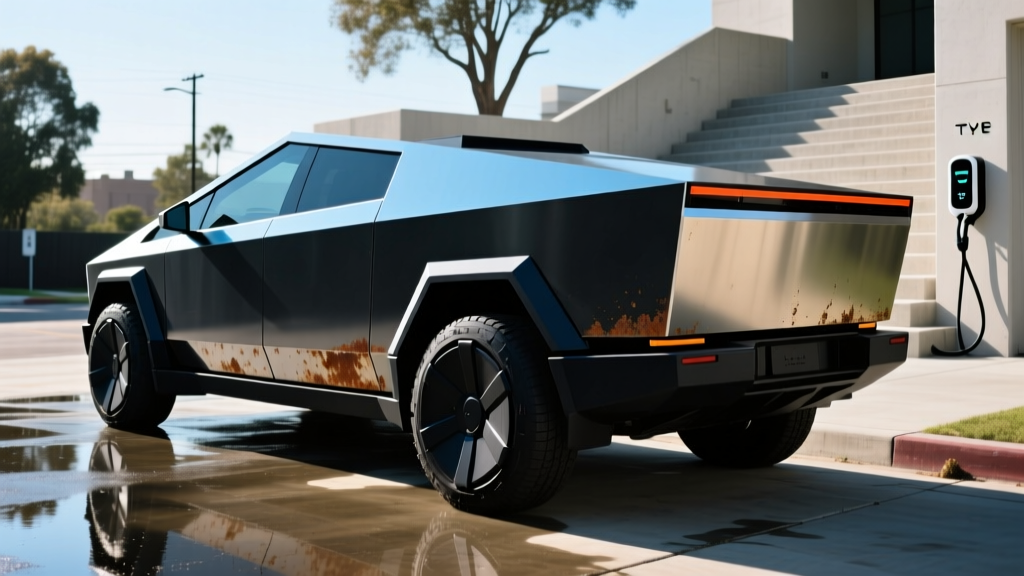
The Tesla Cybertruck's cold-rolled stainless steel exoskeleton was supposed to be impervious. Bulletproof, even — famously surviving 9mm rounds in Tesla's demonstrations. But since deliveries began, a growing chorus of owners has posted photos of rust-colored spots, streaking, and surface discoloration on their trucks. For a vehicle starting near $80,000, the optics are alarming. So what's actually happening, and should it derail a purchase? Below, we break down the metallurgy, the owner reports, and every spec you need — range, charging, pricing, and tax credit eligibility — to make an informed decision on the 2026 Cybertruck.
The Rust Question: Surface Staining vs. Structural Corrosion
The Cybertruck's body panels use a 300-series austenitic stainless steel, similar in family to what you'll find in commercial kitchen equipment and architectural cladding. This alloy forms a passive chromium-oxide layer that resists corrosion. However, "stainless" does not mean "stain-proof."
Owner reports of rust-like discoloration generally fall into three categories:
- Iron contamination transfer: The most common culprit. When carbon-steel particles (from brake dust, nearby grinding, or industrial fallout) embed in the stainless surface, those particles rust — not the panel itself. This appears as small orange dots or streaks, often near the wheel wells or lower body.
- Surface oxidation from environmental exposure: Road salt, acidic bird droppings, tree sap, and industrial pollution can compromise the passive oxide layer if left untreated, leading to superficial tea-colored staining. This is cosmetic and generally removable with the right cleaners.
- Weld-zone sensitization: In stainless steel, heat from welding can deplete chromium in adjacent zones, making those areas more susceptible to corrosion. Tesla's laser-welding process is designed to minimize this, but a few owners have noted discoloration near panel seams.
In our assessment, and consistent with metallurgical analysis shared by independent materials engineers, there is no evidence as of early 2026 of structural corrosion compromising the Cybertruck's body integrity. The reports are overwhelmingly cosmetic — but cosmetic issues on a $100,000 vehicle are still legitimate concerns. Tesla has addressed some cases under warranty, and aftermarket ceramic-coating providers have developed products specifically for the Cybertruck's uncoated steel.
2026 Cybertruck Specs at a Glance
| Spec | AWD (Dual Motor) | Cyberbeast (Tri-Motor) |
|---|---|---|
| EPA Est. Range | 340 miles | 320 miles |
| Battery (usable, est.) | ~123 kWh, NMC (4680 cells) | ~123 kWh, NMC (4680 cells) |
| Drivetrain | Dual-motor AWD | Tri-motor AWD |
| Horsepower | 600 hp | 845 hp |
| 0–60 mph | 3.9 sec | 2.6 sec |
| Top Speed | 112 mph | 130 mph |
| Max DC Fast Charge | ~350 kW peak (800V architecture) | ~350 kW peak (800V architecture) |
| 10–80% DC Fast Charge | ~18 min (optimal conditions) | ~18 min (optimal conditions) |
| Level 2 Home Charging | 11.5 kW (~34 mi/hr) | 11.5 kW (~34 mi/hr) |
| Towing Capacity | 11,000 lbs | 11,000 lbs |
| MPGe (combined) | ~67 MPGe | ~64 MPGe |
| Efficiency | ~50 kWh/100 mi | ~52 kWh/100 mi |
| Base MSRP | $79,990 | $99,990 |
| Federal Tax Credit (§30D) | Not eligible (MSRP cap exceeded) | Not eligible (MSRP cap exceeded) |
Range, Efficiency, and Real-World Expectations
The Cybertruck's slab-sided, angular design creates a higher drag coefficient than a sleek sedan — estimated around 0.38 to 0.40 Cd — which hits highway efficiency hard. At 50 kWh per 100 miles, it consumes significantly more energy per mile than a Tesla Model Y (roughly 28 kWh/100 mi). If most of your driving is highway commuting above 70 mph, plan your charging stops accordingly. The optional range-extender bed accessory, announced for later availability, claims to push range past 470 miles but remains unreleased as of this writing.
Charging Speed: 800V Architecture Delivers
The Cybertruck uses an 800-volt electrical architecture — the same platform found in the Hyundai Ioniq 5 and Porsche Taycan — enabling very fast DC charging when paired with a capable station. Here's what charging looks like across levels:
| Charging Level | Power (kW) | Approx. Miles Added per Hour | Notes |
|---|---|---|---|
| Level 1 (120V household) | ~1.4 kW | ~3 mi/hr | Emergency/trickle only |
| Level 2 (240V, 48A) | 11.5 kW | ~34 mi/hr | Full charge overnight (~10 hrs) |
| DC Fast Charge (V4 Supercharger) | Up to ~350 kW peak | ~1,000+ mi/hr (peak) | 10–80% in ~18 min; tapers sharply above 80% |
| DC Fast Charge (older 150 kW station) | ~150 kW sustained | ~450 mi/hr | 10–80% in ~35 min |
The charge curve matters: the Cybertruck peaks near 350 kW only at low state-of-charge (SoC) and optimal battery temperature. Expect the rate to taper to ~150 kW around 50% SoC and further to ~50 kW above 80%. This is normal lithium-ion behavior, but it means the last 20% takes nearly as long as the first 60%. For road trips, the practical strategy is charging from 10–80% and moving on — exactly what Tesla's navigation-based preconditioning is designed to optimize.
At home, a Wall Connector on a 60-amp circuit delivers 11.5 kW, adding roughly 34 miles of range per hour. A full 0–100% charge takes about 10–11 hours. If you're upgrading from a standard NEMA 14-50 outlet (which delivers ~3 mi/hr on Level 1), budget $500–$2,000 for a licensed electrician to install a dedicated 60A circuit, depending on your panel capacity and run length.
Performance, Tech, and Daily Livability
The Cyberbeast's 2.6-second 0–60 mph time makes it one of the quickest production vehicles on Earth, truck or otherwise. The dual-motor AWD variant is hardly slow at 3.9 seconds. Both deliver instant torque, and the steer-by-wire system — which eliminates the mechanical connection between the steering wheel and the rack — provides quick, precise turn-in, though it takes some acclimation for drivers accustomed to traditional feedback.
Standout tech features:
- Steer-by-wire with a yoke-style steering wheel (no hand-over-hand needed at lock)
- Adaptive air suspension with up to 16 inches of ground clearance in Extract Mode
- Powered tonneau cover with a 6-foot bed rated for 2,500 lbs payload
- 18.5-inch front touchscreen with Tesla's latest infotainment software, including a dedicated off-road visualization display
- Bioweapon Defense Mode (HEPA cabin filtration)
- Autopilot standard; FSD (Supervised) available as an $8,000 add-on or subscription
- Vault-like frunk (front trunk) adding ~7 cu ft of secure storage
Notable drawbacks:
- Rear visibility is severely limited; the truck relies heavily on the backup camera and digital rearview mirror
- The angular stainless steel panels show fingerprints, water spots, and — yes — surface staining readily
- Cabin space is tighter than a Ford F-150 or Rivian R1T; rear legroom is approximately 36 inches, adequate but not generous for tall adults
- Bed length is 6 feet with the tailgate up, shorter than many full-size truck beds
- Insurance premiums run 20–40% higher than comparable trucks due to repair costs and stainless-steel panel replacement complexity
Pricing, Tax Credits, and Total Cost
The 2026 Cybertruck lineup has consolidated after initial Foundation Series pricing:
| Trim | Base MSRP | Typical As-Tested (with options) | Federal §30D Credit |
|---|---|---|---|
| AWD (Dual Motor) | $79,990 | $82,000–$87,000 | $0 — exceeds $80,000 truck MSRP cap |
| Cyberbeast (Tri-Motor) | $99,990 | $102,000–$110,000 | $0 — exceeds $80,000 truck MSRP cap |
The Cybertruck does not qualify for the federal §30D clean vehicle credit of up to $7,500. The IRS caps eligible trucks, vans, and SUVs at an $80,000 MSRP, and both Cybertruck trims exceed this threshold. Additionally, the buyer income caps ($300,000 joint / $150,000 single for modified AGI) and critical-mineral/battery-sourcing requirements would further complicate eligibility even if the price were under the cap. Do not factor the federal credit into your Cybertruck purchase budget.
Some states offer their own EV rebates or tax credits that may apply — check your state's energy or DMV website for current programs, as these vary widely and change frequently.
Warranty Coverage
Tesla provides the following warranty for the 2026 Cybertruck:
- Basic Vehicle: 4 years / 50,000 miles
- Battery & Drive Unit: 8 years / 120,000 miles (whichever comes first), with a minimum 70% capacity retention guarantee over that period
- Restraint System: 5 years / 60,000 miles
The 8-year/120,000-mile battery warranty is competitive for the truck segment. The 70% retention threshold is the industry-standard floor — if your battery degrades below 70% of its original capacity within the warranty period, Tesla will repair or replace it. In practice, NMC 4680 cells with Tesla's thermal management system have shown degradation curves that flatten after the first 20,000–30,000 miles, typically retaining 88–92% at 100,000 miles based on fleet data from Model 3/Y vehicles using similar chemistry. For reference, fueleconomy.gov lists official efficiency and range figures.
Cybertruck vs. the Competition
| Attribute | Tesla Cybertruck AWD | Ford F-150 Lightning (Ext. Range) | Rivian R1T (Dual-Motor Max) |
|---|---|---|---|
| EPA Range | 340 mi | 320 mi | 410 mi |
| Base MSRP | $79,990 | $76,995 | $87,900 |
| Towing | 11,000 lbs | 10,000 lbs | 11,000 lbs |
| Bed Length | 6 ft | 5.5 ft | 4.5 ft (w/ Gear Tunnel option for more) |
| Federal Tax Credit | No (MSRP cap) | No (MSRP cap on most trims) | No (MSRP cap) |
| Supercharger Network | Native access | Access via adapter (NACS) | Access via adapter (NACS) |
| Rust/Body Concern | Surface staining reported | Traditional painted steel/aluminum | Painted aluminum/composite |
- Choose the Cybertruck if: You want the fastest available electric truck, value Supercharger network native access, prefer the stainless-steel aesthetic (and are willing to maintain it), and prioritize tech-forward features like steer-by-wire.
- Choose the F-150 Lightning if: You need a more traditional truck experience, want a proven fleet-proven platform, value a larger dealer/service network, or prefer a lower entry price.
- Choose the Rivian R1T if: Maximum range (410 mi with Max Pack) and off-road capability are priorities, you want a Gear Tunnel for adventure gear, and you don't mind a higher starting price for the larger battery.
Frequently Asked Questions
Is the Tesla Cybertruck actually rusting?
The stainless steel body panels themselves are not experiencing structural rust. What owners are seeing is primarily surface-level iron contamination — microscopic carbon-steel particles from brake dust, road debris, or industrial fallout that land on the stainless surface and rust independently. Environmental staining from road salt and hard water can also create discoloration. Both are cosmetic and treatable with proper cleaning products. No widespread structural corrosion has been documented as of early 2026.
How do I prevent staining on my Cybertruck?
Wash regularly (every 1–2 weeks), especially in winter or after driving on salted roads. Avoid parking near industrial sites where metal grinding occurs. Apply a ceramic coating designed for bare stainless steel to create a hydrophobic barrier. Use a dedicated stainless steel cleaner (not abrasive pads or chloride-based products) to remove any spots that do appear. Tesla's official care guide provides approved products and methods.
What is the real-world highway range?
Expect 270–295 miles on the AWD model at 70–75 mph in mild conditions (60–80°F). Below 30°F, range drops to approximately 230–260 miles due to battery resistance and cabin heating demands. The Cyberbeast's higher power output and wider rear tires reduce range by roughly 20 miles across all scenarios.
Does the Cybertruck qualify for the $7,500 federal tax credit?
No. Both trims exceed the IRS §30D MSRP cap of $80,000 for trucks. Even if pricing were adjusted, the buyer would still need to meet income limits ($300K joint / $150K single) and the vehicle would need to satisfy critical-mineral and battery-component sourcing requirements. Budget without the federal credit.
Is the Cybertruck worth buying over an F-150 Lightning or R1T?
It depends on your priorities. The Cybertruck offers the quickest acceleration, native Supercharger access, and a distinctive design. The F-150 Lightning provides a more conventional truck experience with broader service infrastructure. The Rivian R1T leads in EPA range and off-road versatility. All three are compelling — but none qualify for the federal tax credit at current pricing, so the financial playing field is more level than it might appear.
How expensive is Cybertruck insurance?
Insurance premiums for the Cybertruck are notably higher than for conventional trucks — typically 20–40% above an F-150 Lightning, depending on your state, driving record, and coverage level. The stainless steel panels require specialized repair processes, and Tesla's direct repair network is still scaling. Get quotes from multiple insurers before purchasing to set realistic ownership-cost expectations.