Why Cybertruck Resale Value Is the Most Debated Topic in EVs Right Now
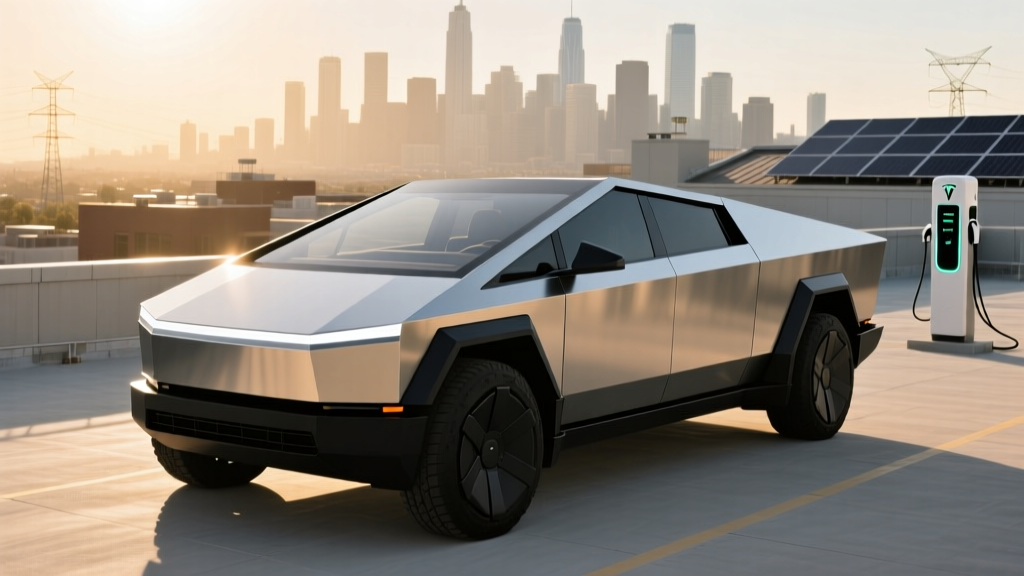
The Tesla Cybertruck launched with unprecedented hype, a polarizing design, and a price tag that crept well beyond early promises. Now, with the truck in customers' driveways for over a year, the market has spoken — and the numbers tell a complicated story. If you're researching Cybertruck resale dynamics before buying, leasing, or selling, you need more than Reddit speculation. You need hard data on depreciation curves, real-world range, charging costs, and how this stainless-steel wedge stacks up against the Rivian R1T and Ford F-150 Lightning in long-term ownership economics.
This profile breaks down the Cybertruck's total cost of ownership picture — the factor that ultimately drives resale — with exact specs, tax-credit math, and the practical realities that depreciation calculators often miss.
2026 Tesla Cybertruck Core Specs at a Glance
| Specification | AWD (Dual Motor) | Cyberbeast (Tri Motor) |
|---|---|---|
| EPA Range | 340 miles | 320 miles |
| Battery Capacity (usable) | ~123 kWh (NMC) | ~123 kWh (NMC) |
| Peak DC Fast Charge | 250 kW (Supercharger V3) | 250 kW (Supercharger V3) |
| 10–80% DC Charge Time | ~28 minutes | ~28 minutes |
| Level 2 Home Charge (11.5 kW) | ~44 mi/hr | ~44 mi/hr |
| 0–60 mph | 3.9 seconds | 2.6 seconds |
| Horsepower | 600 hp | 845 hp |
| Drivetrain | Dual-Motor AWD | Tri-Motor AWD |
| Towing Capacity | 11,000 lbs | 11,000 lbs |
| EPA Efficiency | 58 MPGe / 58 kWh/100mi | 54 MPGe / 62 kWh/100mi |
| Base MSRP (2026) | $79,990 | $99,990 |
| Battery Warranty | 8 yr / 120,000 mi | 8 yr / 120,000 mi |
Real-World Range: What the EPA Sticker Doesn't Tell You
EPA Estimated Range (AWD): 340 miles
Real-World Highway Expectation: ~260–290 miles at 70–75 mph
Cold-Weather (below 32°F): ~220–250 miles with cabin heating
Cyberbeast Highway: ~240–270 miles (higher consumption from tri-motor output)
The Cybertruck's angular stainless-steel body creates a drag coefficient that punishes highway efficiency far more than a conventional pickup or the smoother Rivian R1T. In sustained 75 mph driving, energy consumption climbs to roughly 65–70 kWh/100mi, cutting the EPA figure by 20–25%. Towing even a modest 5,000-lb trailer collapses range to approximately 140–160 miles, which demands careful route planning around Supercharger stations.
The ~123 kWh usable battery pack uses NMC (nickel manganese cobalt) chemistry rather than LFP, prioritizing energy density for this heavy platform. NMC cells degrade slightly faster than LFP over thousands of cycles, but Tesla's battery management system and the 8-year/120,000-mile warranty (minimum 70% capacity retention per Tesla's warranty documentation) provide a meaningful floor.
Charging Speed and Infrastructure: The Supercharger Advantage
| Charging Level | Power (kW) | Miles Added per Hour | Notes |
|---|---|---|---|
| Level 1 (120V, 12A) | ~1.4 kW | ~3 mi/hr | Emergency/trickle only |
| Level 2 (240V, 48A) | 11.5 kW | ~44 mi/hr | Home Wall Connector; full charge ~11 hrs |
| DC Fast (V3 Supercharger) | Peak 250 kW | ~175 mi in 15 min | 10–80% in ~28 min; tapers above 80% |
| DC Fast (V4 Supercharger) | Peak 250+ kW | Similar to V3 | Integrated CCS adapter not needed for Tesla network |
The Cybertruck's charge curve peaks at 250 kW around 20–30% State of Charge (SoC) and begins tapering noticeably after 55%. The 10–80% sprint takes roughly 28 minutes at a V3 Supercharger, which is competitive but not class-leading — the 800V architectures in the Hyundai Ioniq 5 and Porsche Macan Electric achieve 10–80% in under 20 minutes, though neither is a truck.
For home charging, a 48-amp Level 2 Tesla Wall Connector on a 60-amp circuit delivers 11.5 kW, adding roughly 44 miles per hour of charging. A full overnight charge from 20% takes about 10–11 hours. Installation costs for a dedicated 240V/60A circuit typically run $800–$2,500 depending on panel proximity and local permit fees. The Cybertruck uses the NACS connector natively — no adapter required on Tesla's Supercharger network, which now hosts over 6,000 stations in North America.
Cybertruck Resale Value: The Numbers Behind the Headlines
This is where the Cybertruck story diverges sharply from most EVs. Here's what the used market data reveals:
The Depreciation Curve So Far
Early Cybertruck resale prices were distorted by speculative markups. Foundation Series buyers paid $119,990 (AWD) to $120,990 (Cyberbeast) and some flipped units above MSRP in the first months of scarcity. That bubble has fully deflated. As of early 2026:
- Foundation Series AWD (2024, ~15,000 mi): Selling for $72,000–$82,000 on the used market — a 30–40% loss from the original $119,990 sticker.
- Foundation Series Cyberbeast (2024, ~10,000 mi): Listing between $78,000–$90,000 — representing 25–35% depreciation.
- Standard AWD (2025, ~5,000 mi): Resale around $68,000–$74,000 against a $79,990 MSRP — roughly 8–15% loss.
Why the Cybertruck Depreciated Faster Than Expected
Several factors converged to soften resale:
- Price normalization: Tesla dropped the Cybertruck MSRP from the Foundation Series pricing to the current $79,990/$99,990 structure, instantly underwater-ing early buyers who paid $120K+.
- Production ramp-up: As Tesla increased output and eliminated waitlists, the scarcity premium vanished.
- EV market-wide depreciation: According to iSeeCars data, EVs as a segment depreciated more steeply than gas vehicles in 2024–2025, driven by price wars and rapid model improvements.
- Polarizing design: The Cybertruck's angular aesthetic limits its buyer pool on the used market compared to conventionally styled trucks.
- Build-quality concerns: Early reports of panel misalignment, tonneau cover failures, and the steer-by-wire system's learning curve have made some used buyers cautious.
Cybertruck Resale vs. Competitors
For context, here's how the Cybertruck's depreciation trajectory compares to key rivals in the electric truck segment (approximate 1-year/10,000-mile depreciation from MSRP):
- Ford F-150 Lightning (Lariat): ~20–28% (stabilizing after initial drops; benefits from fleet demand and familiar styling)
- Rivian R1T Dual-Motor: ~18–25% (Rivian's strong brand loyalty and adventure positioning support residual value)
- Tesla Cybertruck AWD: ~15–25% for standard trims; ~30–40% for Foundation Series
The Foundation Series numbers are an outlier driven by the MSRP reset. Standard-trim Cybertruck depreciation is more in line with the segment, though still on the higher end. The long-term question is whether the Cybertruck's stainless-steel body (no paint to fade, dent-resistant panels) and Tesla's software update cadence will help it hold value better in years 3–5.
Pricing, Trims, and Federal Tax Credit Eligibility
| Trim | MSRP | Federal §30D Credit | Effective Price (if eligible) |
|---|---|---|---|
| RWD (announced, expected late 2026) | $60,990 (est.) | Up to $7,500 | ~$53,490 |
| AWD (Dual Motor) | $79,990 | $0 (over MSRP cap) | $79,990 |
| Cyberbeast (Tri Motor) | $99,990 | $0 (over MSRP cap) | $99,990 |
This is a critical factor for Cybertruck resale: the AWD and Cyberbeast trims do NOT qualify for the $7,500 federal EV tax credit. Under IRS §30D rules, pickup trucks must have an MSRP at or below $80,000 to be eligible. The AWD at $79,990 technically clears this cap, but destination fees and any dealer-installed options push it over. The Cyberbeast at $99,990 is well above the threshold.
The anticipated RWD trim, if and when it arrives, would likely qualify — subject to the buyer's income caps ($150,000 single / $300,000 joint filing) and battery critical-mineral sourcing requirements. This credit ineligibility for current trims suppresses new-vehicle demand at the margin, which in turn affects resale by reducing the pool of buyers willing to pay near-MSRP used prices.
Who Should Buy a Cybertruck — and Who Should Skip It
Pros
- Class-leading acceleration (2.6s 0–60 Cyberbeast) in a pickup
- 11,000-lb towing capacity with integrated trailer brake controller
- Stainless-steel exoskeleton is dent- and corrosion-resistant
- Tesla Supercharger network access (18,000+ stalls globally)
- Vault-style 6.5-ft bed with 120V/240V power outlets (V2L capability)
- Over-the-air updates continuously add features
- Steer-by-wire provides a uniquely tight turning radius for a full-size truck
Cons
- Real-world highway range drops to ~260–290 mi (AWD); ~240 mi Cyberbeast
- No federal tax credit on AWD/Cyberbeast trims
- Poor visibility and large blind spots; camera reliance
- Foundation Series early buyers took a 30–40% depreciation hit
- Towing slashes range to ~140–160 miles
- Limited aftermarket and accessory ecosystem vs. F-150/R1T
- Steer-by-wire has a steep learning curve; no physical steering column backup
- Cargo bed narrower than conventional trucks between wheel wells
Best Use Cases
The Cybertruck makes sense for: Tech-forward owners who want a daily-driver truck with sports-car acceleration, light-to-moderate towing needs, and access to home Level 2 charging. It works as a commuter vehicle with occasional utility use — think weekend project hauling, not daily contractor duty.
Consider alternatives if: You need maximum highway range (Rivian R1T Max Pack offers ~410 miles EPA), you tow frequently over long distances, you rely on the federal tax credit, or you prefer a proven platform with a robust dealer/service network (Ford F-150 Lightning).
Cargo, Tech, and Daily Livability
The Cybertruck seats five with 41.0 inches of rear legroom — adequate but not generous for a full-size truck. The 6.5-foot bed offers approximately 74 cu ft of volume with the motorized tonneau cover closed, and the lockable vault design provides weather-sealed security that an open bed cannot match. The front trunk (frunk) adds roughly 7 cu ft of lockable storage.
Inside, an 18.5-inch central touchscreen handles all infotainment, climate, and vehicle controls — there are no physical buttons. The minimalist approach extends to the yoke-style steering wheel (standard on Cyberbeast, optional on AWD). Tesla's Autopilot comes standard; Full Self-Driving (Supervised) remains a $8,000 add-on. A critical reminder: FSD is SAE Level 2 driver-assist, meaning the driver must remain fully engaged with hands on the yoke and eyes on the road at all times. It is not autonomous driving.
Notable tech includes a bioweapon defense mode (HEPA cabin filtration), a front-row 15-inch display for passengers in updated builds, and a powered frunk. Drawbacks include the absence of Apple CarPlay/Android Auto (Tesla uses its proprietary infotainment exclusively) and the reliance on touchscreen controls for functions like wiper speed and mirror adjustment that are safer with physical buttons.
Cybertruck Resale FAQ
What is the real-world range of the Tesla Cybertruck?
The AWD's EPA estimate is 340 miles, but expect roughly 260–290 miles in real-world highway driving at 70–75 mph. In cold weather (below freezing), range drops to approximately 220–250 miles due to battery conditioning demands and cabin heating. The Cyberbeast, with its tri-motor output, delivers about 240–270 miles on the highway.
How fast does the Cybertruck charge at home and on DC fast chargers?
On a Tesla V3 Supercharger (250 kW peak), the Cybertruck charges from 10–80% in approximately 28 minutes. At home on a Level 2 Wall Connector (11.5 kW / 48A), it adds about 44 miles of range per hour, with a full charge from near-empty taking around 11 hours. Level 1 (120V) charging is impractical for daily use at roughly 3 miles per hour.
How much does a Cybertruck cost after tax credits?
The AWD at $79,990 and Cyberbeast at $99,990 do not qualify for the $7,500 federal §30D tax credit because they exceed (or, with fees, effectively exceed) the $80,000 MSRP cap for trucks. The effective purchase price remains at or near MSRP. The anticipated RWD trim at an estimated $60,990 could qualify for the full credit if buyer income and battery sourcing requirements are met, bringing it to approximately $53,490.
Is the Cybertruck worth buying vs. the Rivian R1T or Ford F-150 Lightning?
It depends on priorities. The Cybertruck offers the quickest acceleration, Supercharger network access, and a unique design. The Rivian R1T (Max Pack, ~410 mi EPA) wins on range and adventure capability with a growing service network. The Ford F-150 Lightning provides the most conventional truck experience, a wider dealer network, and better towing range. For resale value, the R1T has shown slightly better retention so far, while the Lightning benefits from fleet demand.
Does the Cybertruck qualify for the federal EV tax credit?
Currently, the AWD ($79,990) is at the very edge of the $80,000 MSRP cap for trucks under IRS §30D, but destination charges and options typically push it over, disqualifying it. The Cyberbeast ($99,990) does not qualify. The future RWD trim is expected to be eligible. All buyers must also meet income caps ($150K single / $300K joint) and the vehicle must satisfy critical-mineral and battery-component sourcing requirements.
Will the Cybertruck hold its value better over 3–5 years?
Several factors could support long-term residual value: the stainless-steel body's resistance to cosmetic aging, Tesla's OTA update cadence keeping the platform current, and Supercharger network exclusivity (though this advantage is eroding as other OEMs gain NACS access). However, rapid EV advancement, the absence of a tax credit for most trims, and the niche design limit the buyer pool on the used market. Expect 45–55% depreciation over 5 years — roughly in line with the EV truck segment average but steeper than the Toyota Tacoma or F-150 gas equivalents.
The Bottom Line on Cybertruck Resale
The Cybertruck's resale story in 2026 is one of market correction. Foundation Series early adopters absorbed steep losses as Tesla normalized pricing and production scaled. Standard-trim depreciation is more moderate but still reflects the broader EV market's headwinds: rapid technological improvement, aggressive price competition, and tax-credit ineligibility on higher trims.
For buyers entering the market now, the silver lining is that used Cybertrucks represent a compelling value proposition — you're acquiring a 600-hp, 340-mile (EPA) electric truck with Supercharger access for 15–35% below its original sticker. For sellers, the market has largely stabilized around current MSRP benchmarks, meaning further steep drops are unlikely unless Tesla initiates another significant price cut.
Track the latest EPA efficiency data on fueleconomy.gov and verify current tax-credit eligibility on the IRS clean vehicle credits page before making a purchase decision.