Ford F-150 Lightning Reliability: What Three Years of Data Tells Us
The Ford F-150 Lightning has been on American roads since mid-2022, and by the 2026 model year, it has accumulated enough real-world mileage for buyers to move past speculation and examine actual reliability patterns. For a vehicle with a starting price hovering around $55,000 and a battery pack costing upwards of $20,000 to replace, reliability isn't an abstract concern — it's the single largest financial variable in long-term ownership.
This review examines the 2026 Ford F-150 Lightning through the lens of documented reliability data, battery longevity projections, charging infrastructure, and total cost of ownership. We'll pair every EPA sticker figure with real-world expectations, because a truck that loses 30% of its range in January or while towing a trailer isn't the same truck the window sticker advertises.
Spec Table: 2026 F-150 Lightning at a Glance
| Specification | Standard Range | Extended Range |
|---|---|---|
| EPA Range | 240 miles | 320 miles |
| Battery Capacity (usable) | 98 kWh (LFP) | 131 kWh (NMC) |
| Battery Chemistry | Lithium Iron Phosphate | Nickel Manganese Cobalt |
| Peak DC Fast Charge | 120 kW | 150 kW |
| 10–80% DC Charge Time | ~44 minutes | ~41 minutes |
| Level 2 Home Charge Rate | 11.3 kW (~25 mi/hr) | 19.2 kW (~38 mi/hr) w/ 80A charger |
| Horsepower | 452 hp | 580 hp |
| Torque | 775 lb-ft | 775 lb-ft |
| 0–60 mph | ~5.0 seconds | ~3.8 seconds |
| Drivetrain | Dual-motor AWD | Dual-motor AWD |
| Max Towing Capacity | 7,700 lbs | 10,000 lbs |
| MPGe (combined) | 76 MPGe | 70 MPGe |
| Efficiency | 44 kWh/100 mi | 48 kWh/100 mi |
| Base MSRP (Pro trim) | $54,995 | $69,995 (Lariat ext.) |
| Battery/Powertrain Warranty | 8 years / 100,000 miles (70% capacity retention) | |
Real-World Range: What the EPA Sticker Doesn't Tell You
The F-150 Lightning's boxy aerodynamic profile and substantial curb weight (roughly 6,200–6,700 lbs depending on trim and battery) work against highway efficiency. Unlike lower-slung EVs that maintain relatively flat efficiency curves up to 75 mph, the Lightning's energy consumption climbs steeply above 65 mph. For buyers whose daily driving is primarily suburban or city-based at speeds under 50 mph, the Standard Range pack's 240 EPA miles translates to a genuine 210–230 real-world miles — ample for most commutes with home charging.
Towing is where range expectations require the most recalibration. Ford's own range calculator acknowledges that towing a 7,000-lb trailer at highway speed can cut range nearly in half. This is physics, not a Lightning-specific flaw — the Rivian R1T and GMC Hummer EV experience similar losses — but it means any buyer planning regular towing should budget for charging stops every 100–130 miles on the road.
Battery Chemistry, Degradation, and Long-Term Reliability
The 2026 F-150 Lightning offers two distinct battery chemistries, and the choice between them has meaningful implications for long-term reliability and ownership cost.
| Factor | LFP (Standard Range) | NMC (Extended Range) |
|---|---|---|
| Energy Density | Lower (heavier pack for same kWh) | Higher (more range per pound) |
| Cycle Life | 3,000–5,000+ cycles to 80% SoH | 1,000–2,000 cycles to 80% SoH |
| Cold-Weather Performance | Moderately reduced charge acceptance below freezing | Better low-temp performance with preconditioning |
| Recommended Charge Habit | Can charge to 100% daily without accelerated degradation | Best kept at 80–90% daily; 100% for trips only |
| Thermal Runaway Risk | Extremely low | Low (but higher than LFP) |
| Cobalt Content | Zero | Contains cobalt and nickel |
| Estimated 8-Year Capacity | ~90–95% SoH | ~82–88% SoH |
The Standard Range LFP pack is, from a pure longevity standpoint, the more durable option. LFP chemistry tolerates daily full charges, has a dramatically longer cycle life, and exhibits less capacity loss over time. For a work truck that will be charged nightly and driven 30–60 miles daily, the LFP pack is projected to retain well above 90% of its original capacity after eight years — comfortably exceeding Ford's warranty threshold of 70% retention.
The Extended Range NMC pack offers more usable miles per charge but requires more careful charging habits to maximize lifespan. Ford's battery management system includes a substantial buffer (roughly 5–8 kWh of the gross capacity is reserved) to protect against deep discharge and overcharge stress. Real-world data from 2022–2024 model year Lightnings, as aggregated by owner communities and analyzed by Recurrent Auto, shows NMC Lightning packs averaging approximately 94–96% State of Health after two years and 30,000–40,000 miles. This is consistent with industry-leading degradation curves, though the sample size of high-mileage (100,000+ mi) Lightnings remains limited as of early 2026.
Ford's battery warranty covers 8 years or 100,000 miles against capacity loss below 70% of original. This is standard for the segment and matches Chevrolet, Rivian, and most competitors. Tesla's warranty on the Cybertruck uses the same 70% threshold. The critical distinction is that Ford's warranty applies regardless of charging habits — there is no exclusion for frequent DC fast charging, which some manufacturers have been known to scrutinize during warranty claims.
Charging Speed and Infrastructure: Home and DC Fast Charging
| Charging Level | Power / Rate | Standard Range (mi/hr) | Extended Range (mi/hr) | Equipment Needed |
|---|---|---|---|---|
| Level 1 (120V household) | ~1.4 kW | ~3 mi/hr | ~3 mi/hr | Standard outlet; included mobile cord |
| Level 2 (240V, 32A) | 7.7 kW | ~17 mi/hr | ~17 mi/hr | 240V NEMA 14-50 outlet or hardwired EVSE |
| Level 2 (240V, 48A) | 11.3 kW | ~25 mi/hr | ~25 mi/hr | 48A hardwired EVSE (Ford Charge Station Pro or equivalent) |
| Level 2 (240V, 80A) | 19.2 kW | ~42 mi/hr | ~38 mi/hr | 80A hardwired EVSE; requires 100A dedicated circuit |
| DC Fast Charge | 120 kW peak (Std) / 150 kW peak (Ext) | 10–80% in ~44 min | 10–80% in ~41 min | CCS or NACS connector at public stations |
The F-150 Lightning's DC fast-charging speed is the most frequently cited criticism among EV enthusiasts, and the numbers warrant honest discussion. A peak of 150 kW on the Extended Range model is substantially slower than competitors like the Hyundai Ioniq 5 (peak 240 kW, 10–80% in ~18 minutes) or the Rivian R1T (peak 220 kW on the newer pack). The Lightning's large battery and conservative charge curve mean it spends relatively little time near peak power — the rate tapers noticeably above 60% SoC.
However, context matters enormously. For the approximately 85% of Lightning owners who charge at home nightly, DC fast-charging speed is relevant only during road trips. A 41-minute 10–80% charge translates to a rest stop every 200–250 miles (Extended Range, non-towing), which aligns reasonably with driver fatigue breaks. The Lightning's NACS adapter (standard on 2025+ models, retrofittable on earlier models) grants access to Tesla's Supercharger network, which remains the most reliable DC fast-charging infrastructure in the United States.
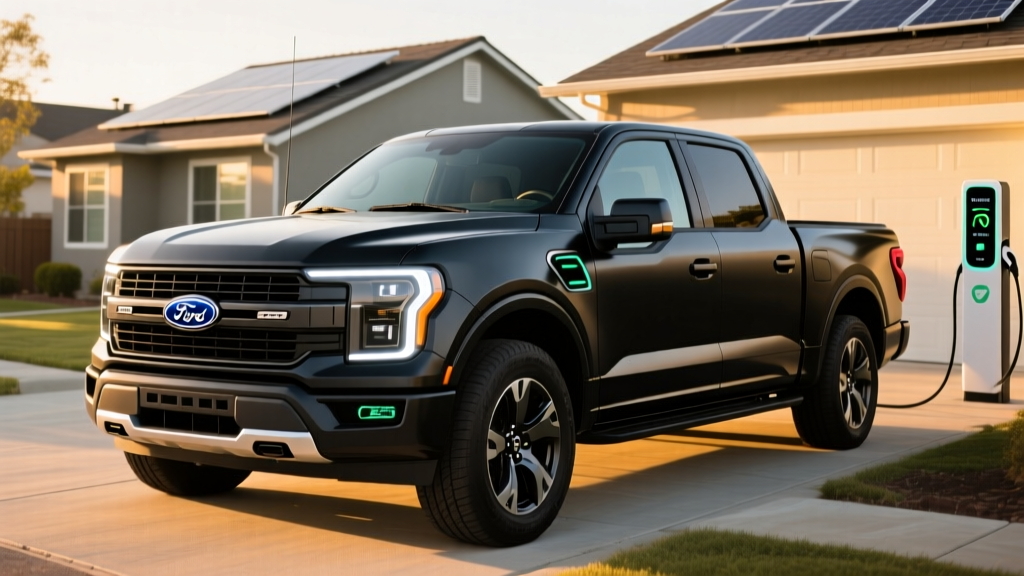
Home charging is where the Lightning excels. Ford's available 80A Charge Station Pro can replenish the Extended Range battery from 15% to 100% in approximately 8 hours — meaning even a heavily depleted pack recovers fully overnight. The 80A charger requires a 100-amp dedicated circuit, which means many homes will need an electrical panel upgrade (typically $1,500–$3,000 depending on local codes and existing panel capacity). Buyers should budget for a licensed electrician to assess their panel before purchase. The available Ford Intelligent Backup Power feature allows the Lightning to power home circuits during outages (up to 9.6 kW output), which requires the Charge Station Pro and a home transfer switch installed by a qualified electrician.
Pricing, Tax Credits, and Ownership Economics
| Trim Level | Base MSRP | Federal §30D Credit | Effective Price (if eligible) |
|---|---|---|---|
| Pro (Standard Range) | $54,995 | Up to $7,500 | ~$47,495 |
| XLT (Standard Range) | $59,995 | Up to $7,500 | ~$52,495 |
| Lariat (Extended Range) | $69,995 | Up to $7,500 | ~$62,495 |
| Platinum (Extended Range) | $84,995 | Up to $7,500 | ~$77,495 |
The federal EV tax credit under IRS §30D remains available for the 2026 F-150 Lightning, but eligibility is not automatic. Several conditions must be met, and buyers should verify current-year rules at IRS.gov before relying on the credit in their purchase decision.
- MSRP Cap: Trucks and vans must have an MSRP at or below $80,000. The Pro, XLT, and Lariat trims qualify; the Platinum trim at $84,995 base exceeds the cap (though option packages on lower trims that push MSRP above $80,000 also disqualify the vehicle).
- Buyer Income Limits: Modified adjusted gross income must not exceed $300,000 (married filing jointly), $225,000 (head of household), or $150,000 (single filers).
- Battery Component & Critical Mineral Sourcing: The $7,500 credit is split into two $3,750 halves — one for battery component manufacturing (North America) and one for critical mineral sourcing (US or FTA-partner countries). Sourcing requirements tighten annually. As of 2026, the Lightning's eligibility for the full $7,500 depends on Ford's evolving supply chain; buyers should confirm with their dealer and cross-reference the IRS eligible-vehicle list at the point of sale.
- Point-of-Sale Transfer: The credit can now be transferred to the dealer at purchase, reducing the purchase price directly rather than requiring the buyer to wait for a tax refund. This is available regardless of tax liability, effectively functioning as a rebate.
Beyond the purchase price, the Lightning's operating costs are significantly lower than a comparable gasoline F-150. At a national average electricity rate of $0.16/kWh and the Extended Range model's 48 kWh/100 mi consumption, the Lightning costs approximately $7.68 per 100 miles to charge at home. A gasoline F-150 at 20 MPG combined and $3.40/gallon costs $17.00 per 100 miles — a savings of roughly $932 per year at 10,000 miles driven annually. Over five years, fuel savings alone can offset $4,000–$5,000 of the price premium, before accounting for reduced maintenance (no oil changes, fewer brake replacements due to regenerative braking, no transmission fluid).
Insurance costs, however, run 15–25% higher than a comparable gas F-150, based on industry averages. Buyers should obtain quotes before purchasing, as premiums vary substantially by state, driving record, and insurer.
Reliability Track Record: Known Issues and Build Quality
Across the 2022–2025 model years, the F-150 Lightning has demonstrated better-than-average reliability for a first-generation EV platform, though it has not been without issues. Consumer Reports has rated the Lightning's predicted reliability as average to slightly above average in recent model years, a notable achievement given that the F-150 gasoline counterpart has historically scored below average.
Documented issues from 2022–2025 model years include:
- 12V battery failures: Like many modern EVs, the Lightning uses a 12V auxiliary battery to power electronics, lighting, and the contactors that connect the high-voltage pack. Several owners reported 12V battery failures within the first 18 months, leaving the vehicle unable to start even with a full traction battery. Ford issued software updates to improve 12V charging management, and the 2026 model year benefits from these revisions.
- Software and infotainment glitches: SYNC 4A, the Lightning's infotainment system, has drawn complaints for occasional screen freezes, Bluetooth disconnections, and delayed navigation route recalculations. Most issues have been addressed via over-the-air (OTA) updates, though some owners report persistent lag in the 15.5-inch portrait touchscreen in extreme heat.
- Build quality variance: Early-production 2022 models exhibited panel-gap inconsistencies and occasional water intrusion around the frunk (front trunk) seal. Ford addressed these in subsequent production runs, and 2025–2026 models show markedly improved assembly consistency from the Rouge Electric Vehicle Center.
- Range estimation accuracy: The Lightning's "Intelligent Range" system, which adjusts estimated range based on driving style, weather, and terrain, was initially overly conservative, sometimes displaying range estimates 15–20% below actual achievable range. OTA updates have improved calibration, but some owners still report the estimate fluctuating significantly during the first few miles of a drive.
The Lightning's dual-motor drivetrain has proven notably robust. Unlike internal-combustion powertrains with hundreds of moving parts, the Lightning's electric motors have minimal wear components. There have been no widespread reports of motor failures, inverter issues, or reduction-gear problems. The primary long-term reliability question centers on the battery pack, and the early degradation data (as discussed above) is encouraging.
Safety ratings have been strong. The NHTSA awarded the F-150 Lightning a 5-Star Overall Safety Rating, and the IIHS named it a Top Safety Pick when equipped with specific headlight configurations. Ford's BlueCruise hands-free driving system (SAE Level 2 — driver must remain attentive and hands may be off the wheel only on pre-mapped divided highways) has received positive reviews for smoothness and reliability, though it remains a driver-assistance system, not autonomous driving.
Cargo, Passenger Space, and Practical Utility
The Lightning retains the SuperCrew cab configuration with four full doors and seating for five (six with the available front bench seat on Pro trim). Rear-seat legroom measures 43.6 inches, among the most generous in the full-size truck segment, and the rear floor is flat thanks to the absence of a driveshaft tunnel.
Cargo dimensions:
- Bed length: 67.1 inches (5.5 ft) — note this is the shorter bed option only; the Lightning does not offer an 8-foot bed
- Bed volume: 52.8 cu ft
- Frunk (Mega Power Frunk): 14.1 cu ft, lockable, weatherproof, with four 120V outlets and two USB ports — a standout feature for job-site use or tailgating
- Max payload: 2,235 lbs (Standard Range); 1,952 lbs (Extended Range)
- Max towing: 7,700 lbs (Standard Range); 10,000 lbs (Extended Range, with Max Trailer Tow Package)
The frunk is genuinely transformative for a truck. The 14.1 cu ft of sealed, lockable front storage replaces the engine bay and includes a drain plug (it doubles as a cooler), making it far more secure and weather-resistant than an open bed. For contractors carrying tools, or families storing groceries, the frunk adds utility that gas trucks simply cannot match.
The available Pro Power Onboard system (2.4 kW standard, 9.6 kW available on Lariat and above) turns the Lightning into a mobile generator. The 9.6 kW version can power most home circuits during an outage (via the Intelligent Backup Power system and home transfer switch), run power tools on a job site, or operate a full campsite setup — a feature that has drawn significant interest from buyers in areas with unreliable grid power.
Pros, Cons, and Who Should Buy the F-150 Lightning
Pros
- Best-in-class frunk (14.1 cu ft) with integrated power outlets
- LFP battery option offers exceptional long-term cycle life
- Strong towing capacity (10,000 lbs max) with integrated trailer tech
- Pro Power Onboard / Intelligent Backup Power for home and job-site use
- Quiet, refined ride with strong acceleration (3.8s 0–60 Extended Range)
- Below-average operating costs vs. gas F-150
- 5-Star NHTSA safety rating
- Access to Tesla Supercharger network via NACS adapter
Cons
- DC fast charging is slow vs. competitors (150 kW peak, ~41 min 10–80%)
- Range drops dramatically when towing (expect ~50% loss)
- Heavy curb weight reduces efficiency vs. smaller EVs
- Platinum trim exceeds $80,000 MSRP cap for federal tax credit
- Only available in 5.5 ft bed — no long-bed option
- Insurance premiums 15–25% higher than gas F-150
- 80A home charger requires 100A circuit; panel upgrade may be needed
- Extended Range NMC battery requires more careful charge management
Who the F-150 Lightning Is For
- Homeowners with garage or driveway charging who want a daily-driver truck with minimal fuel cost and the ability to power their home during outages.
- Contractors and tradespeople who value the lockable frunk, Pro Power Onboard for job-site tool use, and the tax credit to offset the purchase price.
- Families who need truck utility (towing a boat, hauling lumber) but want car-like refinement and quiet for daily school runs and commuting.
- Buyers in states with clean-energy grids who want to reduce their transportation carbon footprint without sacrificing truck capability.
Who should look elsewhere: Buyers who regularly tow heavy trailers long distances (the range hit is punishing), those without reliable home charging access, and buyers whose budget stretches only to the Platinum trim (which may not qualify for the tax credit).
Frequently Asked Questions
What is the real-world range of the 2026 F-150 Lightning?
The Extended Range model's EPA estimate is 320 miles. Real-world highway driving at 70 mph typically yields 260–280 miles. City and suburban driving is closer to the EPA figure, around 290–310 miles. Cold weather (below 32°F) reduces range by 20–30%. Towing a 5,000+ lb trailer can cut range to 150–200 miles. The Standard Range model delivers approximately 185–220 real-world miles depending on conditions.
How fast does the F-150 Lightning charge at home and on the road?
At home on a 48A Level 2 charger (11.3 kW), the Lightning adds roughly 25 miles of range per hour, fully charging overnight. The available 80A charger (19.2 kW) reduces a full charge to about 8 hours. On DC fast chargers, the Extended Range model peaks at 150 kW, reaching 10–80% in approximately 41 minutes. The Standard Range model peaks at 120 kW with a 10–80% time of about 44 minutes. These speeds are slower than many competing EVs but adequate for most road-trip patterns.
Does the 2026 F-150 Lightning qualify for the $7,500 federal tax credit?
It can, but eligibility depends on several factors. The truck must have an MSRP at or below $80,000 (which excludes the Platinum trim at base price). The buyer's income must fall below IRS thresholds ($300,000 joint / $150,000 single). Battery component and critical mineral sourcing requirements must be met, and these tighten annually. The credit can be transferred to the dealer at point of sale. Always verify eligibility at IRS.gov and with your dealer before finalizing a purchase.
Is the F-150 Lightning reliable compared to the gas F-150?
Early data suggests the Lightning is at least as reliable as the gas F-150, and likely more so. The electric powertrain has far fewer moving parts than a gasoline V6 or V8 — no spark plugs, no timing chain, no transmission, no exhaust system. Documented issues have centered on 12V battery failures (addressed via software updates), SYNC 4A software glitches (improved via OTA), and early-production build quality (corrected in later model years). Consumer Reports rates Lightning reliability as average to above average, while the gas F-150 has historically scored below average.
Is the F-150 Lightning worth buying over the Rivian R1T or Chevy Silverado EV?
The Lightning wins on value, frunk utility, home backup power capability, and the familiarity of the F-150 platform. The Rivian R1T offers faster DC charging (up to 220 kW), a more adventure-oriented design, and a quad-motor option, but starts at a higher price and has a smaller service network. The Chevy Silverado EV offers more range (up to 400+ miles EPA on the top battery option) and a larger bed, but is newer to market with less reliability history. For most buyers who prioritize daily practicality, home charging, and value, the Lightning remains the strongest all-around electric truck in its price range.
How long will the F-150 Lightning battery last?
Ford warranties the battery for 8 years or 100,000 miles against capacity loss below 70%. The LFP (Standard Range) battery is projected to retain 90–95% capacity at that point based on chemistry characteristics. The NMC (Extended Range) battery is expected to retain 82–88%. Real-world data from 2022–2024 models shows average degradation of 4–6% after two years and 30,000–40,000 miles. Full battery replacement, if needed out of warranty, is estimated at $15,000–$25,000 depending on pack size, though costs are expected to decline as battery manufacturing scales.