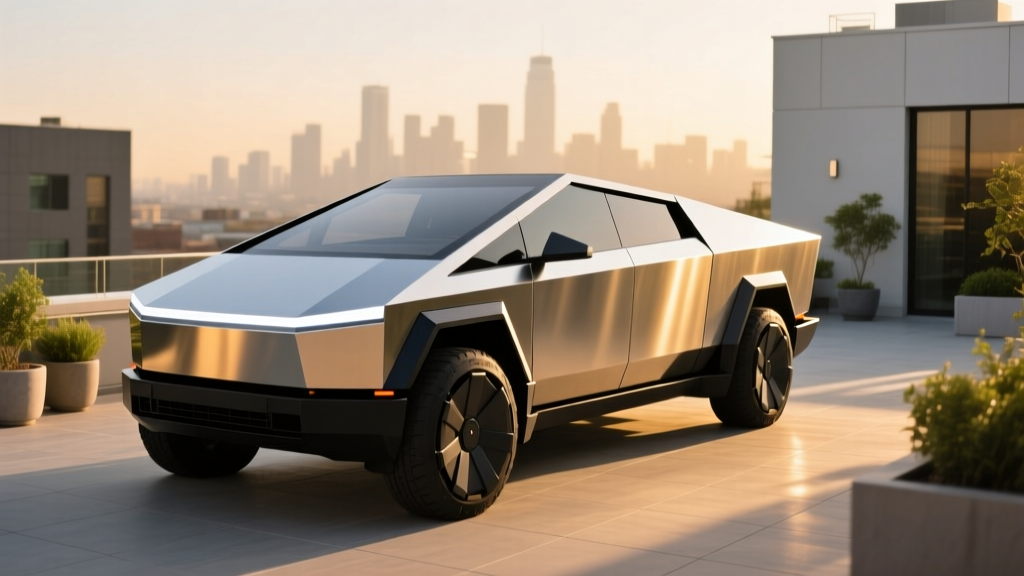
The Tesla Cybertruck is polarizing, massive, and undeniably fascinating. But before you drop $80,000+ on one, a Tesla Cybertruck rental might be the smartest move you make. Spending a weekend or a week behind the wheel answers questions no spec sheet can: How does it actually drive? Does the range hold up? Can you live with the quirks?
This guide covers everything you need to know about the 2026 Tesla Cybertruck — from real-world range and charging speeds to pricing and tax credit eligibility — framed around a simple question: Is renting one worth it before committing to a purchase?
2026 Tesla Cybertruck: The Specs That Matter
| Specification | AWD (Dual-Motor) | Cyberbeast (Tri-Motor) |
|---|---|---|
| EPA Range | 340 miles | 320 miles |
| Battery (usable) | ~123 kWh, NMC (4680 cells) | ~123 kWh, NMC (4680 cells) |
| 0-60 mph | 4.1 seconds | 2.6 seconds |
| Horsepower | 600 hp | 845 hp |
| Drivetrain | Dual-motor AWD | Tri-motor AWD |
| Max DC Fast Charge | 250 kW (Supercharger V3/V4) | 250 kW (Supercharger V3/V4) |
| 10-80% DC Charge Time | ~30 minutes | ~30 minutes |
| Level 2 Home Charging | 11.5 kW (~37 mi/hr) | 11.5 kW (~37 mi/hr) |
| MPGe (combined) | 68 MPGe / 50 kWh/100mi | 65 MPGe / 52 kWh/100mi |
| Towing Capacity | 11,000 lbs | 11,000 lbs |
| Bed Length | 6 ft (vault) | 6 ft (vault) |
| Cargo Volume (bed + frunk) | ~67 cu ft bed + ~7 cu ft frunk | ~67 cu ft bed + ~7 cu ft frunk |
| Base MSRP (2026) | $79,990 | $99,990 |
| Battery/Drive Unit Warranty | 8 years / 120,000 miles | 8 years / 120,000 miles |
Sources: fueleconomy.gov, Tesla Cybertruck specs.
Real-World Range: What the EPA Sticker Doesn't Tell You
Real-World Expectation: 270-300 miles highway at 70-75 mph; 240-270 miles in freezing temperatures; up to 320 miles in mixed city driving with regen.
The Cybertruck's angular stainless-steel body is striking but aerodynamically costly. Its drag coefficient is significantly worse than a Model Y or Rivian R1T, and that matters at highway speeds. In independent testing and owner reports, highway range at sustained 70-75 mph speeds typically lands between 270 and 300 miles for the AWD model — roughly a 12-20% reduction from the EPA sticker.
Cold weather compounds the problem. The NMC 4680 battery pack loses efficiency in freezing temperatures, and the truck's mass (nearly 7,000 lbs curb weight) demands more energy to accelerate. Expect 240-270 miles in sub-30°F conditions. Tesla's heat pump helps, but physics wins: a heavy, boxy truck in winter will not match its sticker range.
City driving with frequent regenerative braking events gets closer to the EPA number, sometimes exceeding 310 miles on the AWD variant. If your rental test involves mostly urban and suburban driving, you'll come away with a rosier range impression than highway-heavy road trippers.
Charging Speed: DC Fast and Home Level 2
The Cybertruck uses Tesla's NACS connector natively and charges on the Supercharger network — currently the most reliable DC fast-charging infrastructure in the US. Here's what to expect:
| Charging Level | Power (kW) | Miles Added per Hour | Notes |
|---|---|---|---|
| Level 1 (120V outlet) | ~1.4 kW | ~3-4 mi/hr | Emergency/trickle only |
| Level 2 (240V, 48A) | 11.5 kW | ~37 mi/hr | Home Wall Connector; full charge in ~11 hours |
| DC Fast (Supercharger V3/V4) | Peak 250 kW | ~200 mi in 15 min (peak) | 10-80% in ~30 min; tapers above 80% |
The 250 kW peak charge rate is respectable but not class-leading. The Rivian R1T (Dual-Motor Max) and some 800V-architecture vehicles charge faster. The Cybertruck's charge curve holds near peak rate from roughly 10-50% State of Charge, then tapers progressively. Plan for 30 minutes at a Supercharger to go from 10% to 80%, and add another 15-20 minutes if you need to push past 90%.
For home charging, Tesla's Wall Connector at 48 amps delivers 11.5 kW, adding roughly 37 miles of range per hour. An overnight charge (10 hours) restores about 370 miles — more than enough for a full battery. Installation costs vary: expect $800-$2,000 if your electrical panel supports a 60A circuit, or $2,500-$5,000+ if a panel upgrade is needed.
Pricing, Trims, and Federal Tax Credit Eligibility
The 2026 Cybertruck lineup has settled into two main trims after the discontinuation of the rear-wheel-drive base model:
| Trim | Base MSRP | As-Tested (typical options) | §30D Federal Tax Credit | Effective Price After Credit |
|---|---|---|---|---|
| AWD (Dual-Motor) | $79,990 | $82,000-$85,000 | Up to $7,500 (see eligibility) | ~$72,490-$77,500 |
| Cyberbeast (Tri-Motor) | $99,990 | $102,000-$108,000 | Up to $7,500 (see eligibility) | ~$92,490-$100,500 |
Federal tax credit caveat (§30D): The Cybertruck qualifies as a light truck under the IRS MSRP cap of $80,000. The AWD trim's base price of $79,990 squeaks under the limit, but adding options or destination charges can push it over — eliminating eligibility. The Cyberbeast at $99,990 exceeds the cap and does not qualify for the $7,500 credit regardless of buyer income. Additional §30D requirements include:
- Buyer income caps: AGI must not exceed $300,000 (joint), $225,000 (head of household), or $150,000 (single)
- Battery sourcing: Critical minerals and battery components must meet phased percentage thresholds from US or FTA-partner countries (rules tighten annually through 2032)
- Point-of-sale transfer: Eligible buyers can apply the credit as a down-payment reduction at purchase rather than waiting for tax filing
- Assembly: Must be assembled in North America (Cybertruck is built in Austin, TX — qualifies)
Always verify current-year eligibility on irs.gov or consult a tax professional. Rules change annually.
Why Rent a Cybertruck Before Buying?
A Tesla Cybertruck rental — available through platforms like Turo, Hertz's EV fleet (when in stock), and specialty EV rental companies — typically runs $250-$500 per day depending on location and trim. That's a significant outlay, but it buys you answers to questions that matter:
Size and drivability. The Cybertruck is 231 inches long, 80 inches wide (with mirrors folded), and weighs nearly 7,000 lbs. It does not fit in every garage, and tight urban parking can be stressful. A rental reveals whether you can live with its footprint daily.
Vision and ergonomics. The massive A-pillars, small rear window, and camera-dependent rear visibility are polarizing. Some drivers adapt quickly; others find it fatiguing. The yoke-style steering (standard on Cyberbeast, optional on AWD) is another love-it-or-hate-it feature that demands real-world testing.
Charging logistics. If you don't currently have home Level 2 charging, a rental forces you to plan around public charging and reveals whether your lifestyle supports EV ownership. The Cybertruck's 123 kWh battery is large — Level 1 charging is essentially useless, making home Level 2 nearly mandatory.
Towing and payload reality. Tesla rates the Cybertruck at 11,000 lbs towing, but towing a 7,000-lb trailer cuts range roughly in half. A rental weekend with a trailer (if available) is the only way to gauge real towing usability.
Cybertruck vs. Key Competitors: Is It the Right Truck?
| Feature | Tesla Cybertruck AWD | Rivian R1T Dual-Motor Max | Ford F-150 Lightning Extended Range |
|---|---|---|---|
| EPA Range | 340 mi | 420 mi | 320 mi |
| Starting MSRP | $79,990 | $87,900 | $69,995 |
| 0-60 mph | 4.1 sec | 3.5 sec | 3.8 sec |
| Max DC Charge | 250 kW | 220 kW | 150 kW |
| Towing | 11,000 lbs | 11,000 lbs | 10,000 lbs |
| Bed Length | 6 ft (vault) | 4.5 ft (+ Gear Tunnel) | 5.5 ft |
| Charging Network | Tesla Supercharger (NACS) | NACS adapter + Supercharger access | NACS adapter + Supercharger access |
| §30D Tax Credit | Up to $7,500 (AWD base only) | Up to $7,500 (select trims) | Up to $7,500 (select trims) |
The Rivian R1T wins on range (420 miles with the Max pack) and offers a more conventional, refined driving experience with the innovative Gear Tunnel. The F-150 Lightning is the value pick — more affordable, familiar truck ergonomics, and adequate for most buyers. The Cybertruck's advantages are its Supercharger network integration (no adapter needed), Cyberbeast performance, and stainless-steel durability.
Standout Tech and Notable Drawbacks
What's impressive:
- 48-volt electrical architecture (industry-first for a production vehicle) enables thinner wiring harnesses and more efficient accessories
- Steer-by-wire system with variable ratio — fewer turns lock-to-lock at low speeds, more precise at highway speeds
- 18.5-inch front touchscreen with full vehicle controls, gaming, and streaming
- Autopilot standard; Full Self-Driving (Supervised) available as a $8,000 add-on or subscription — note this is SAE Level 2, requiring active driver supervision at all times
- Stainless-steel exoskeleton resists dents and corrosion; armored glass (improved from the infamous 2019 demo)
- Bioweapon Defense Mode HEPA air filtration
What's frustrating:
- Rear visibility is poor; the backup camera and side cameras are essential, not optional aids
- Build quality inconsistencies still appear — panel gaps, trim alignment (improving but not at German/Japanese luxury standards)
- No Apple CarPlay or Android Auto — Tesla's proprietary infotainment only
- The bed "vault" is enclosed with a powered tonneau, limiting access for tall items compared to an open bed
- Insurance premiums run 30-50% higher than comparable trucks due to repair costs for the stainless-steel body and structural battery pack
- Weight and tire wear: expect to replace tires every 20,000-30,000 miles given the truck's mass and instant torque
Who Should Rent (or Buy) the Cybertruck?
- You want a performance truck with sub-3-second 0-60 capability (Cyberbeast)
- You're invested in the Tesla/Supercharger ecosystem and want native NACS charging
- You value the stainless-steel body for corrosion resistance and dent protection
- You primarily drive in urban/suburban settings where the 340-mile range is sufficient
- You need maximum range for frequent road trips (Rivian R1T Max at 420 miles)
- You want a conventional truck experience with familiar ergonomics (F-150 Lightning)
- You tow heavy loads regularly and need maximum range while towing
- You prefer Apple CarPlay/Android Auto or a traditional steering wheel
Frequently Asked Questions
What is the real-world range of the Tesla Cybertruck?
The EPA rates the AWD Cybertruck at 340 miles and the Cyberbeast at 320 miles. In real-world highway driving at 70-75 mph, expect 270-300 miles. Cold weather (below 30°F) reduces this to 240-270 miles. City driving with regenerative braking gets closest to the EPA figure.
How fast does the Cybertruck charge?
On a Tesla Supercharger (V3 or V4), the Cybertruck peaks at 250 kW and charges from 10-80% in approximately 30 minutes. At home on a Level 2 Wall Connector (11.5 kW), it adds about 37 miles of range per hour, requiring roughly 11 hours for a full charge from empty.
Does the Cybertruck qualify for the $7,500 federal EV tax credit?
The AWD trim at its $79,990 base MSRP falls under the IRS §30D light-truck cap of $80,000 and may qualify — but adding options that push the price above $80,000 eliminates eligibility. The Cyberbeast at $99,990 exceeds the cap and does not qualify. Buyer income limits ($150K single / $300K joint) and battery-sourcing requirements also apply. Verify on irs.gov.
How much does it cost to rent a Tesla Cybertruck?
Tesla Cybertruck rentals typically range from $250-$500 per day on platforms like Turo, depending on location, trim, and availability. Specialty EV rental companies may charge more. A 3-day weekend rental ($750-$1,500) is often enough to evaluate daily drivability, charging logistics, and ergonomics.
Is the Cybertruck worth buying over the Rivian R1T or F-150 Lightning?
It depends on priorities. The Cybertruck excels in performance (Cyberbeast's 2.6-second 0-60), native Supercharger access, and stainless-steel durability. The Rivian R1T offers superior range (420 mi) and a more refined interior. The F-150 Lightning is more affordable ($69,995) with conventional truck ergonomics. Renting each for a weekend is the best way to decide.
What are the biggest Cybertruck drawbacks?
Poor rear visibility, build-quality inconsistencies, no Apple CarPlay/Android Auto, the enclosed bed vault limiting tall-item access, high insurance premiums (30-50% above comparable trucks), and accelerated tire wear from the truck's 7,000-lb weight and instant torque.
Can I tow with the Cybertruck?
Yes — Tesla rates it at 11,000 lbs maximum towing capacity. However, towing a 7,000-lb trailer cuts range roughly in half (to approximately 150-170 miles), making long-distance towing impractical without frequent Supercharger stops. Preconditioning and route planning via the Tesla navigation system are essential for towing trips.