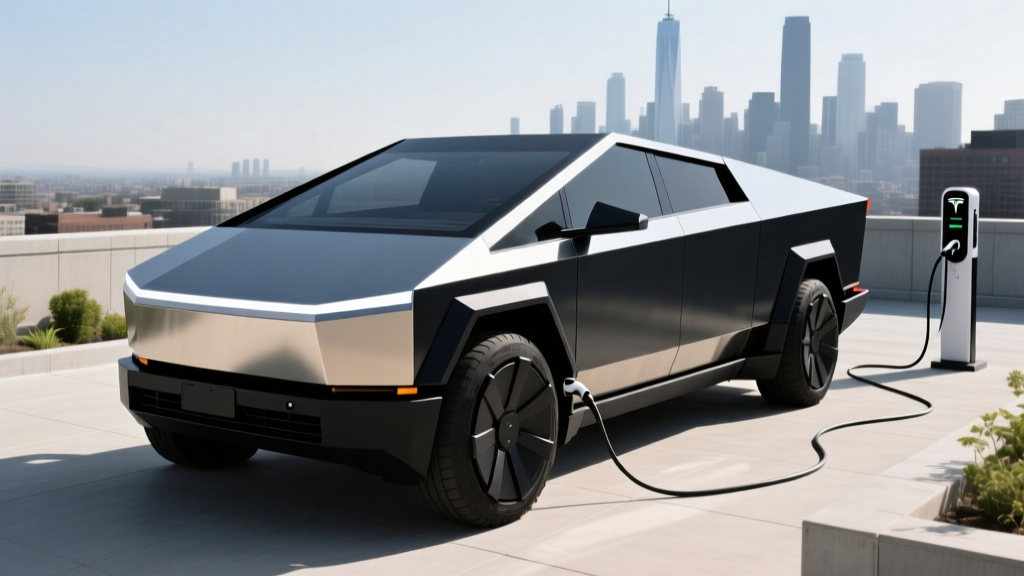
If you've been searching "tesla gun" online, you're almost certainly looking for the Tesla Cybertruck — the angular, stainless-steel electric pickup that Elon Musk has compared to an armored personnel carrier and that internet culture has nicknamed for its bullet-resistant exoskeleton and weaponized aesthetic. Whatever you call it, the Cybertruck is now in customer driveways, and the real-world data is finally catching up to years of concept-car hype.
This review breaks down the Cybertruck's actual EPA range, DC fast-charging behavior, battery chemistry, pricing after federal tax credits, and how it stacks up against the Ford F-150 Lightning and Rivian R1T in 2026. No fluff — just the numbers and ownership realities you need before putting down a deposit.
Cybertruck Specs at a Glance
| Spec | AWD | Cyberbeast |
|---|---|---|
| EPA Range | 340 miles | 320 miles |
| Battery (usable) | ~123 kWh (est.), NMC | ~123 kWh (est.), NMC |
| 0-60 mph | 4.1 sec | 2.6 sec |
| Horsepower | 600 hp | 845 hp |
| Drivetrain | Dual-Motor AWD | Tri-Motor AWD |
| Max DC Fast Charge | ~350 kW (peak) | ~350 kW (peak) |
| 10-80% DC Time | ~17 min (peak conditions) | ~17 min (peak conditions) |
| Level 2 Home Charge | 11.5 kW (~44 mi/hr) | 11.5 kW (~44 mi/hr) |
| Towing Capacity | 11,000 lbs | 11,000 lbs |
| Payload | 2,500 lbs | 2,500 lbs |
| Base MSRP | $79,990 | $99,990 |
| Efficiency | ~58 MPGe / ~58 kWh/100mi | ~54 MPGe / ~62 kWh/100mi |
| Battery Warranty | 8 yr / 120,000 mi | 8 yr / 120,000 mi |
Note: The previously announced Rear-Wheel-Drive base model ($60,990 target) has been pushed to 2027 production and is not currently orderable. The dual-motor AWD and tri-motor Cyberbeast are the only configurations available for 2026 delivery.
Real-World Range: What the EPA Sticker Doesn't Tell You
The AWD Cybertruck carries an EPA-estimated 340 miles of range, while the Cyberbeast drops to 320 miles. But the Cybertruck's massive frontal area and stainless-steel mass punish it on the highway.
Expect in real-world driving:
- Highway (70-75 mph, moderate temps): ~250-280 miles usable
- Mixed city/highway (65°F): ~280-310 miles
- Cold weather (20-30°F, highway): ~200-240 miles — the steel body sheds heat quickly, and battery preconditioning draws from the pack
- Towing (5,000+ lb trailer): ~140-170 miles — expect range to roughly halve under load
Bottom line: the Cybertruck's range is adequate for daily commuting and moderate road trips, but if you regularly tow or drive in northern winters, plan your charging stops conservatively.
According to fueleconomy.gov, the Cybertruck AWD's combined efficiency lands around 58 MPGe, translating to roughly 58 kWh consumed per 100 miles driven. That's considerably thirstier than a Model Y (~28 kWh/100mi) and even trails the F-150 Lightning Extended Range (~49 kWh/100mi). The aerodynamics of a stainless-steel wedge simply can't overcome physics.
Charging Speed: Peak kW vs. the Real Charge Curve
The Cybertruck uses an 800-volt-class architecture, enabling DC fast-charge peaks near 350 kW at V4 Superchargers or compatible third-party CCS/NACS stations. Tesla claims a 10-80% charge in roughly 17 minutes under optimal conditions (battery preconditioned, warm ambient temps, uncrowded stall).
| Charging Level | Power / Rate | Miles Added per Hour | Notes |
|---|---|---|---|
| Level 1 (120V, 12A) | ~1.4 kW | ~3-4 mi/hr | Emergency trickle only |
| Level 2 (240V, 48A) | 11.5 kW | ~44 mi/hr | Full overnight charge (~8-9 hrs from 10%) |
| DC Fast (NACS/CCS, peak) | ~350 kW | ~1,000+ mi/hr (peak) | 10-80% in ~17 min; tapers sharply above 80% |
| DC Fast (50 kW station) | 50 kW | ~150 mi/hr | Older Electrify America / CHAdeMO adapters |
Charge-curve reality check: That 350 kW peak only holds between roughly 10-30% State of Charge. By 50% SoC, you'll typically see ~200 kW; by 75%, it drops to ~100 kW; and above 85%, charging slows dramatically to protect the NMC cells. If you arrive at a Supercharger at 5% SoC with a preconditioned battery, the 10-80% sprint is genuinely quick. But if your battery is cold or you're topping off from 60%, expect considerably longer dwell times.
At home, a Level 2 Tesla Wall Connector (or any J1772/NACS 48-amp unit) delivers about 44 miles of range per hour of charging. Most owners will plug in overnight and wake up with a full pack — the most practical "refueling" strategy for daily use.
Battery Chemistry, Degradation, and Warranty
Tesla has not officially published the Cybertruck's exact battery capacity, but teardown data and EPA efficiency calculations suggest a usable capacity of approximately 123 kWh, using an NMC (nickel manganese cobalt) chemistry. This is consistent with Tesla's high-energy-density packs used in the Model S and Model X.
Why NMC matters here: NMC cells offer superior energy density compared to LFP (lithium iron phosphate), which is essential for a 6,800+ lb truck to achieve 300+ miles of range. The trade-off is that NMC cells are more sensitive to sustained high State of Charge. Tesla recommends daily charging to 80-90% and only charging to 100% when you need maximum range for a trip.
The battery and drive unit warranty covers 8 years or 120,000 miles (whichever comes first), with Tesla guaranteeing a minimum of 70% capacity retention over that period. Based on historical Tesla NMC pack data from Model 3 Long Range owners, most packs retain 90-93% capacity at 50,000 miles and 85-88% at 100,000 miles — comfortably above the warranty threshold. A full out-of-warranty pack replacement would likely cost $18,000-$25,000 based on current Tesla service pricing for comparable pack sizes.
Pricing, Trims, and Federal Tax Credit Eligibility
| Trim | Base MSRP | Est. Federal Credit (§30D) | Effective Price |
|---|---|---|---|
| AWD | $79,990 | $0 (exceeds MSRP cap) | $79,990 |
| Cyberbeast | $99,990 | $0 (exceeds MSRP cap) | $99,990 |
Critical tax-credit note: Under IRS §30D Clean Vehicle Credit rules, the federal EV tax credit for trucks, vans, and SUVs carries an $80,000 MSRP cap. The Cybertruck AWD at $79,990 technically sits at the threshold — but once destination fees and any mandatory options push the sticker above $80,000, it loses eligibility entirely. The Cyberbeast at $99,990 is categorically ineligible.
Additionally, §30D imposes buyer income caps (modified AGI of $150,000 single / $300,000 joint filers) and critical-mineral and battery-component sourcing requirements that phase in more strictly each year. Even if the AWD trim squeaks under the MSRP cap on a bare-bones build, battery-sourcing rules may reduce or eliminate the credit. Always verify current eligibility on fueleconomy.gov and consult a tax professional before counting on the credit.
For buyers who can't access the federal credit, some states offer additional EV rebates (California's CVRP, Colorado's state credit, etc.) — but these vary by jurisdiction and often have their own income and price caps. Check your state energy office for current programs.
Performance and Driving Impressions
The Cyberbeast's tri-motor powertrain produces 845 horsepower and launches the truck to 60 mph in a claimed 2.6 seconds — making it one of the quickest production pickups ever built, rivaling supercars from a decade ago. The dual-motor AWD still delivers a potent 600 hp and a 4.1-second 0-60 time.
Steer-by-wire is standard across all trims, replacing the traditional mechanical steering column with an electronic system. The yoke-style steering wheel (a rectangular "butterfly" design) pairs with a variable ratio that requires less than one full turn lock-to-lock. Adaptation takes most drivers about 20-30 minutes of real-world driving, but low-speed parking maneuvers feel unintuitive at first. A round steering wheel is now available as a no-cost option for those who prefer conventional controls.
Ride quality is firm — the air suspension offers adjustable ride height (from 9" to 17" of ground clearance) and reasonable compliance on highways, but the truck's mass is always present through corners and over sharp bumps. Body roll is well-controlled for a 6,800-lb vehicle, but this is not a sports sedan. It drives like what it is: a heavy, powerful truck with excellent straight-line thrust.
Tech, Interior, and Cargo
The Cybertruck's cabin is minimalist even by Tesla standards. A single 18.5-inch center touchscreen handles all infotainment, climate, and vehicle controls — there are no physical buttons, no instrument cluster, and no traditional gauge readout. A 9.4-inch rear touchscreen serves back-seat passengers for climate and media.
Driver assistance: Tesla's Autopilot (adaptive cruise + lane centering) is standard. Full Self-Driving (Supervised) is available as a $8,000 add-on or $99/month subscription. FSD Supervised remains an SAE Level 2 system — the driver must remain fully attentive, hands on the yoke (or wheel), and ready to intervene at any moment. It is not autonomous driving.
Tesla's Autopilot and FSD (Supervised) are SAE Level 2 driver-assistance systems. The human driver is responsible for all driving decisions and must continuously supervise. Level 4 autonomous driving (no driver needed in defined conditions) is currently only available through robotaxi services like Waymo in limited metro areas.
Cargo and passenger space:
- Vault (bed): 6.5 feet long, ~67 cu ft volume, with a powered retractable tonneau cover rated to support 300 lbs
- Front trunk (frunk): ~7 cu ft — enough for a charging cable kit and a small bag
- Front legroom: 41.5 inches
- Rear legroom: 38.2 inches (tighter than an F-150 SuperCrew)
- Seating: 5 passengers (3-across rear bench, though the middle position is narrow)
The powered vault cover and integrated ramp system are clever, but the bed's shorter length and narrower width between the wheel wells (48" — standard 4×8 plywood does not fit flat) limit utility compared to traditional full-size pickups.
Cybertruck vs. F-150 Lightning vs. Rivian R1T
| Attribute | Cybertruck AWD | F-150 Lightning Lariat ER | Rivian R1T Dual-Motor Max |
|---|---|---|---|
| EPA Range | 340 mi | 320 mi | 410 mi |
| Starting MSRP | $79,990 | ~$69,995 | ~$89,000 |
| 0-60 mph | 4.1 sec | ~4.5 sec | ~3.5 sec |
| Towing | 11,000 lbs | 10,000 lbs | 11,000 lbs |
| Bed Length | 6.5 ft | 5.5 ft | 4.5 ft (+ Gear Tunnel) |
| Federal §30D Credit | Unlikely (MSRP cap) | Likely eligible (under $80K cap) | Unlikely (MSRP cap) |
| Charging Network | Tesla Supercharger (NACS) | NACS (Supercharger access via adapter) | NACS (Supercharger access) |
The F-150 Lightning wins on price, federal credit eligibility, conventional pickup ergonomics, and dealer-service accessibility. The R1T wins on range (with the Max pack), adventure capability, and build refinement. The Cybertruck wins on raw performance, Supercharger network seamlessness, and sheer visual impact — but at a premium price with no tax-credit help.
- Tesla Supercharger network — most reliable DC fast-charging in the US
- Brutal acceleration (Cyberbeast especially)
- Stainless exoskeleton resists dents, scratches, and minor impacts
- Over-the-air updates continuously add features
- 11,000-lb towing capacity
- Unique design — nothing else looks like it
- No federal tax credit at current pricing
- Real-world highway range significantly below EPA estimate
- Bed too narrow for flat 4×8 plywood
- Steer-by-wire and yoke require adaptation
- Rear-seat comfort trails F-150 and R1T
- Stainless steel shows fingerprints and water spots constantly
- Insurance premiums 30-50% above comparable trucks
Who Should Buy the Cybertruck?
- Choose the Cybertruck if: you want the fastest production pickup available, you value Tesla's Supercharger network for road trips, you prioritize tech and OTA updates, and you don't need the $7,500 federal credit to make the math work.
- Choose the F-150 Lightning if: you want a more conventional truck experience, you need the federal tax credit, you regularly haul standard lumber/sheets, or you want a local Ford dealer for service.
- Choose the Rivian R1T if: you want maximum range (410 mi with Max Pack), premium interior quality, best-in-class off-road capability, and you're willing to pay a similar premium.
The Cybertruck is best suited for tech-forward buyers who want a statement vehicle that doubles as a daily driver and occasional hauler. It's not the most practical truck, nor the most efficient — but no one buys a Cybertruck for subtlety. If your primary needs are towing long distances, hauling construction materials daily, or maximizing value with tax incentives, the Lightning or R1T are more rational choices.
Frequently Asked Questions
What is the real-world range of the Tesla Cybertruck?
The EPA rates the AWD at 340 miles and the Cyberbeast at 320 miles. In mixed real-world driving at moderate temperatures, expect 280-310 miles. Highway driving at 75 mph drops this to roughly 250-280 miles. Cold weather (below 30°F) combined with highway speeds can reduce range to 200-240 miles. Towing cuts range approximately in half.
How fast does the Cybertruck charge at home and on the road?
On a Level 2 home charger (240V, 48A), the Cybertruck adds about 44 miles of range per hour, fully recharging overnight in 8-9 hours. On a V4 Supercharger or 350 kW-capable DC fast charger, it peaks near 350 kW and can go from 10-80% in approximately 17 minutes under optimal conditions. Charging slows significantly above 80% SoC to protect the NMC battery.
Does the Cybertruck qualify for the $7,500 federal EV tax credit?
Likely not. The §30D credit caps truck MSRP at $80,000. The AWD trim starts at $79,990, but destination charges and any options push it over the limit. The Cyberbeast at $99,990 is far above the cap. Additionally, buyer income limits ($300K joint / $150K single) and battery-sourcing requirements further restrict eligibility. Verify on IRS.gov and consult a tax professional.
Is the Cybertruck worth buying over the F-150 Lightning or Rivian R1T?
It depends on priorities. The Cybertruck excels in acceleration, Supercharger network access, and design uniqueness. The F-150 Lightning is more practical, more affordable, and likely eligible for the federal credit. The R1T offers superior range, interior quality, and off-road capability. For most truck buyers, the Lightning is the value pick; for adventure seekers, the R1T; for performance and tech enthusiasts, the Cybertruck.
Can the Cybertruck really stop a bullet?
Tesla has demonstrated the stainless-steel body resisting 9mm handgun rounds in controlled tests. The "bulletproof" claim applies to the body panels at certain angles and calibers — it is not armored to military or ballistic-glass standards. The windows shattered during Tesla's own 2019 demo. Treat the "armored" marketing as impact-resistant, not tactical-grade protection.
What's the warranty coverage?
Tesla covers the battery and drive units for 8 years or 120,000 miles (whichever comes first), guaranteeing at least 70% capacity retention. The limited vehicle warranty covers 4 years or 50,000 miles. These terms are competitive with Ford and Rivian's electric powertrain coverage.