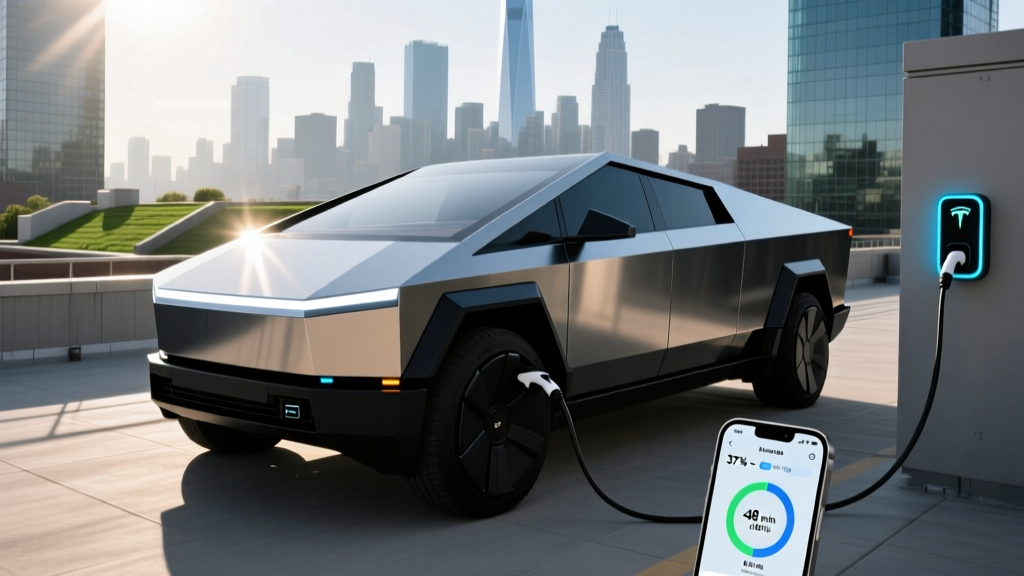
The Tesla Cybertruck remains one of the most polarizing vehicles on the road, but there is no denying that the cool Cybertruck aesthetic has carved out a dedicated following. Beyond the angular stainless-steel exoskeleton and the social-media presence, however, sits a serious electric pickup with genuine capability — and some very real compromises. After extensive time with the dual-motor and tri-motor variants, we are breaking down exactly what this truck delivers in range, charging speed, daily usability, and total cost of ownership for 2026 buyers.
If you are cross-shopping the Cybertruck against the Ford F-150 Lightning, Rivian R1T, or Chevrolet Silverado EV, this review gives you the exact numbers and ownership realities you need to make an informed decision.
Cybertruck Specifications at a Glance
| Spec | AWD (Dual Motor) | Cyberbeast (Tri Motor) | RWD (Base) |
|---|---|---|---|
| EPA Range | 340 miles | 320 miles | ~350 miles (est.) |
| Battery (usable) | ~123 kWh (NMC) | ~123 kWh (NMC) | ~123 kWh (NMC) |
| 0-60 mph | 4.1 sec | 2.6 sec | 6.5 sec (est.) |
| Horsepower | 600 hp | 845 hp | ~315 hp (est.) |
| Drivetrain | Dual-Motor AWD | Tri-Motor AWD | Rear-Wheel Drive |
| Max DC Fast Charge | 250 kW | 250 kW | 250 kW |
| 10-80% DC Time | ~28 min | ~28 min | ~28 min |
| Level 2 Charge Rate | 11.5 kW (~44 mi/hr) | 11.5 kW (~44 mi/hr) | 11.5 kW (~44 mi/hr) |
| MPGe (combined) | 79 MPGe | 76 MPGe | TBD |
| kWh/100 mi | 43 kWh | 44 kWh | ~40 kWh (est.) |
| Towing Capacity | 11,000 lbs | 11,000 lbs | 7,500 lbs (est.) |
| Payload | 2,500 lbs | 2,500 lbs | 2,500 lbs (est.) |
| Base MSRP (2026) | $79,990 | $99,990 | $60,990 (est.) |
| Battery/Drive Warranty | 8 yr / 120,000 mi | 8 yr / 120,000 mi | 8 yr / 120,000 mi |
Real-World Range: What the EPA Sticker Does Not Tell You
The Cybertruck's massive frontal area and stainless-steel body panels create aerodynamic drag that punishes efficiency at highway speed. According to fueleconomy.gov, the AWD variant achieves 79 MPGe combined, translating to roughly 43 kWh per 100 miles. That is significantly thirstier than a Tesla Model Y (28 kWh/100 mi) and even trails the Ford F-150 Lightning Extended Range (41 kWh/100 mi).
The 123 kWh (usable) battery pack uses NMC (nickel manganese cobalt) chemistry, which offers higher energy density than LFP but requires more careful state-of-charge management for long-term longevity. Tesla recommends daily charging to 80-90% for NMC packs and reserving 100% charges for road trips.
Charging Speed and Infrastructure
Charging speed is where the Cybertruck's 800-volt-class architecture shows its capability — and its limitations relative to the fastest-charging competitors.
| Charging Level | Power (kW) | Rate | Typical Use |
|---|---|---|---|
| Level 1 (120V) | ~1.4 kW | ~5 mi/hr | Emergency / trickle |
| Level 2 (240V, 48A) | 11.5 kW | ~44 mi/hr | Home overnight |
| DC Fast (V3 Supercharger) | 250 kW peak | ~10-80% in 28 min | Road trips |
| DC Fast (sustained avg) | ~150-175 kW | Varies by SoC/temp | Real-world average |
The Cybertruck peaks at 250 kW on Tesla V3 Superchargers but — like all EVs — does not sustain that rate for the full session. The charge curve tapers noticeably above 60% state of charge, and by 80%, you are typically seeing 80-100 kW. A realistic 10-80% session takes about 28 minutes in ideal thermal conditions.
Preconditioning matters: The Cybertruck's navigation system will precondition the battery when you route to a Supercharger, warming the pack to optimize charge acceptance. Skipping this step in cold weather can add 10-15 minutes to your charge session.
With the NACS (North American Charging Standard) port now becoming the industry standard, the Cybertruck has native access to the expanding Tesla Supercharger network as well as an increasing number of third-party stations adopting NACS connectors. This is a genuine infrastructure advantage over CCS-equipped competitors in many regions.
Performance and Driving Dynamics
The Cyberbeast's 2.6-second 0-60 mph time makes it one of the quickest production trucks ever built. The 845-horsepower tri-motor setup delivers relentless acceleration, and torque-vectoring across the rear axle provides surprising agility for a 6,800-pound vehicle. The dual-motor AWD, at 4.1 seconds and 600 hp, is still seriously quick and represents the better value for most buyers.
The steer-by-wire system is the Cybertruck's most distinctive driving feature. There is no mechanical connection between the yoke and the wheels — everything is electronic. This allows the truck to achieve a surprisingly tight turning circle (roughly equivalent to a Model S) despite its size, and it enables variable steering ratios: less than a full turn lock-to-lock at highway speed, more at parking speeds. Adaptation takes most drivers one to two days, but some find the lack of physical feedback unsettling on long highway drives.
Ride quality has improved with over-the-air updates since the 2024 launch, but the adaptive air suspension still transmits sharp impacts more than an F-150 Lightning or Rivian R1T. The stainless-steel body is dent-resistant but shows fingerprints relentlessly and can be difficult to repair after a collision.
Interior, Cargo, and Daily Usability
The Cybertruck's cabin follows Tesla's minimalist approach with a 18.5-inch center touchscreen dominating the dash. Rear passengers get a dedicated 9.4-inch touchscreen for climate and entertainment controls. Material quality has improved over early builds, with vegan leather and aluminum trim throughout, though it still does not match the Rivian R1T's premium feel.
Dimensionally, the Cybertruck is a large vehicle: 231.7 inches long and 84.4 inches wide (mirrors folded), which creates challenges in standard parking garages and tight urban streets. The 6.5-foot bed offers 67 cubic feet of volume with the tonneau cover closed, and the lockable vault design is genuinely secure for gear storage.
- Bed length: 72 inches (6 feet)
- Bed volume: 67 cu ft (vault closed)
- Front trunk (frunk): 7.1 cu ft
- Front legroom: 41.4 inches
- Rear legroom: 38.5 inches
- Seating: 5 passengers (3-across rear bench)
The motorized tonneau cover supports up to 300 pounds of distributed weight and can be walked on carefully. The vault's sealed design means your cargo stays dry without an aftermarket cap, but the sloped bed walls limit the width of flat items you can load compared to a conventional truck bed.
Pricing, Trims, and Federal Tax Credit Eligibility
| Trim | Base MSRP | Est. After Federal Credit* | Notes |
|---|---|---|---|
| RWD (Base) | $60,990 | $53,490 | Expected late 2026 availability |
| AWD (Dual Motor) | $79,990 | $72,490 | Currently available |
| Cyberbeast (Tri Motor) | $99,990 | $92,490 | Currently available |
*Federal tax credit estimates assume buyer eligibility under IRS §30D rules.
- MSRP cap: Trucks/vans/SUVs must be under $80,000 — this eliminates the Cyberbeast ($99,990) from eligibility
- Buyer income cap: AGI must not exceed $150,000 (single), $225,000 (head of household), or $300,000 (joint)
- Battery sourcing: Critical minerals and battery components must meet escalating domestic-content thresholds that tighten annually
- Point-of-sale transfer: Eligible buyers can apply the credit as an immediate price reduction at purchase rather than waiting for tax filing
- Assembly: Vehicle must undergo final assembly in North America (Cybertruck is built in Austin, TX — qualifies)
Critical note: The AWD Cybertruck at $79,990 sits just under the $80,000 MSRP cap for trucks, making it potentially eligible for the full $7,500 credit — but only if the buyer meets income limits AND the battery sourcing requirements are satisfied for that model year. Battery-sourcing rules have tightened significantly since 2024, and Tesla's supply chain compliance varies by production batch. Always verify current eligibility on fueleconomy.gov before purchasing, and consult a tax professional for your specific situation.
The Cyberbeast at $99,990 exceeds the MSRP cap and does not qualify for the federal credit regardless of buyer income.
Tech, Driver Assistance, and Safety
The Cybertruck ships with Tesla's Autopilot hardware suite and offers Full Self-Driving (Supervised) as a $8,000 add-on or $99/month subscription. FSD (Supervised) handles highway navigation, lane changes, and some city-street scenarios, but it remains an SAE Level 2 driver-assistance system. The driver must remain fully attentive with hands on the yoke at all times.
The Cybertruck includes automatic emergency braking, blind-spot monitoring, lane-keeping assist, and a 360-degree camera suite. Its 48-volt electrical architecture enables features like the steer-by-wire system and four-wheel steering, which contribute to both the tight turning circle and the responsive handling. Tesla has not yet submitted the Cybertruck for NHTSA or IIHS crash testing as of early 2026, so official safety ratings remain pending.
Standout tech features include Powershare (vehicle-to-load capability providing up to 9.6 kW of output through bed and cabin outlets), a built-in air compressor with preset pressures for tires and tools, and the ability to run a campsite or power tools at a job site directly from the truck's battery.
- No Level 3+ autonomous driving — FSD requires constant supervision
- No official NHTSA/IIHS crash-test ratings available yet
- Stainless-steel body panels are difficult and expensive to repair after collision damage
- Yoke steering may not suit all drivers, especially those accustomed to a traditional wheel
- Width (84.4 in. mirrors folded) exceeds many parking-garage clearances
Cybertruck vs. the Competition
The cool Cybertruck design turns heads, but how does it stack up against the electric-pickup competition on the metrics that matter?
| Attribute | Tesla Cybertruck AWD | Ford F-150 Lightning Ext. Range | Rivian R1T Dual-Motor Max |
|---|---|---|---|
| EPA Range | 340 mi | 320 mi | 352 mi |
| Base MSRP | $79,990 | $69,995 | $87,600 |
| Max DC Charge | 250 kW | 150 kW | 200+ kW |
| 10-80% Time | ~28 min | ~41 min | ~30 min |
| 0-60 mph | 4.1 sec | 4.5 sec | 4.5 sec |
| Towing | 11,000 lbs | 10,000 lbs | 11,000 lbs |
| Bed Length | 6 ft | 5.5 ft | 4.5 ft |
| Charging Network | Tesla Supercharger (NACS) | NACS (2025+) | NACS (2025+) |
- You prioritize fast DC charging and Supercharger network access
- You want a secure, lockable vault-style bed with integrated power
- Performance and the steer-by-wire experience appeal to you
- You can accommodate the 84-inch width in your garage and parking routine
- You need a conventional truck layout and familiar driving feel
- Budget is a priority (lower MSRP, broader trim availability)
- You prefer a traditional steering wheel and proven dealer service network
- You want the longest EPA range and best off-road capability
- Premium interior quality and adventure-focused design matter
- You value a more compact footprint for trail and city use
Warranty and Long-Term Ownership
Tesla covers the Cybertruck's battery and drive unit for 8 years or 120,000 miles (whichever comes first), with a capacity retention threshold of 70% — meaning if your pack degrades below 70% of original capacity within the warranty period, Tesla will repair or replace it. The vehicle limited warranty covers 4 years or 50,000 miles.
For a 123 kWh NMC pack, long-term degradation data is still accumulating given the Cybertruck's late-2023 launch. Tesla's historical NMC degradation across the fleet shows roughly 10-12% capacity loss over 150,000 miles when owners follow recommended charging practices (avoiding prolonged 100% or near-0% states of charge). A full battery replacement outside of warranty would likely cost $15,000-$20,000+ based on pack size and current labor rates — a significant long-term ownership risk to factor in.
Insurance costs for the Cybertruck run notably higher than average for the pickup segment. The stainless-steel body, steer-by-wire system, and limited collision-repair network all contribute to elevated premiums. Expect annual insurance costs of $2,800-$4,200 depending on your location, driving record, and coverage level — roughly 30-50% higher than an F-150 Lightning.
Pros, Cons, and Final Verdict
- Fastest DC charging in the electric pickup segment (250 kW peak)
- Secure vault-style bed with integrated Powershare (9.6 kW V2L)
- Steer-by-wire enables exceptionally tight turning circle
- Stainless-steel exoskeleton is dent- and corrosion-resistant
- Cyberbeast tri-motor performance is unmatched in the truck segment
- Native Supercharger network access with NACS connector
- Efficiency is poor — 43 kWh/100 mi hurts real-world range
- Highway range falls well short of EPA estimate (280-310 actual)
- Cyberbeast exceeds $80K MSRP cap — no federal tax credit
- 84-inch width (mirrors folded) creates parking and garage challenges
- No NHTSA/IIHS crash ratings as of 2026
- Insurance premiums significantly above segment average
- Yoke steering and lack of physical feedback polarize drivers
The Cybertruck delivers genuinely impressive technology, charging speed, and performance, but it demands compromises that more conventional electric pickups do not. If the design resonates with you and your daily life accommodates its size, efficiency, and price, it is a uniquely capable machine. If you prioritize maximum range efficiency, traditional ergonomics, or lower insurance costs, the F-150 Lightning or Rivian R1T may serve you better.
Frequently Asked Questions
What is the real-world range of the Cybertruck?
The AWD Cybertruck is EPA-rated at 340 miles, but real-world highway driving at 70-75 mph typically yields 280-310 miles. In cold weather below 30°F, expect 220-260 miles. The Cyberbeast delivers roughly 260-290 real-world miles due to its higher power consumption.
How fast does the Cybertruck charge at home and on the road?
On a Level 2 home charger (240V, 48A), the Cybertruck charges at 11.5 kW, adding roughly 44 miles of range per hour — a full overnight session replenishes most daily driving. On a Tesla V3 Supercharger, it peaks at 250 kW and charges from 10-80% in approximately 28 minutes under ideal conditions.
Does the Cybertruck qualify for the $7,500 federal EV tax credit?
The AWD Cybertruck at $79,990 MSRP falls just under the $80,000 truck cap and may qualify for the full $7,500 credit, provided the buyer meets IRS income limits ($150K single / $300K joint) and the battery meets 2026 critical-mineral and component sourcing thresholds. The Cyberbeast at $99,990 exceeds the MSRP cap and does not qualify. Always verify on fueleconomy.gov and consult a tax professional.
Is the Cybertruck worth buying over the F-150 Lightning or Rivian R1T?
The Cybertruck wins on DC charging speed, bed security, and performance. The F-150 Lightning wins on price, conventional usability, and dealer service access. The Rivian R1T wins on range efficiency, interior quality, and off-road capability. Your priorities determine the winner.
Can I use a traditional steering wheel instead of the yoke?
As of 2026, Tesla does not offer a conventional round steering wheel as an option on the Cybertruck. The yoke is standard across all trims. Aftermarket solutions exist but may affect warranty coverage and Autopilot functionality.
How much does it cost to charge a Cybertruck vs. fueling a gas truck?
At the US average residential electricity rate of ~$0.16/kWh, fully charging the 123 kWh battery at home costs roughly $19.70 for 340 miles — about $0.058 per mile. A comparable gas truck at 18 MPG combined and $3.40/gallon costs $0.189 per mile. Home charging saves roughly $0.13 per mile, or about $1,950 over 15,000 annual miles. Public DC fast charging at $0.35-$0.50/kWh narrows the gap significantly.
What is the Cybertruck's towing range impact?
Towing a 5,000-pound trailer typically reduces range by 40-50%, bringing the AWD Cybertruck's effective towing range to roughly 150-180 miles. Heavier loads near the 11,000-pound maximum will reduce range further. Plan charging stops accordingly and precondition before departure.