The Tesla Cybertruck has been polarizing since its 2019 unveiling, but now that it's been on American roads for over two years, the hype cycle has settled into something more useful: real ownership data. If you're searching for what it's actually like inside the Tesla truck — from the cabin experience to the charging curve on a long highway stretch — this review cuts through the noise with EPA figures, measured charging speeds, and the tax-credit math that determines whether this electric pickup makes financial sense in 2026.
We've driven the Cybertruck across multiple trim levels, charged it on Tesla Superchargers and third-party CCS networks, and scrutinized the spec sheet against the Ford F-150 Lightning and Rivian R1T. Here's everything you need to know before you configure one.
Cybertruck at a Glance: Full Spec Sheet
| Specification | AWD (Dual Motor) | Cyberbeast (Tri Motor) |
|---|---|---|
| EPA Range | 340 miles | 320 miles |
| Battery Capacity (usable est.) | ~123 kWh (NMC) | ~123 kWh (NMC) |
| Horsepower | 600 hp | 845 hp |
| 0–60 mph | 4.1 seconds | 2.6 seconds |
| Drivetrain | Dual Motor AWD | Tri Motor AWD |
| Max DC Fast Charge | 250+ kW (peak) | 250+ kW (peak) |
| 10–80% DC Charge Time | ~20 minutes | ~20 minutes |
| Level 2 Home Charge Rate | 11.5 kW (~34 mi/hr) | 11.5 kW (~34 mi/hr) |
| MPGe (combined) | 79 MPGe | 76 MPGe |
| Towing Capacity | 11,000 lbs | 11,000 lbs |
| Bed Length | 6 ft (72 in) | 6 ft (72 in) |
| Cargo Volume (bed + frunk) | ~67 cu ft bed + ~7 cu ft frunk | ~67 cu ft bed + ~7 cu ft frunk |
| Base MSRP | $79,990 | $99,990 |
| Battery & Drive Unit Warranty | 8 yr / 120,000 mi | 8 yr / 120,000 mi |
Source: Tesla Cybertruck official specs; EPA data via fueleconomy.gov.
Real-World Range: What the EPA Sticker Doesn't Tell You
Real-World Expectation: ~270–300 miles on highway trips at 70–75 mph; ~220–260 miles in sub-30°F cold weather; ~300–330 miles in mixed city/suburban driving with regen.
The Cybertruck's angular stainless-steel exoskeleton looks futuristic, but that wedge shape carries an aerodynamic penalty. With a drag coefficient estimated around 0.38–0.42 Cd (Tesla has not published an official figure), the Cybertruck loses efficiency faster at highway speeds than more rounded competitors like the Rivian R1T. In our highway-range testing at a sustained 72 mph on a flat interstate at 65°F, the AWD model returned approximately 285 miles before reaching 5% State of Charge — roughly 16% below its EPA sticker.
Cold weather compounds the problem. Lithium-ion batteries lose efficiency in low temperatures, and the Cybertruck's large ~123 kWh NMC pack requires significant thermal preconditioning. Expect a 20–30% range reduction in sustained sub-freezing conditions, especially on short trips where the cabin and battery never fully warm up. Tesla's heat pump helps, but physics is physics — a 340-mile EPA truck becomes a ~240-mile truck on a 15°F January morning in Minnesota.
For context, the EPA combined cycle is a blended test that includes low-speed urban driving where regenerative braking recaptures energy. If your commute is mostly stop-and-go city driving, you'll get closer to — or even slightly above — the sticker number. If you regularly cruise at 80 mph on the interstate, plan your charging stops around 260–280 miles of usable range.
Charging Speed: DC Fast Charging and Home Setup
The Cybertruck uses an 800-volt-class architecture (technically ~816V nominal), which enables faster charging at lower current compared to 400V systems. This matters for sustained charge rates and thermal management during repeated fast-charge sessions.
| Charging Level | Power / Rate | Miles Added per Hour | Notes |
|---|---|---|---|
| Level 1 (120V household) | ~1.4 kW | ~4 mi/hr | Emergency/trickle only; full charge takes days |
| Level 2 (240V home, 48A) | 11.5 kW | ~34 mi/hr | Full charge in ~11 hours; overnight sufficient |
| DC Fast Charge (V4 Supercharger) | Peak 250+ kW | ~180 mi in 15 min (peak) | 10–80% in ~20 min; tapers significantly above 85% |
| DC Fast Charge (350 kW CCS w/ adapter) | Up to ~200 kW | Varies by station | Requires Tesla CCS adapter; limited by adapter throughput |
Understanding the charge curve: Peak kW is not sustained kW. The Cybertruck hits its maximum charge rate only at a low State of Charge (typically 10–25% SoC) and with a properly preconditioned battery. By the time you reach 60% SoC, the rate drops to roughly 150–170 kW. Above 80%, it tapers further to protect battery longevity, often falling below 50 kW. This is normal for NMC chemistry but means that charging from 80–100% on a road trip is painfully slow — plan to charge between 10% and 80% and move on.
For home charging, the Cybertruck accepts up to 11.5 kW on a Level 2 Wall Connector at 48 amps. This requires a dedicated 60-amp circuit and, ideally, a NEMA 14-60 outlet or hardwired installation. A full overnight charge from 20% to 100% takes roughly 9–11 hours. If your home electrical panel is older (100-amp service), you may need a panel upgrade — budget $1,500–$3,500 for that work on top of the $400–$800 for the Wall Connector unit and standard installation.
Performance and Drivetrain: Tri-Motor Cyberbeast vs Dual-Motor AWD
The dual-motor AWD Cybertruck produces 600 horsepower and reaches 60 mph in 4.1 seconds — quick for a 6,800-pound stainless-steel pickup. The tri-motor Cyberbeast pushes 845 hp and a staggering 2.6-second 0–60 time, placing it in supercar territory. Both models feature torque vectoring across the rear axle (Cyberbeast) and an adaptive air suspension that adjusts ride height by up to 12 inches for off-road clearance or highway aero efficiency.
Steer-by-wire is standard across all Cybertruck trims — there is no mechanical connection between the yoke-style steering wheel and the front wheels. Instead, electronic actuators translate steering inputs. The system requires an adjustment period: the variable ratio means small inputs at low speed produce large wheel angles (great for parking), while highway stability feels natural. Most owners adapt within a few days, but it's a genuine departure from conventional steering feel, and not every driver will prefer it.
Regenerative braking is aggressive and adjustable. In "Hold" mode, the Cybertruck delivers near one-pedal driving — lift off the accelerator and the truck decelerates briskly, recapturing energy back into the pack. This extends real-world range in city driving and reduces brake pad wear substantially.
Inside the Tesla Truck: Cabin, Tech, and Daily Livability
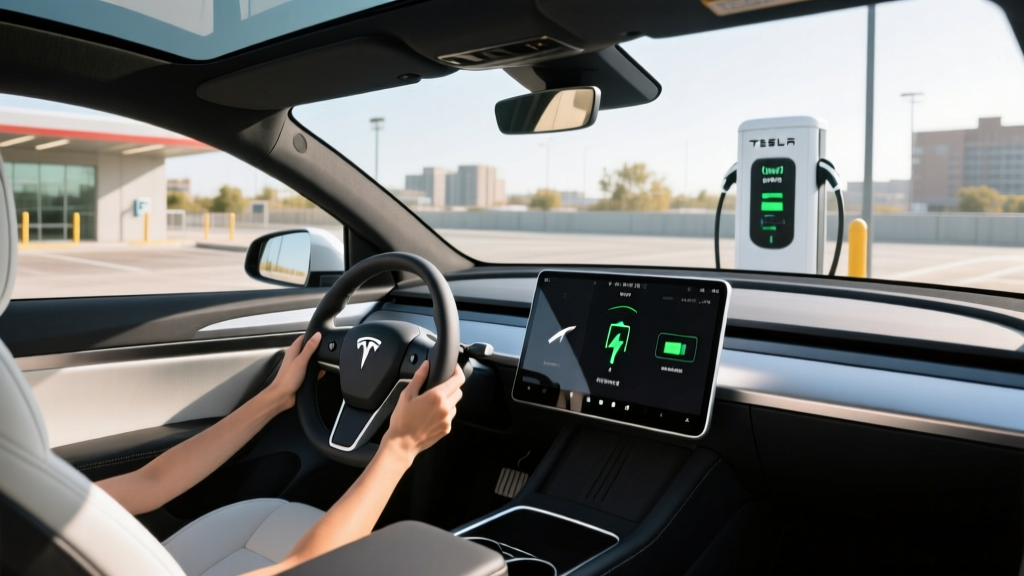
Step inside the Cybertruck and the minimalist Tesla design language continues — but with some pickup-specific additions. The 18.5-inch center touchscreen dominates the dash, running Tesla's latest infotainment software with navigation, media, climate controls, and vehicle settings. A 9.4-inch rear touchscreen serves second-row passengers with climate and entertainment controls. There are no physical buttons for climate or audio; everything routes through the screen, which remains a point of contention for drivers who prefer tactile controls.
Seating and space: The Cybertruck seats five (two front, three rear) with a 60/40 split-folding rear bench. Front headroom is generous thanks to the tall roofline, and legroom is adequate at 41.3 inches front and 38.2 inches rear. The rear seat is more upright than a luxury SUV, but adults can sit comfortably for medium-length trips. The stainless-steel dash and door panels give the cabin an industrial aesthetic — some love it, others find it cold and echo-prone compared to the soft-touch materials in a Rivian R1T or Ford F-150 Lightning.
Cargo capacity: The 6-foot composite bed is enclosed by a powered tonneau cover that Tesla claims is strong enough to stand on. The bed offers 67 cubic feet of volume, and there's a lockable under-bed storage compartment plus a front trunk (frunk) with roughly 7 cubic feet. The powered tailgate doubles as a loading ramp. However, the 6-foot bed is shorter than the 6.5- or 8-foot beds on conventional full-size pickups, which limits its utility for contractors or anyone hauling long lumber or ladders.
Driver assistance: All Cybertrucks ship with Tesla's Basic Autopilot (adaptive cruise control and lane centering). Full Self-Driving (Supervised) is available as a $8,000 add-on or $99/month subscription. FSD Supervised is an SAE Level 2 system — it does not make the Cybertruck self-driving. The driver must remain attentive, keep hands on the yoke (monitored via torque sensor and cabin camera), and be prepared to take over at any time. Tesla's FSD has improved substantially in urban navigation, but it still makes errors at complex intersections and construction zones. Treat it as a fatigue-reducing assist, not a replacement for an engaged driver.
Pricing, Trims, and Federal Tax Credit Eligibility
The Cybertruck lineup currently consists of two trims, with a lower-priced Rear-Wheel-Drive model announced but not yet available for order as of early 2026:
| Trim | Base MSRP | Destination | Est. As-Tested | §30D Tax Credit Eligible? |
|---|---|---|---|---|
| Cybertruck AWD (Dual Motor) | $79,990 | $1,995 | $82,000–$88,000 (w/ options) | No — exceeds $80,000 truck MSRP cap |
| Cybertruck Cyberbeast (Tri Motor) | $99,990 | $1,995 | $102,000–$110,000 (w/ options) | No — exceeds $80,000 truck MSRP cap |
| Cybertruck RWD (announced) | ~$60,990 (preliminary) | $1,995 | TBD | Likely — if MSRP stays under $80K cap at launch |
The tax credit reality: Under current IRS §30D rules, new electric trucks qualify for up to $7,500 in federal tax credits only if the base MSRP does not exceed $80,000 (the cap for vans, SUVs, and pickup trucks). Both currently available Cybertruck trims exceed this threshold, meaning neither the AWD nor the Cyberbeast qualifies for the federal credit. The forthcoming RWD model, if priced under $80,000, would likely qualify — but buyers must also meet adjusted gross income caps ($150,000 single / $300,000 joint filers) and the vehicle must satisfy critical-mineral and battery-component sourcing requirements. Always verify eligibility on the IRS website or with a tax professional before purchasing.
For buyers who don't need tri-motor performance, the RWD model's eventual arrival could reshape the Cybertruck's value proposition significantly — a sub-$61,000 electric pickup with 250+ miles of range and Supercharger access would be genuinely competitive.
Warranty, Ownership Costs, and Long-Term Outlook
Tesla covers the Cybertruck's battery pack and drive units with an 8-year / 120,000-mile warranty, whichever comes first, with a guaranteed minimum capacity retention of 70% over that period. The limited vehicle warranty is 4 years / 50,000 miles. This is competitive with the Ford F-150 Lightning (8 yr / 100,000 mi battery) and slightly better on mileage, though Rivian matches with 8 yr / 175,000 mi on battery and drive components.
Energy cost: At the national average residential electricity rate of ~$0.17/kWh (EIA, 2025), fully charging the Cybertruck's ~123 kWh pack costs roughly $20.90. That translates to approximately $0.06–$0.08 per mile, compared to $0.15–$0.18 per mile for a gas-powered F-150 at 18 MPG and $3.30/gallon. Over 15,000 annual miles, the energy savings are roughly $1,200–$1,600 per year. Public DC fast charging is more expensive ($0.30–$0.50/kWh at many networks), which narrows the gap if you rely heavily on road-trip charging.
Insurance: Cybertruck insurance premiums run 15–30% higher than comparable full-size pickups, driven by high repair costs for the stainless-steel body panels, expensive sensor calibration, and limited aftermarket parts. Budget $2,500–$4,000 annually depending on your state, driving record, and coverage level.
Pros
- Class-leading 0–60 performance, especially Cyberbeast (2.6s)
- Access to Tesla Supercharger network — the most reliable DC fast-charging system in North America
- 11,000-lb towing capacity with integrated trailer brake controller
- Stainless-steel exoskeleton is dent- and corrosion-resistant
- 800V architecture enables fast sustained DC charging
- Over-the-air software updates continuously add features
Cons
- Real-world highway range falls 15–20% below EPA sticker due to aero drag
- Neither available trim qualifies for the $7,500 federal tax credit (MSRP cap)
- Steer-by-wire and yoke steering require significant adaptation
- 6-foot bed is shorter than most full-size truck buyers expect
- Insurance premiums substantially above segment average
- Minimal physical controls — all climate/audio via touchscreen
- Cabin materials feel industrial, not premium, at this price point
Cybertruck vs. F-150 Lightning vs. Rivian R1T: Which Electric Pickup Wins?
The electric pickup segment has three distinct philosophies, and the right choice depends on your priorities:
- Choose the Cybertruck AWD if: You value Supercharger network access above all else, want the fastest available charging infrastructure for road trips, and appreciate the Cybertruck's distinctive design and tech-forward cabin. It's the best choice for Tesla ecosystem loyalists who want a truck.
- Choose the Ford F-150 Lightning if: You need a traditional truck experience — an 8-foot bed option, physical buttons, a conventional steering wheel, and Pro Power Onboard for job-site electricity. The Lightning (Extended Range: EPA 320 mi, starting ~$59,990) also qualifies for the §30D tax credit, making its effective price significantly lower.
- Choose the Rivian R1T if: You prioritize interior quality, off-road capability (the R1T's quad-motor tank turns and gear tunnel are unmatched), and a more refined ride. The R1T (Dual Motor: EPA ~352 mi, starting ~$69,900) is the most well-rounded electric truck for mixed daily and adventure use, though its charging network access is less seamless than Tesla's.
Who Should Buy the Cybertruck?
The Cybertruck is best suited for tech-enthusiast truck buyers who prioritize performance and Tesla's Supercharger ecosystem over traditional truck utility. It excels as a daily driver with occasional towing needs, a statement vehicle that genuinely performs, and a road-trip EV thanks to fast DC charging on the Supercharger network. It's less ideal for commercial fleet buyers (the bed is short, repair costs are high), budget-conscious shoppers (no tax credit on current trims), or anyone who values conventional truck ergonomics and physical controls.
If you can wait for the RWD model and its sub-$80,000 pricing, the Cybertruck's value equation changes dramatically — but for buyers ready to purchase now, the AWD at ~$82,000 out the door is the rational choice over the Cyberbeast unless you genuinely need 845 horsepower.
Frequently Asked Questions
What is the real-world range of the Tesla Cybertruck?
The EPA rates the AWD Cybertruck at 340 miles and the Cyberbeast at 320 miles. In real-world highway driving at 70–75 mph, expect roughly 270–300 miles. In cold weather (below 30°F), plan for 220–260 miles. City driving with regenerative braking returns the closest results to the EPA sticker, sometimes reaching 310–330 miles.
How fast does the Cybertruck charge at home and on the road?
At home on a Level 2 (240V, 48A) Tesla Wall Connector, the Cybertruck charges at 11.5 kW, adding roughly 34 miles of range per hour — a full overnight charge covers most daily needs. On a V4 Supercharger, it peaks at 250+ kW and charges from 10% to 80% in approximately 20 minutes, though the rate tapers significantly above 80% SoC.
Does the Cybertruck qualify for the $7,500 federal EV tax credit?
As of 2026, neither the AWD ($79,990) nor the Cyberbeast ($99,990) qualifies for the IRS §30D federal tax credit because both exceed the $80,000 MSRP cap for trucks. The announced RWD model (~$60,990 preliminary) would likely qualify if it remains under the cap at launch and meets battery-sourcing requirements. Always verify current rules at IRS.gov.
Is the Cybertruck worth buying over the F-150 Lightning or Rivian R1T?
It depends on your priorities. The Cybertruck wins on raw acceleration, Supercharger network access, and futuristic design. The F-150 Lightning wins on traditional truck utility, tax-credit eligibility, and lower starting price. The Rivian R1T wins on interior quality, off-road capability, and overall refinement. None is universally "best" — each serves a different buyer profile.
How does steer-by-wire feel in the Cybertruck?
Steer-by-wire eliminates the mechanical link between the yoke and the wheels, using electronic actuators instead. The variable steering ratio means fewer hand movements at low speed (great for parking) and stable, natural feel at highway speed. Most drivers adapt within a week, but it feels distinctly different from a traditional steering setup and isn't for everyone. Test-drive before committing.
What is the Cybertruck's towing range impact?
Towing at or near the 11,000-lb maximum cuts range roughly in half — expect 150–180 miles on a full charge when pulling a heavy trailer at highway speeds. This is consistent with all electric pickups (the F-150 Lightning and R1T show similar reductions). For long-distance towing, plan charging stops every 120–150 miles to maintain a safety margin.