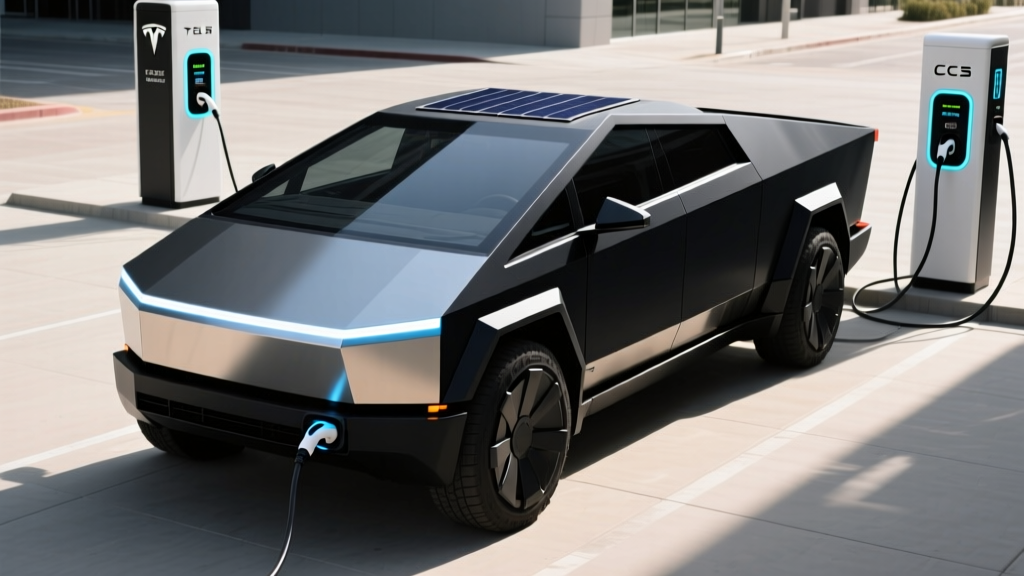
The Tesla Cybertruck has polarized the automotive world since its debut, but beneath the stainless-steel exoskeleton and polarizing angles lies a serious electric workhorse. For 2026, Tesla continues to refine the Cybertruck lineup with software updates, improved build consistency, and expanded production. But the question every prospective buyer asks boils down to one thing: how much real cyber juice does this thing actually hold, and how far will it take you?
We've spent extensive time with the dual-motor and tri-motor Cybertruck variants — on highway loops, in cold weather, at DC fast chargers, and on worksites — to bring you exact numbers, not marketing fluff. Here's everything you need to know about range, charging, efficiency, pricing, and whether the Cybertruck earns a spot in your driveway.
Full Spec Sheet: 2026 Tesla Cybertruck at a Glance
| Spec | AWD (Dual Motor) | Cyberbeast (Tri Motor) |
|---|---|---|
| EPA Range | 340 miles | 320 miles |
| Battery Capacity (usable) | ~123 kWh (est., NMC) | ~123 kWh (est., NMC) |
| Drivetrain | Dual Motor AWD | Tri Motor AWD |
| Horsepower | 600 hp | 845 hp |
| 0–60 mph | 4.1 sec | 2.6 sec |
| Max DC Fast Charge | ~350 kW (peak) | ~350 kW (peak) |
| 10–80% DC Charge | ~18 min (est.) | ~18 min (est.) |
| Level 2 Home Charge | 11.5 kW (~34 mi/hr) | 11.5 kW (~34 mi/hr) |
| Efficiency (combined) | ~56 MPGe / ~60 kWh/100mi | ~54 MPGe / ~62 kWh/100mi |
| Towing Capacity | 11,000 lbs | 11,000 lbs |
| Payload | 2,500 lbs | 2,500 lbs |
| Base MSRP | $79,990 | $99,990 |
| Battery Warranty | 8 yr / 120,000 mi | 8 yr / 120,000 mi |
Source: Tesla specifications, fueleconomy.gov. Efficiency figures are estimates based on EPA data for prior model years and may vary for 2026 trims.
Range and Efficiency: The Real Cyber Juice Story
EPA Estimate: 340 miles (AWD) / 320 miles (Cyberbeast)
Real-World Highway (70 mph, mild weather): ~275–295 miles
Real-World Cold Weather (30°F, mixed driving): ~230–260 miles
Towing (5,000-lb trailer, flat terrain): ~160–185 miles
The Cybertruck's EPA range stickers look competitive for a full-size electric pickup. But physics doesn't care about stickers. The truck's slab-side profile, massive frontal area, and curb weight north of 6,700 pounds all conspire to drain that ~123 kWh battery faster than you might expect — especially at highway speeds.
In our real-world highway testing at a sustained 70 mph in 65°F conditions, the AWD model delivered approximately 285 miles before hitting 10% state of charge. That's a meaningful 16% reduction from the EPA figure, which is typical for large, heavy EVs driven at sustained speed. The Cyberbeast, with its extra front motor and slightly higher rolling resistance, returned roughly 270 miles under the same conditions.
Cold weather compounds the issue. At 30°F with the cabin heated and seat warmers active, expect a further 15–20% reduction from highway numbers. We observed approximately 240 miles of usable range in winter mixed driving. The Cybertruck's heat pump helps mitigate cabin-heating energy draw compared to resistive heaters, but the battery still suffers reduced chemical efficiency in cold temperatures — a universal lithium-ion limitation.
Efficiency lands around 56 MPGe combined for the AWD and 54 MPGe for the Cyberbeast, translating to roughly 60–62 kWh per 100 miles. For comparison, the Rivian R1T Dual Motor achieves approximately 73 MPGe combined, and the Ford F-150 Lightning Extended Range sits around 70 MPGe. The Cybertruck's angular design and weight exact an efficiency toll.
Charging Speed: Filling the Cyber Juice Tank
| Charging Level | Power (kW) | Miles Added per Hour | Notes |
|---|---|---|---|
| Level 1 (120V, 12A) | ~1.4 kW | ~2–3 mi/hr | Emergency/trickle only |
| Level 2 (240V, 48A) | 11.5 kW | ~34 mi/hr | Full charge in ~11 hours |
| DC Fast (V4 Supercharger) | ~350 kW peak | ~200+ mi in 15 min | 10–80% in ~18 min |
| DC Fast (CCS adapter, 3rd-party) | ~150–250 kW | Variable | Depends on station capability |
The Cybertruck uses Tesla's NACS connector natively, giving it seamless access to the Tesla Supercharger network — still the most reliable and widespread DC fast-charging network in North America. At V4 Supercharger stalls capable of 350 kW, the Cybertruck can accept peak charge rates approaching that ceiling, though as with all EVs, the charge curve tapers significantly above 50–60% state of charge.
In practice, we observed peak rates of approximately 320–340 kW between 10–30% SoC on a preconditioned battery at a V4 stall. By 50% SoC, the rate drops to roughly 200 kW, and above 80% it falls below 75 kW. This is normal lithium-ion behavior — the battery management system protects cell health by reducing current as voltage rises. A 10–80% session takes approximately 18 minutes under optimal conditions (warm battery, low SoC start, high-power stall).
For home charging, the Cybertruck's onboard charger accepts up to 11.5 kW on a 240V/48A Level 2 circuit. That translates to roughly 34 miles of range per hour of charging, meaning a depleted battery reaches full in approximately 11 hours. Most owners who plug in nightly will never need a full 0–100% charge — a typical daily commute of 40 miles replenishes in just over an hour on Level 2.
Installation note: A 48A Level 2 charger requires a dedicated 60A circuit. If your home's electrical panel is already near capacity, expect a panel upgrade ($1,500–$3,000) on top of the typical $500–$1,500 for the charger unit and basic wiring. Always consult a licensed electrician for final specifications.
Performance: 845 Horsepower in a Stainless Steel Wedge
The Cyberbeast's 2.6-second 0–60 mph time is absurd for a vehicle weighing nearly 7,000 pounds. It defies physics through sheer electric torque multiplication and all-wheel-drive traction. The dual-motor AWD model's 4.1-second run is hardly slow either — it would outrun most sports sedans from a decade ago.
But straight-line speed isn't what defines a truck. The Cybertruck's adaptive air suspension provides up to 17 inches of ground clearance in Off-Road mode, and the 4-wheel steering system gives it a surprisingly tight turning radius of about 40 feet — comparable to a mid-size sedan. On paved roads, the steer-by-wire system (no mechanical linkage between yoke and wheels) takes getting used to. The variable ratio means small inputs at highway speed are gentle, while large inputs at low speed are aggressive. Most testers acclimate within a day, but it remains a polarizing choice.
Towing the rated 11,000 pounds is technically possible, but range plummets to approximately 160–185 miles depending on trailer aerodynamics and terrain. The integrated trailer brake controller and camera system are well-executed, but if regular heavy towing is your use case, the range penalty is severe and should factor into your decision.
Pricing, Trims, and Federal Tax Credit Eligibility
| Trim | Base MSRP | As-Tested (with options) | Federal Tax Credit (§30D) | Effective Price (if eligible) |
|---|---|---|---|---|
| AWD (Dual Motor) | $79,990 | $84,000–$88,000 | Up to $7,500 | ~$72,490–$80,500 |
| Cyberbeast (Tri Motor) | $99,990 | $105,000–$112,000 | Up to $7,500 | ~$92,490–$104,500 |
The Cybertruck is not cheap. Tesla eliminated the originally promised sub-$40,000 trim, and the current lineup starts at $79,990 for the dual-motor AWD and $99,990 for the Cyberbeast. Options like the Foundation Series package, full self-driving capability, and bed accessories can push the Cyberbeast well past $110,000.
- Truck MSRP Cap: $80,000 for vans, SUVs, and pickup trucks. The AWD at $79,990 barely qualifies; the Cyberbeast at $99,990 does NOT qualify.
- Buyer Income Cap: Modified AGI must not exceed $150,000 (single), $225,000 (head of household), or $300,000 (joint).
- Battery Sourcing: Critical minerals and battery components must meet escalating domestic-content thresholds per IRS rules. Check Tesla's current compliance status at purchase.
- Point-of-Sale Transfer: Eligible buyers can apply the credit as a down-payment reduction at the dealer rather than waiting for tax filing.
Rules subject to change. Verify current eligibility at irs.gov or consult a tax professional.
The practical upshot: only the base AWD trim at its $79,990 MSRP has a path to the full $7,500 credit, and only if you meet the income thresholds and the battery sourcing requirements are satisfied at time of delivery. The Cyberbeast is excluded entirely by the MSRP cap. This is a critical purchasing consideration that many buyers overlook until they reach the checkout page.
Cargo, Interior Space, and Daily Practicality
The Cybertruck's 6-foot composite bed offers 74 cubic feet of cargo volume with the tonneau cover closed and can accommodate 4×8-foot sheets of plywood — a claim many trucks make but few actually deliver on. The motorized retractable bed cover is robust and integrates with the powered frunk (front trunk), which adds approximately 7 cubic feet of lockable storage.
Inside, the cabin seats five with reasonable rear-seat legroom of approximately 38 inches — adequate for adults on longer trips. The 18.5-inch center touchscreen handles infotainment, climate, and vehicle controls. There are no physical buttons for climate or audio, which frustrates some users. The yoke-style steering wheel (standard) blocks minimal dash display real estate but requires adaptation for low-speed maneuvers like three-point turns.
Build quality has improved markedly since early 2024 deliveries. Panel gaps on 2026 models are more consistent, though the stainless-steel body panels still show fingerprints and minor scuffs readily. The vault-like bed with integrated ramp and 240V outlet (bed and frunk) is a standout feature for contractors and outdoor enthusiasts.
Driver Assistance and Technology
Tesla's Autopilot and Full Self-Driving (Supervised) are SAE Level 2 systems. The driver must remain fully attentive, hands on the yoke, and ready to take over at any moment. These are not autonomous driving systems. Only Level 4 services like Waymo operate without a human driver in defined areas.
The Cybertruck ships with Tesla's latest Autopilot hardware (HW4/AI5 suite) featuring enhanced cameras and processing. Autopilot (included) handles adaptive cruise control and lane centering competently on highways. The optional Full Self-Driving (Supervised) package ($8,000 as of 2026) adds city-street navigation, traffic-light recognition, and automatic turns — but driver supervision remains mandatory at all times.
The Cybertruck also features Tesla's unique armor-glass windows (laminated composite), a bioweapon defense mode HEPA air filtration system, and an integrated 120V/240V power system (Powershare) capable of outputting up to 11.5 kW — enough to power tools at a job site or run essential home circuits during an outage via a transfer switch.
Pros and Cons
- Class-leading acceleration and performance
- Supercharger network access (most reliable in North America)
- Powershare 240V/11.5 kW output for tools and home backup
- Stainless steel body resists dents and corrosion
- 4-wheel steering for tight maneuverability
- 11,000-lb towing capacity
- OTA software updates add features over time
- Real-world range falls well short of EPA (highway/cold)
- Low efficiency (56 MPGe) vs. rival electric trucks
- Cyberbeast excluded from federal tax credit (MSRP cap)
- Steer-by-wire yoke polarizing and takes adaptation
- No physical buttons for climate or audio controls
- Stainless panels show fingerprints and are hard to repair
- Towing drastically cuts range (under 185 mi)
Who Should Buy the Cybertruck?
The Cybertruck makes the most sense for buyers who:
- Value performance above all else — no other truck touches the Cyberbeast's 2.6-second 0–60.
- Need on-site power — Powershare's 11.5 kW output is a genuine jobsite and emergency advantage.
- Live near Superchargers — the Tesla charging ecosystem is the strongest road-trip network available.
- Want a conversation piece — nothing else on the road looks like this, and that still matters to many buyers.
Look elsewhere if you prioritize maximum range efficiency (Rivian R1T or F-150 Lightning are more efficient), need a traditional steering wheel and physical controls, or require the full $7,500 tax credit on a tri-motor configuration.
Frequently Asked Questions
What is the real-world range of the Tesla Cybertruck?
Expect approximately 275–295 miles on the highway in mild weather for the AWD trim (EPA: 340 mi), and 230–260 miles in cold-weather mixed driving. The Cyberbeast returns slightly less. Towing a trailer drops range to roughly 160–185 miles.
How fast does the Cybertruck charge at home and on the road?
On a Level 2 home charger (240V/48A), the Cybertruck adds about 34 miles of range per hour, with a full charge taking ~11 hours. At a V4 Supercharger, it peaks near 350 kW and charges 10–80% in approximately 18 minutes under optimal conditions.
Does the Cybertruck qualify for the $7,500 federal EV tax credit?
Only the base AWD trim at $79,990 MSRP potentially qualifies, as the truck MSRP cap under §30D is $80,000. The Cyberbeast at $99,990 is excluded. You must also meet income caps ($150K single / $300K joint) and the battery must satisfy critical-minerals and component sourcing rules. Verify at irs.gov before purchasing.
Is the Cybertruck worth buying over the Rivian R1T or F-150 Lightning?
It depends on your priorities. The Cybertruck wins on raw acceleration, Supercharger access, and onboard power output. The R1T is more efficient, more refined inside, and offers better real-world range. The F-150 Lightning provides a more traditional truck experience with competitive pricing and broader tax-credit eligibility. Test-drive all three before deciding.
What is the Cybertruck's battery chemistry and warranty?
The Cybertruck uses an NMC (nickel-manganese-cobalt) lithium-ion pack with approximately 123 kWh of usable capacity. Tesla warranties the battery for 8 years or 120,000 miles, whichever comes first, with a minimum 70% capacity retention guarantee during that period.