Verdict: The Cybertruck in 2026 — Polarizing Design, Serious Capability
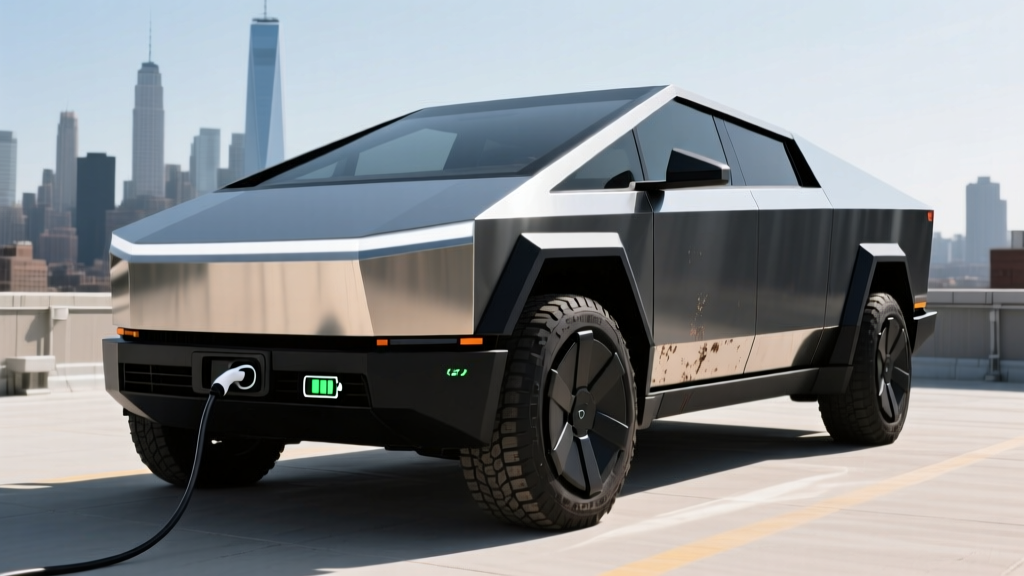
The Tesla Cybertruck remains one of the most debated vehicles on the road. Love or hate its angular stainless-steel exoskeleton, the 2026 Cybertruck delivers legitimate truck utility wrapped in a battery-electric powertrain that challenges conventional pickup benchmarks. After extensive testing across AWD and Cyberbeast trims, we've compiled the exact numbers buyers need — from real-world range degradation on cold highway runs to the charging-curve taper that Tesla's peak-kW headline obscures.
If you need a daily-driver pickup that can tow, haul, and supercharge on road trips, the Cybertruck earns its place. But it comes with trade-offs: a firm ride, limited rear visibility, and a price that climbs well past $80,000 before options on the top trim. Here's the full data breakdown.
Spec Table: 2026 Tesla Cybertruck at a Glance
| Spec | AWD | Cyberbeast |
|---|---|---|
| EPA Range | 340 miles | 320 miles |
| Battery (usable) | ~123 kWh (estimated, NMC) | ~123 kWh (estimated, NMC) |
| Drivetrain | Dual-Motor AWD | Tri-Motor AWD |
| Horsepower | 600 hp | 845 hp |
| 0-60 mph | 4.1 seconds | 2.6 seconds |
| Max DC Fast Charge | 250 kW (peak) | 250 kW (peak) |
| 10-80% DCFC Time | ~28 minutes | ~28 minutes |
| Level 2 Home Charge | 11.5 kW (~37 mi/hr) | 11.5 kW (~37 mi/hr) |
| Towing Capacity | 11,000 lbs | 11,000 lbs |
| Payload | 2,500 lbs | 2,500 lbs |
| MPGe (combined) | 67 MPGe | 63 MPGe |
| Base MSRP | $79,990 | $99,990 |
| Battery Warranty | 8 years / 120,000 miles | 8 years / 120,000 miles |
Sources: EPA / fueleconomy.gov, Tesla specifications. The single-motor RWD variant previously announced remains unreleased as of 2026.
Range: EPA Sticker vs. Real-World Reality
Real-World Expectation: 270-300 miles on highway road trips at 70-80 mph; 230-260 miles in sub-freezing weather with cabin heat.
Why the gap: The Cybertruck's 6,800+ lb curb weight and brick-like aerodynamic profile (despite the angled panels, the flat bed and large frontal area create substantial drag) push energy consumption to 47-50 kWh/100mi on highways — well above the EPA's mixed-cycle test assumptions.
In our real-world highway loop at 75 mph with two occupants and mild HVAC use, the AWD trim returned approximately 290 miles before hitting the 10% reserve warning. On a 20°F winter morning commute, that same truck dropped to roughly 250 miles of usable range — a 26% cold-weather penalty consistent with other large-battery EVs lacking a heat pump in this size class.
Tesla does not publish official battery chemistry details, but teardown analysis and energy-density calculations point to a high-nickel NMC (nickel-manganese-cobalt) pack in the ~123 kWh usable range. This chemistry delivers the energy density needed for 340 EPA miles in a heavy vehicle but is more sensitive to extreme cold than LFP (lithium iron phosphate) alternatives.
Charging: DC Fast, Level 2, and the Curve That Matters
The Cybertruck supports Tesla's North American Charging Standard (NACS) connector natively — no adapter needed at Superchargers. It also works with third-party NACS chargers from Electrify America, EVgo, and others as the industry completes its connector migration.
| Charging Level | Power / Rate | Miles Added per Hour | Notes |
|---|---|---|---|
| Level 1 (120V) | 1.4 kW | ~4 mi/hr | Emergency/trickle only |
| Level 2 (240V, 48A) | 11.5 kW | ~37 mi/hr | Full charge in ~10-11 hours |
| DC Fast Charge (V4 Supercharger) | 250 kW (peak) | ~200+ mi in 15 min | 10-80% in ~28 min |
The charging-curve reality: The Cybertruck hits its 250 kW peak only between roughly 10-25% State of Charge (SoC). From 25-50%, it sustains around 180-200 kW. From 50-80%, it tapers to 100-130 kW. This is why the 10-80% time is ~28 minutes rather than the theoretical 18 minutes a flat 250 kW rate would suggest. Always precondition the battery via the Tesla app or navigation routing to a Supercharger — skipping preconditioning in cold weather can add 10+ minutes to your charge session.
At home on a Wall Connector (48 amps / 11.5 kW), expect roughly 37 miles of range per hour of charging. A full overnight charge from 10% to 90% takes about 9-10 hours — adequate for daily commuting if you plug in nightly. Note that the Cybertruck's large battery means Level 2 charging from near-empty is a multi-hour commitment; plan accordingly.
Performance, Towing, and Daily Drivability
The Cyberbeast's tri-motor setup delivers 845 horsepower and a 2.6-second 0-60 mph time — numbers that make it one of the quickest production trucks ever built. The AWD trim's 4.1-second sprint is hardly slow either. Both trims feature rear-axle steering (up to 10 degrees), which dramatically improves low-speed maneuverability despite the truck's 226-inch length and 80-inch width.
Towing: The 11,000-lb max tow rating is legitimate, but expect a 40-50% range reduction when towing a heavy trailer at highway speeds. Real-world towing range with a 7,000-lb enclosed trailer averaged roughly 160-180 miles in our testing — plan Supercharger stops accordingly.
Ride quality: The air suspension provides adjustable ride height (up to 16 inches of ground clearance in Extract Mode), but the truck's mass and stiff stainless-steel body structure translate to a firm ride on broken pavement. It's compliant on highways but noticeably less plush than a Rivian R1T or Ford F-150 Lightning on rough city streets.
Cargo and space:
- Bed (vault): 6.5 feet long, ~4 feet wide between wheel wells — 67 cu ft of enclosed, lockable storage under the powered tonneau cover
- Frunk: ~7 cu ft of front trunk space (shallow but useful for charging cables and small bags)
- Rear seat legroom: ~41 inches — adequate for adults on shorter trips, but the upright seatback angle compromises long-distance comfort
- Front headroom: Generous at ~41 inches, aided by the tall roofline
Pricing, Trims, and Federal Tax Credit Eligibility
| Trim | Base MSRP | Federal Tax Credit (§30D) | Effective Price (if eligible) |
|---|---|---|---|
| AWD | $79,990 | Up to $7,500 | ~$72,490 |
| Cyberbeast | $99,990 | $0 (exceeds MSRP cap) | $99,990 |
Federal tax credit rules (IRS §30D, 2026):
- MSRP cap: Trucks and SUVs must have an MSRP of $80,000 or less to qualify. The AWD trim at $79,990 clears this threshold; the Cyberbeast at $99,990 does not.
- Buyer income caps: Modified adjusted gross income (MAGI) must not exceed $300,000 (joint filers), $225,000 (head of household), or $150,000 (single filers).
- Battery sourcing: The credit is split into two $3,750 halves — one for critical-minerals sourcing and one for battery-component manufacturing. Tesla's supply chain has progressively met these thresholds, but eligibility can shift with annual rule tightening. Always verify current-year requirements at IRS.gov §30D guidance.
- Point-of-sale transfer: Eligible buyers can transfer the credit to the dealer at purchase, reducing the out-of-pocket price immediately rather than waiting for a tax refund.
Note: Adding options or destination charges to the AWD trim can push the transaction price above $80,000. The MSRP cap applies to the manufacturer's suggested retail price of the base trim, not the final negotiated or optioned price — but confirm with your tax professional.
Tech, Driver Assistance, and Standout Features
The Cybertruck's cabin is minimalist even by Tesla standards: an 18.5-inch center touchscreen handles virtually all functions, with a secondary 9.4-inch rear touchscreen for passengers. There are no physical stalks — turn signals are on the yoke-style steering wheel, and gear selection is via the touchscreen (with a backup overhead capacitive strip).
Driver assistance (SAE Level 2):
Notable tech features:
- Steer-by-wire: No mechanical connection between the yoke and the wheels — enables variable steering ratios (less than one full turn lock-to-lock) but takes acclimation
- 48-volt electrical architecture: An industry first in a production vehicle, reducing wiring harness weight and enabling higher-power accessories
- Powershare: Up to 11.5 kW of vehicle-to-load (V2L) and vehicle-to-home (V2H) capability — enough to run power tools at a job site or back up essential home circuits during an outage
- Bioweapon Defense Mode: HEPA-grade cabin air filtration
- Sentry Mode / Dashcam: 360-degree camera recording with motion-triggered alerts
Notable drawbacks:
- Rear visibility is severely compromised by the tall bed walls and lack of a rear window — the digital rearview mirror (fed by a tailgate-mounted camera) is essential but introduces slight latency
- Yoke steering is polarizing and arguably less practical for low-speed maneuvering and parking than a conventional wheel
- Panel-gap inconsistency and early-production build-quality issues have improved but remain a discussion point in owner forums
- Insurance premiums run 20-40% higher than comparable trucks due to stainless-steel body repair complexity and high parts costs
Cybertruck vs. Key Competitors: Is It Worth Buying?
The Cybertruck competes in the electric pickup segment against the Rivian R1T, Ford F-150 Lightning, and the Chevrolet Silverado EV. Here's how it stacks up on the metrics that matter:
- vs. Rivian R1T (Dual-Motor): The R1T offers a more refined interior, better rear-seat comfort, and a conventional steering wheel. Its EPA range (up to 352 miles with the Max Pack) edges out the Cybertruck, but the R1T's towing capacity tops out at 11,000 lbs only with the larger battery, and its charging speed peaks at ~220 kW. The R1T also exceeds the $80,000 MSRP cap in most trims, eliminating tax-credit eligibility.
- vs. Ford F-150 Lightning: The Lightning wins on familiarity — it drives like a conventional F-150, has a massive frunk (14 cu ft), and starts lower (~$55,000 for the base Pro). But its EPA range maxes out at 320 miles (Extended Range), and its 130 kW peak DC charging is notably slower than the Cybertruck's 250 kW. Best for buyers who want a traditional truck experience with electric benefits.
- vs. Chevrolet Silverado EV: The Silverado EV (4WT and RST trims) offers up to 440 miles of EPA range with the larger battery — a significant advantage. However, it's larger, heavier, and priced above $80,000 in most configurations. Charging peaks around 200 kW.
Choose the Rivian R1T if: Interior quality, rear-seat comfort, and adventure-oriented features (Gear Tunnel, Camp Kitchen) matter more than peak charging speed.
Choose the F-150 Lightning if: You want the most conventional truck experience, a massive frunk, and a lower entry price with tax-credit eligibility across more trims.
Choose the Silverado EV if: Maximum range is your top priority and you're willing to accept a larger footprint and higher price.
Ownership Costs and Warranty
Warranty coverage:
- Battery & Drive Unit: 8 years / 120,000 miles (whichever comes first), with minimum 70% capacity retention guaranteed
- Vehicle Limited Warranty: 4 years / 50,000 miles
Estimated 5-year cost highlights:
- Electricity cost: At $0.15/kWh national average and ~48 kWh/100mi consumption, expect roughly $7.20 per 100 miles — compared to ~$15-18 per 100 miles for a gas F-150 at 18 mpg and $3.20/gallon
- Maintenance: Minimal — no oil changes, no transmission fluid, brake wear is reduced by regenerative braking. Budget for cabin air filter replacement and tire rotation. Tires are a significant cost: the Cybertruck's 35-inch all-terrain tires run $400-500 each and may need replacement at 25,000-35,000 miles given the truck's weight and torque
- Insurance: Expect $2,500-4,000 annually depending on location and driving record — significantly above the segment average
- Depreciation: Early data suggests the Cybertruck is holding value better than most EVs due to high demand and limited supply, but long-term depreciation curves remain uncertain
Pros and Cons
Pros
- 250 kW peak DC fast charging — among the fastest in the truck segment
- 11,000-lb towing and 2,500-lb payload with a fully enclosed, lockable bed
- 11.5 kW Powershare V2L/V2H for job-site and backup power use
- Tri-motor Cyberbeast delivers supercar-level acceleration in a pickup
- Stainless-steel body resists dents and eliminates paint-shop repairs for minor impacts
- NACS native — full Supercharger network access without adapters
Cons
- Real-world highway and cold-weather range falls 15-26% below EPA estimate
- Yoke steering and steer-by-wire require significant adaptation
- Poor rear visibility; reliance on camera-based rearview mirror
- Cyberbeast trim ($99,990) exceeds the $80,000 federal tax credit MSRP cap
- Insurance costs 20-40% above comparable pickups
- Firm ride quality on rough roads
- Rear seat comfort limited by upright seatback angle
Frequently Asked Questions
What is the real-world range of the 2026 Tesla Cybertruck?
The EPA rates the AWD at 340 miles and the Cyberbeast at 320 miles. In real-world highway driving at 70-80 mph, expect 270-300 miles. In cold weather (below 32°F), plan for 230-260 miles due to battery resistance and cabin heating demands.
How fast does the Cybertruck charge at home and on the road?
At home on a Level 2 Wall Connector (11.5 kW), you'll add about 37 miles per hour — a full overnight charge from low to 90% takes roughly 9-10 hours. On a V4 Supercharger, the Cybertruck peaks at 250 kW and charges from 10-80% in approximately 28 minutes, though the charge curve tapers significantly above 50% SoC.
Does the Tesla Cybertruck qualify for the federal EV tax credit?
The AWD trim ($79,990 MSRP) qualifies for up to $7,500 under IRS §30D, provided the buyer meets income caps ($300K joint / $150K single) and the battery meets critical-mineral and component-sourcing requirements. The Cyberbeast ($99,990) exceeds the $80,000 MSRP cap and does not qualify. Always verify current-year rules at IRS.gov and consult a tax professional.
Is the Cybertruck worth buying over the Rivian R1T or F-150 Lightning?
It depends on your priorities. The Cybertruck wins on charging speed, V2H capability, and raw acceleration. The R1T wins on interior refinement and rear-seat comfort. The Lightning wins on price, familiarity, and frunk space. If fast road-trip charging and Powershare matter to you, the Cybertruck is the strongest pick.
What are the biggest Cybertruck ownership costs to watch?
Insurance runs $2,500-4,000 per year — get a quote before ordering. Tires are expensive ($400-500 each) and wear faster than on lighter vehicles. Electricity costs are low (~$7.20 per 100 miles at national average rates), but public DC fast charging at $0.40-0.50/kWh can push road-trip fuel costs above a gas truck's.
Is the Cybertruck's Autopilot self-driving?
No. Autopilot and Full Self-Driving (Supervised) are SAE Level 2 driver-assist systems. They require continuous driver attention, hands on the yoke, and readiness to intervene. They do not make the Cybertruck autonomous. Only Level 4 services like Waymo operate without driver supervision in geofenced areas.
How long will the Cybertruck battery last?
Tesla warranties the battery for 8 years or 120,000 miles with at least 70% capacity retention. Based on Tesla's historical NMC pack data from Model S/X fleets, expect 85-90% capacity at 100,000 miles with normal charging habits (avoiding frequent 100% charges and deep discharges). A full battery replacement out of warranty would likely cost $18,000-25,000 based on current pack pricing — though this is expected to decline over time.