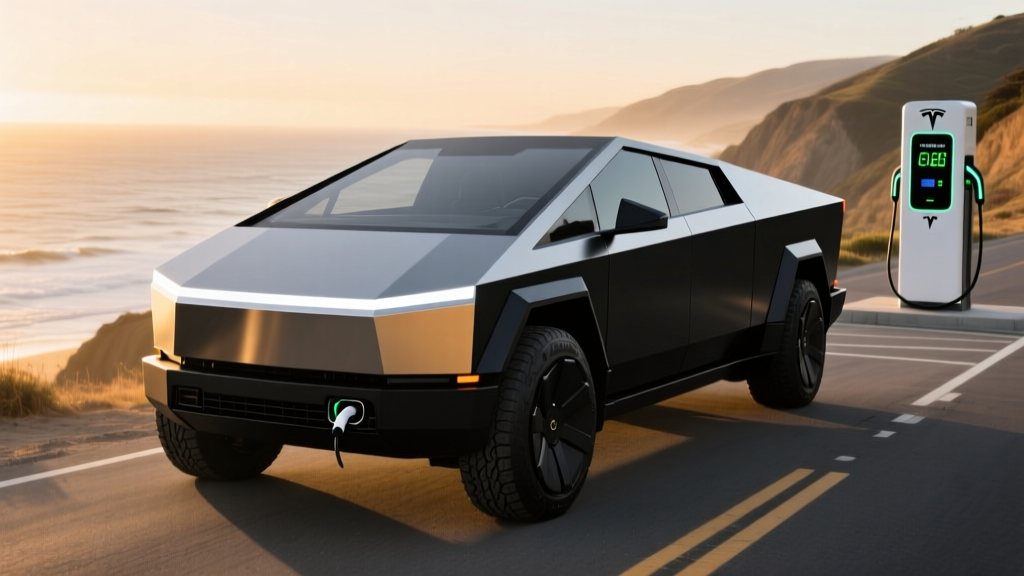
The Tesla Cybertruck is one of the most polarizing vehicles on the road, but for prospective buyers, the most practical question cuts through the design debates: how far can a Cybertruck go on one charge? The answer depends heavily on which trim you choose, how you drive, and what conditions you face. Tesla's stainless-steel pickup is heavy, angular, and packed with battery capacity — but its real-world efficiency tells a more nuanced story than the EPA sticker alone.
In this review, we dissect every range figure, charging metric, and ownership cost you need to evaluate the Cybertruck as a daily driver, road-trip hauler, or work truck. All specs reflect the current 2025/2026 model year lineup.
Cybertruck Range by Trim: EPA vs. Real World
The Cybertruck is offered in three configurations, each with a different battery pack size and motor setup. Here is how the official EPA range estimates break down across the lineup:
| Trim | Drivetrain | Battery (usable kWh) | Chemistry | EPA Range | MPGe (Combined) |
|---|---|---|---|---|---|
| Long Range AWD | Dual Motor AWD | ~123 kWh | NMC (2170 cells) | 340 mi | 66 MPGe |
| Cyberbeast | Tri Motor AWD | ~123 kWh | NMC (2170 cells) | 320 mi | 62 MPGe |
| Rear-Wheel Drive | Single Motor RWD | ~100 kWh (est.) | LFP (est.) | ~250 mi (est.) | TBD |
A note on the RWD trim: Tesla announced a rear-wheel-drive Cybertruck as the most affordable entry point, with deliveries expected in 2026. The specs above are preliminary estimates based on Tesla's filings and should be confirmed before purchase.
Real-World Range Reality Check
EPA sticker: 340 miles (Long Range AWD) / 320 miles (Cyberbeast)
Expect in real-world highway driving (70-80 mph): ~260–290 miles. The Cybertruck's tall, flat front profile creates significant aerodynamic drag at highway speeds, which is the single biggest range killer for any EV.
Expect in cold weather (below 32°F): ~220–260 miles. NMC chemistry loses efficiency in cold temperatures, and the heavy cabin heating load compounds the loss. Preconditioning while plugged in helps recover some of this.
City/mixed driving in mild weather: ~300–330 miles. Regenerative braking recovers energy in stop-and-go traffic, and lower speeds reduce drag substantially.
Towing a 5,000-lb trailer: ~150–180 miles. Towing roughly halves range due to added weight and drag. Plan charging stops accordingly.
The Cybertruck's efficiency of 66 MPGe combined (Long Range) translates to roughly 51 kWh per 100 miles driven. For context, a Ford F-150 Lightning Extended Range achieves about 70 MPGe combined — the Cybertruck's wedge shape and ~6,800-pound curb weight work against it at speed.
Charging Speed: DC Fast Charge and Home Level 2
Range is only half the equation. How quickly the Cybertruck can replenish its large battery pack determines its viability for road trips and daily convenience alike. Tesla's 800-volt-class electrical architecture enables competitive charging speeds, though the massive pack means absolute charge times are longer than smaller EVs.
| Charge Level | Power / Rate | Time (10–80%) | Miles Added per Hour |
|---|---|---|---|
| Level 1 (120V household) | ~1.4 kW | N/A (days) | ~3–4 mi/hr |
| Level 2 (240V, 48A Wall Connector) | 11.5 kW | ~9–10 hours (0–100%) | ~33 mi/hr |
| Level 2 (240V, 32A mobile connector) | 7.7 kW | ~14 hours (0–100%) | ~22 mi/hr |
| DC Fast Charge (Tesla Supercharger V4) | Peak ~350 kW | ~15–18 min (10–80%) | Up to ~460 mi/hr (peak) |
| DC Fast Charge (non-Tesla CCS, with adapter) | Up to ~250 kW | ~20–25 min (10–80%) | Varies by station |
Understanding the charge curve: The Cybertruck will peak at ~350 kW only at a low state of charge (typically 10–20%) on a V4 Supercharger. As the battery fills past 50%, the charge rate tapers significantly. By 80%, you may be pulling under 100 kW. This is normal lithium-ion behavior — the battery management system slows charging to protect cell health. Don't plan road-trip stops around the peak number; the 10–80% average is more useful, and it lands around 15–18 minutes at a V4 stall.
Home charging recommendation: With a ~123 kWh pack, you need a 48-amp Tesla Wall Connector on a 60-amp circuit to achieve the 11.5 kW Level 2 rate. That adds roughly 33 miles of range per hour of charging, meaning an overnight session (8–10 hours) fully replenishes the pack. A standard 15-amp outlet (Level 1) is impractical for daily use — you'd gain only ~30 miles overnight.
Tesla now provides a NACS-to-CCS adapter with new Cybertruck deliveries, enabling access to Electrify America, EVgo, and other public DC fast-charging networks. However, non-Tesla stations often cap at 150–250 kW, and adapter overhead can slightly reduce peak speeds compared to native Supercharger connections.
Performance: Acceleration, Power, and Drivetrain
The Cybertruck's performance figures vary dramatically by trim, from competent to supercar-rivaling:
| Trim | Horsepower | Torque (lb-ft) | 0–60 mph | Top Speed | Max Towing |
|---|---|---|---|---|---|
| Long Range AWD | ~600 hp | ~740 | 3.9 sec | 112 mph | 11,000 lbs |
| Cyberbeast (Tri Motor) | ~845 hp | ~1,030 | 2.6 sec | 130 mph | 11,000 lbs |
| RWD (est.) | ~315 hp (est.) | ~420 (est.) | ~6.5 sec (est.) | TBD | ~7,500 lbs (est.) |
The Cyberbeast's 2.6-second 0–60 time makes it one of the quickest production pickups ever built, rivaling the GMC Hummer EV and surpassing the Rivian R1T Tri-Motor. The Long Range AWD's 3.9-second sprint is more than adequate for any real-world merging or passing scenario.
All trims feature adaptive air suspension with up to 16 inches of ground clearance in Extract Mode, a 6-foot bed with a powered tonneau cover, and a stainless-steel exoskeleton body. The steer-by-wire system replaces the traditional steering column with an electrically controlled yoke — a polarizing feature that takes adjustment but offers a variable steering ratio that's quick at low speeds and stable on the highway.
Pricing, Tax Credits, and Total Cost
The Cybertruck's pricing has shifted since its initial announcement. Here is where the lineup stands for 2025/2026:
| Trim | Base MSRP | As-Tested (typical options) | §30D Federal Credit Eligible? |
|---|---|---|---|
| Long Range AWD | $79,990 | $82,000–$88,000 | Yes — if MSRP ≤ $80,000 (truck classification) |
| Cyberbeast | $99,990 | $105,000–$115,000 | No — exceeds $80,000 MSRP cap for trucks |
| RWD (est.) | ~$60,990 (est.) | ~$63,000–$68,000 | Yes — if MSRP ≤ $80,000 |
Federal tax credit rules (§30D): Under current IRS guidelines, the Cybertruck qualifies as a light truck, which carries an $80,000 MSRP cap (versus $55,000 for sedans/SUVs). The Long Range AWD at $79,990 base MSRP technically falls under the cap, making it potentially eligible for up to $7,500 — but only if the buyer also meets income thresholds ($150,000 single / $300,000 joint AGI) and the vehicle satisfies battery critical-mineral and component sourcing requirements. Tesla's battery sourcing has shifted over time, and eligibility can change between model years.
§30D Tax Credit Eligibility Checklist
- MSRP cap: ≤ $80,000 for trucks (Long Range AWD qualifies at base; Cyberbeast does not)
- Buyer income cap: AGI ≤ $150,000 (single), $225,000 (head of household), $300,000 (joint)
- Battery sourcing: Must meet critical-minerals and battery-component requirements (check fueleconomy.gov for current status)
- Point-of-sale transfer: Eligible buyers can apply the credit as a down-payment reduction at the dealer, rather than waiting for a tax refund
- Final assembly: Must be assembled in North America (Cybertruck is built in Austin, TX — qualifies)
Always verify current eligibility with a tax professional and the IRS before purchasing. Rules change frequently.
Interior, Cargo, and Technology
The Cybertruck's cabin is minimalist and tech-forward, with materials and build quality that have improved since early 2024 deliveries but still draw mixed reviews compared to the Rivian R1T or luxury pickups.
Passenger space: The Cybertruck seats five with a 60/40-split rear bench. Front legroom is generous at approximately 41 inches; rear legroom measures roughly 38 inches — adequate for adults on shorter trips but not class-leading. Headroom is ample thanks to the tall roofline.
Cargo capacity: The 6-foot bed offers 67 cubic feet of volume with the powered tonneau cover closed. A front trunk (frunk) provides additional lockable storage — roughly 7 cubic feet, enough for charging cables and a soft-sided bag. The bed features built-in 120V and 240V outlets, enabling V2L (vehicle-to-load) capability to power tools, appliances, or even a campsite directly from the battery.
Infotainment: An 18.5-inch central touchscreen runs Tesla's proprietary interface with navigation, streaming media, and over-the-air updates. A 9.4-inch rear touchscreen controls rear climate and entertainment. There is no Apple CarPlay or Android Auto — Tesla's ecosystem is self-contained. A 15-speaker audio system with active noise cancellation is standard on all trims.
Driver assistance: Tesla's Basic Autopilot (lane centering, adaptive cruise) is standard. Enhanced Autopilot ($6,000) adds automatic lane changes, navigate-on-autopilot, and auto-park. Full Self-Driving (Supervised) at $8,000 adds traffic-light recognition and city-street navigation — but remains SAE Level 2, requiring constant driver attention and hands-on (or eyes-on) supervision at all times.
⚠️ Autopilot & FSD Are NOT Self-Driving
Tesla's Autopilot and FSD (Supervised) are SAE Level 2 driver-assistance systems. The driver must remain fully engaged, monitor the road, and be prepared to take over instantly. These systems do not make the Cybertruck autonomous. Hands-off, eyes-off driving is not supported and is illegal on public roads.
Battery Warranty and Longevity
Tesla provides the following warranty coverage for the Cybertruck:
| Component | Coverage |
|---|---|
| Battery & Drive Unit | 8 years / 120,000 miles (whichever comes first), with minimum 70% capacity retention |
| Vehicle Limited Warranty | 4 years / 50,000 miles |
| Restraint System | 5 years / 60,000 miles |
| Corrosion (perforation) | 12 years / unlimited miles |
The 8-year/120,000-mile battery warranty with a 70% retention threshold is competitive with the industry standard. Tesla's NMC 2170 cells have a proven track record in the Model S, Model 3, and Model X — real-world degradation data from those platforms suggests roughly 10–15% capacity loss over 150,000 miles under normal use. The stainless-steel body eliminates traditional paint-related corrosion concerns, though the panels are prone to fingerprint smudges and fine scratching.
Cybertruck vs. Key Competitors
The electric truck market is no longer a one-horse race. Here is how the Cybertruck stacks up against its primary rivals on the metrics that matter most:
| Spec | Cybertruck LR AWD | F-150 Lightning Ext. Range | Rivian R1T Dual Max |
|---|---|---|---|
| EPA Range | 340 mi | 320 mi | 352 mi |
| Battery (kWh) | ~123 | ~131 | ~141 |
| 0–60 mph | 3.9 sec | ~5.0 sec | ~3.5 sec |
| Peak DC Charge | ~350 kW | ~150 kW | ~220 kW |
| 10–80% DCFC | ~15–18 min | ~38 min | ~27 min |
| Max Towing | 11,000 lbs | 10,000 lbs | 11,000 lbs |
| Base MSRP | $79,990 | ~$77,995 | ~$87,600 |
| Bed Length | 6 ft | 5.5 ft | 4.5 ft (w/ gear tunnel) |
Where the Cybertruck wins: Fastest DC charging speeds in the class, highest towing capacity (tied with R1T), and the most distinctive design. The Supercharger network remains the most reliable public charging ecosystem in the US.
Where it falls short: The 6-foot bed is shorter than the Lightning's 5.5-foot box plus the Lightning's conventional pickup layout is more familiar. The Rivian R1T offers a more refined interior, a gear tunnel for creative storage, and a longer Max Pack range. The Cybertruck's steer-by-wire yoke and lack of Apple CarPlay are deal-breakers for some buyers.
Pros, Cons, and Who Should Buy
✅ Pros
- Class-leading DC fast-charge speed (~350 kW peak, 10–80% in ~15 min)
- 340-mile EPA range (Long Range AWD) is competitive for an electric truck
- V2L capability with 120V/240V bed outlets — powers tools, camping gear, appliances
- 11,000-lb towing capacity and adaptive air suspension
- Access to Tesla Supercharger network (17,000+ stalls in North America)
- Stainless-steel body resists dents and corrosion
- Cyberbeast offers 2.6-sec 0–60 for those who want supercar acceleration in a truck
❌ Cons
- Real-world highway range drops to ~260–290 mi due to aerodynamic drag
- Cyberbeast at $99,990 does not qualify for the §30D federal tax credit
- Steer-by-wire yoke is polarizing and takes significant adaptation
- No Apple CarPlay or Android Auto
- Rear visibility is limited; relies heavily on camera feeds
- 6-foot bed is shorter than some competitors
- Cold-weather range loss is pronounced with NMC chemistry (~20–30%)
- Insurance premiums are higher than average for the segment
Who Is the Cybertruck For?
Choose the Cybertruck Long Range AWD if: You want the best combination of range, fast charging, and towing in an electric truck, you have access to home Level 2 charging, and you value Supercharger network reliability for road trips. The base $79,990 price and potential tax-credit eligibility make this the value pick in the lineup.
Choose the Cyberbeast if: Performance is your priority and budget is flexible. The tri-motor setup and 845 hp deliver absurd acceleration, but the $99,990 price eliminates tax-credit eligibility and the range drops to 320 miles.
Wait for the RWD trim if: You want the most affordable Cybertruck entry point, primarily drive in mild climates, and can accept ~250 miles of range. Expected pricing around $60,990 makes this the budget option, but availability is limited to 2026.
Look at the Rivian R1T or F-150 Lightning instead if: You need a conventional steering wheel, prefer CarPlay/Android Auto, want a longer bed, or prioritize interior refinement over raw tech and performance.
Frequently Asked Questions
What is the real-world range of the Tesla Cybertruck?
The EPA rates the Long Range AWD at 340 miles and the Cyberbeast at 320 miles. In real-world highway driving at 70–80 mph, expect 260–290 miles. In cold weather (below freezing), plan for 220–260 miles. City driving with regenerative braking in mild conditions can approach 300–330 miles. Towing cuts range roughly in half.
How fast does the Cybertruck charge at home and on the road?
At home on a Tesla Wall Connector (48A, 240V), the Cybertruck charges at 11.5 kW, adding about 33 miles of range per hour — a full charge takes 9–10 hours. On a Tesla V4 Supercharger, it peaks at ~350 kW and charges from 10% to 80% in approximately 15–18 minutes. Non-Tesla DC fast chargers (with the included CCS adapter) typically deliver 150–250 kW, resulting in 10–80% times of 20–25 minutes.
Does the Cybertruck qualify for the $7,500 federal EV tax credit?
The Long Range AWD at $79,990 base MSRP falls under the $80,000 truck cap and is potentially eligible for up to $7,500 under IRS §30D — provided the buyer meets income limits ($150K single / $300K joint AGI) and the vehicle meets battery sourcing requirements. The Cyberbeast at $99,990 exceeds the MSRP cap and does not qualify. Always verify current eligibility on fueleconomy.gov and consult a tax professional.
How far can a Cybertruck go on one charge while towing?
When towing a 5,000-pound trailer, expect roughly 150–180 miles of range from the Long Range AWD. Heavier loads near the 11,000-pound maximum will reduce range further. Plan charging stops every 120–140 miles when towing to maintain a safety buffer. Preconditioning and moderate speeds (60–65 mph) help maximize towing range.
Is the Cybertruck worth buying over the F-150 Lightning or Rivian R1T?
The Cybertruck excels in charging speed and Supercharger network access, making it the best choice for frequent road-trippers who value fast stops. The F-150 Lightning offers a more traditional truck experience with a familiar cab layout and competitive pricing. The Rivian R1T provides the most refined interior and creative storage (gear tunnel) but costs more and charges slower. Your decision should hinge on whether you prioritize fast charging and Tesla's ecosystem (Cybertruck), conventional usability (Lightning), or interior quality and adventure features (R1T).
What battery chemistry does the Cybertruck use?
The Long Range AWD and Cyberbeast use NMC (nickel manganese cobalt) chemistry in Tesla's 2170 cell format. NMC offers higher energy density than LFP, which is necessary to achieve 320–340 miles of range in a heavy truck. The trade-off is slightly faster degradation over time and more pronounced cold-weather range loss compared to LFP. The upcoming RWD trim is expected to use LFP chemistry, which sacrifices range for lower cost and longer cycle life.
How long will the Cybertruck battery last?
Tesla warranties the battery and drive unit for 8 years or 120,000 miles, guaranteeing at least 70% capacity retention. Based on data from Tesla's other NMC vehicles, owners typically see 10–15% degradation over 150,000 miles. With proper care — avoiding frequent 100% charges, using preconditioning, and minimizing DC fast charging when Level 2 is available — the battery should provide reliable service well beyond 200,000 miles. A full battery replacement, if ever needed, is estimated at $15,000–$20,000 out of warranty.