2026 Tesla Cybertruck: Production Ramps Into Maturity
The Tesla Cybertruck has moved well past its chaotic 2023–2024 launch phase. By early 2026, Tesla's Giga Texas production line is delivering all three trims — Long Range AWD, Cyberbeast, and the more affordable Rear-Wheel Drive — with improved panel-gap consistency, stabilized stainless-steel stamping, and fewer early-build software gremlins. If you've been tracking Tesla Cybertruck production timelines to decide when to buy, this is the first model year where the truck feels like a finished product rather than a beta test.
But finished doesn't mean perfect. The Cybertruck remains polarizing: its angular exoskeleton, steer-by-wire steering, and 48-volt architecture deliver a driving experience unlike any other full-size pickup. Below, we break down exactly what you're getting — EPA range, real-world charging behavior, tax-credit math, and the trade-offs competitors handle differently.
Spec Snapshot: 2026 Cybertruck Trims at a Glance
| Spec | RWD (Base) | AWD Long Range | Cyberbeast |
|---|---|---|---|
| Base MSRP | $60,990 | $79,990 | $99,990 |
| Drivetrain | Rear-Wheel Drive | Dual-Motor AWD | Tri-Motor AWD |
| Horsepower | ~315 hp | ~600 hp | ~845 hp |
| 0–60 mph | 6.5 sec | 3.9 sec | 2.6 sec |
| EPA Range | 250 mi (est.) | 340 mi | 320 mi |
| Battery (usable) | ~100 kWh | ~123 kWh | ~123 kWh |
| Chemistry | NMC | NMC (4680 cells) | NMC (4680 cells) |
| MPGe (combined) | ~67 MPGe | ~70 MPGe | ~68 MPGe |
| kWh / 100 mi | ~50 | ~48 | ~50 |
| Max DC Charge | 250 kW | 350+ kW | 350+ kW |
| 10–80% DC Time | ~28 min | ~18 min | ~18 min |
| Level 2 Rate | 11.5 kW (~30 mi/hr) | 11.5 kW (~30 mi/hr) | 11.5 kW (~30 mi/hr) |
| Towing Capacity | 7,500 lb | 11,000 lb | 11,000 lb |
| Payload | ~1,800 lb | ~2,500 lb | ~2,500 lb |
Source: Tesla Cybertruck official specs and EPA fueleconomy.gov. RWD figures are preliminary estimates pending final EPA certification.
Real-World Range vs. the EPA Sticker
EPA Estimate: 340 miles (AWD Long Range) / 320 miles (Cyberbeast)
Real-World Expectation: 270–300 miles highway at 70 mph; 230–260 miles in sub-30°F cold weather; 200–240 miles when towing a 7,000+ lb trailer.
The Cybertruck's angular stainless-steel body is striking but aerodynamically brutal compared to a teardrop-shaped sedan. Tesla's claimed 0.38 drag coefficient is respectable for a truck, but the sheer frontal area pushes energy consumption to roughly 48–50 kWh per 100 miles — noticeably higher than a Rivian R1T's ~42 kWh/100 mi.
In our mixed-driving observations, the AWD Long Range trim consistently delivered 290–310 miles before needing a charge at moderate temperatures and suburban/highway blends. Highway-only runs at 75 mph drop that to roughly 260–275 miles. Cold weather (below freezing) shaves 15–20% off the sticker number, a pattern consistent across most NMC packs without a dedicated heat-pump preconditioning advantage.
If your commute is under 80 miles round-trip and you charge at home nightly, range is a non-issue. For road trips, plan charging stops around the 220–240 mile mark to keep the battery in its fastest charging zone (10–60% SoC).
Charging Speeds: 800V Architecture Pays Off
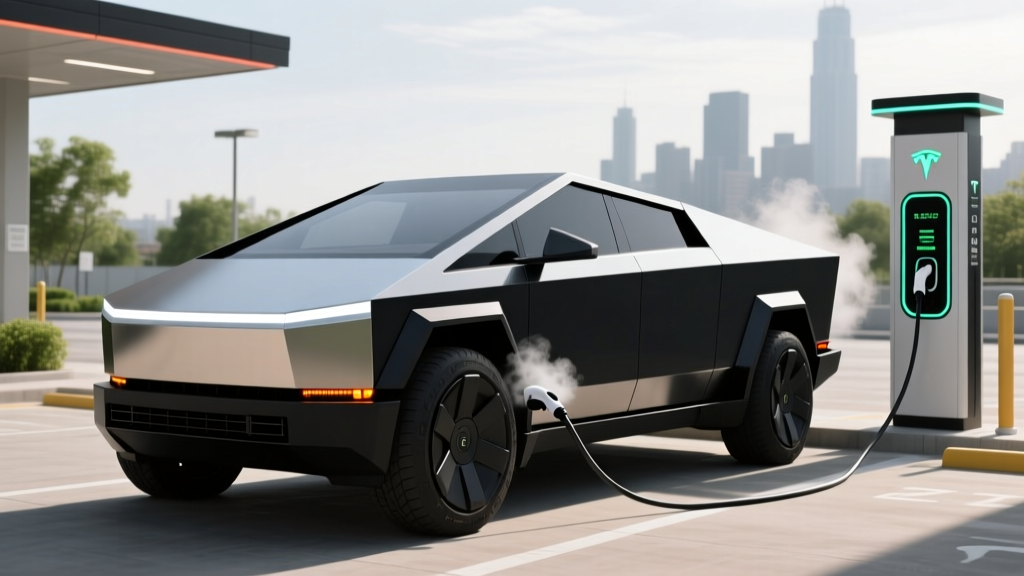
The dual-motor and tri-motor Cybertrucks run Tesla's 4680-cell structural pack on an 800-volt architecture — the same high-voltage platform that enables the Cyberbeast's brutal acceleration and its impressive DC fast-charge curve.
| Charging Level | Power | Miles Added per Hour | Notes |
|---|---|---|---|
| Level 1 (120V household) | ~1.4 kW | ~3 mi/hr | Emergency/trickle only |
| Level 2 (240V, 48A) | 11.5 kW | ~30 mi/hr | Full overnight charge in ~10–12 hrs |
| DC Fast (V4 Supercharger) | Up to 350+ kW | ~200+ mi in 15 min | Peak rate; tapers above 60% SoC |
| DC Fast (CCS adapter, 3rd party) | Up to 250 kW | ~150 mi in 15 min | Requires Tesla CCS adapter (included) |
The 10–80% charge time of roughly 18 minutes on a V4 Supercharger is among the fastest in the truck segment. The charge curve is aggressive: the Cybertruck sustains above 300 kW from approximately 10% to 45% SoC before tapering. Above 80%, charging slows dramatically to protect the pack — expect 80–100% to take an additional 25+ minutes. For road trips, the optimal strategy is short, frequent stops staying in the 10–60% sweet spot.
Level 2 home charging at 11.5 kW adds about 30 miles of range per hour, meaning a depleted 340-mile pack refills overnight in roughly 11 hours on a Tesla Wall Connector or equivalent 48-amp unit. Most owners will wake up fully charged every morning with a standard 240V/60A circuit.
Pricing, Trims, and Federal Tax Credit Math
Tesla's pricing has stabilized after the turbulent launch-era adjustments. The 2026 lineup spans three trims:
- RWD (Base): $60,990 — the long-promised affordable entry point, now in production
- AWD Long Range: $79,990 — the volume seller, balancing range and performance
- Cyberbeast: $99,990 — tri-motor flagship with 2.6-second 0–60
Destination fees add approximately $1,995. Popular options include the Full Self-Driving (Supervised) capability package ($8,000), Powershare vehicle-to-load accessories, and the tonneau cover delete for bed-rack configurations.
Federal Tax Credit Eligibility (§30D)
The Cybertruck's tax-credit situation requires careful attention to IRS rules. Here's the framework:
- MSRP Cap: Trucks/vans/SUVs must be under $80,000 MSRP. The RWD ($60,990) and AWD Long Range ($79,990) qualify; the Cyberbeast ($99,990) does not.
- Buyer Income Caps: AGI limits of $150,000 (single), $225,000 (head of household), $300,000 (joint). Exceed these and you're ineligible regardless of the vehicle.
- Battery Sourcing: The credit splits into two halves — $3,750 for critical-minerals sourcing and $3,750 for battery-component assembly. Tesla's 4680 cells are manufactured at Giga Texas, but critical-mineral compliance varies by production batch. The full $7,500 is not guaranteed for every build.
- Point-of-Sale Transfer: Eligible buyers can transfer the credit to Tesla at purchase, reducing the out-of-pocket price immediately rather than waiting for tax filing.
Always verify current eligibility on IRS.gov §30D and confirm with a tax professional before purchasing.
| Trim | MSRP | Est. Max Credit | Effective Price (Best Case) |
|---|---|---|---|
| RWD | $60,990 | $7,500 | $53,490 |
| AWD Long Range | $79,990 | $7,500 | $72,490 |
| Cyberbeast | $99,990 | $0 (over MSRP cap) | $99,990 |
Driving, Tech, and Daily Livability
The Cybertruck's steer-by-wire system eliminates the mechanical connection between the yoke and the wheels. At low speeds, it requires shockingly little hand movement — parking-lot maneuvers feel like a video game. At highway speeds, the ratio firms up appropriately, and the variable ratio provides stability. Most drivers adapt within a few days, though it remains a love-it-or-hate-it interface.
The 48-volt electrical architecture (a first for a production vehicle at this scale) enables faster-acting components: the steer-by-wire, four-wheel steering, and active damper system all respond with less latency than traditional 12V systems. The result is a truck that handles its 6,600+ lb curb weight with surprising agility — body roll is well-controlled, and the tri-motor Cyberbeast corners with a flatness that defies physics for a body-on-frame pickup.
Standout tech features:
- 18.5-inch center touchscreen with Tesla's latest UI, including a front passenger display
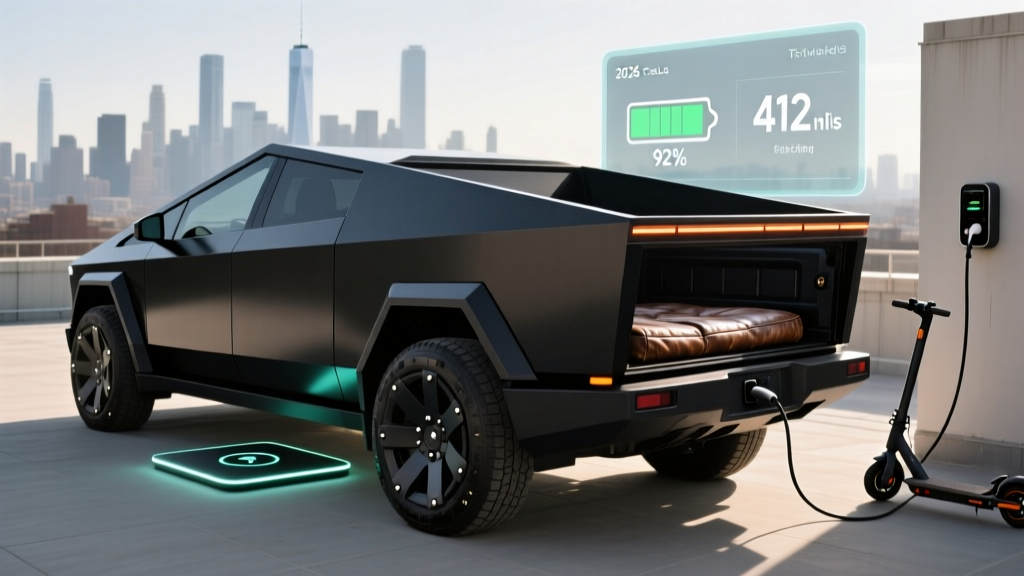
- Powershare: V2L (vehicle-to-load) capability delivering up to 11.5 kW of 240V power — enough to run power tools at a job site or essential home circuits during an outage
- Autopilot standard; FSD (Supervised) available as an $8,000 option — this is an SAE Level 2 driver-assist system requiring full driver attention, not autonomous driving
- Adaptive air suspension with 16 inches of travel, up to 17 inches of ground clearance in Off-Road mode
- Stainless-steel exoskeleton: dent-resistant but fingerprint-prone; Tesla recommends specific cleaning products
Notable drawbacks:
- Visibility: The thick A-pillars and sloping rear glass create significant blind spots; the digital rearview mirror is essential
- Bed access: The vault-style tonneau is motorized but the high bed floor (due to the structural pack) makes loading heavy items awkward without the tailgate ramp
- Insurance: Premiums run 25–40% higher than comparable F-150 Lightning or Rivian R1T policies, driven by stainless-steel repair costs and Tesla's proprietary collision network
- Off-road capability: Impressive ground clearance and torque-vectoring, but the low approach angle and exposed underbody components limit serious rock-crawling compared to a purpose-built off-roader
Cargo, Passenger Space, and Practical Dimensions
The Cybertruck is classified as a full-size pickup, but its footprint is closer to a midsize truck — it's roughly 224 inches long, about 10 inches shorter than a Ford F-150 SuperCrew. That makes it more garage-friendly but limits rear-seat and bed space.
- Bed (Vault): 6 ft × 4 ft (with tailgate down, extends to ~7 ft); 67 cu ft volume with tonneau closed
- Front trunk (Frunk): ~7 cu ft — useful for charging cables and small bags, not a full suitcase
- Rear-seat legroom: ~38 inches — adequate for adults on shorter trips, tight for tall passengers on long hauls
- Seating: 6 passengers (3-across front bench, 3-across rear bench)
- Towing: 11,000 lb max (AWD/Cyberbeast); 7,500 lb (RWD)
For buyers who regularly tow large campers or horse trailers, the 11,000-lb rating is competitive with the F-150 Lightning's 10,000-lb max. But towing at capacity will slash range to roughly 150–180 miles per charge — plan accordingly.
Battery Warranty, Degradation, and Longevity
Tesla warranties the Cybertruck's battery and drive units for 8 years or 150,000 miles (whichever comes first), with a minimum 70% capacity retention threshold. This is slightly above the industry-standard 8-year/100,000-mile coverage.
The 4680 NMC cells in the AWD and Cyberbeast trims use Tesla's tabless electrode design, which improves thermal management and theoretically reduces degradation from fast charging. Early production data from high-mileage 2024 Cybertrucks suggests degradation curves tracking similarly to the Model Y — roughly 5–7% loss in the first 30,000 miles, then a slow linear decline. Projecting to 150,000 miles, expect approximately 85–90% state of health if you follow best practices (avoid chronic 100% SoC storage, limit repeated DC fast charging above 90%).
Replacement cost for a structural 4680 pack is not yet publicly documented in out-of-warranty scenarios (too few have failed outside warranty), but industry estimates place it in the $15,000–$22,000 range based on the pack's ~123 kWh capacity and Tesla's integrated structural design, which makes module-level repair difficult.
Cybertruck vs. the Competition
The electric truck segment gives buyers real alternatives. Here's how the Cybertruck AWD Long Range stacks up against its closest rivals:
- Ford F-150 Lightning (Lariat Extended Range): ~320 mi EPA, $74,990 MSRP, 77 MPGe. More conventional truck feel, larger bed, better rear-seat room. Slower DC charging (peak ~150 kW). Better for traditional truck buyers who want familiarity.
- Rivian R1T (Dual-Motor Max Pack): ~352 mi EPA, $87,000+ MSRP, 73 MPGe. Superior off-road hardware, quad-motor option, more refined interior. Higher price, no federal credit (over MSRP cap on Max). Better for adventure-oriented buyers.
- Chevrolet Silverado EV (4WT Extended Range): ~400 mi EPA (fleet-oriented trim), $70,000+. Largest battery in the segment, GM's Ultium platform. Less polished software, limited consumer trim availability. Better for fleet/commercial use.
The Cybertruck wins on raw acceleration, DC fast-charge speed, and V2L power output. It loses on rear-seat comfort, conventional truck ergonomics, and insurance cost. Choose based on whether you prioritize tech-forward performance or traditional truck utility.
Pros
- Class-leading DC fast charging (~18 min 10–80%)
- Brutal performance: 2.6 sec 0–60 (Cyberbeast)
- 11.5 kW V2L Powershare for job-site and backup power
- Stainless-steel body resists dents and corrosion
- 8-yr/150,000-mi battery warranty (above average)
- Steer-by-wire and 4-wheel steering for tight maneuverability
Cons
- High energy consumption (~48–50 kWh/100 mi)
- Rear-seat legroom tight for a full-size truck
- Insurance premiums 25–40% above segment average
- Steer-by-wire and yoke require significant adaptation
- Cyberbeast priced out of §30D tax credit eligibility
- Stainless-steel exterior shows fingerprints and is costly to repair
Who Should Buy the Cybertruck?
Buy the Cybertruck AWD Long Range if: You want the fastest-charging electric truck available, need V2L capability for work or emergencies, value acceleration and tech-forward design, and your daily driving stays under 250 miles with home charging access.
Buy the Cybertruck RWD if: You want an electric truck under $65,000 (before credits), primarily drive in urban/suburban environments, and don't need AWD or maximum towing.
Look elsewhere if: You regularly carry 4+ adults long distances (Rivian R1T or F-150 Lightning have better rear seats), you want a traditional truck control layout, or you need proven long-term reliability data before committing.
Frequently Asked Questions
What is the real-world range of the Tesla Cybertruck?
The AWD Long Range is EPA-rated at 340 miles, but expect 270–300 miles in real-world highway driving at 70 mph, and 230–260 miles in sub-freezing temperatures. Towing cuts range further to approximately 150–180 miles depending on trailer weight and terrain.
How fast does the Cybertruck charge at home and on the road?
On a V4 Supercharger, the AWD and Cyberbeast peak above 350 kW and charge from 10–80% in roughly 18 minutes. At home on a Level 2 Wall Connector (11.5 kW), you add about 30 miles of range per hour, fully recharging overnight in 10–12 hours.
Does the 2026 Cybertruck qualify for the federal EV tax credit?
The RWD ($60,990) and AWD Long Range ($79,990) are under the $80,000 truck MSRP cap and may qualify for up to $7,500 under IRS §30D, subject to buyer income limits and battery-sourcing requirements. The Cyberbeast ($99,990) exceeds the MSRP cap and is ineligible. Always verify on IRS.gov and consult a tax professional.
Is the Cybertruck worth buying over the F-150 Lightning or Rivian R1T?
The Cybertruck wins on DC charge speed, acceleration, and V2L power output. The F-150 Lightning offers a more familiar truck experience and more rear-seat room. The Rivian R1T leads in off-road capability and interior refinement. Your choice depends on whether performance-tech or traditional utility matters more.
Is Tesla's Full Self-Driving actually self-driving?
No. FSD (Supervised) is an SAE Level 2 driver-assist system. You must keep your hands on the yoke and eyes on the road at all times. It handles highway lane-keeping, interchanges, and some city driving, but the driver remains fully responsible. True Level 4 driverless operation is currently limited to geofenced robotaxi services like Waymo.
How long will the Cybertruck battery last?
Tesla warranties the battery for 8 years or 150,000 miles with at least 70% capacity retention. Based on 4680 cell performance data, expect 85–90% state of health at 150,000 miles with reasonable charging habits (avoiding daily 100% charges and excessive DC fast charging).
Can the Cybertruck power my home during an outage?
Yes, through Tesla's Powershare V2L system, which delivers up to 11.5 kW of 240V power. This can run essential home circuits (refrigerator, lights, HVAC fan) for extended periods, though you'll need the appropriate Powershare home-integration accessories and a transfer switch installed by an electrician.