The Cybertruck Fire Question: Separating Viral Clips from Engineering Reality
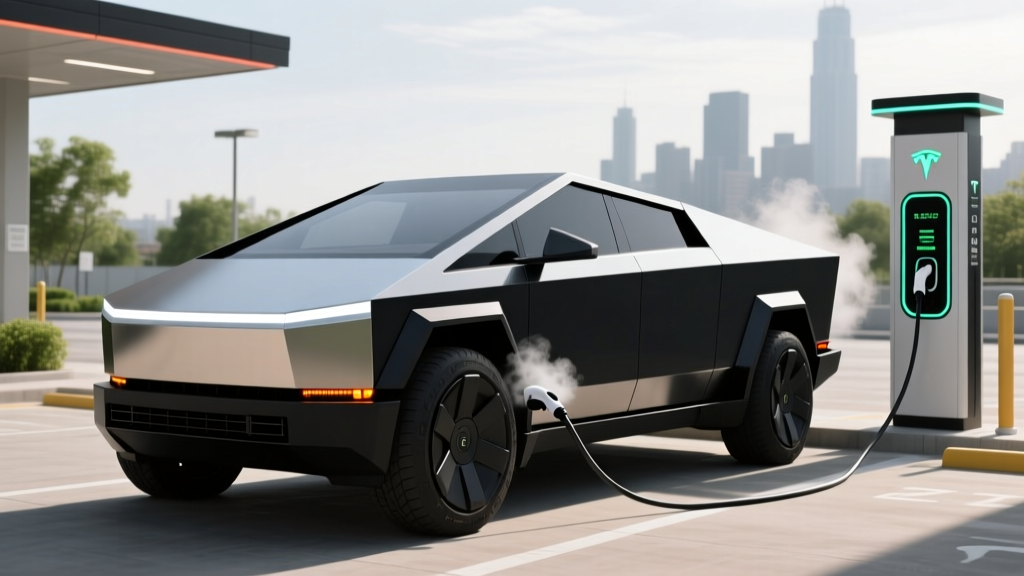
Search "Cybertruck fire" and you'll find a handful of dramatic videos: a prototype engulfed during early testing, a 2024 incident in California, and scattered social-media alarm. But context matters. With over 130,000 Cybertrucks on US roads as of early 2026, the actual fire incidence rate remains well below the national average for internal-combustion vehicles (roughly 1 fire per 1,000 gas cars annually, per NHTSA data). This review examines the real engineering, the actual safety record, and whether thermal-event risk should factor into your 2026 purchase decision.
Range, Battery Chemistry, and the Thermal-Runaway Question
The 2026 Cybertruck uses a structural 4680-cell battery pack with an NMC (nickel-manganese-cobalt) chemistry—chosen for energy density over the LFP chemistry Tesla uses in base Model 3/Y. The usable capacity is approximately 123 kWh across AWD and Cyberbeast trims (the base RWD, announced for late 2026, is expected to use a smaller pack).
- AWD trim: EPA 340 miles — expect 270-290 mi at sustained 75 mph highway speeds; 220-250 mi in sub-30°F cold with cabin heat.
- Cyberbeast: EPA 320 miles — expect 250-270 mi highway; 200-230 mi in freezing conditions.
- Foundation Series: EPA 320 miles — similar to Cyberbeast; added weight from accessories reduces efficiency.
The stainless-steel exoskeleton provides no thermal insulation benefit; cold-weather range loss is comparable to other large NMC packs (~25-30%).
Charging Speed: Peak kW vs. Sustained Curve
The Cybertruck supports an 800-volt architecture and peaks at 250 kW on V3 Superchargers. However, as with all large packs, the charge curve tapers aggressively above 60% state of charge to manage cell temperature—this is protective engineering, not a flaw.
| Charging Method | Peak Power | Typical Speed | Notes |
|---|---|---|---|
| DC Fast Charge (V3 Supercharger) | 250 kW | 10-80% in ~28 minutes | Sustains 200+ kW only to ~50% SoC, then tapers |
| DC Fast Charge (third-party 350 kW) | 250 kW (capped) | 10-80% in ~30 minutes | Vehicle limits intake; no benefit from higher-cap stalls |
| Level 2 Home (48A / 11.5 kW) | 11.5 kW | ~36 miles per hour | Full 0-100% in ~11 hours; requires 60A circuit |
| Level 2 Home (32A / 7.7 kW) | 7.7 kW | ~24 miles per hour | Full 0-100% in ~16 hours; works on 40A circuit |
| Level 1 (120V / 12A) | 1.4 kW | ~4 miles per hour | Emergency only; impractical for daily use |
Thermal management note: The Cybertruck's active liquid cooling system preconditioning the pack before DC fast charging is standard behavior. If you navigate to a Supercharger via the built-in nav, the vehicle begins warming cells 10-15 minutes before arrival—this reduces thermal stress during high-rate charging and is one reason fire incidents at chargers are statistically rare.
Performance, Efficiency, and Towing Reality
| Spec | AWD | Cyberbeast |
|---|---|---|
| 0-60 mph | 3.9 seconds | 2.6 seconds |
| Horsepower | 600 hp (dual motor) | 845 hp (tri-motor) |
| Drivetrain | AWD (2 motors) | AWD (3 motors) |
| Efficiency | 2.0 kWh/mi (50 MPGe) | 2.1 kWh/mi (48 MPGe) |
| Towing Capacity | 11,000 lbs | 11,000 lbs |
| Payload | 2,500 lbs | 2,500 lbs |
Efficiency is the Cybertruck's weak point. At 2.0-2.1 kWh per mile, it consumes roughly 40% more energy per mile than a Rivian R1T (1.4 kWh/mi) and double a Ford F-150 Lightning Extended Range (1.5 kWh/mi). The angular stainless-steel body creates significant aerodynamic drag (estimated Cd ~0.42, though Tesla has not published an official figure). For owners paying $0.15/kWh at home, that's $0.30 per mile in electricity—competitive with a 20 MPG gas truck at $3.00/gallon, but not the "fuel savings" EVs typically promise.
Pricing, Tax Credits, and Total Cost
| Trim | Base MSRP | §30D Credit Eligibility | Effective Price (if eligible) |
|---|---|---|---|
| RWD (announced, late 2026) | $60,990 (est.) | Likely eligible (under $80K truck cap) | ~$53,490 |
| AWD | $79,990 | Eligible (at $80K truck cap) | ~$72,490 |
| Cyberbeast | $99,990 | Not eligible (exceeds $80K truck MSRP cap) | $99,990 |
| Foundation Series (limited) | $119,990 | Not eligible | $119,990 |
Tax credit caveats (2026 rules): The §30D credit for trucks is capped at $80,000 MSRP. The AWD trim at $79,990 squeaks in, but any dealer-installed accessories pushing the final price above $80K disqualify it. Buyer income caps also apply: $300K joint / $225K head-of-household / $150K single (modified AGI). Battery component and critical-mineral sourcing requirements must also be met—Tesla's US-assembled packs have largely complied, but the IRS eligible-models list should be verified at purchase time. Point-of-sale transfer is available, reducing the purchase price directly.
Safety Record: Fire Incidents in Context
As of Q1 2026, the Cybertruck has been involved in approximately 3-4 publicly documented fire incidents out of 130,000+ units delivered. That's an incidence rate of roughly 0.003%—or 1 in 32,500 vehicles. For comparison:
- Gas vehicles: ~1 fire per 1,000 vehicles annually (per NHTSA)
- Overall EV fleet (all brands): ~1 fire per 4,000 vehicles (per Swedish Civil Contingencies Agency, 2023 data)
- Cybertruck to date: ~1 per 32,500
The 4680 cells use a tabless design that Tesla claims improves thermal distribution. The structural pack is bonded into the chassis, which complicates post-crash firefighting (a known challenge with all structural packs, including those in the BMW iX and Tesla Model Y). However, no NHTSA recall specific to Cybertruck battery fire risk has been issued as of early 2026. The single 2024 incident most commonly cited in "Cybertruck fire" searches involved a collision with a concrete barrier at highway speed—a scenario where any high-energy battery pack faces thermal risk.
Cargo, Interior, and Daily Usability
The 6-foot bed offers 67 cu ft of volume with the tonneau cover closed (the powered cover is standard, a $2,000 value elsewhere). The vault includes a 120V and 240V outlet (up to 11.5 kW continuous output via Powershare, sufficient for job-site tools or home backup). Cabin space is tight for a full-size truck: rear legroom measures 34.2 inches, compared to 43.6 inches in the F-150 Lightning. The 18.5-inch center touchscreen runs Tesla's latest software, but the yoke-style steering wheel (now optional alongside a round wheel) and lack of physical stalks remain polarizing. Autopilot (Level 2 SAE driver assist) is standard; Full Self-Driving (Supervised) is a $8,000 add-on but requires full driver engagement at all times.
Who Should Buy It (and Who Shouldn't)
Buy if: You need a 11,000-lb tow rating with EV torque, want Powershare for job-site or backup power, accept the efficiency penalty for the design, and value the Supercharger network (now NACS-standard across the industry).
Skip if: You prioritize range efficiency, need full-size crew-cab rear seat room, want a proven 8-year track record, or require a sub-$60K price point. The Rivian R1T offers better efficiency and interior space; the F-150 Lightning offers lower pricing and conventional truck ergonomics.
Warranty and Long-Term Ownership
Tesla covers the battery and drive units for 8 years or 120,000 miles (whichever comes first), with a 70% capacity retention threshold. The limited vehicle warranty is 4 years / 50,000 miles. Replacement pack cost, if out of warranty, is estimated at $20,000-$28,000 based on current 4680 cell pricing—though this figure will likely decline as cell manufacturing scales. Insurance premiums run 25-40% above comparable F-150 Lightning rates, driven by stainless-steel panel repair complexity and high claim severity.
Frequently Asked Questions
Is the Cybertruck a fire risk compared to other EVs?
Current data (2024-2026) shows the Cybertruck's fire incidence rate at approximately 1 in 32,500 units—significantly lower than gas vehicles and comparable to or better than the broader EV fleet. No NHTSA recall for battery fire risk has been issued. The 4680 cells and structural pack have not shown systemic thermal-runaway patterns.
What's the real-world range on a road trip?
Plan for 250-270 miles between charges at 75 mph in mild weather for the AWD trim. In winter (sub-30°F), reduce that to 200-230 miles. The 340-mile EPA figure assumes mixed city/highway driving at moderate speeds.
Does it qualify for the $7,500 federal tax credit?
The AWD trim at $79,990 qualifies if you meet income caps ($300K joint / $150K single) and the battery sourcing requirements are met at time of purchase. The Cyberbeast and Foundation Series exceed the $80K MSRP cap for trucks and do not qualify. Verify on IRS.gov before purchase.
How does it compare to the F-150 Lightning and Rivian R1T?
The Lightning wins on price ($55K-$90K), rear-seat room, and conventional ergonomics. The R1T wins on efficiency (1.4 kWh/mi vs. 2.0), interior quality, and off-road capability. The Cybertruck wins on tow rating (11,000 lbs vs. 10,000 for Lightning, 11,000 for R1T), Powershare output, and Supercharger access (though CCS adapters now open other networks to non-Tesla EVs).
Should I wait for the RWD base model?
If you don't need AWD or tri-motor performance, the $60,990 RWD (expected late 2026) would qualify for the full $7,500 credit, bringing the effective price to ~$53,490. However, range is expected to be ~250 miles EPA, and availability is unconfirmed.