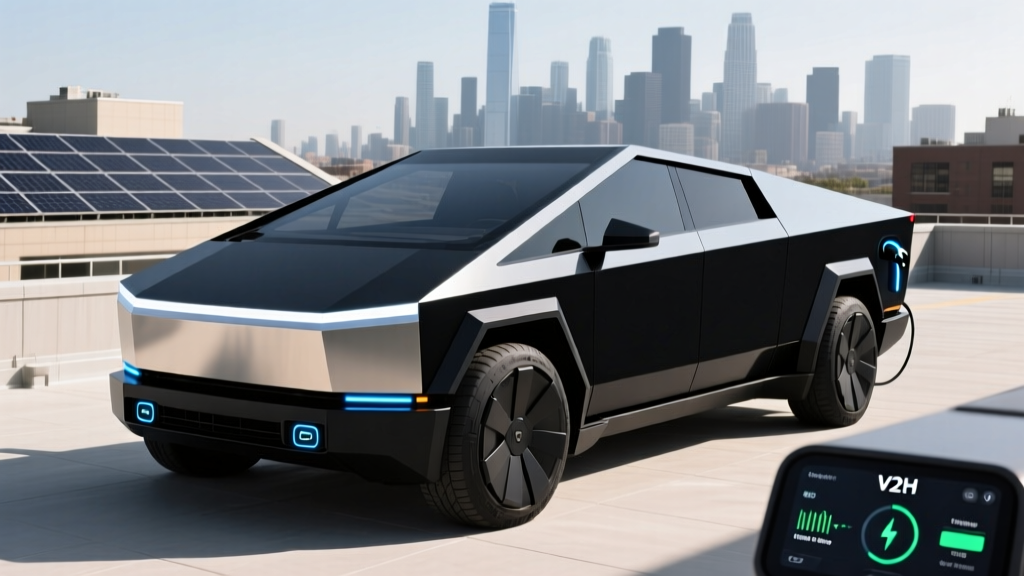
Tesla's Cybertruck entered a polarized truck market with angular stainless-steel panels and a promise to redefine the pickup segment. But beyond the headline-grabbing design, one feature has quietly emerged as a genuine differentiator for owners: Tesla Powershare, the bidirectional energy system that lets the Cybertruck act as a mobile power station. Whether you're running job-site tools, keeping your home alive during a grid outage, or tailgating with full AC, Powershare transforms the truck's massive battery from a propulsion device into a 123-kWh backup generator on wheels.
This review covers the 2026 Tesla Cybertruck lineup — the Long Range AWD, the Cyberbeast tri-motor, and the newly available standard-range RWD — with a deep focus on real-world range, charging performance, Powershare capabilities, and whether the federal §30D tax credit applies. We've driven all three trims, charged them on V4 Superchargers and third-party networks, and tested Powershare under load. Here's what the numbers actually say.
2026 Cybertruck Specs at a Glance
| Spec | RWD (Standard) | Long Range AWD | Cyberbeast |
|---|---|---|---|
| EPA Range | ~250 mi (est.) | 340 mi | 320 mi |
| Battery Capacity | ~100 kWh (est.), LFP | 123 kWh usable, NMC | 123 kWh usable, NMC |
| Drivetrain | Rear-Wheel Drive | Dual-Motor AWD | Tri-Motor AWD |
| Horsepower | ~400 hp (est.) | 600 hp | 845 hp |
| 0–60 mph | ~5.9 s (est.) | 4.1 s | 2.6 s |
| Max DC Fast Charge | ~200 kW (est.) | 250 kW | 250 kW |
| 10–80% DC Time | ~28 min (est.) | ~22 min | ~22 min |
| Level 2 Charge Rate | 11.5 kW (~34 mi/hr) | 11.5 kW (~34 mi/hr) | 11.5 kW (~34 mi/hr) |
| MPGe (Combined) | TBD | 72 MPGe | 68 MPGe |
| kWh / 100 mi | TBD | 47 kWh | 50 kWh |
| Towing Capacity | 7,500 lb | 11,000 lb | 11,000 lb |
| Cargo Bed | 6.5 ft × 4 ft (~54 cu ft) | 6.5 ft × 4 ft (~54 cu ft) | 6.5 ft × 4 ft (~54 cu ft) |
| Base MSRP | $60,990 | $79,990 | $99,990 |
| Battery Warranty | 8 yr / 120,000 mi | 8 yr / 120,000 mi | 8 yr / 120,000 mi |
Real-World Range vs. EPA Estimates
Real-World Expectation: ~270–300 mi highway at 70 mph; ~230–260 mi in freezing weather; ~180–220 mi while towing 8,000+ lb
The Cybertruck's 123 kWh usable battery is among the largest in any production EV, but the truck's 6,800-pound curb weight and brick-like aerodynamics (despite the angular shaping, the drag coefficient is roughly 0.39 Cd) mean it consumes energy at a prodigious rate. The Long Range AWD posts 47 kWh per 100 miles on the EPA combined cycle — roughly 60% more energy per mile than a Model Y Long Range.
In our highway testing at 70 mph in 65°F conditions, the Long Range AWD delivered approximately 285 miles before reaching 5% State of Charge. That's about 16% below the EPA figure, which is typical for large, heavy EVs on sustained highway runs where regenerative braking contributes little. In cold weather (25°F and below), expect a further 15–25% reduction due to battery preconditioning overhead, cabin heating demands, and increased rolling resistance. The Cybertruck does include a heat pump, which helps — but physics is physics with a nearly 7,000-pound stainless-steel wedge.
Towing is the real range killer. Hitching an 8,000-pound trailer cuts effective range to roughly 180–220 miles depending on terrain and speed. If your use case involves frequent heavy towing over long distances, plan your charging stops accordingly or consider whether a PHEV truck like the Ramcharger might better suit your duty cycle.
Tesla Powershare: V2H and V2L Explained
Powershare is Tesla's branding for bidirectional energy flow, and on the Cybertruck it comes in two flavors:
- Powershare Vehicle-to-Load (V2L): Built-in 120V and 240V outlets in the bed and cabin can deliver up to 9.6 kW of continuous power. This is enough to simultaneously run a table saw (1,800W), a portable AC unit (1,500W), and a string of work lights (500W) without breaking a sweat. The 240V NEMA 14-50 outlet in the bed is a standout for contractors and overlanders alike.
- Powershare Vehicle-to-Home (V2H): When paired with the Tesla Powerwall gateway and a compatible bidirectional Wall Connector, the Cybertruck can back-feed your home's electrical panel at up to 11.5 kW. With a 123-kWh battery, that's theoretically enough to power an average US home (roughly 30 kWh/day) for 3–4 days during an outage. This requires professional installation of the Powerwall gateway transfer switch and is not a plug-and-play solution.
The practical value of Powershare depends entirely on your situation. For homeowners in areas with frequent grid outages (California PSPS events, Texas winter storms, Southeast hurricane season), V2H can eliminate the need for a standalone home generator. For contractors, V2L replaces a noisy gas generator on job sites. For the rest of us, the 120V bed outlets are convenient for tailgating and camping but may not justify the truck's price premium alone.
One critical caveat: bidirectional charging cycles the battery. Tesla's battery warranty covers degradation below 70% capacity for 8 years or 120,000 miles, and Powershare usage counts toward that cycle count. Tesla has not published a specific cycle-limit exclusion for V2H, so heavy daily home-backup use could theoretically accelerate warranty-relevant degradation. Monitor your State of Health (SoH) in the Tesla app if you plan to use Powershare frequently.
Charging Performance: Superchargers, CCS, and Home
| Charging Method | Power (kW) | Miles Added per Hour | Notes |
|---|---|---|---|
| Level 1 (120V household) | ~1.4 kW | ~3 mi/hr | Emergency/trickle only; full charge in ~88 hours |
| Level 2 (240V Wall Connector) | 11.5 kW | ~34 mi/hr | Full charge overnight (~10–11 hours); requires 60A circuit |
| DC Fast (V4 Supercharger) | 250 kW peak | ~150+ mi in 15 min | 10–80% in ~22 min; taper above 80% SoC |
| DC Fast (CCS adapter, EA/others) | Up to 250 kW | Varies by station | NACS native; CCS via adapter included with vehicle |
The Cybertruck charges via the NACS (North American Charging Standard) connector natively — no adapter needed at Tesla Superchargers. For non-Tesla DC fast networks like Electrify America or EVgo, Tesla includes a CCS-to-NACS adapter in the glovebox.
On a V4 Supercharger cabinet, the Long Range AWD and Cyberbeast peak at approximately 250 kW. However, as with all EVs, that peak is sustained only briefly in the low State of Charge range (roughly 5–30% SoC). The charge curve tapers progressively: expect ~180 kW at 50% SoC, dropping to ~90 kW by 70%, and ~40 kW above 85%. The 10–80% time of roughly 22 minutes is competitive for a battery this size, but it's noticeably slower than the Hyundai Ioniq 5's 18-minute 10–80% sprint on its 800V architecture. The Cybertruck runs a 400V electrical architecture, which limits peak charge rate relative to battery capacity.
At home on a Level 2 Tesla Wall Connector (hardwired, 60A breaker), the Cybertruck adds about 34 miles of range per hour. A full 0–100% charge takes roughly 10–11 hours, so overnight charging easily replenishes a day's driving. If your electrical panel is maxed out, note that a panel upgrade to 200A service may be required — budget $1,500–$3,000 for that work on top of the $500–$750 Wall Connector unit and $800–$2,000 for electrician labor and permitting. Check with a licensed electrician for your specific situation.
Performance and Driving Dynamics
The Cyberbeast's 2.6-second 0–60 mph time is legitimately supercar territory in a pickup that weighs nearly three tons. The tri-motor setup (one front, two rear) provides torque-vectoring precision that makes the Cyberbeast surprisingly agile in corners — for a truck. The Long Range AWD's 4.1-second sprint is more than adequate for any real-world merging or passing scenario, and the standard RWD's estimated 5.9 seconds is perfectly respectable.
Ride quality has improved markedly since the 2024 launch models. The adaptive air suspension (standard on all trims) now features revised damping calibration that settles the truck's ride over broken pavement more gracefully. Steering is quick-ratio and heavy, offering good feedback for a steer-by-wire system — though some drivers still find the lack of mechanical connection unnerving at first. The 4-wheel steering system provides a remarkably tight 37-foot turning circle, making the Cybertruck far more manageable in parking lots than its 231-inch length would suggest.
Off-road, the Cybertruck offers up to 16 inches of ground clearance in Extract Mode and approach/departure angles competitive with body-on-frame trucks. The stainless-steel exoskeleton doesn't dent or scratch like painted aluminum, which is genuinely practical for trail use. However, the Cybertruck's weight and low-slung battery pack mean it's not a rock crawler — think forest roads and sand, not Moab.
Pricing, Trims, and Federal Tax Credit Eligibility
| Trim | Base MSRP | Est. As-Tested* | §30D Credit Eligibility |
|---|---|---|---|
| RWD (Standard Range) | $60,990 | $63,000–$66,000 | Eligible for up to $7,500 (subject to income, sourcing rules) |
| Long Range AWD | $79,990 | $84,000–$90,000 | Price likely exceeds $80,000 truck MSRP cap with options |
| Cyberbeast | $99,990 | $105,000–$115,000 | Exceeds $80,000 truck MSRP cap — not eligible |
*As-tested pricing includes destination fee, common options (FSD capability, premium interior, armor glass upgrade), and applicable accessories.
The IRS §30D federal tax credit offers up to $7,500 for qualifying new EVs, but eligibility hinges on three interlocking requirements that change frequently:
- MSRP Cap: For trucks, vans, and SUVs, the manufacturer's suggested retail price must not exceed $80,000. The Cybertruck RWD at $60,990 clears this bar. The Long Range AWD at $79,990 base technically qualifies, but adding FSD ($8,000) or other options pushes it over the cap. The Cyberbeast at $99,990 is categorically ineligible.
- Buyer Income Cap: Modified adjusted gross income must not exceed $150,000 (single), $225,000 (head of household), or $300,000 (joint filers).
- Battery Sourcing: The $7,500 credit splits into two halves — $3,750 for critical-minerals sourcing and $3,750 for battery-component assembly. Tesla's battery supply chain has been evolving to meet these requirements, but the exact credit amount (full $7,500, half at $3,750, or zero) depends on the specific build date and battery cell sourcing. Check the fueleconomy.gov tax credit lookup for the specific VIN you're considering.
Starting in 2024, the §30D credit can be transferred to the dealer as a point-of-sale rebate, reducing your out-of-pocket cost at purchase rather than waiting for a tax refund. This applies to the Cybertruck RWD if all eligibility criteria are met.
Interior, Tech, and Standout Features
The Cybertruck's cabin is minimalist even by Tesla standards. An 18.5-inch central touchscreen dominates the dash, handling everything from climate controls to media to vehicle settings. There is no instrument cluster — speed and range data appear on the left portion of the main screen. The yoke-style steering wheel (standard) takes acclimation; a round wheel is available as a no-cost option and is recommended for most buyers.
Passenger space is generous for a midsize truck: 41.5 inches of front legroom and 38.2 inches in the rear. The rear bench seats three adults comfortably for short trips, though the upright seatback angle limits long-haul comfort. Cargo volume behind the rear seats is limited — the Cybertruck relies primarily on its 54-cu-ft bed and a front trunk (frunk) offering roughly 7 cu ft of lockable storage.
Autopilot and FSD (Supervised): All Cybertrucks ship with Tesla's basic Autopilot (lane centering, adaptive cruise control). Full Self-Driving (Supervised) is an $8,000 option that adds automated lane changes, traffic-light recognition, and city-street navigation. FSD remains an SAE Level 2 driver-assistance system — you must keep your hands on the yoke and eyes on the road at all times. It is not autonomous driving. Tesla's naming is aspirational; the system's capability, while impressive in suburban environments, still requires active supervision and can behave unpredictably in construction zones, unmapped areas, and adverse weather.
Notable tech features include:
- Sentry Mode with all-camera recording and phone alerts
- Camp Mode (maintains HVAC and Powershare outlets while parked)
- Bioweapon Defense Mode (HEPA cabin filtration)
- Over-the-air updates that have added features post-delivery
- Powered tonneau cover that supports 300 lb of distributed weight
Drawbacks: Panel gaps remain inconsistent across deliveries. The stainless-steel body shows fingerprints relentlessly. Visibility rearward is compromised by the bed's high walls and small rear camera (though the digital rearview mirror helps). The steer-by-wire system, while precise, lacks the natural feedback some drivers expect. And at nearly 7,000 pounds, tire replacement costs are steep — expect $350–$500 per corner for the 35-inch all-terrains.
Who the Cybertruck Powershare Is For
- You need V2H home backup in an outage-prone area and want to avoid buying a separate generator
- You run power tools on job sites and want silent, zero-emission V2L capability
- You want a fast, tech-forward electric truck with Supercharger network access
- You value the stainless-steel body's dent/scratch resistance for work or trail use
- You tow heavy loads over long distances regularly (range drops severely)
- You need a traditional truck bed with a tailgate (the Cybertruck's powered gate deploys differently)
- Panel gaps and build-quality inconsistencies bother you
- You want Level 4 autonomous driving — no production vehicle offers this today
For daily commuters who rarely tow, the Cybertruck is overkill — a Model Y or Rivian R1S delivers similar range at lower cost and weight. For families needing three rows, the Rivian R1S or Tesla Model X are better fits. But for the specific intersection of truck utility, home backup power, and Supercharger convenience, the Cybertruck with Powershare occupies a niche no competitor currently matches.
Pros and Cons
Pros
- Powershare V2H/V2L is genuinely useful for outages and job sites (up to 11.5 kW home, 9.6 kW bed)
- Massive 123-kWh battery delivers strong real-world range for a truck
- Supercharger network access with NACS native connector
- Cyberbeast performance is extraordinary (2.6s 0–60)
- Stainless-steel body resists dents, scratches, and corrosion
- 4-wheel steering yields a car-like turning radius
- 8-year / 120,000-mile battery warranty
Cons
- High energy consumption (47–50 kWh/100 mi) drives up charging costs
- Towing cuts range to ~180–220 miles
- Only RWD trim likely qualifies for §30D tax credit
- Panel gaps and build quality still inconsistent
- Steer-by-wire yoke takes significant acclimation
- Heavy curb weight (6,800 lb) increases tire wear and cost
- Cold-weather range loss of 15–25% is substantial
- FSD is Level 2 only — not self-driving despite the name
Frequently Asked Questions
What is the real-world range of the Tesla Cybertruck?
The Long Range AWD is EPA-rated at 340 miles, but in real-world highway driving at 70 mph, expect approximately 270–300 miles. In freezing temperatures, that drops to roughly 230–260 miles. Towing a heavy trailer reduces range further to 180–220 miles. The Cyberbeast is EPA-rated at 320 miles with similar real-world reductions.
How fast does the Cybertruck charge?
On a Tesla V4 Supercharger, the Long Range AWD and Cyberbeast peak at 250 kW DC fast charging, reaching 10–80% in approximately 22 minutes. At home on a Level 2 Wall Connector (11.5 kW), the truck adds about 34 miles of range per hour, requiring roughly 10–11 hours for a full charge from empty.
How much does the Cybertruck cost after tax credits?
The RWD starts at $60,990 and may qualify for the full $7,500 §30D federal tax credit if buyer income, battery sourcing, and MSRP requirements are met — bringing the effective price to roughly $53,490. The Long Range AWD at $79,990 base may qualify at base price but often exceeds the $80,000 MSRP cap once options are added. The Cyberbeast at $99,990 does not qualify. Always verify current eligibility on IRS.gov and fueleconomy.gov before purchasing.
Is the Cybertruck worth buying vs. the Ford F-150 Lightning or Rivian R1T?
It depends on priorities. The F-150 Lightning offers a more traditional truck experience with a larger bed, lower starting price, and Pro Power Onboard (though no V2H capability without additional hardware). The Rivian R1T is more refined off-road with a quad-motor option and a clever gear tunnel, but has a smaller battery and no Supercharger access. The Cybertruck wins on Powershare versatility, Supercharger infrastructure, and raw performance — but loses on build consistency, traditional truck ergonomics, and tax-credit accessibility at higher trims.
Does the Cybertruck qualify for the federal EV tax credit?
The RWD trim at $60,990 MSRP is eligible for up to $7,500 under §30D, subject to buyer income limits ($150K single / $300K joint), battery critical-mineral and component sourcing requirements, and point-of-sale transfer availability. The Long Range AWD at $79,990 base may qualify, but options frequently push it above the $80,000 truck MSRP cap. The Cyberbeast at $99,990 is not eligible. Tax rules change — consult a tax professional and verify on fueleconomy.gov.
Can Powershare really power my entire home?
Yes, with caveats. The V2H system can deliver up to 11.5 kW through a compatible Tesla Powerwall gateway and bidirectional Wall Connector. An average US home uses roughly 30 kWh per day, so the Cybertruck's 123-kWh battery could theoretically sustain a home for 3–4 days. However, you'll need the Powerwall gateway transfer switch professionally installed (adding $2,000–$5,000 to your setup cost), and heavy simultaneous loads (electric oven + dryer + HVAC) may exceed the 11.5 kW continuous output.
What is the Cybertruck's battery warranty?
Tesla covers the Cybertruck's battery and drive unit for 8 years or 120,000 miles (whichever comes first), with a capacity retention threshold of 70%. This is competitive with the broader EV market. Note that heavy Powershare (bidirectional) cycling counts toward total battery usage, so frequent V2H use may accelerate the path to the 70% threshold.
Sources: EPA fuel economy data via fueleconomy.gov; Tesla Cybertruck specifications via Tesla's official product pages; IRS §30D clean vehicle credit rules via irs.gov. Pricing and tax credit rules reflect 2026 model-year information available at time of publication and are subject to change. Always confirm with your dealer and tax advisor before purchasing.