Verdict: The Cybertruck Is a Power Plant That Happens to Drive
If you're searching for Tesla Cybertruck PowerShare home backup capabilities, you're looking at one of the most capable vehicle-to-home (V2H) systems on the North American market. The Cybertruck's 123 kWh battery pack doesn't just deliver 325+ miles of EPA range — it can sustain an average American home for roughly 3 to 4 days during an outage. But the Cybertruck remains a polarizing vehicle: blistering performance and unmatched utility tech come wrapped in a stainless-steel exoskeleton that divides opinion and a price tag that pushes well into luxury territory. This review breaks down every number that matters for 2026 buyers.
Spec Table: 2026 Tesla Cybertruck at a Glance
| Specification | AWD | Cyberbeast |
|---|---|---|
| EPA Range | 340 mi | 320 mi |
| Battery (usable) | ~123 kWh, NMC (4680 cells) | |
| Peak DC Fast Charge | 350 kW (800V architecture) | |
| 10–80% DC Charge Time | ~18 min (preconditioned) | |
| Level 2 Home Charge | 11.5 kW / ~37 mi/hr | |
| 0–60 mph | 3.9 sec | 2.6 sec |
| Horsepower | 600 hp | 845 hp |
| Drivetrain | Dual-motor AWD | |
| Towing Capacity | 11,000 lbs | |
| MPGe (combined) | 67 MPGe | 63 MPGe |
| Efficiency | 50 kWh/100mi | 53 kWh/100mi |
| Base MSRP (2026) | $79,990 | $99,990 |
| Battery/Drive Unit Warranty | 8 yr / 120,000 mi | |
| PowerShare Output | Up to 11.5 kW continuous (V2H/V2L) | |
Range and Efficiency: Real-World Numbers Behind the EPA Sticker
The EPA rates the dual-motor AWD Cybertruck at 340 miles and the tri-motor Cyberbeast at 320 miles. Those figures assume a mix of city and highway driving at moderate temperatures. Real-world results differ — sometimes substantially.
- City/suburban (mild weather): 310–340 mi — regenerative braking recovers energy in stop-and-go traffic.
- Highway (70–75 mph, mild): 260–290 mi — the Cybertruck's 6,600+ lb curb weight and brick-like aerodynamics punish efficiency at speed. Expect ~50 kWh/100mi or worse.
- Cold weather (below 32°F, highway): 200–240 mi — battery conditioning and cabin heating can reduce range 25–40%. The heat pump helps, but physics wins.
- Towing (5,000–8,000 lb trailer): 150–190 mi — plan charging stops accordingly.
Source: fueleconomy.gov
Efficiency is the Cybertruck's weakest spec-sheet category. At roughly 50 kWh per 100 miles, it consumes significantly more energy per mile than a Model Y (28 kWh/100mi) or a Rivian R1T (42 kWh/100mi). For home-backup use, though, that large battery is precisely what makes PowerShare so effective.
Charging Speed: 800V Architecture Pays Off
The Cybertruck uses Tesla's 4680-cell battery on an 800V architecture, enabling peak DC fast-charge rates up to 350 kW at V4 Superchargers. In practice, sustained rates taper as state of charge (SoC) climbs.
| Charging Level | Power | Speed / Notes |
|---|---|---|
| Level 1 (120V) | ~1.4 kW | ~4 mi/hr — emergency trickle only |
| Level 2 (240V, 48A) | 11.5 kW | ~37 mi/hr — full charge in ~11 hours |
| DC Fast (V4 Supercharger) | Peak 350 kW | 10–80% in ~18 min; tapers above 80% |
| DC Fast (CCS adapter, 3rd-party) | Up to 250 kW | 10–80% in ~25 min at non-Tesla networks |
Charging curve reality: The 350 kW peak holds roughly from 10% to 40% SoC, then tapers to ~200 kW through 60%, and drops further above 80%. If you're road-tripping, plan to charge to 80% and go — the last 20% adds 15+ minutes. Preconditioning the battery via the navigation system is essential for achieving peak rates in cold weather.
PowerShare Home Backup: How It Actually Works
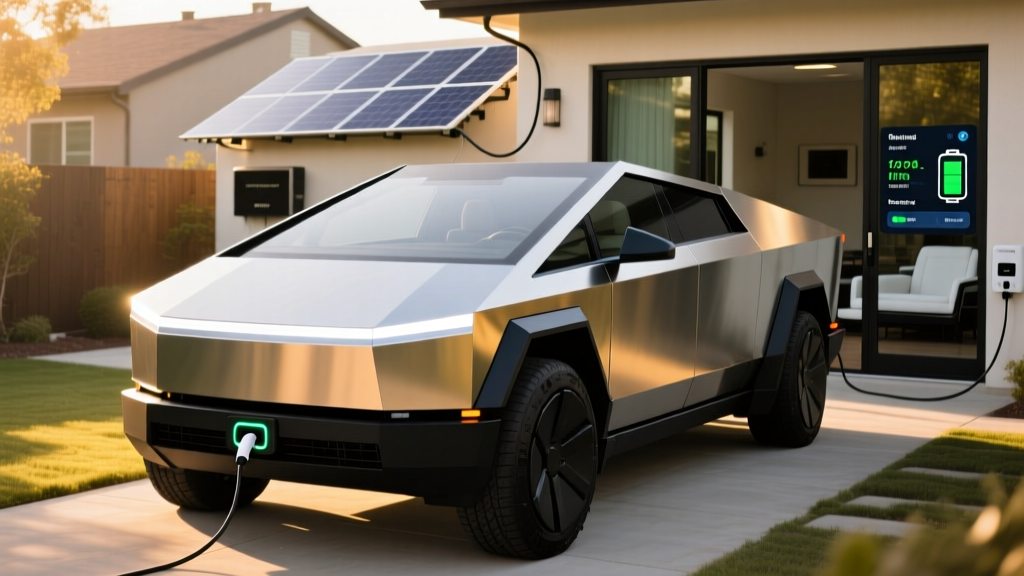
This is the feature driving many Cybertruck purchases. Tesla's PowerShare system enables bidirectional charging — the truck can push energy back out through its outlets or through a Tesla Wall Connector with PowerShare integration to your home's electrical panel.
PowerShare Capabilities
- Vehicle-to-Home (V2H): Up to 11.5 kW continuous output via a Tesla Wall Connector paired with a Tesla Gateway (similar to Powerwall integration). This can run essential circuits — refrigerator, lights, HVAC fan, well pump, internet — or, with load management, an entire modest home.
- Vehicle-to-Load (V2L): Built-in 120V and 240V outlets in the bed and cabin deliver up to 9.6 kW for tools, appliances, or job-site equipment without any additional hardware.
- Duration: A 123 kWh battery at 11.5 kW output provides roughly 10 hours at full draw, or 3–4 days at typical home backup loads (2–4 kW average).
What You Need for Home Backup
To use the Cybertruck as a home backup system, you'll need:
- A Tesla Wall Connector with PowerShare (~$550 for the unit).
- A Tesla Gateway transfer switch (~$450) installed at your electrical panel to isolate backup circuits and prevent back-feeding the grid.
- A licensed electrician to install the gateway and configure circuits. Expect $1,500–$3,500 for installation depending on panel complexity and whether a main-panel upgrade (200A to 400A) is needed.
Total setup cost for V2H typically lands between $2,500 and $4,500 — significantly less than a Tesla Powerwall installation ($12,000–$18,000 installed) while offering comparable energy capacity.
PowerShare vs. Standalone Home Battery
| Feature | Cybertruck PowerShare | Tesla Powerwall 3 |
|---|---|---|
| Usable Energy | ~123 kWh (vehicle battery) | 13.5 kWh |
| Continuous Output | 11.5 kW | 11.5 kW |
| Installed Cost | $2,500–$4,500 (gateway + install) | $12,000–$18,000 |
| Available When Vehicle Is Away? | No | Yes |
| 30% Federal Tax Credit (standalone storage) | No (vehicle purchase only) | Yes (IRC §25D) |
The trade-off is clear: PowerShare gives you far more energy for far less money, but only when the truck is home and plugged in. If your outages are predictable (storms, grid alerts), you can plan to keep the truck connected. For always-on backup, a Powerwall remains the dedicated solution.
Performance, Towing, and Practicality
The Cybertruck's performance numbers are supercar-tier. The AWD model hits 60 mph in 3.9 seconds with 600 hp; the Cyberbeast drops that to 2.6 seconds with 845 hp. Air suspension provides up to 16 inches of ground clearance and adjusts automatically for highway efficiency or off-road terrain.
Cargo and Dimensions
- Bed length: 6 ft (with tailgate closed); extends to 8 ft with tailgate down
- Bed width: 4 ft between wheel wells
- Lockable bed storage (vault): 67 cu ft
- Frunk: 7 cu ft
- Rear-seat legroom: 38.2 inches (adequate for adults on shorter trips, tight for tall passengers on long hauls)
- Curb weight: ~6,650 lbs (AWD) / ~6,850 lbs (Cyberbeast)
Towing capacity is rated at 11,000 lbs, competitive with full-size gas pickups. However, towing cuts range roughly in half — plan for 150–190 miles between charges with a heavy trailer. The integrated trailer brake controller and rear-view camera system help, but the Cybertruck is not a semi-truck replacement for daily heavy towing.
Driver-Assist Technology
Tesla's Autopilot comes standard with adaptive cruise control, lane centering, and automatic emergency braking. Full Self-Driving (Supervised) is available as a paid add-on for $8,000 or $99/month.
Despite the "Full Self-Driving" name, Tesla FSD (Supervised) is an SAE Level 2 driver-assistance system. The driver must remain fully attentive, hands on or near the wheel, and ready to take over at any moment. It is not a self-driving system. Only Level 4 robotaxi services like Waymo operate without a human driver.
Pricing, Trims, and Federal Tax Credit Eligibility
The 2026 Cybertruck lineup carries premium pricing. Here's what buyers face before incentives:
| Trim | Base MSRP | As-Tested (typical options) | §30D Federal Tax Credit |
|---|---|---|---|
| AWD | $79,990 | $84,000–$88,000 | See eligibility below |
| Cyberbeast | $99,990 | $103,000–$108,000 | See eligibility below |
Does the Cybertruck Qualify for the §30D Federal EV Tax Credit?
The answer depends on three moving targets under current IRS rules (irs.gov §30D):
- MSRP cap: Trucks, vans, and SUVs must have an MSRP at or below $80,000. The AWD Cybertruck at $79,990 squeaks under the cap; the Cyberbeast at $99,990 does not qualify.
- Buyer income cap: Modified adjusted gross income must not exceed $150,000 (single), $225,000 (head of household), or $300,000 (joint filing).
- Battery sourcing: A percentage of critical minerals and battery components must be sourced from the U.S. or free-trade-agreement countries. Tesla's 4680 cell supply chain has been evolving — confirm current-year compliance on the IRS eligible vehicles list before purchasing.
- Point-of-sale transfer: Eligible buyers can transfer the credit to the dealer at purchase, reducing the sale price by up to $7,500 rather than waiting for a tax refund.
Bottom line: The AWD trim may qualify for up to $7,500 if you meet income limits and current-year sourcing rules are satisfied. The Cyberbeast is excluded by MSRP. Always verify on fueleconomy.gov before committing, as eligibility can change mid-year based on supply-chain shifts.
Pros and Cons
- 123 kWh battery provides best-in-class V2H home backup (3–4 days)
- 350 kW peak DC charging — among the fastest light-duty trucks available
- Supercar acceleration (2.6 sec Cyberbeast) with full-size truck utility
- Stainless-steel exoskeleton is dent- and corrosion-resistant
- 11,000-lb towing, lockable 67 cu ft bed vault, 48V architecture
- OTA software updates continuously add features
- Poor highway efficiency (~50 kWh/100mi) cuts real-world range sharply
- Towing range drops to 150–190 mi with heavy loads
- Cyberbeast excluded from §30D tax credit due to MSRP cap
- Rear-seat comfort is compromised vs. conventional crew-cab trucks
- Polarizing design limits resale appeal in some markets
- PowerShare V2H requires additional hardware ($2,500–$4,500)
- Insurance premiums run 20–40% higher than comparable pickups
Who Should Buy the Cybertruck (and Who Shouldn't)
- You need home backup power and want a dual-purpose vehicle rather than a standalone battery system
- You want a high-performance electric truck with genuine towing and off-road capability
- You have home Level 2 charging and access to the Supercharger network for road trips
- You value tech-forward features and OTA updates over traditional truck styling
- Maximum range and efficiency are your top priorities (consider the Rivian R1T Dual-Motor or a Chevy Silverado EV 4WT for fleet/commercial)
- You need a comfortable daily-driver rear seat for adults on long trips
- Your budget is under $75,000 — the Cybertruck doesn't play in the affordable EV truck segment
- You tow heavy trailers frequently and can't tolerate 150-mile range between charging stops
Frequently Asked Questions
How long can the Cybertruck power my home during an outage?
With a 123 kWh usable battery and typical home backup loads of 2–4 kW (refrigerator, lights, HVAC fan, router, a few outlets), expect 3 to 4 days of continuous backup. At maximum 11.5 kW draw, you'll deplete the battery in roughly 10 hours. Smart load management via the Tesla Gateway extends runtime significantly.
Can I charge the Cybertruck and power my home at the same time?
No. The system operates in one direction at a time — either charging the battery from the grid/solar or discharging to the home. During an outage when the grid is down, the truck discharges. Once grid power returns, it resumes charging automatically.
Does using PowerShare degrade the battery faster?
Bidirectional cycling adds to total battery throughput, but the 4680 NMC cells are designed for high cycle life. Occasional home backup use (a few outages per year) will have negligible impact on long-term state of health. Daily V2H cycling would accelerate degradation modestly — Tesla's 8-year/120,000-mile battery warranty (minimum 70% capacity retention) provides protection.
How does the Cybertruck compare to the Ford F-150 Lightning for home backup?
The F-150 Lightning Extended Range offers a 131 kWh battery with up to 9.6 kW of Pro Power Onboard output. The Cybertruck's 123 kWh battery and 11.5 kW output are comparable, but the Tesla charges faster (350 kW peak vs. ~150 kW for the Lightning) and has a more integrated V2H ecosystem via the Tesla Gateway. The Lightning has a more conventional truck interior and a lower starting price.
Is the Cybertruck eligible for any state incentives beyond the federal credit?
State incentives vary widely and change frequently. Some states offer rebates, HOV-lane access, or reduced registration fees for EVs. Check your state's energy office or the Alternative Fuels Data Center for current programs in your jurisdiction.
What is the real cost to charge a Cybertruck at home?
At the U.S. average residential electricity rate of ~$0.16/kWh, fully recharging the 123 kWh battery costs approximately $19.70. For context, that delivers 300+ miles of range — equivalent to roughly $50–$60 in gasoline for a comparable gas truck getting 18 MPG. Over a year of 12,000 miles, home charging costs roughly $960 vs. $2,400+ in fuel.