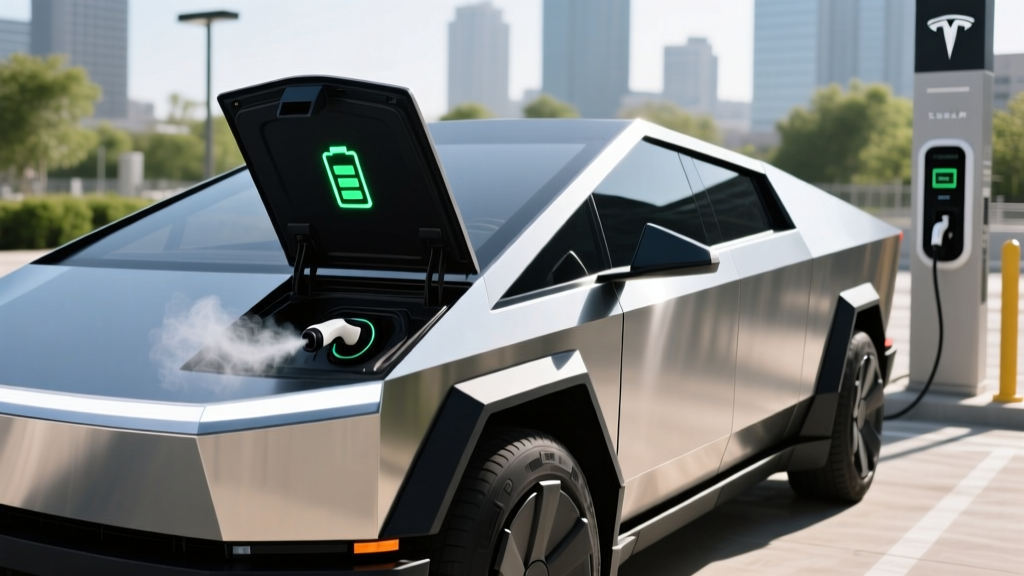
If you own or are considering a Tesla Cybertruck, you've probably asked: Is leaving my Tesla Cybertruck plugged in a long time going to damage the battery? It's one of the most common anxieties among new EV owners, and the Cybertruck's massive stainless-steel presence only amplifies the question. After all, this is a vehicle with up to 123 kWh of usable battery capacity — you want to protect that investment.
The short answer: Yes, leaving your Cybertruck plugged in for extended periods is not only safe but recommended by Tesla, provided you configure your charge limit correctly. The vehicle's Battery Management System (BMS) actively monitors cell temperature, voltage balance, and state of charge (SoC), drawing only what it needs to maintain your target percentage. In this review, we break down exactly what happens when your Cybertruck sits connected to power, along with a full 2026 model-year profile covering range, charging, pricing, and whether this electric truck earns a spot in your driveway.
What Happens When Your Cybertruck Is Plugged In for Days or Weeks
Modern EVs like the Cybertruck don't "overcharge." Once the battery reaches your configured charge limit — say 80% for daily driving or 50% for long-term storage — the onboard charger stops pulling current from the wall. The truck then enters a standby state, drawing only minimal power for thermal management, 12V auxiliary battery maintenance, and Sentry Mode if enabled.
Tesla explicitly recommends keeping your vehicle plugged in when not in use, especially during extreme temperatures. The thermal management system will use shore power (your wall outlet or charger) rather than the traction battery to keep cells within an optimal temperature window. This preserves long-term battery health far better than letting the truck sit unplugged, where the battery must power its own climate regulation — slowly draining SoC in the process.
Key takeaway: The Cybertruck's BMS is designed for continuous connection. The real risk isn't leaving it plugged in — it's leaving it plugged in at 100% SoC for weeks on end with an NMC chemistry pack. Set your charge limit to 50% for storage or 80% for daily use, and you're following best practice.
Cybertruck Specs at a Glance: Range, Battery & Performance
| Specification | AWD | Cyberbeast |
|---|---|---|
| EPA Estimated Range | 340 miles | 320 miles |
| Battery Capacity (Usable) | ~123 kWh (NMC) | ~123 kWh (NMC) |
| Max DC Fast Charge Rate | 250 kW (peak) | 250 kW (peak) |
| 10–80% DC Charge Time | ~30 minutes | ~30 minutes |
| Level 2 Home Charge Rate | 11.5 kW (~34 mi/hr) | 11.5 kW (~34 mi/hr) |
| 0–60 mph | 4.1 seconds | 2.6 seconds |
| Horsepower | 600 hp | 845 hp |
| Drivetrain | Dual-Motor AWD | Tri-Motor AWD |
| MPGe (Combined) | 70 MPGe | 68 MPGe |
| Efficiency (kWh/100 mi) | 48 kWh | 50 kWh |
| Towing Capacity | 11,000 lbs | 11,000 lbs |
| Base MSRP (2026) | $79,990 | $99,990 |
Charging Speed: DC Fast Charging and Home Level 2
The Cybertruck uses the NACS (North American Charging Standard) connector natively — no adapter needed at Tesla Superchargers. It accepts up to 250 kW at V3 and V4 Supercharger stalls, though sustained charge rates taper significantly as SoC climbs.
| Charging Level | Power (kW) | Miles Added Per Hour | Typical Use Case |
|---|---|---|---|
| Level 1 (120V) | ~1.4 kW | ~3–4 mi/hr | Emergency/trickle only |
| Level 2 (240V/48A) | 11.5 kW | ~34 mi/hr | Daily home charging |
| DC Fast (V3 Supercharger) | 250 kW peak | ~170 mi in 15 min | Road trips |
Charge curve reality: The Cybertruck peaks near 250 kW only between roughly 10–30% SoC. From 30–60%, expect sustained rates around 150–180 kW. Above 80%, charging slows dramatically to protect the NMC cells — often below 50 kW. This is why Tesla recommends charging to 80% for road-trip stops rather than topping to 100%. A full 10–80% session takes approximately 30 minutes under ideal thermal conditions; cold-soaked batteries will precondition before accepting peak power, adding time.
At home on a Wall Connector (240V/48A), the Cybertruck adds about 34 miles of range per hour. A full overnight charge from 20% to your 80% daily limit takes roughly 7–8 hours — well within a typical sleep cycle. This is also why leaving it plugged in long-term at home is ideal: the truck tops off only the small percentage lost to idle vampire drain (roughly 1–2 miles of range per day in standby).
Idle Drain, Vampire Loss & Battery Health Over Time
When unplugged, the Cybertruck loses roughly 1–3% of SoC per day to background systems: the cellular modem, Sentry Mode cameras, thermal regulation, and the 12V lithium auxiliary battery maintainer. Over two weeks unplugged, that's potentially 15–25 miles of range lost — not catastrophic, but enough to cause concern if you return to a low-SoC vehicle in cold weather.
When plugged in, this drain is offset by shore power. The battery never cycles unnecessarily. Tesla's BMS also performs periodic cell-balancing routines while connected, which actually improves long-term pack health. For NMC chemistry specifically, the enemy is prolonged storage at very high or very low SoC. Keeping your Cybertruck plugged in at 50–80% is the single best thing you can do for battery longevity.
The Cybertruck's battery and drive unit carry an 8-year / 120,000-mile warranty (whichever comes first) with a minimum 70% capacity retention threshold. Tesla's historical degradation data across its fleet suggests most NMC packs retain roughly 88–92% capacity after 100,000 miles, though the Cybertruck's heavy weight and potential for high-current towing use could accelerate wear slightly compared to lighter vehicles like the Model 3.
Pricing, Tax Credit Eligibility & Ownership Costs
| Trim | Base MSRP | Federal Credit (§30D) | Effective Price (if eligible) |
|---|---|---|---|
| AWD | $79,990 | Up to $7,500 | ~$72,490 |
| Cyberbeast | $99,990 | Up to $7,500 | ~$92,490 |
Federal tax credit caveats (2026 rules, per IRS §30D): The Cybertruck qualifies as a light truck, so the MSRP cap is $80,000. The AWD trim at $79,990 clears this threshold; the Cyberbeast at $99,990 does not qualify for the new-vehicle credit. Buyer income caps apply: $300,000 joint / $225,000 head of household / $150,000 single MAGI. Additionally, critical-mineral and battery-component sourcing requirements must be met — Tesla's supply chain has progressively shifted to comply, but eligibility can shift. The credit is available as a point-of-sale transfer to the dealer, reducing your out-of-pocket at purchase. Always verify current eligibility on IRS.gov and consult a tax professional before relying on the credit.
5-year ownership estimate (AWD, 15,000 mi/yr): Electricity costs roughly $0.14/kWh nationally, putting annual "fuel" spend around $1,000–$1,200. Compare that to a gas truck at 17 MPG and $3.50/gallon — roughly $3,100/year. Over five years, the energy savings alone approach $9,500–$10,000. Insurance, however, runs higher than average for the Cybertruck due to repair costs for the stainless-steel exoskeleton; expect $2,500–$3,500/year depending on your profile.
Interior, Cargo, Tech & Driver Assistance
The Cybertruck seats five across two rows, with 41.1 inches of front legroom and 38.4 inches in the rear — adequate for adults but not class-leading. The rear bench is relatively flat and firm, optimized more for utility than long-haul comfort.
Cargo: The 6-foot bed offers 67 cu ft of volume with the tonneau closed. The lockable "vault" is weather-sealed, and the powered tonneau retracts to accept taller items. A front trunk (frunk) adds roughly 7 cu ft of enclosed storage — useful for groceries or charging cables.
Tech highlights:
- 18.5-inch center touchscreen running Tesla's latest UI with navigation, media, and vehicle controls
- Rear-seat 9.4-inch touchscreen for passengers
- Wireless phone charging (two front, two rear)
- Powered tonneau with integrated LED bed lighting
- 120V and 240V bed outlets (Powershare V2L — up to 11.5 kW output for tools or backup home power)
- Steer-by-wire system with yoke-style steering (no mechanical column)
- Adaptive air suspension with up to 16 inches of ground clearance in Off-Road mode
Driver assistance: The Cybertruck ships with Tesla's Basic Autopilot (adaptive cruise, lane centering). Enhanced Autopilot ($6,000) adds auto lane-change, Navigate on Autopilot, and Smart Summon. Full Self-Driving (Supervised) at $8,000 adds traffic-light recognition and city-street navigation. Important: All of these are SAE Level 2 systems. The driver must remain attentive, hands on the yoke, and ready to intervene at any moment. This is not autonomous driving.
Pros, Cons & Who Should Buy the Cybertruck
- 11,000-lb towing with integrated trailer brake controller
- Powershare V2L/V2H: run tools, campsite, or home backup from the bed
- Stainless-steel exoskeleton resists dents and corrosion
- Tri-motor Cyberbeast offers supercar-level acceleration (2.6s to 60)
- NACS native — full Supercharger network access without adapters
- Over-the-air updates continuously add features
- Highway efficiency suffers (~48–50 kWh/100 mi) — range drops fast at 75+ mph
- Steer-by-wire yoke requires significant adaptation; not for everyone
- Visibility compromised by thick A-pillars and angular rear design
- Insurance premiums 30–50% above comparable trucks
- Stainless panels show fingerprints and are difficult/expensive to repair if dented
- Rear-seat comfort lags behind Rivian R1T and Ford F-150 Lightning
Who the Cybertruck suits best: Tech-forward truck buyers who need serious towing capacity, want V2L/V2H capability for job sites or camping, and have reliable home Level 2 charging. It excels as a dual-purpose daily driver and adventure/tow rig. It is not the best choice for buyers prioritizing rear-seat comfort, traditional driving ergonomics, or lowest cost of ownership in the electric truck segment.
Cybertruck vs. Key Competitors: Is It Worth Buying?
The Cybertruck competes with the Ford F-150 Lightning (starting ~$55,000, EPA range up to 320 mi, conventional steering, broader dealer network), the Rivian R1T (starting ~$73,000, quad-motor option, superior interior refinement), and the Chevrolet Silverado EV (starting ~$55,000, up to 440 mi EPA on select trims). Per fueleconomy.gov, the Cybertruck's 70 MPGe combined trails the Lightning's 70–77 MPGe and the Silverado EV's efficiency, largely due to its weight and aerodynamics.
The Cybertruck wins on raw performance (Cyberbeast's 2.6-second 0–60 is unmatched), V2L output capability, and the integrated Supercharger ecosystem. It loses on price-to-range value, rear-seat comfort, and insurance costs. If you need a work truck with the lowest operating cost, the Lightning or Silverado EV may serve better. If you want a statement vehicle that also tows 11,000 lbs and powers your campsite, the Cybertruck has no equal.
Frequently Asked Questions
Is it safe to leave my Tesla Cybertruck plugged in for weeks at a time?
Yes. Tesla recommends keeping your vehicle plugged in when not driving. The BMS maintains your configured charge limit and uses shore power for thermal management, preserving battery health. Set the limit to 50% for long-term storage or 80% for daily readiness.
What is the real-world range of the Cybertruck?
The EPA rates the AWD at 340 miles and the Cyberbeast at 320 miles. In real-world highway driving at 70 mph, expect 270–295 miles. In sub-freezing temperatures, plan for 220–260 miles. Towing a trailer can cut range by 40–50%.
How fast does the Cybertruck charge at home and on the road?
At home on a 240V/48A Level 2 Wall Connector, the Cybertruck charges at 11.5 kW, adding roughly 34 miles per hour. On a V3 Supercharger (250 kW peak), a 10–80% session takes approximately 30 minutes, though charge rates taper significantly above 60% SoC.
Does the Cybertruck qualify for the $7,500 federal EV tax credit?
The AWD trim ($79,990 MSRP) qualifies under the $80,000 truck MSRP cap, provided buyer income limits and battery-sourcing requirements are met. The Cyberbeast ($99,990) exceeds the cap and does not qualify for the new-vehicle credit. Verify current rules at IRS.gov.
How much does it cost to charge a Cybertruck vs. fueling a gas truck?
At $0.14/kWh (national average), fully charging the ~123 kWh battery costs roughly $17. Driving 15,000 miles per year costs approximately $1,050 in electricity. A comparable gas truck at 17 MPG and $3.50/gallon costs about $3,100/year — a savings of over $2,000 annually with the Cybertruck.
What's the battery warranty on the Cybertruck?
Tesla covers the battery and drive unit for 8 years or 120,000 miles (whichever comes first), guaranteeing a minimum of 70% capacity retention over that period. Tesla's fleet data suggests most NMC packs retain 88–92% capacity at 100,000 miles under normal use.
Can the Cybertruck power my home during an outage?
Yes, via Tesla's Powershare system. The Cybertruck supports V2H (vehicle-to-home) through a compatible bidirectional Wall Connector, providing up to 11.5 kW of backup power — enough to run essential circuits for multiple days depending on usage and remaining SoC.