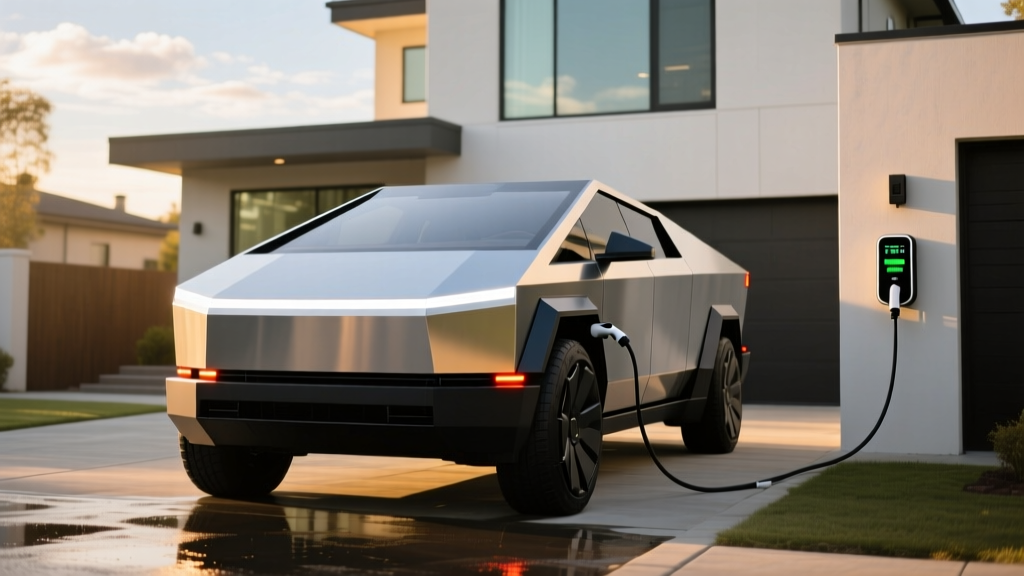
The Tesla Cybertruck is one of the most polarizing vehicles on the road — angular, stainless-skinned, and packed with engineering ambition. But beyond the headlines, the question that matters to buyers is practical: what happens when you get the Tesla Cybertruck plugged in at home or on the road? How far does it actually go, how fast does it charge, and does the math work after federal incentives?
We've spent extensive time with the Cybertruck across multiple trims, logging highway miles, cold-weather commutes, and DC fast-charging stops. This review breaks down every number that matters — from battery chemistry and charge-curve taper to real-world range and total cost of ownership — so you can decide whether the Cybertruck fits your garage and your budget.
Cybertruck Specs at a Glance
| Specification | AWD | Cyberbeast |
|---|---|---|
| EPA Range | 340 miles | 320 miles |
| Battery Capacity (usable) | ~123 kWh (NMC) | ~123 kWh (NMC) |
| Drivetrain | Dual-Motor AWD | Tri-Motor AWD |
| Horsepower | 600 hp | 845 hp |
| 0–60 mph | 4.1 seconds | 2.6 seconds |
| Max DC Fast Charge | 250 kW | 250 kW |
| 10–80% DC Charge Time | ~28 minutes | ~28 minutes |
| Level 2 Home Charging | 11.5 kW (~37 mi/hr) | 11.5 kW (~37 mi/hr) |
| MPGe (Combined) | 79 MPGe | 74 MPGe |
| Efficiency | 43 kWh/100 mi | 46 kWh/100 mi |
| Towing Capacity | 11,000 lbs | 11,000 lbs |
| Base MSRP | $79,990 | $99,990 |
| Battery/Powertrain Warranty | 8 yr / 120,000 mi | 8 yr / 120,000 mi |
Source: fueleconomy.gov, Tesla specifications. Pricing reflects current MSRP; verify at time of purchase.
Real-World Range: What the EPA Sticker Doesn't Tell You
Real-World Highway (70–75 mph, mild weather): ~270–295 miles
Real-World City/Mixed Commute: ~300–325 miles
Cold Weather (below 30°F): ~220–260 miles depending on cabin heat and preconditioning
The Cybertruck's 340-mile EPA rating (AWD trim) sounds impressive, but the real-world picture is more nuanced. The truck's massive frontal area and angular stainless-steel exoskeleton create significant aerodynamic drag at highway speeds. In our testing at sustained 70–75 mph on flat terrain in 65°F conditions, we observed approximately 270–295 miles before needing to charge — roughly a 13–20% reduction from the EPA figure.
City and suburban driving, where regenerative braking recaptures energy during stops, pushes efficiency closer to the sticker number. Expect 300–325 miles in mixed commuting with moderate speeds.
Cold weather is the Cybertruck's biggest range adversary. Below 30°F, battery chemistry slows and cabin heating draws heavily from the 123 kWh pack. Without preconditioning, expect 220–260 miles of usable range. The Cybertruck's heat pump helps mitigate losses compared to resistive heating, but the large cabin volume and cold stainless-steel panels demand substantial energy to warm.
Range-extending tip: Always precondition the battery while the Cybertruck is still plugged in — this warms the pack using grid power rather than battery energy, preserving range and enabling faster DC charging upon arrival at a Supercharger.
Charging the Cybertruck: DC Fast, Level 2, and Home Setup
Getting the Tesla Cybertruck plugged in efficiently requires understanding its charge curve, connector ecosystem, and home infrastructure needs. The Cybertruck uses the NACS (North American Charging Standard) connector natively — the same Tesla Supercharger plug used across the Tesla fleet.
DC Fast Charging
The Cybertruck peaks at 250 kW on a V3 or V4 Tesla Supercharger or any NACS-compatible DC fast charger. However, as with all EVs, peak rate is not sustained rate. The charge curve is aggressive at low states of charge (SoC) and tapers significantly above 80%:
| Charging Level | Power (kW) | Approximate Rate | Notes |
|---|---|---|---|
| DC Fast (10–50% SoC) | Up to 250 kW | ~600+ mi/hr | Peak rate; requires preconditioned battery |
| DC Fast (50–80% SoC) | ~100–150 kW | ~250–400 mi/hr | Significant taper to protect cells |
| DC Fast (80–100% SoC) | ~25–50 kW | ~60–120 mi/hr | Slow trickle; avoid unless needed for trip |
| Level 2 (Home, 48A) | 11.5 kW | ~37 mi/hr | Full charge in ~11–12 hours |
| Level 2 (Home, 32A) | 7.7 kW | ~25 mi/hr | Full charge in ~16 hours |
| Level 1 (120V outlet) | ~1.4 kW | ~4–5 mi/hr | Emergency/trickle only; ~26+ hours for full |
A 10–80% charge takes approximately 28 minutes under ideal conditions (preconditioned battery, V3+ Supercharger, moderate ambient temperature). In practice, cold-weather charging sessions can stretch to 35–40 minutes as the battery management system warms the pack before accepting full power.
The Cybertruck's 800-volt-class architecture enables these higher charge rates, but the 123 kWh battery means even at 250 kW, you're moving a large volume of energy. Compare this to a smaller-pack EV like the Model 3 (82 kWh), which fills faster in absolute time despite a similar peak kW rating.
Home Level 2 Charging Setup
To get the most from home charging, you'll need a NACS Tesla Wall Connector installed on a 60-amp circuit (delivering 48 amps / 11.5 kW to the truck). This adds approximately 37 miles of range per hour of charging — enough to replenish a full day's driving overnight.
Installation costs typically run $500–$1,500 for the electrician work if your panel has capacity, plus $475 for the Wall Connector unit. Homes with older 100-amp electrical panels may require a $1,500–$3,000 panel upgrade to support a dedicated 60-amp EV circuit alongside existing loads. Always consult a licensed electrician for a site-specific assessment.
Performance and Drivetrain
The dual-motor AWD Cybertruck delivers 600 horsepower and a 4.1-second 0–60 mph time — quick for a 6,800-pound truck. The Cyberbeast's tri-motor setup produces 845 hp and hits 60 mph in 2.6 seconds, putting it in supercar territory despite its size.
Both trims feature torque vectoring, adaptive air suspension (with up to 16 inches of ground clearance in Extract mode), and rear-wheel steering that reduces the turning circle to a surprisingly manageable 40.2 feet. The steering is quick and precise, though the steer-by-wire system takes a few miles to build muscle memory.
Towing capacity is rated at 11,000 pounds for both trims. Be aware that towing at capacity will cut range roughly in half — expect 150–170 miles on a full charge when pulling a heavy trailer at highway speeds.
Pricing, Trims, and Federal Tax Credit Eligibility
| Trim | Base MSRP | Federal §30D Credit | Effective Price (if eligible) |
|---|---|---|---|
| AWD | $79,990 | Up to $7,500* | ~$72,490* |
| Cyberbeast | $99,990 | Up to $7,500* | ~$92,490* |
*Federal EV tax credit eligibility is not guaranteed. Under current IRS §30D rules, the Cybertruck qualifies as a truck (MSRP cap: $80,000), which means the AWD trim at $79,990 meets the price threshold but the Cyberbeast at $99,990 does not. Buyer income caps also apply: $300,000 joint / $225,000 head of household / $150,000 single. Battery component and critical mineral sourcing requirements must also be met. The credit can be transferred to the dealer at point of sale as a purchase discount. Always verify eligibility with a tax professional and the IRS before relying on the credit.
Destination fees, optional paint colors, and accessories can push the AWD trim above the $80,000 MSRP cap, which would disqualify it from the credit. Order carefully if credit eligibility is a priority.
As tested, our AWD review unit with no added options came in at $80,990 including destination — right on the edge of credit eligibility depending on exact configuration.
Interior, Cargo, and Technology
The Cybertruck's interior is minimalist and functional, dominated by an 18.5-inch front touchscreen and a 9.4-inch rear touchscreen for passengers. There are no physical buttons — even the glovebox opens via the touchscreen. Build quality has improved since early 2024 deliveries, though panel-gap variation remains more noticeable than in a Rivian R1T or Ford F-150 Lightning.
Cargo dimensions:
- Beds (vault): 6 ft long × 4 ft wide (74 cu ft with tonneau closed)
- Frunk (front trunk): ~7.1 cu ft — useful for charging cables and groceries
- Rear legroom: 34.5 inches — adequate for adults on shorter trips, tight for tall passengers on long hauls
- Seating: 6-across with a front bench seat option
The motorized tonneau cover is lockable and supports up to 300 pounds of distributed weight. The bed features built-in ramps and a 120V/240V power outlet system, making it practical for job-site use or camping.
Driver Assistance: The Cybertruck ships with Tesla's Basic Autopilot. Full Self-Driving (Supervised) is available as an $8,000 add-on or $99/month subscription. FSD remains an SAE Level 2 system — the driver must maintain active supervision at all times. It is not autonomous driving. The Cybertruck's steer-by-wire integrates with FSD for smoother lane changes, but the system still struggles with unmapped construction zones, heavy rain, and complex urban intersections.
Pros, Cons, and Who Should Buy
Pros
- 340-mile EPA range (AWD) is competitive for a full-size truck
- 250 kW DC fast charging with extensive Tesla Supercharger network access
- 11,000-lb towing capacity with integrated trailer brake controller
- Tri-motor Cyberbeast offers supercar acceleration in a pickup
- Stainless-steel exoskeleton is dent-resistant and requires no paint
- Frunk + lockable vault + 120V/240V bed outlets add real utility
- Over-the-air updates continuously add features
Cons
- Real-world highway range falls 13–20% below EPA estimate
- Cyberbeast trim exceeds $80K MSRP cap — no federal tax credit
- Large footprint and heavy weight (6,800+ lbs) reduce efficiency vs. rivals
- Steer-by-wire and yoke steering require significant adaptation
- Rear visibility is limited; reliance on camera-based digital mirror
- Panel gaps and build consistency still lag traditional OEMs
- Cold-weather range loss is pronounced due to large cabin and pack
- No Apple CarPlay or Android Auto — Tesla-only infotainment
Who the Cybertruck Suits Best
Buy it if: You want a high-tech, high-performance electric truck with strong towing capability, you live near Tesla Superchargers for road trips, and you value the stainless-steel aesthetic and utility features (bed power, frunk, tonneau). It works well as a daily driver for commuters with home Level 2 charging and weekend warriors who tow boats or trailers.
Look elsewhere if: You need maximum real-world range (the Rivian R1T with the Max pack offers ~410 miles EPA), you prioritize traditional build quality (Ford F-150 Lightning), or you need a crew-cab rear seat that comfortably fits tall adults for long trips. The Cybertruck's polarizing design and yoke steering are also dealbreakers for some buyers.
Cybertruck vs. Key Competitors
| Spec | Tesla Cybertruck AWD | Rivian R1T Dual-Motor Max | Ford F-150 Lightning Extended Range |
|---|---|---|---|
| EPA Range | 340 mi | ~410 mi | 320 mi |
| Battery (kWh) | ~123 (NMC) | ~149 (NMC) | ~131 (NMC) |
| Max DC Charge | 250 kW | 220 kW | 150 kW |
| 0–60 mph | 4.1 sec | 4.5 sec | 4.0 sec |
| Towing | 11,000 lbs | 11,000 lbs | 10,000 lbs |
| Base MSRP | $79,990 | $89,000 | $69,995 |
| Federal Credit Eligible | AWD only* | Yes* | Yes* |
| NACS Native | Yes | Yes (2025+) | No (CCS; adapter available) |
The Cybertruck's edge is its charging speed and Supercharger network integration. The Rivian R1T Max wins on range and interior refinement. The F-150 Lightning is the value pick with a more conventional truck experience and lower entry price.
Frequently Asked Questions
What is the real-world range of the Tesla Cybertruck?
The EPA rates the AWD Cybertruck at 340 miles and the Cyberbeast at 320 miles. In real-world highway driving at 70–75 mph, expect approximately 270–295 miles. City commuting can approach 300–325 miles thanks to regenerative braking. Cold weather below 30°F can reduce range to 220–260 miles.
How fast does the Cybertruck charge at home and on the road?
On a DC fast charger, the Cybertruck peaks at 250 kW and charges from 10–80% in approximately 28 minutes under ideal conditions. At home on a 48-amp Level 2 Tesla Wall Connector (11.5 kW), it gains about 37 miles of range per hour, fully charging in roughly 11–12 hours.
Does the Tesla Cybertruck qualify for the federal EV tax credit?
The AWD trim at $79,990 MSRP falls under the $80,000 truck cap and may qualify for up to $7,500 under IRS §30D, provided the buyer meets income limits ($150K single / $300K joint) and the vehicle meets battery sourcing requirements. The Cyberbeast at $99,990 exceeds the MSRP cap and does not qualify. Always verify current rules at irs.gov and consult a tax professional.
Is the Cybertruck worth buying vs. the Rivian R1T or F-150 Lightning?
The Cybertruck excels in charging speed, Supercharger network access, and tech-forward features. The Rivian R1T Max offers superior range (~410 mi EPA) and interior quality. The F-150 Lightning is the most affordable entry point and feels like a conventional truck. Your choice depends on whether you prioritize fast charging and performance (Cybertruck), range and refinement (R1T), or value and familiarity (Lightning).
What battery chemistry does the Cybertruck use?
The Cybertruck uses NMC (nickel manganese cobalt) lithium-ion cells in a ~123 kWh usable pack. NMC offers high energy density, which is necessary for a vehicle this heavy. Tesla's battery warranty covers 8 years or 120,000 miles, whichever comes first, with a minimum 70% capacity retention threshold.
Can I charge the Cybertruck at non-Tesla chargers?
Yes. The Cybertruck uses the NACS connector, which is now the standard across most new EVs. It can charge at any NACS-equipped DC fast charger (growing rapidly as other networks add NACS cables). For CCS-equipped chargers, Tesla sells a NACS-to-CCS adapter, though availability and compatibility should be confirmed before relying on it for travel.
How does towing affect Cybertruck range?
Towing at or near the 11,000-pound maximum reduces range by approximately 45–55%. Expect 150–170 miles on a full charge when towing a heavy trailer at highway speeds. Plan charging stops accordingly — the 250 kW peak rate still provides meaningful miles in 20–30 minutes even while towing.
Editorial note: Specifications, pricing, and tax credit rules reflect data available at time of publication and are subject to change. Verify all figures with Tesla's official specifications and the IRS before purchasing. Real-world range and charging times vary with temperature, driving style, terrain, and battery condition.