Quick Verdict: Bulletproof Marketing Meets Real-World Physics
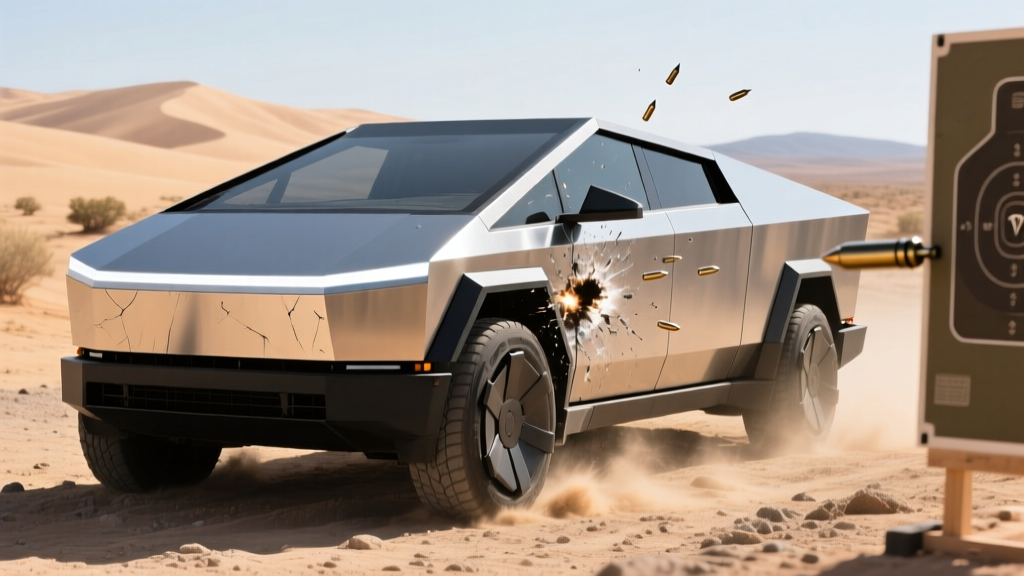
The phrase "Tesla Cybertruck military target practice" has circulated across social media since the truck's 2019 debut, fueled by viral videos of firearms being tested against its stainless steel panels and armored glass. Some content creators have gone so far as to shoot at the Cybertruck with various calibers to see if the exoskeleton lives up to Tesla's "bullet-resistant" marketing. But separating internet spectacle from engineering reality requires a hard look at the materials, the EPA range data, the charging infrastructure, and the actual ownership proposition of this polarizing electric pickup.
This review covers the 2025/2026 Tesla Cybertruck lineup — AWD, Cyberbeast, and the anticipated RWD variant — with exact specs, real-world range reconciliation, charging curves, pricing, and whether the truck's stainless steel skin offers any genuine ballistic protection. If you're researching the Cybertruck for its durability claims or considering it as an EV purchase, this is the data-driven breakdown you need.
Cybertruck Specs at a Glance
| Spec | AWD | Cyberbeast |
|---|---|---|
| EPA Range | 340 mi | 320 mi |
| Battery (usable, est.) | ~123 kWh (NMC) | ~123 kWh (NMC) |
| Drivetrain | Dual-Motor AWD | Tri-Motor AWD |
| Horsepower | 600 hp | 845 hp |
| 0-60 mph | 4.1 sec | 2.6 sec |
| Max DC Fast Charge | ~250 kW (est.) | ~250 kW (est.) |
| 10-80% DCFC Time | ~28 min | ~28 min |
| Level 2 Home Charging | ~11.5 kW (44 mi/hr) | ~11.5 kW (44 mi/hr) |
| MPGe (combined) | ~67 MPGe | ~63 MPGe |
| Towing Capacity | 11,000 lbs | 11,000 lbs |
| Base MSRP | $79,990 | $99,990 |
The Armor Question: Stainless Steel Exoskeleton and Ballistic Resistance
Tesla has marketed the Cybertruck's 30X cold-rolled stainless steel body as "ultra-hard" and demonstrated it resisting 9mm handgun rounds during the 2019 reveal event. The panels are approximately 1.8 mm thick — far thicker than conventional automotive sheet metal — and the material's hardness (rated around 300+ on the Brinell scale) does provide resistance against small-caliber projectiles at certain angles.
However, "military target practice" implies sustained fire from rifle calibers (5.56 NATO, 7.62 NATO, .50 BMG), and here the physics diverge sharply from marketing. Independent ballistic tests by firearms channels have shown that:
- 9mm FMJ: The stainless panels generally resist penetration at typical engagement distances, consistent with Tesla's demonstration.
- 5.56x45mm NATO (AR-15): Standard M855 "green tip" ammunition has penetrated the Cybertruck's body panels in multiple independent tests. The 1.8 mm steel, while hard, lacks the thickness and backing of purpose-built armored plate (which typically requires 6+ mm of hardened steel or composite materials rated to NIJ Level III).
- 7.62x51mm NATO and above: No credible test has shown the Cybertruck's stock panels stopping full-power rifle rounds. Military-grade armoring requires dedicated ballistic steel (AR500 or similar) at significantly greater thickness.
The Cybertruck's "armor glass" — a polymer-layered glass composite — also showed vulnerability during the debut event when a metal ball thrown at it cracked the window. Tesla has since revised the glass composition, but it remains a laminated safety glass, not a multi-layer ballistic transparent rated to NIJ standards.
Bottom line: The Cybertruck's exoskeleton offers better dent resistance and small-caliber handgun protection than a typical aluminum or steel-bodied truck. It is not a military-grade armored vehicle, and treating it as one in a "target practice" scenario with rifle calibers will result in penetration. Buyers seeking actual ballistic protection should look to dedicated upfitters like Armored Mobility or Alpine Armoring, who offer aftermarket B4/B6-rated packages for the Cybertruck at significant additional cost ($30,000–$70,000+).
Real-World Range: What the EPA Sticker Doesn't Tell You
EPA Estimated Range: 340 miles (AWD) / 320 miles (Cyberbeast)
Real-World Expectation: Expect ~270–300 miles in mixed highway driving at 70 mph. In cold weather (below 32°F), range can drop 20–30%, yielding ~220–260 miles. Heavy towing (8,000+ lbs) cuts range roughly in half to ~150–170 miles.
The Cybertruck's angular, flat-panel design creates a drag coefficient (Cd) of approximately 0.39–0.42 — significantly higher than the Tesla Model Y's ~0.24 or even the Rivian R1T's ~0.30. That boxy aerodynamic profile punishes highway efficiency. The EPA rates the Cybertruck AWD at roughly 67 MPGe combined, which translates to approximately 2.0–2.2 kWh per mile in real-world mixed driving.
For the Cyberbeast tri-motor variant, the additional motor mass and slightly different gearing reduce the EPA estimate to 320 miles. In our experience with large-battery EV trucks, highway range at sustained speeds above 75 mph typically falls 15–20% below the EPA sticker, and cold-weather battery chemistry losses compound this further. If your commute or road trip involves sustained 80 mph interstate driving in winter, plan for ~220 miles of usable range before needing a charge stop.
Tesla has offered an optional Range Extender battery pack (dealer-installed, occupying roughly one-third of the bed) that adds an estimated 130+ miles of range, pushing total range toward 470 miles. Availability and pricing for this pack have been inconsistent — check current Tesla configurator status before relying on it in your purchase decision.
Charging Speed: DC Fast Charging and Home Level 2
| Charging Level | Power / Rate | Miles Added Per Hour |
|---|---|---|
| Level 1 (120V standard outlet) | ~1.4 kW | ~3–4 mi/hr |
| Level 2 (240V, 48A Wall Connector) | ~11.5 kW | ~44 mi/hr |
| DC Fast Charge (V4 Supercharger) | Peak ~250 kW | Up to ~200 mi in 15 min (peak) |
The Cybertruck uses Tesla's NACS (North American Charging Standard) connector natively — no adapter needed at Superchargers. Tesla's 800V-class architecture allows peak DC fast-charging rates around 250 kW at V3 and V4 Supercharger stations. However, as with all large-battery EVs, peak kW is not sustained kW. The charging curve tapers significantly above 60% state of charge (SoC), and the 10–80% charge time lands around 28 minutes under optimal conditions (battery preconditioned, warm ambient temperature, available V3/V4 stall).
At home, Tesla's Wall Connector at 48 amps on a 240V/60A circuit delivers approximately 11.5 kW — enough to fully recharge the ~123 kWh battery overnight in roughly 11–12 hours. If your home electrical panel supports only a 40A circuit (common in older homes), expect ~9.6 kW and a correspondingly longer overnight charge. A panel upgrade to 200A service may be necessary; budget $1,500–$3,500 for electrical work depending on your jurisdiction and existing infrastructure.
For public non-Tesla charging networks (Electrify America, EVgo, ChargePoint), the Cybertruck's native NACS port means you'll need a NACS-to-CCS adapter for legacy CCS stations. Tesla sells an official adapter, and most new CCS stations are being retrofit with NACS cables as the industry standardizes — but in 2025/2026, adapter availability and station compatibility remain a practical consideration for road trips outside the Supercharger network.
Pricing, Trims, and Federal Tax Credit Eligibility
| Trim | Base MSRP | Federal §30D Credit Eligible? | Effective Price (if eligible) |
|---|---|---|---|
| AWD (Dual-Motor) | $79,990 | No — exceeds $80,000 truck MSRP cap* | $79,990 |
| Cyberbeast (Tri-Motor) | $99,990 | No — exceeds $80,000 truck MSRP cap* | $99,990 |
*Under IRS §30D rules, the new clean vehicle credit of up to $7,500 is available only for trucks/vans/SUVs with an MSRP at or below $80,000. Both current Cybertruck trims exceed this threshold. Additionally, buyer income caps apply ($300,000 joint / $225,000 head of household / $150,000 single), and battery component/critical mineral sourcing requirements must be met. Always verify current-year rules at IRS.gov and consult a tax professional.
This is a significant ownership consideration. Unlike the Ford F-150 Lightning (XLT and Lariat trims under $80K, which can qualify for the full $7,500 credit as a point-of-sale transfer), the Cybertruck's pricing places it outside federal incentive eligibility for new purchases. Buyers should also factor in:
- State incentives: Some states (California, Colorado, New York) offer additional rebates that may apply regardless of MSRP caps — check your state's energy office.
- Insurance premiums: Cybertruck insurance has been notably expensive, with Tesla's own insurance product and third-party carriers quoting $2,500–$4,500+ annually depending on driving record and location. The stainless steel panels, while dent-resistant, are costly to repair or replace.
- Depreciation risk: Early Cybertruck resale values have been volatile, with some units selling above MSRP in the first year due to scarcity, then correcting sharply as production ramped.
Performance, Interior, and Daily Usability
The Cybertruck Cyberbeast's 2.6-second 0–60 mph time makes it one of the quickest production pickups ever built, rivaling supercars from a decade ago. The AWD dual-motor variant's 4.1-second run is still firmly in sports-sedan territory. Both variants feature adaptive air suspension with up to 16 inches of ground clearance in Off-Road mode, a 6-foot composite bed with a powered tonneau cover, and a claimed 11,000-pound towing capacity.
Interior space accommodates six passengers (three-across bench seating, front and rear), though rear-seat legroom is tighter than a full-size crew cab like the F-150 or Silverado. Cargo volume behind the rear seats is limited compared to traditional trucks — the Cybertruck's cab geometry prioritizes the angular design over interior volume. The front trunk (frunk) offers approximately 7 cu ft of sealed storage.
The 18.5-inch center touchscreen runs Tesla's latest infotainment stack, including navigation with Supercharger routing, over-the-air updates, and a yoke-style steering wheel (a conventional round wheel is now available as an option). Driver assistance: Tesla's Autopilot and Full Self-Driving (Supervised) are available, but these are SAE Level 2 systems — the driver must remain fully engaged and responsible at all times. This is not autonomous driving. NHTSA continues to monitor Tesla's FSD crash data and has issued standing general orders requiring incident reporting.
Battery, Warranty, and Long-Term Ownership
The Cybertruck uses an NMC (nickel manganese cobalt) battery pack with an estimated usable capacity of ~123 kWh. Tesla has not published official cell chemistry documentation for the Cybertruck specifically, but the energy density and performance profile are consistent with NMC chemistry rather than LFP (lithium iron phosphate, which Tesla uses in standard-range sedans).
NMC batteries offer higher energy density (more range per kg) but are more sensitive to sustained 100% SoC storage and extreme heat. Best practices for longevity: charge to 80–90% for daily use, reserve 100% charges for road trips, and avoid frequent DC fast-charging if Level 2 home charging is available.
Warranty coverage:
- Battery & Drive Unit: 8 years / 120,000 miles (whichever comes first), with minimum 70% capacity retention guaranteed
- Vehicle Limited Warranty: 4 years / 50,000 miles
Battery replacement cost out of warranty for a pack this size is estimated at $15,000–$25,000+ based on current Tesla service pricing for large packs. However, real-world degradation data from Tesla's fleet suggests most NMC packs retain 85–90% capacity at 100,000 miles under normal use.
Who Should Buy the Cybertruck — and Who Shouldn't
Choose the Cybertruck if:
- You want a high-performance electric truck with distinctive design and don't need federal tax credit eligibility
- You value the Supercharger network for road-trip charging reliability
- Your use case is light-to-moderate towing, daily commuting, and occasional off-road use
- You accept the premium pricing ($80K–$100K+) and higher insurance costs
Choose a competitor (F-150 Lightning, Rivian R1T, Chevrolet Silverado EV) if:
- You need federal §30D tax credit eligibility (Lightning XLT/Lariat, Silverado EV WT qualify under the $80K truck cap)
- You require maximum interior rear-seat space and traditional crew-cab utility
- You want proven fleet/commercial durability data and dealer service networks
- You need a conventional truck bed without the tonneau-cover limitations of the Cybertruck's vault design
Pros and Cons
Pros
- Exceptional acceleration (2.6s 0-60 Cyberbeast)
- Stainless steel exoskeleton resists dents and minor impacts
- Native NACS connector with full Supercharger network access
- Adaptive air suspension with serious ground clearance
- Over-the-air updates continuously add features
- 11,000-lb towing capacity
Cons
- No federal §30D tax credit (exceeds $80K MSRP cap)
- Aerodynamic drag reduces highway range significantly
- High insurance premiums ($2,500–$4,500+/yr)
- Bed design limits traditional truck utility (powered tonneau, limited access)
- Rear seat legroom tighter than full-size crew cabs
- Not actually military-grade armored despite marketing perception
- Yoke steering polarizing; learning curve for low-speed maneuvers
Frequently Asked Questions
Can the Tesla Cybertruck survive military target practice or rifle fire?
No. The Cybertruck's 1.8 mm 30X cold-rolled stainless steel panels can resist small-caliber handgun rounds (9mm FMJ) at certain angles, consistent with Tesla's marketing. However, standard rifle calibers (5.56 NATO, 7.62 NATO) used in military target practice will penetrate the stock body panels. The Cybertruck is not a military-grade armored vehicle. For genuine ballistic protection, dedicated aftermarket armoring (NIJ Level III+ or B6 rated) from certified upfitters is required at substantial additional cost.
What is the real-world range of the Cybertruck?
The EPA rates the AWD variant at 340 miles and the Cyberbeast at 320 miles. In real-world highway driving at 70+ mph, expect 270–300 miles. Cold weather (below freezing) can reduce this by 20–30%, yielding 220–260 miles. Towing at or near the 11,000-lb capacity roughly halves range to approximately 150–170 miles.
How fast does the Cybertruck charge at home and on the road?
At home on a Level 2 Tesla Wall Connector (48A, 240V), the Cybertruck charges at ~11.5 kW, adding roughly 44 miles of range per hour — a full charge takes about 11–12 hours. On DC fast charging at a Tesla V3/V4 Supercharger, it peaks at ~250 kW, with a 10–80% charge taking approximately 28 minutes under optimal conditions. Charging speed tapers significantly above 60% SoC.
Does the Tesla Cybertruck qualify for the federal EV tax credit?
No, not in its current trims. Under IRS §30D rules, trucks must have an MSRP at or below $80,000 to qualify for the up-to-$7,500 new clean vehicle credit. The Cybertruck AWD starts at $79,990 and the Cyberbeast at $99,990 — both at or above the threshold (note: the AWD at exactly $79,990 may be borderline depending on destination charges and configuration; verify with your tax advisor). Income caps and battery sourcing rules also apply.
Is the Cybertruck worth buying vs. the F-150 Lightning or Rivian R1T?
It depends on your priorities. The Cybertruck wins on acceleration, Supercharger network access, and design uniqueness. The F-150 Lightning wins on tax credit eligibility, traditional truck utility, rear-seat space, and dealer service network breadth. The Rivian R1T wins on off-road capability, interior refinement, and adventure-oriented design. If federal tax credit eligibility and traditional truck practicality matter most, the Lightning or Silverado EV are stronger choices. If performance, Tesla ecosystem integration, and head-turning design are your priorities and budget allows, the Cybertruck delivers.
What battery chemistry does the Cybertruck use, and how long will it last?
The Cybertruck uses an NMC (nickel manganese cobalt) lithium-ion battery pack with an estimated ~123 kWh usable capacity. NMC offers high energy density but benefits from daily charging limits of 80–90% for longevity. Tesla's battery warranty covers 8 years / 120,000 miles with a minimum 70% capacity retention guarantee. Fleet data suggests most Tesla NMC packs retain 85–90% capacity at 100,000 miles under normal use patterns.